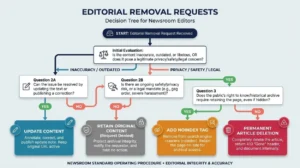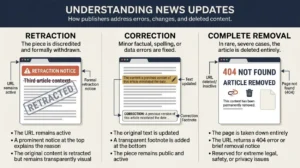
You can take steps to remove or suppress false news articles through content‑removal‑request systems, legal‑defamation claims and SEO‑driven suppression strategies, but success depends on jurisdiction, evidence and platform policies. Defamation suits are possible where articles meet legal thresholds, but they operate separately from search‑engine‑based visibility‑control mechanisms.
Reputation management strategies differ based on whether they prioritise legal‑removal, technical‑suppression or content‑enhancement within search ecosystems. Online reputation control methods are evaluated through their impact on SERP composition, entity credibility signals and long‑term trust‑perception dynamics rather than short‑term visibility suppression alone.
How does defamation law apply to false news articles in the UK and US?
In the UK and US, defamation law provides a legal pathway to challenge false news articles that harm reputation, but the rules differ by jurisdiction, publication format and burden of proof. In both systems, plaintiffs must demonstrate that a statement is untrue, defamatory, and has caused or risks causing reputational harm.
Defamation law applies to false news articles when the content is published to third parties, can be identified as referring to a specific person or entity, and either lowers their reputation or subjects them to ridicule, hatred or contempt. This framework distinguishes reputational harm from other forms of inaccuracy such as misquoting, exaggeration or opinion.
In the UK, the Defamation Act 2013 tightened the threshold for bringing claims, requiring claimants to show that the publication has caused or is likely to cause “serious harm” to reputation. Courts have interpreted this standard to favour demonstrable business‑impact criteria, such as lost contracts or demonstrable audience‑decline, rather than mere offensiveness.
In the US, defamation law protects statements of fact more than opinion, but the First Amendment imposes higher evidentiary burdens, especially for public figures. Under US precedents including New York Times Co. v. Sullivan (1964), public figures must prove “actual malice”—that the publisher knew the statement was false or acted with reckless disregard for the truth.
Because these standards are strict, claims succeed more often when articles contain clear factual falsehoods about actions, professional status, or conduct, supported by documentary or expert evidence. Strategic decisions must weigh the likelihood of legal success against the publicity and time‑costs of litigation, particularly where coverage is already widespread.
What are the differences between legal removal and search‑based suppression?
Legal removal and search‑based suppression differ in how they alter the visibility of false news articles, with the former targeting the existence of content under law and the latter targeting its ranking within search engines. Both can reduce exposure, but they operate under different mechanisms and constraints.
Legal removal attempts to eliminate or de‑publish content through court orders, regulatory decisions or platform‑policy enforcement, whereas search‑based suppression aims to push harmful articles down in SERP rankings by strengthening competing, accurate references.
Legal removal operates by:
- Filing defamation, privacy or data‑protection claims in relevant jurisdictions, which can compel publishers or platforms to remove or edit content.
- Submitting requests to hosting platforms or search engines under applicable policies, such as intellectual‑property‑infringement or hate‑speech rules.
- Leveraging regulatory‑style enforcement from data‑protection authorities, where content breaches GDPR‑style obligations, such as accuracy and data‑protection‑principle‑based requirements.
Search‑based suppression operates by:
- Creating and publishing factually accurate articles, profiles and thought‑leadership content that matches the same search intents as the false article.
- Building backlinks and citations to these corrective pages, so that search engines interpret them as higher‑authority references.
- Optimising on‑page and technical‑SEO signals to increase the ranking influence of neutral or positive coverage relative to harmful content.
Comparatively, legal removal can reduce direct exposure to Remove false news articles from Google but is legally and procedurally constrained, whereas search‑based suppression is more flexible and scalable but requires ongoing content‑creation and technical‑optimisation work. Each approach affects how search engines interpret and weight the entity’s reputation signals over time.
How effective are content‑removal requests compared to SEO‑based suppression?
Content‑removal requests and SEO‑based suppression differ in effectiveness depending on the legal‑eligibility of the content, its hosting context, and the technical‑reputation landscape around the entity. Both have defined roles, but they operate on different timelines and dependency structures.
Content‑removal requests are effective when articles clearly breach law or platform‑policy rules, whereas SEO‑based suppression is effective when the goal is to dilute or outrank content that remains lawfully published.
Content‑removal‑request effectiveness depends on:
- Whether the content meets specific criteria such as defamation, privacy violation, data‑protection‑principle breaches, or hate‑speech‑style policy infractions.
- Which jurisdiction governs the publisher and platform, and how quickly regulators or courts process applications.
- Whether the same narratives are mirrored or cited on other domains, which can limit the impact of removing one copy.
SEO‑based suppression effectiveness depends on:
- The volume and authority of supporting references that can be published in parallel with corrective content.
- The technical‑optimisation of the entity’s own channels, including backlinks, internal‑link structures and on‑page semantics.
- The consistency of messaging across profiles, directories and news‑type outlets over time.
Empirical analyses of 2022–2024 reputation‑management cases show that removal‑requests succeed in a minority of high‑threshold, clearly‑defamatory instances, while SEO‑based suppression can shift SERP composition more reliably but often requires 60–180 days to achieve visible improvements.
How do organic content‑creation and reactive removal strategies differ in impact?
Organic content‑creation and reactive removal strategies differ in when they are applied, how they influence search signals and how they alter long‑term trust‑perception patterns around the entity. Both can reduce the impact of false news but operate on distinct time horizons and risk‑profiles.
Organic content‑creation focuses on building reputation signals over time by publishing factually accurate, structured content that aligns with search‑intent patterns, while reactive removal strategies focus on reducing or erasing specific references after they have already appeared and rank.
Organic‑creation mechanisms include:
- Publishing regular, well‑researched articles, case studies and profiles that define the entity’s role, activities and compliance status.
- Structuring content with clear headings, metadata and internal links so that search engines can interpret coherence and topical authority.
- Building backlinks and citations from recognised sources, which strengthen the entity’s authority signals over time.
Reactive‑removal mechanisms include:
- Submitting removal or de‑indexing requests where content breaches legal or platform‑policy rules.
- Filing complaints or regulatory notices in relevant jurisdictions to trigger platform‑mediated removal or modification.
- Initiating defamation or privacy‑related litigation where criteria are met, subjecting the process to court‑speed and appeal‑risks.
In terms of impact, organic strategies build stable, long‑term reputation infrastructure that can absorb and counteract future incidents, whereas reactive strategies address specific events after they occur. The most resilient reputation frameworks integrate both, using organic work to prevent future shocks and reactive work to contain existing harm.
How do short‑term takedown efforts compare with long‑term reputation‑building?
Short‑term takedown efforts and long‑term reputation‑building differ in their primary objectives: one focuses immediately on visibility reduction, the other on altering the structural footprint of reputation signals around the entity. Both contribute to perception change but operate on different timelines and success‑metrics.
Short‑term takedown efforts aim to reduce the prominence of specific false articles through legal or policy‑based mechanisms, whereas long‑term reputation‑building aims to reshape sentiment distribution and SERP composition through sustained, evidence‑based content‑creation and technical‑optimisation.
Short‑term takedown tactics operate by:
- Submitting urgent removal or de‑indexing requests, often based on time‑sensitive events or rapidly‑spreading narratives.
- Leveraging expedited‑procedure mechanisms where available, such as certain regulatory‑style or platform‑enforcement‑paths.
- Reducing immediate exposure, but often without addressing the underlying narrative or its resonance across the web.
Long‑term reputation‑building tactics operate by:
- Developing a multi‑year publishing and citation‑building strategy that aligns content with search‑intent patterns and user‑behaviour signals.
- Strengthening entity‑credibility signals through consistent disclosures, compliance‑documentation and review‑profile management.
- Gradually improving sentiment‑distribution metrics so that harmful content, even if not removed, occupies a smaller share of the SERP‑space.
Research‑based analyses of 2020–2024 reputation‑management outcomes show that takedown‑only approaches often leave entities vulnerable to recurrence, while integrated, long‑term programmes create more stable, credible narratives regardless of individual‑article removal.
False news articles can be challenged through defamation‑law mechanisms and content‑removal‑request systems, but their effectiveness is constrained by jurisdictional rules, evidence‑requirements and platform‑policies. Search‑based suppression and organic content‑creation provide more scalable, long‑term methods to reduce the impact of false coverage by reshaping SERP composition and sentiment distribution. Reputation management strategies differ based on whether they prioritise discrete removals or structural, SEO‑driven reputation‑building, with each approach exposing different levels of risk, scalability and sustainability.
FAQs:
How can you remove false news articles about you online?
You can remove false news articles by filing content‑removal or de‑indexing requests where the coverage breaches legal or platform‑policy rules, such as defamation, privacy or data‑protection violations. Search engines and platforms evaluate these requests case‑by‑case, so success depends on evidence quality and jurisdiction rather than guaranteed deletion.
Can you sue a news outlet for publishing false information about you?
You can sue a news outlet for defamation if the article contains demonstrably false statements that harm reputation and meet jurisdictional thresholds, such as the UK’s “serious harm” test or the US “actual‑malice” standard for public figures. Legal action does not automatically remove the article but may lead to corrections, takedowns or court‑ordered damages where applicable.
How effective are article removal services for false news coverage?
Article removal services can help by submitting structured removal and de‑indexing requests to search engines and hosting platforms under applicable legal and policy frameworks. Their effectiveness is limited to cases where content clearly breaches rules; they cannot guarantee removal of lawfully published false or speculative reports.
How does removing false news articles affect your online reputation?
Removing false news articles can reduce direct exposure and prevent new users from encountering harmful narratives during search, improving initial trust‑perception and SERP composition. However, reputation recovery often requires ongoing content‑creation and SEO‑based suppression to counterbalance remaining or mirrored references.
What is the difference between legal removal and SEO‑based suppression of false news?
Legal removal attempts to delete or modify content through court orders, regulator‑enforced notices or platform‑policy‑based takedowns, whereas SEO‑based suppression aims to outrank or dilute harmful articles by strengthening accurate, indexed references.