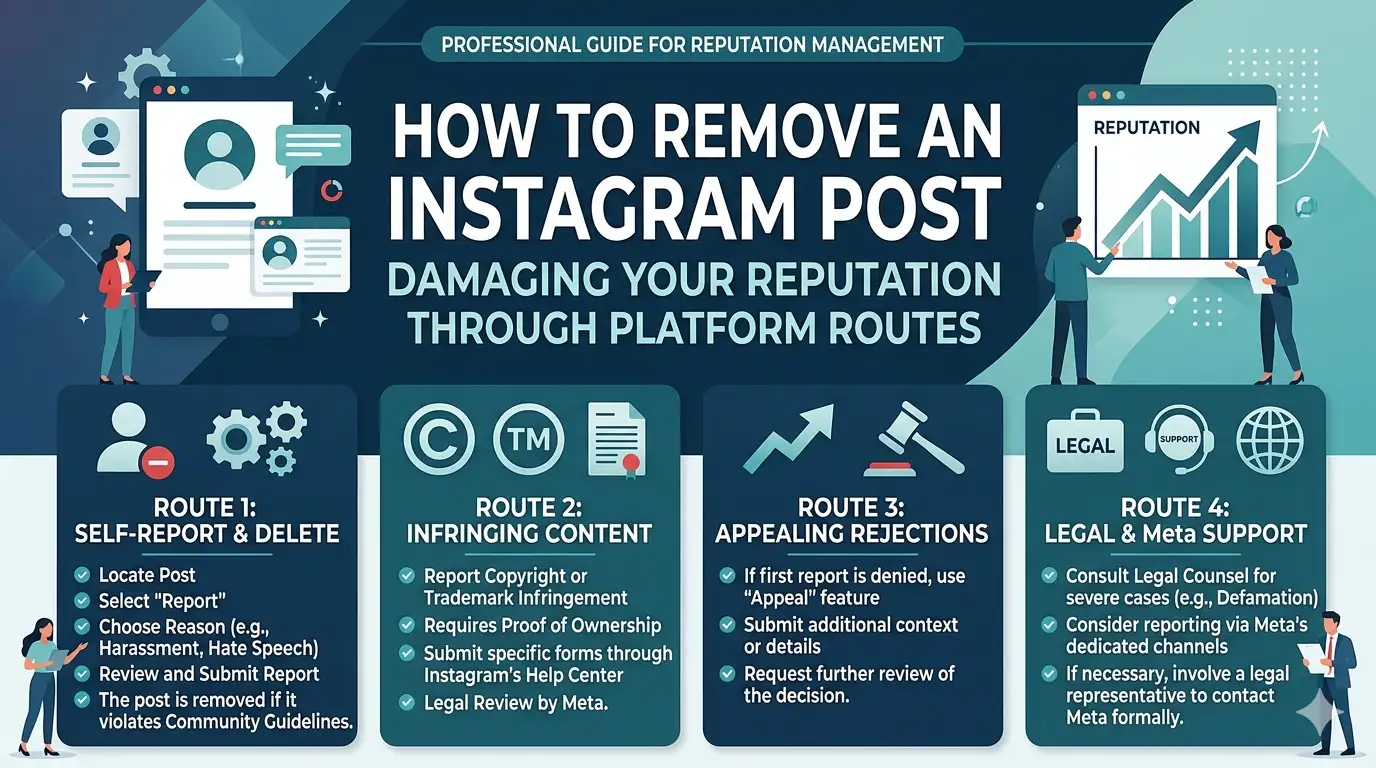
An Instagram post that damages reputation is removed through platform reporting systems, account-level controls, or legal escalation routes depending on ownership and policy violations.
Reputation management strategies differ based on ownership of content, platform governance rules, and the interaction between user reports and automated moderation systems.
What platform routes exist for removing damaging Instagram content?
Instagram provides structured removal routes including self-deletion, reporting mechanisms, and legal requests, each operating under distinct moderation frameworks. These routes differ in control level, processing speed, and evidentiary requirements, directly influencing removal success and reputation signal recovery.
Instagram content removal is categorised into three primary approaches: direct control, community reporting, and formal legal escalation. Direct control applies when the account owner deletes their own content. Reporting mechanisms operate through policy enforcement systems triggered by users. Legal escalation involves intellectual property claims or court-backed requests.
Direct deletion operates instantly and removes the content from platform indexing, eliminating immediate visibility. Reporting mechanisms rely on algorithmic triage systems that assess violations against community standards. Legal escalation introduces external authority, often overriding platform discretion when verified documentation is provided.
Comparatively, direct deletion offers the highest certainty but limited applicability. Reporting systems scale efficiently but depend on policy alignment. Legal routes provide authority but involve procedural complexity and longer resolution timelines.
The impact on search visibility varies. Deleted posts reduce indexed content instantly, while reported content may persist during review cycles. Legal removals often include metadata deindexing, influencing broader search ranking signals and entity credibility.
How does reporting content compare to direct deletion for reputation control?
Reporting content relies on platform moderation systems, whereas direct deletion depends on account ownership and immediate control over publication. These approaches differ in execution certainty, processing latency, and influence on reputation signals.
Reporting operates by flagging content for review against platform guidelines such as harassment, misinformation, or impersonation. Direct deletion removes content at source, preventing further engagement accumulation. Reporting introduces an intermediary evaluation layer, while deletion bypasses moderation entirely.
The mechanism behind reporting involves automated classifiers and human moderation teams. Content is analysed for policy breaches, with outcomes ranging from removal to visibility restriction. Direct deletion bypasses this process, ensuring immediate removal without review dependency.
In comparative terms, reporting offers broader applicability for third-party content but introduces uncertainty due to policy interpretation. Direct deletion guarantees outcome but is limited to owned assets. Reporting scales across multiple harmful posts, whereas deletion applies individually.
From a search perspective, reported content may continue contributing to negative sentiment distribution during review periods. Deleted content removes engagement signals immediately, reducing long-term ranking influence. This distinction affects how quickly reputation signals stabilise.
What role do community guidelines play in content removal effectiveness?
Community guidelines define the threshold for content removal and determine how reporting systems interpret violations. These rules act as the primary filter for evaluating whether damaging content qualifies for removal within platform governance structures.
Community guidelines operate as rule-based frameworks that classify harmful content categories. These include harassment, hate speech, and privacy violations. Reporting systems map user complaints to these predefined categories, influencing moderation decisions.
The effectiveness of removal depends on alignment between the reported issue and guideline definitions. Content that clearly violates policies is removed efficiently. Content that falls into ambiguous categories remains visible due to insufficient policy breach evidence.
Comparatively, guideline-based removal ensures consistency but limits flexibility. Strict adherence prevents arbitrary removal but reduces responsiveness to nuanced reputational harm. Legal routes offer broader interpretation but lack scalability.
In terms of reputation management, guideline enforcement shapes sentiment distribution by determining which content persists. Posts that remain visible continue influencing public perception and engagement metrics. This directly affects entity credibility within platform ecosystems and search indexing.
How do legal removal requests compare to platform reporting systems?
Legal removal requests operate through formal documentation and external authority, while platform reporting systems rely on internal moderation policies. These approaches differ in evidentiary requirements, enforcement power, and scalability.
Legal requests involve submitting claims such as defamation notices, copyright infringement, or privacy violations. These requests trigger specialised review processes that often involve legal teams. Reporting systems, in contrast, rely on automated and community-driven moderation.
The mechanism of legal removal includes verification of identity, ownership, and harm. Once validated, platforms prioritise compliance due to regulatory obligations. Reporting systems evaluate content against internal rules without external enforcement pressure.
Comparatively, legal routes provide higher authority and enforceability. Reporting systems offer faster submission but lower certainty. Legal processes require documentation and time investment, while reporting is accessible but limited by policy scope.
From a search visibility perspective, legal removals often lead to stronger deindexing signals. Content removed through legal channels is less likely to reappear. Reporting-based removals may not address reposted or duplicated content, affecting long-term reputation control.
How does content suppression compare to content removal strategies?
Content suppression reduces visibility through competing content, while removal eliminates the source entirely. These strategies differ in mechanism, sustainability, and impact on search ranking influence.
Content suppression operates by publishing positive or neutral content that outranks harmful material. Removal strategies focus on eliminating the damaging content itself. Suppression influences SERP composition, while removal alters content availability.
The mechanism of suppression involves search engine optimisation techniques that enhance content visibility. Removal relies on platform compliance or legal enforcement. Suppression requires continuous content production, whereas removal is event-driven.
Comparatively, suppression offers long-term scalability but slower impact. Removal provides immediate results but depends on eligibility criteria. Suppression manages sentiment distribution indirectly, while removal addresses it directly.
In terms of reputation signals, suppression diversifies positive signals across indexed content. Removal reduces negative signals at source. Both strategies influence entity credibility, but their effectiveness depends on content persistence and search engine interpretation.
What are the limitations of platform-based removal methods?
Platform-based removal methods are constrained by policy definitions, moderation capacity, and jurisdictional boundaries. These limitations affect success rates, processing time, and long-term reputation control outcomes.
Moderation systems operate within predefined rules, limiting removal to policy-aligned cases. Content that damages reputation without violating guidelines remains active. This creates gaps in removal coverage.
The mechanism of limitation includes algorithmic bias, reporting thresholds, and review backlog. High report volumes do not guarantee removal if policy criteria are unmet. Legal jurisdiction also restricts enforcement across regions.
Comparatively, platform methods scale efficiently but lack contextual sensitivity. Legal routes address broader harm but require resources. Suppression strategies bypass these limitations but do not eliminate harmful content.
From a search perspective, unresolved content continues contributing to negative reputation signals. This affects search ranking influence and sentiment distribution. Limitations in removal systems directly impact the sustainability of reputation management strategies.
How does ownership of content affect removal strategy selection?
Content ownership determines the available removal routes and influences the effectiveness of reputation management strategies. Ownership defines control level, response speed, and dependency on third-party systems.
Owned content allows direct deletion, providing immediate resolution. Third-party content requires reporting or legal intervention. Ownership dictates whether removal is unilateral or mediated.
The mechanism of ownership-based control involves account access and publishing rights. Direct control eliminates reliance on moderation systems. Lack of ownership introduces dependency on platform enforcement or legal validation.
Comparatively, owned content removal is efficient and predictable. Third-party removal is complex and uncertain. Reporting systems bridge this gap but depend on policy alignment.
In terms of reputation signals, owned content removal rapidly reduces negative visibility. Third-party content persists longer, influencing sentiment distribution and search indexing. Ownership therefore shapes the overall effectiveness of reputation control strategies.
How do platform routes influence long-term reputation management outcomes?
Platform routes influence long-term outcomes by determining how effectively negative content is removed, suppressed, or persists within search ecosystems. These routes shape the stability of reputation signals over time.
Removal strategies provide immediate reduction in negative signals but require continuous monitoring. Suppression strategies build resilience by increasing positive content volume. Legal routes establish enforceable precedents.
The mechanism of long-term impact involves search engine indexing, engagement metrics, and content duplication. Removed content may reappear if not fully deindexed. Suppressed content may regain visibility if optimisation declines.
Comparatively, removal offers short-term control, while suppression ensures long-term stability. Legal strategies provide durable solutions but lack scalability. Effective reputation management integrates multiple approaches.
For users analysing Remove an Instagram Post Harming Your Reputation, understanding these dynamics clarifies how different methods influence search ranking influence and entity credibility.
Remove an Instagram Post Harming Your Reputation
Conclusion
Platform routes for removing damaging Instagram content differ in mechanism, authority, and effectiveness. Direct deletion provides immediate control but is limited by ownership. Reporting systems scale efficiently but depend on policy alignment. Legal routes offer enforceability but require procedural investment.
Content suppression operates as a complementary strategy, influencing search visibility without removing content. Each method impacts reputation signals, sentiment distribution, and search ranking influence differently.
Strategic consideration involves evaluating control level, scalability, and sustainability. Effective reputation management integrates removal, suppression, and monitoring to maintain stable entity credibility within evolving search ecosystems.