
Content removal timelines in the UK vary significantly due to platform enforcement design, search engine indexing cycles, and legal classification routes.
Reputation management strategies differ based on how systems process content removal requests through structured moderation, indexing delays, and trust signal evaluation. Online reputation control methods are evaluated through content suppression efficiency, entity credibility signals, and SERP re-indexing behaviour.
How do platform enforcement systems compare with search engine indexing in removal speed?
Platform enforcement systems remove content faster than search engine indexing systems because they operate directly on hosted data rather than external crawl based systems.
Platform enforcement is a structured moderation system that processes, reviews, and removes content within the same environment where it is published. This creates immediate suppression of visibility inside the platform. Search engine indexing, in contrast, depends on external bots that recrawl and update databases over time, which introduces delay in visibility changes across SERPs.
How platform moderation removes content instantly
Platform moderation uses automated filters and human review systems to remove or restrict content at the source. Once actioned, the content disappears from feeds, profiles, and internal search systems almost immediately.
How search engines delay visibility updates
Search engines rely on crawl schedules and indexing refresh cycles to update content status. Even after removal, cached versions and snippets may persist until recrawling occurs.
How this gap affects SERP visibility
This difference creates a visibility lag where content is removed at the source but remains visible in search results, extending overall exposure duration.
What is the difference between legal removal routes and platform policy enforcement?
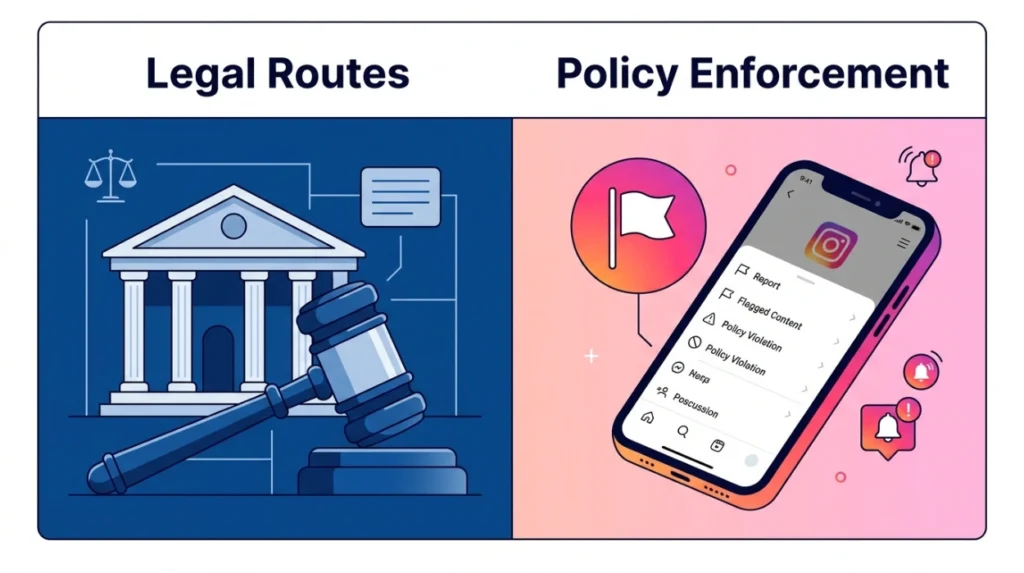
Legal removal routes achieve deeper search engine suppression, while platform policy enforcement achieves faster but surface-level removal.
Legal removal refers to structured compliance processes based on regulatory frameworks such as privacy law or defamation rules. These processes directly influence search engine indexing systems by instructing removal or de ranking. Platform policy enforcement operates internally and focuses on removing content within the platform ecosystem.
How legal mechanisms affect search indexing
Legal removal triggers compliance-based de-indexing actions that directly modify search engine databases. This bypasses normal crawling delays and accelerates SERP updates.
How platform policies handle internal suppression
Platform policies use automated moderation and human review to remove content from feeds and accounts. However, this does not always affect external search results immediately.
Comparative impact on visibility duration
Legal routes reduce long-term search visibility, while platform enforcement reduces immediate exposure but may leave residual SERP traces.
How does content severity classification influence removal timelines?
High-severity classification accelerates removal, while low-severity classification extends moderation and review cycles.
Content severity classification is a system that categorises content based on risk level, including privacy breaches, harmful content, or policy violations. This classification determines priority within moderation queues and affects processing speed.
How high severity content is prioritised
High-severity content enters accelerated review pipelines where automated systems reduce visibility quickly and escalate cases for urgent review.
How low severity content remains in standard queues
Low-severity content is processed through standard moderation workflows that require additional context evaluation before action is taken.
How severity affects reputation signals
Higher severity results in faster reduction of negative entity perception, while lower severity allows extended visibility in search systems before suppression.
How does content type affect moderation speed and search persistence?
Text content is removed faster than visual or multimedia content because it requires simpler classification and fewer validation layers.
Content type refers to the structure of digital material such as text, images, and video. Each format requires different analysis systems, which directly influence moderation time and indexing updates.
How text content is processed quickly
Text is evaluated through linguistic and semantic classifiers that detect policy violations efficiently, enabling faster removal decisions.
How visual and video content increases processing time
Images and videos require metadata analysis, object detection, and contextual interpretation, which increases moderation complexity.
How content type affects SERP persistence
Multimedia content remains indexed longer due to additional verification cycles required before search engines update removal status.
How do trust signals and entity credibility influence removal speed?
High entity credibility slows removal visibility reduction, while weak trust signals accelerate suppression across search systems.
Entity credibility refers to the perceived authority of a source based on backlinks, engagement, and historical reliability. Trust signals are algorithmic indicators used by search engines to determine content ranking stability.
How high authority sources extend visibility
High authority domains maintain stronger ranking signals, which delay de-indexing even after removal requests are processed.
How low trust sources are suppressed faster
Low credibility content is deprioritised within indexing systems, leading to faster visibility reduction in SERPs.
How engagement influences persistence
High engagement content reinforces ranking signals, extending the time it remains visible across search results.
How does multi platform duplication affect removal timelines?
Content duplicated across multiple platforms increases removal time because each system requires independent moderation and indexing updates.
Multi-platform duplication occurs when identical content exists across different digital ecosystems, each with separate moderation rules and indexing schedules. This creates fragmentation in enforcement and extends overall suppression timelines.
How duplication increases moderation workload
Each platform processes removal requests independently, requiring separate review cycles and validation steps.
How search engines aggregate duplicated content
Search engines index multiple versions of the same content, which increases persistence until all sources are de-indexed.
How synchronization delays extend visibility
Differences in platform update speeds create staggered removal outcomes, prolonging overall SERP visibility.
Content removal timelines in the UK are shaped by platform enforcement systems, legal compliance mechanisms, content classification severity, trust signal strength, and duplication across platforms. Platform-based systems provide faster internal removal, while search engines introduce delays due to indexing cycles and ranking dependencies.
Reputation management analysis demonstrates that visibility persistence is controlled by structured interactions between moderation systems and algorithmic trust evaluation. Understanding these mechanisms explains why identical content can have different removal timelines across platforms and search results.
What factors affect how fast content removal takes in the UK?
Content removal speed in the UK depends on platform enforcement systems, content severity, and legal classification routes. High-risk content such as privacy violations or defamation is prioritised for faster review. Lower-risk content follows standard moderation queues, which increases overall removal timelines.
Why does content removal take longer on search engines than social media platforms?
Search engines rely on crawling and indexing cycles, while social media platforms control content directly within their systems. This means social platforms can remove content instantly, but search engines need time to update SERPs and cached pages. As a result, visibility may persist even after original removal.
How does content type influence removal timelines in the UK?
Content type affects removal speed because text is processed faster than images or videos. Visual and multimedia content requires additional analysis such as metadata and object recognition, which increases review time. This leads to longer persistence in search results compared to simple text content.
Do legal removal requests speed up content removal in the UK?
Legal removal requests often speed up de-indexing because they bypass standard moderation queues. These requests trigger compliance-based review processes that directly affect search engine indexing. However, verification and jurisdiction checks can still influence final processing time.
Can duplicated content across platforms slow down removal?
Yes, duplicated content increases removal timelines because each platform must process takedown requests separately. Search engines may also index multiple versions of the same content, extending visibility duration. Full suppression only occurs once all indexed sources are updated or removed.