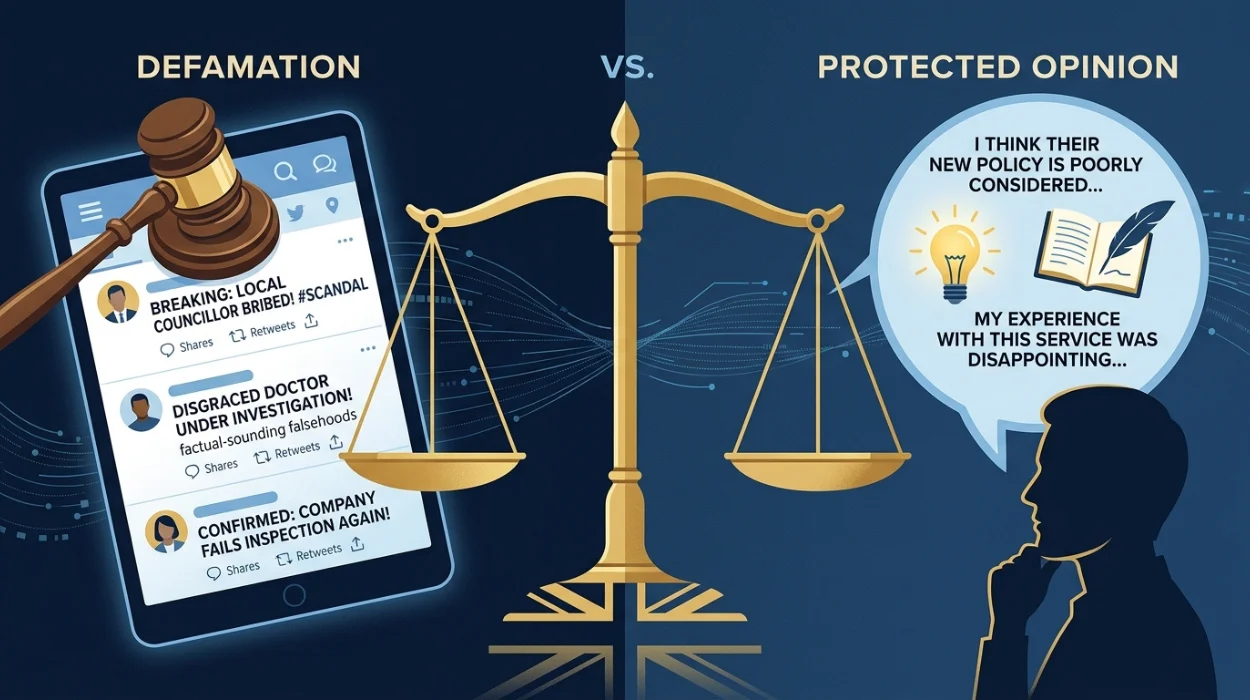
Online defamation under UK law refers to a false statement published to a third party that causes serious harm to a person’s or organisation’s reputation. Opinion differs from defamation because it expresses a viewpoint rather than presenting a false statement of fact.
Reputation management is the study of how information influences public perception across digital environments. Online reputation refers to the collection of reputation signals, indexed content, entity associations, and search results that contribute to how individuals and organisations are evaluated within search ecosystems.
What Is Online Defamation Under UK Law?
Online defamation is a legal concept that refers to the publication of false statements that damage the reputation of an identifiable person or organisation. Under UK law, defamation focuses on the effect of published information on reputation and public perception. The legal framework evaluates whether content causes serious harm to reputation and whether the statement is presented as fact rather than opinion.
Within search ecosystems, defamatory content becomes part of a digital footprint when search engines discover, crawl, and index the material. Once indexed, the content contributes to entity perception because search engines associate the published information with a specific individual, business, or public figure. The visibility of defamatory material influences how users interpret credibility when evaluating search results.
Defamation differs from ordinary criticism because legal assessment focuses on factual accuracy, publication, identification, and reputational harm. Search visibility amplifies the impact of defamatory content because indexed pages remain accessible through branded searches, entity searches, and reputation-related queries.
How Does UK Law Assess Defamation?
UK law assesses defamation by examining whether a statement:
- Identifies a specific person or organisation.
- Presents information as fact rather than opinion.
- Has been communicated to at least one third party.
- Causes serious harm to reputation.
These elements establish the foundation for determining whether published content affects reputation within both legal and digital environments.
How Does Opinion Differ From Defamation?
Opinion refers to a subjective interpretation, judgement, or viewpoint. Defamation refers to a false factual statement that harms reputation. This distinction forms a central principle within reputation evaluation and content assessment.
Search engines process both factual statements and opinions as content signals. However, legal analysis distinguishes them according to their nature. A statement such as “I dislike this company” represents a personal opinion because it communicates an individual judgement. A statement asserting misconduct as a fact requires evidential support because it presents information as objectively true.
The distinction influences reputation management because search users frequently interpret visible content as trustworthy information regardless of legal classification. When opinion appears in highly visible search results, it contributes to perception formation. When false factual claims appear prominently, they contribute to reputational harm and misinformation.
Entity perception develops through repeated exposure to indexed content. Search engines evaluate relevance, authority, and engagement metrics rather than legal validity. As a result, opinion and factual content can both influence reputation signals even though they carry different legal meanings.
Why Does Online Defamation Affect Search Visibility?

Online defamation affects search visibility because search engines index and rank content according to relevance, authority, freshness, and user value signals. Once defamatory content becomes indexed, it enters the information ecosystem used to evaluate entities and topics.
Search engine results pages function as reputation gateways. Users frequently form impressions before visiting a website because titles, descriptions, URLs, and ranking positions communicate credibility signals. Defamatory content occupying prominent positions can alter entity perception by introducing negative associations into the search experience.
Content ranking dynamics influence the scale of reputational impact. High-authority websites often receive stronger visibility because search engines interpret them as reliable information sources. If defamatory content appears on authoritative domains, the content may acquire substantial search exposure through inherited authority signals.
Reputation signals emerge from the interaction between content visibility and user interpretation. Search visibility transforms individual pieces of content into broader reputation indicators because users evaluate entities based on accessible information rather than direct experience.
How Do Search Engines Interpret Reputation Signals?
Search engines interpret reputation signals through the analysis of content quality, authority indicators, topical relevance, user engagement patterns, and entity associations. Reputation signals help algorithms understand how an entity is represented across the web.
Online reputation refers to the cumulative perception created by indexed information. Search systems analyse relationships between websites, mentions, reviews, news coverage, citations, and user-generated content. These relationships contribute to a broader understanding of credibility and trustworthiness.
Algorithms do not make legal determinations regarding defamation. Instead, they evaluate content according to ranking systems designed to identify relevance and usefulness. As a result, defamatory material can remain visible if search systems interpret it as relevant to user queries.
Entity perception develops through semantic associations. When negative content repeatedly appears alongside an individual’s name or an organisation’s brand references, search engines may strengthen those associations through repeated indexing and retrieval. This process demonstrates how search visibility influences reputation formation independent of legal assessment.
What Role Does Content Indexing Play in Reputation Formation?
Content indexing refers to the process through which search engines discover, process, and store information for retrieval. Reputation formation depends heavily on indexing because unindexed content generally lacks search visibility.
Once a webpage is indexed, it becomes eligible to appear in search engine results pages. Indexed content contributes to the digital footprint of individuals and organisations because search engines connect information through entity recognition systems and semantic relationships.
Reputation management analyses indexing behaviour because visibility originates from discoverable content. Indexed material influences perception when users encounter it during branded searches, reputation investigations, or topic-specific research. Search exposure determines whether content becomes part of public evaluation.
The relationship between indexing and reputation demonstrates the importance of information architecture within search ecosystems. Content that remains highly visible accumulates greater influence over perception than content that receives limited exposure.
How Does Indexed Content Influence Entity Perception?
Indexed content influences entity perception by:
- Establishing associations between names and topics through semantic analysis.
- Reinforcing credibility signals through repeated mentions across authoritative sources.
- Shaping search visibility through ranking eligibility and retrieval frequency.
- Influencing user interpretation during SERP evaluation and reputation assessment.
These mechanisms explain why content indexing remains central to digital reputation development.
How Do Reviews, Comments, and User Generated Content Influence Reputation?
Reviews, comments, and user-generated content contribute to reputation because they introduce public sentiment into searchable environments. These content formats create additional reputation signals that search engines and users evaluate when assessing credibility.
Review content frequently appears within search results, local listings, discussion platforms, and specialised review websites. Search engines interpret review signals as indicators of public engagement and relevance. Users interpret them as evidence of reputation and trustworthiness.
Sentiment interpretation occurs through both human evaluation and algorithmic analysis. Positive sentiment strengthens favourable associations, while negative sentiment introduces reputational challenges. Search visibility amplifies these effects because prominent content receives greater attention during information gathering.
User-generated content expands the digital footprint of an entity by increasing the volume of publicly accessible information. The accumulation of indexed commentary influences how reputation develops across search ecosystems and online communities.
Dive Deeper With Our Expert Guides:
How Negative Content Suppression on Google Works and When It Outperforms Removal
How Negative Search Results in the UK Persist and What Determines Their Visibility
What Authority and Trust Signals Influence Reputation Assessment?
Authority and trust signals refer to indicators that help search engines evaluate credibility and information quality. These signals influence both ranking performance and reputation perception.
Authority emerges through recognised expertise, citation patterns, topical relevance, and content quality. Trust develops through consistency, transparency, factual accuracy, and reliable information sources. Search systems analyse these factors when determining content visibility.
Reputation management examines authority because highly trusted sources influence entity perception more strongly than low-quality sources. Information published on authoritative websites often receives enhanced visibility, broader indexing, and stronger user confidence.
Search visibility and credibility remain interconnected. When authoritative content supports positive entity associations, reputation signals strengthen. When authoritative content contains negative or defamatory information, reputational impact increases because users perceive the source as trustworthy.
How Does Online Defamation Removal in the UK Work Across Platforms and Publishers?
Online defamation removal in the UK refers to the processes used to challenge, assess, modify, or remove defamatory content across websites, publishers, platforms, and digital publications. The mechanism differs according to the platform, publication policies, jurisdiction, and legal considerations involved.
Publishers evaluate content through editorial standards, evidential requirements, and legal review procedures. Platforms often assess reported content through community guidelines, policy frameworks, and complaint processes. Search engines evaluate requests according to applicable legal standards and content policies relating to indexing and visibility.
The removal process exists within a broader reputation ecosystem because visibility, indexing status, publication authority, and search exposure determine how reputational information circulates online. Understanding these mechanisms provides context for analysing how information governance affects reputation outcomes.
From a semantic SEO perspective, content removal intersects with search visibility because indexed material influences entity perception until publication status, accessibility, or indexing conditions change. This relationship demonstrates how legal concepts, publishing systems, and search ecosystems interact within digital reputation management.
Why Is Understanding Defamation Important for Online Reputation?
Understanding defamation is important because reputation depends on the accuracy, visibility, and interpretation of information. Defamation represents a legal framework for evaluating false factual statements that damage reputation, while opinion represents protected subjective expression.
Search ecosystems continuously organise, retrieve, and present information to users. Content indexing, authority signals, sentiment interpretation, and entity associations influence how reputation develops across digital environments. Online reputation therefore emerges from the interaction between information creation, search visibility, and public evaluation.
A clear distinction between defamation and opinion improves understanding of how reputation functions within modern search systems. Legal definitions explain reputational harm, while search mechanisms explain how information becomes visible, discoverable, and influential within the digital landscape.
What is considered online defamation under UK law?
Online defamation under UK law refers to a false statement published to a third party that causes serious harm to a person’s or organisation’s reputation. The statement must be presented as fact rather than opinion and must negatively affect reputation.
How does opinion differ from defamation in the UK?
Opinion expresses a personal view, judgement, or belief, while defamation involves a false factual statement that damages reputation. UK courts assess whether the content would be understood as opinion or as an assertion of fact.
Can negative online reviews be considered defamation?
A negative review is not automatically defamatory. If a review contains false factual claims that harm reputation, it may meet the legal criteria for online defamation under UK law, whereas genuine opinions are generally protected.
How does defamatory content affect online reputation?
Defamatory content can influence online reputation by appearing in search engine results and shaping public perception. Indexed content contributes to reputation signals, entity perception, and search visibility across digital platforms.
What role does Clear Your Name play in understanding online defamation?
Clear Your Name provides information about reputation management concepts, including how online defamation, search visibility, and digital reputation interact. Understanding these principles helps explain how reputational information is interpreted within search ecosystems.