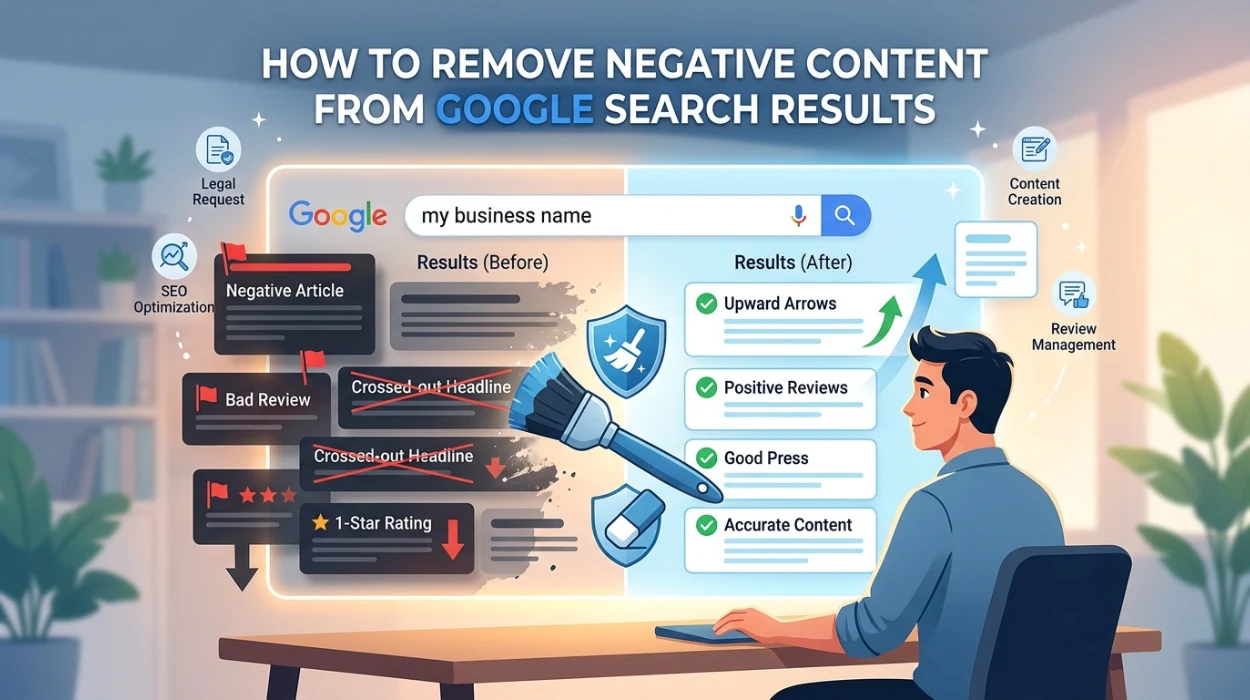
Removing negative content from Google Search results depends on how the content is indexed, evaluated, and ranked within search ecosystems. Different forms of negative content require different removal, de-indexing, suppression, or visibility-management mechanisms.
Reputation management is the analysis of how information influences trust, credibility, and visibility across digital ecosystems. Online reputation refers to the collection of reputation signals that shape entity perception within search engines, review platforms, and search engine results pages (SERPs).
What Is Negative Content in Google Search Results?
Negative content is information that creates unfavourable entity perception within search ecosystems. It includes reviews, news articles, forum discussions, blog posts, complaints, legal records, social media references, and other indexed digital assets that influence how users interpret credibility.
Google does not classify content as negative based on sentiment alone. Search engines evaluate content according to relevance, authority, quality, and user value. A negative article can maintain strong search visibility if it satisfies ranking requirements. This distinction explains why reputation-related content often remains visible despite generating adverse sentiment.
Content visibility influences user interpretation before engagement occurs. Search users frequently form opinions based on information displayed within search results. As a result, negative content affects reputation signals by shaping expectations before a user visits a website or interacts with an entity.
How Does Google Index Negative Content?
Google indexes negative content through automated crawling and content discovery systems. Content indexing refers to the process of collecting, analysing, and storing information within Google’s search infrastructure.
When a webpage becomes publicly accessible, search crawlers evaluate its content, structure, authority signals, and contextual relevance. The indexing process does not evaluate whether information is favourable or unfavourable. Instead, it determines whether the content satisfies inclusion requirements and provides informational value.
Indexed content becomes eligible for ranking within relevant search queries. Negative content remains visible when search algorithms determine that it contributes useful information to a search result. This process explains why reputation-related content often appears prominently within branded searches.
Search visibility is directly influenced by indexing status. Content that is removed from an index cannot appear within standard search results, whereas indexed content continues competing for ranking positions.
Why Does Negative Content Appear Prominently in Search Results?
Negative content appears prominently because search algorithms evaluate relevance and authority rather than sentiment. Ranking systems focus on information quality, topical alignment, user engagement indicators, and source credibility.
Content discussing complaints, disputes, investigations, or criticism often attracts strong engagement signals. User interaction metrics contribute additional relevance indicators that support visibility. High-authority publishers and established websites also generate stronger ranking signals, increasing the probability of prominent placement.
Entity perception is influenced by ranking position. Information displayed near the top of a SERP receives greater visibility and attention than content positioned lower within search results. Consequently, negative content occupying prominent positions can significantly influence reputation signals.
Search engines interpret content through information retrieval systems rather than emotional frameworks. Visibility therefore depends on ranking factors instead of positive or negative sentiment classifications.

What Methods Exist for Removing Negative Content From Google?
Several mechanisms exist for reducing or eliminating negative content visibility within Google Search results. Each method operates through a distinct technical process and addresses different content scenarios.
What Is Content Removal?
Content removal is the elimination of information from its original publishing source. When a webpage is deleted or significantly modified, search engines eventually update indexed records to reflect the change.
Removal represents the most direct method of eliminating visibility because the source content no longer exists. Search indexing systems cannot display content that has been permanently removed from its originating location. The effectiveness of this method depends on publisher cooperation or platform enforcement procedures.
Content removal affects both search visibility and reputation signals because the underlying information asset disappears from the searchable web environment.
What Is De-Indexing?
De-indexing is the exclusion of content from a search engine index while the original content remains online. The content remains accessible through direct URLs but becomes unavailable through standard search queries.
Search engines process de-indexing requests according to eligibility requirements and policy frameworks. The mechanism influences visibility without necessarily affecting publication status. This distinction separates de-indexing from content removal.
De-indexing directly alters SERP composition by reducing the searchable footprint of a content asset. Entity perception may improve when the content no longer appears within branded search environments.
What Is Content Suppression?
Content suppression is the process of reducing the relative visibility of negative content through the promotion of alternative information assets. The objective is not removal but ranking displacement.
Suppression operates by introducing stronger relevance and authority signals into the search ecosystem. Search algorithms compare competing content assets and adjust rankings based on comparative quality and credibility indicators. The mechanism influences search visibility without requiring publisher intervention.
How Do Search Engines Evaluate Reputation Signals?
Search engines evaluate reputation signals through content analysis, authority assessment, engagement indicators, and trust-related information. Reputation signals help algorithms understand how entities are represented across the digital environment.
A reputation signal is any piece of information that contributes to entity perception. Reviews, news mentions, citations, business profiles, social references, and content quality indicators all function as reputation signals. Search systems aggregate these signals to form broader contextual understanding.
Trust and credibility emerge through consistency. Search ecosystems interpret repeated patterns of authoritative information as indicators of reliability. Contradictory or predominantly negative signals can influence overall perception, particularly within branded search queries.
SERP evaluation involves comparing reputation signals across multiple sources simultaneously. This comparative analysis helps determine which content assets receive greater visibility within search results.
How Do Reviews Influence Search Reputation?
Reviews influence search reputation because they provide publicly accessible sentiment indicators. Review platforms contribute substantial reputation signals that affect entity perception across search ecosystems.
Search engines interpret reviews as informational content rather than simple ratings. Review frequency, sentiment distribution, recency, and source credibility all contribute to evaluation processes. These factors help establish broader perceptions of trustworthiness and reliability.
Negative reviews influence perception by introducing adverse sentiment signals. When review content receives strong visibility, its impact extends beyond individual platforms and affects branded search environments. Search users often interpret review information as a representation of credibility.
Review signals interact with broader reputation systems. Search visibility, authority indicators, and review sentiment collectively contribute to entity perception within digital ecosystems.
What Role Does Digital Footprint Play in Reputation Management?
A digital footprint is the collection of information associated with an entity across online environments. It includes websites, reviews, social profiles, news mentions, directory listings, multimedia assets, and other indexed content.
Digital footprint size and composition influence reputation signals because search engines evaluate entities through interconnected information sources. A larger footprint provides more contextual data for algorithmic interpretation. The quality and consistency of this information influence perception outcomes.
Content indexing determines how much of a digital footprint becomes visible within search results. Search engines continuously evaluate indexed assets to understand entity relationships, topical authority, and credibility indicators.
Digital footprints influence search visibility because algorithms rely on available information to generate rankings and contextual associations. The broader the footprint, the greater the number of reputation signals available for analysis.
How Does Authority Influence Content Visibility?
Authority is the perceived credibility and reliability of a content source within search ecosystems. Search engines evaluate authority through links, expertise indicators, publication history, content quality, and trust-related signals.
Authoritative content sources often achieve stronger visibility because their information receives greater algorithmic confidence. Negative content published on authoritative platforms can therefore achieve substantial search prominence. This relationship explains why certain reputation-related content remains highly visible despite sentiment concerns.
Authority influences SERP evaluation by helping algorithms determine which information deserves prioritisation. Search engines compare authority signals alongside relevance indicators when ranking competing content assets.
Entity perception is frequently shaped by authoritative sources because users associate authority with credibility. Search visibility therefore becomes closely linked to the authority profile of the publishing source.
How Does Search Visibility Affect Public Perception?
Search visibility affects public perception because users interact with information presented within search results before engaging with entities directly. The information displayed on the first page of results often forms the basis of initial impressions.
Visibility creates informational exposure. Content appearing prominently receives greater attention, which increases its influence on reputation signals and entity perception. Lower-ranked content receives less engagement and contributes less significantly to overall perception.
Search ecosystems function as information-filtering environments. Algorithms determine which content users encounter first, making ranking position an important factor in perception development. Reputation management analysis therefore frequently examines visibility alongside content quality and authority.
The relationship between visibility and perception demonstrates why search results play a central role in online reputation. Information prominence directly influences how credibility, trust, and reliability are interpreted within digital environments.
Removing negative content from Google Search results involves understanding how search engines index, evaluate, rank, and display information. Content removal, de-indexing, and suppression each operate through distinct mechanisms that influence visibility in different ways.
Search reputation is shaped by reputation signals, authority indicators, review sentiment, digital footprint composition, and SERP evaluation processes. Search engines interpret these factors collectively to determine how entities appear within search ecosystems.
Understanding content indexing, search visibility, entity perception, and credibility assessment provides a clearer framework for analysing why negative content appears in search results and how different reputation management mechanisms influence information visibility across digital environments.
How can negative content be removed from Google Search results?
Negative content can be removed from Google Search results through content removal, de-indexing, legal requests, or reputation management strategies. The appropriate method depends on how the content is published, indexed, and evaluated within search engines.
Does Google remove negative content automatically?
Google does not remove content simply because it is negative. Content removal generally requires a policy violation, legal basis, privacy concern, or removal from the original publishing source before search visibility changes.
What is the difference between content removal and content suppression?
Content removal eliminates information from the original source or search index, while content suppression reduces the visibility of negative content by improving the ranking of other relevant content. Both approaches influence search visibility but operate through different mechanisms.
How does negative content affect online reputation?
Negative content influences reputation signals, entity perception, and public trust across search ecosystems. When highly visible in search results, it can affect credibility assessments and shape user opinions before direct engagement occurs.
Why does negative content rank highly in Google Search results?
Negative content ranks highly when it demonstrates strong relevance, authority, engagement, and content quality signals. Google’s ranking systems evaluate usefulness and credibility rather than whether the information is positive or negative.