
Marriage and divorce records can expose personal information online when official records, public databases, indexes, or third-party websites make details searchable or accessible. Reputation management is the process of monitoring and understanding information that shapes how an individual or entity is represented across digital environments.
Online reputation refers to the information, signals and associations connected to a person or entity across search engines, websites, databases, social platforms and other public sources. Marriage and divorce records form part of this digital footprint when information from those records becomes indexed, reproduced or connected to an individual’s name. The level of exposure depends on the jurisdiction, record-access rules, indexing practices and the way third-party services republish public information. Understanding these mechanisms explains how legally available information can become highly discoverable through search.
How can marriage and divorce records become visible online?
Marriage and divorce records become visible online when record information is published through government portals, court systems, public indexes, archives or third-party databases. The underlying information can include names, dates, locations, case references and other details defined as public under applicable laws. Some sources provide direct access to records, while others publish searchable indexes containing selected information. The distinction between an original record and a derived database is important because each source has different access and indexing characteristics.
Content indexing determines whether information discovered by a search engine becomes available within its searchable database. A webpage containing a person’s name and record details can be crawled and indexed when it is accessible to search-engine systems. Indexing does not guarantee a prominent ranking, but it creates the possibility of appearing for relevant queries. Search visibility therefore depends on both the existence of the record and the mechanisms through which search engines discover and rank the associated page.
Third-party databases can further increase discoverability by aggregating information from different public sources. These websites often organise records around identifiable individuals, making information easier to locate through name-based searches. Once an individual’s details appear across multiple indexed pages, the information becomes part of a broader digital footprint. This creates a distinction between legal public availability and practical online discoverability.
What personal information can marriage and divorce records reveal?
Marriage and divorce records can reveal identifying information that varies according to jurisdiction and the type of record available. Publicly accessible information can include names, dates, locations, case identifiers and details concerning the legal proceeding. Certain records contain additional information, while others restrict public access to specific fields. The information disclosed therefore depends on the applicable public-record framework rather than a universal standard.
The reputational significance of a record relates to its connection with an identifiable person. Search engines can associate names with webpages, databases and documents through textual and structural relationships. When a record contains an exact name match, it can become relevant to searches involving that person. The result contributes to entity perception because users interpret the collection of information presented around the name.
Personal information exposure also involves context. A record displayed without explanation can appear different from the same information presented alongside authoritative sources that clarify its nature. Search results provide limited space for context through titles, snippets and surrounding results. Consequently, the structure of the search results page influences how users encounter and interpret publicly available record information.
Why do public marriage and divorce records affect online reputation?
Public records can affect online reputation because they contribute factual information to the digital environment surrounding an identifiable person. Online reputation is not limited to social media posts or reviews; it also includes searchable legal, administrative and historical information. When a record ranks prominently for a name-based query, it becomes part of the information users encounter during SERP evaluation. Its reputational significance therefore relates to visibility and context rather than simply its existence.
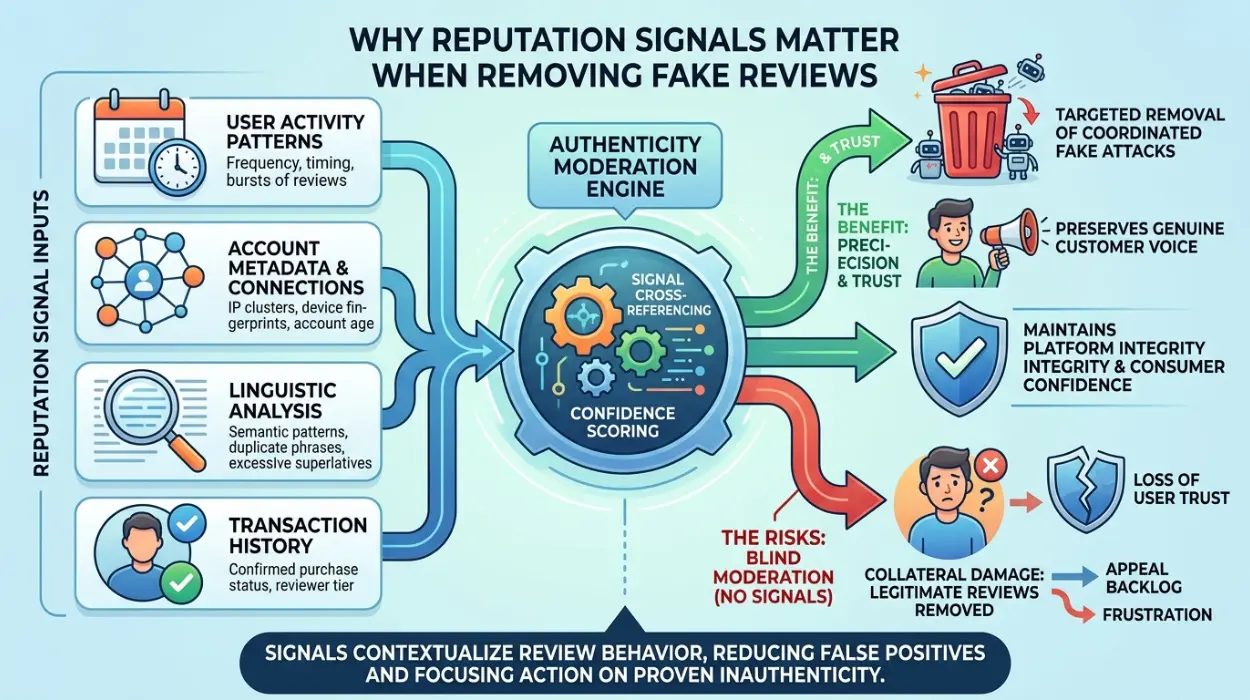
Reputation signals are observable pieces of information that contribute to perceptions of an entity’s credibility, identity or history. A public record can function as a reputation signal when it appears alongside other information connected to the same individual. Search engines do not necessarily treat the existence of a public record as positive or negative. Instead, ranking systems determine its visibility according to factors such as relevance, source characteristics and query relationships.
The impact also depends on the composition of the surrounding search results. A single record appearing among authoritative and relevant sources represents a different information environment from a search page dominated by sensitive personal information. SERP composition therefore provides a useful framework for understanding exposure. It shows not only whether information exists, but also how prominently users encounter it.
How do search engines rank marriage and divorce information?
Search engines rank marriage and divorce information according to their broader systems for evaluating relevance, quality, accessibility and other ranking signals. A public record does not receive a special universal ranking category simply because it concerns marriage or divorce. Instead, the associated webpage competes within search results based on its relationship to the query and the characteristics of its source. Search ranking dynamics therefore determine whether a record remains obscure or becomes prominent for a name-based search.
Authority is an important component of search evaluation. Government websites, established institutions and recognised databases possess different source characteristics from newly created pages or low-quality aggregators. Authority does not automatically determine the position of every page, but it forms part of the broader evaluation environment. Relevance remains important because a record containing an exact name match has a direct relationship with an identity-related query.
Search systems also process information at scale rather than interpreting every record through the circumstances known to the individual involved. This means a search result can display accurate information while still providing limited contextual explanation. Users then form perceptions from the collection of visible results. Entity perception is consequently influenced by the relationship between information accuracy, source authority, ranking position and contextual completeness.
How do third-party record websites increase personal information exposure?

Third-party record websites increase exposure by aggregating, organising and publishing information that users can search through names or other identifying details. These platforms can make information easier to locate than the original source because they provide structured search interfaces. The same individual can therefore appear across multiple databases even when the underlying information originated from a smaller number of official records. Each indexed page adds another potential entry point into the person’s digital footprint.
Aggregation changes the accessibility of information without necessarily changing its underlying accuracy. A public record that requires a specific institutional search can have limited discoverability compared with a database that places a person’s name in a searchable webpage. Search visibility increases when information is presented in formats that align closely with common queries. This explains why aggregation can have a significant effect on online discoverability.
Third-party publication also creates duplication. The same record details can appear across directories, databases and index pages, producing multiple search results associated with the same entity. Search engines evaluate each page separately while also processing relationships between similar information. This can make the information appear more established or prominent within a search environment even when the underlying source material is identical.
How do marriage and divorce records influence entity perception?
Marriage and divorce records influence entity perception primarily through context, visibility and association. Entity perception refers to how search systems and users interpret information connected to a recognised individual or organisation. A record can become part of this perception when its contents are prominently associated with a person’s name. The influence is not determined solely by the record itself because surrounding search results contribute additional context.
Search users frequently evaluate an entity by scanning multiple results rather than analysing one webpage in isolation. A record appearing near the top of a name-based SERP therefore receives greater attention than an equivalent record appearing much lower. The title and snippet can also shape the initial interpretation of the result. These factors demonstrate why search visibility is an important part of digital reputation analysis.
Contextual accuracy remains central to reputation evaluation. A public record can accurately describe a legal event while still creating an incomplete picture of an individual’s broader identity. Search engines retrieve information based on query relevance rather than personal preferences about what information deserves attention. Users therefore encounter an information environment shaped by ranking and indexing systems rather than by a complete biographical assessment.
How do review signals differ from public record information?
Review signals differ from public records because reviews generally represent user-generated evaluations, while public records provide information originating from official or legally accessible sources. Reviews contain sentiment, ratings, descriptions and opinions that search systems can analyse as textual or structured information. Public records primarily provide factual or administrative information defined by the relevant record system. The two categories therefore operate differently within reputation analysis.
Sentiment interpretation is particularly relevant to review content. Search systems and other automated technologies can process language to identify positive, negative or neutral patterns, although sentiment classification does not establish whether a statement is factually correct. Public records generally require a different interpretative framework because their significance depends on the information contained in the record and the context in which it is presented. Treating both categories as identical reputation signals produces an inaccurate analysis.
Authority also differs between the sources. A government record has a different source relationship from an anonymous review, while an established publication provides another type of information signal. Search visibility can amplify both categories, but the mechanisms of credibility differ. Effective reputation analysis therefore evaluates source type, authority, relevance and context before interpreting their potential effect on entity perception.
Dive Deeper With Our Expert Guides:
How Professional Profiles Can Expose More Personal Information Than Intended
Why Old Forum Posts Often Still Reveal Personal Information Today
How does content indexing affect the discoverability of personal records?
Content indexing determines whether search engines retain information from accessible webpages for potential inclusion in search results. When a public record appears on an indexable page, search engines can process its text, structure and relationship to relevant queries. An indexed page is not guaranteed to rank prominently, but it becomes eligible for retrieval. This creates a direct relationship between indexing status and potential search visibility.
Indexing also affects how quickly information enters the broader search ecosystem. Newly published or updated pages can be discovered through crawling processes, links and other discovery mechanisms. Search systems then evaluate the content before determining its search presentation. Changes in the source therefore do not always produce an immediate equivalent change in search results.
The distinction between indexing and ranking is essential when analysing personal information exposure. Indexing answers whether information is stored for search retrieval, while ranking addresses where that information appears for a particular query. A record can therefore remain indexed while having low visibility. Conversely, a highly relevant indexed record can achieve substantial exposure when its source and content align strongly with an identity-related search.
What factors determine whether a marriage or divorce record ranks prominently?
Prominent ranking depends on the relationship between the record page, the search query and the characteristics of the source. Exact name matches create strong relevance for identity-related searches, while source authority and page accessibility contribute to broader search evaluation. The page’s structure, wording and contextual information also influence how search systems understand its subject. Ranking is therefore the result of multiple signals rather than the presence of a public record alone.
Search query intent also changes the results that users receive. A search containing a full name and a specific legal term has a narrower information need than a general name search. Pages containing directly relevant record information become more aligned with the specific query. This demonstrates how search visibility is query-dependent rather than fixed across every search involving the same person.
SERP evaluation provides a practical method for analysing prominence. It examines ranking position, source type, title, snippet, query relevance and the presence of competing information. A record ranking near the top of an identity-specific query has greater practical exposure than one appearing beyond the first results. The analysis therefore focuses on what users encounter rather than simply cataloguing what information exists online.
What options exist to restrict public marriage and divorce records?
Options for restricting public marriage and divorce records depend primarily on jurisdiction, record type, legal status and the rules governing public access. Some records are legally available because transparency requirements define them as public, while others have restricted access or specific procedures for sealing, redaction or confidentiality. The relevant authority determines which mechanisms exist. Online visibility therefore cannot be assessed separately from the legal framework governing the underlying record.
The distinction between record restriction and search-result visibility is important. Restricting access to an underlying record addresses the source itself, while search-result management concerns how already published information appears within search systems. A change at source level can affect subsequent indexing, but search engines maintain separate crawling and ranking processes. The two layers therefore require separate evaluation.
Understanding options to restrict public marriage and divorce records requires examining both legal accessibility and digital discoverability. A record can remain legally public while appearing differently across search platforms, databases and aggregators. Conversely, a restricted source can leave residual references where copies or previously published information remain accessible. This makes source mapping and SERP evaluation important components of understanding personal information exposure.
How can online credibility be evaluated when personal records appear in search?
Online credibility is evaluated through the accuracy, authority, consistency and context of information associated with an identifiable person. Personal records form one category within a wider digital footprint that can also include professional profiles, publications, reviews and institutional references. Evaluating the complete information environment prevents one record from being treated as a complete representation of the entity. This approach focuses on information quality rather than assumptions about personal circumstances.
Trust signals emerge from the relationship between sources and information. Authoritative sources can establish factual context, while consistent information across independent sources can reinforce identity accuracy. Search engines evaluate these signals within their ranking systems, while users interpret the resulting SERP according to their own information needs. Reputation analysis therefore examines both the technical visibility of information and the contextual environment surrounding it.
The central issue is not simply whether marriage or divorce information exists online. The more relevant questions concern where it appears, how easily it is discovered, how prominently it ranks and what other information appears alongside it. These factors determine the practical level of personal information exposure. A structured digital-footprint analysis provides a clearer understanding of how public records participate in online reputation systems.
Marriage and divorce records can become part of an individual’s online reputation when public information is published, aggregated, indexed and ranked across digital platforms. Online reputation refers to the broader information environment surrounding an identifiable person, while digital footprint describes the collection of discoverable information connected to that identity. Public records represent one information category within this wider system.
Search visibility depends on indexing, query relevance, source authority, ranking dynamics and SERP composition. Third-party databases can increase discoverability by transforming legally accessible information into searchable pages, while repeated publication can create multiple digital references to the same underlying record. Reviews and other reputation signals operate differently because they involve sentiment and user-generated evaluations rather than primarily administrative information.
Understanding these mechanisms separates legal public access from practical online exposure. It also demonstrates why entity perception depends on context, source characteristics and search visibility rather than on the existence of one record alone. Evaluating the digital footprint as an interconnected information system provides a more accurate framework for understanding how marriage and divorce records can expose personal information online.
Can marriage and divorce records be found online?
Marriage and divorce records can become searchable online when government sources, court systems, public indexes or third-party databases publish accessible information. Search visibility depends on the jurisdiction, record-access rules, indexing status and the way information is presented.
What personal information can marriage and divorce records reveal?
Public records can reveal information such as names, dates, locations and case references, depending on the jurisdiction and record type. Third-party databases can also organise this information into searchable profiles, increasing its discoverability.
Can divorce records affect my online reputation?
Divorce records can become part of an individual’s digital footprint when they are indexed and appear in name-based search results. Their impact on entity perception depends on ranking position, source authority, context and the other reputation signals visible on the SERP.
How do I restrict public marriage and divorce records online?
Restricting access depends on local laws, the record type and the rules of the authority holding the information. Available mechanisms can include access restrictions, redaction, sealing or confidentiality procedures where legally applicable.
Can personal information removal services remove marriage and divorce records from search results?
Personal information removal services can assess where marriage or divorce information appears and identify appropriate removal or restriction options. However, legally public records, official sources and third-party copies are subject to different access and removal rules.