

Removing personal details from genealogy sites requires source-level identification, evidence-based assessment and structured action against the relevant records. Clear Your Name applies a controlled removal process while monitoring search visibility, reputation signals and changes across the wider digital footprint.
Why does genealogy information require professional reputation management?
Genealogy records can connect names, family relationships, historical documents, locations and other identifying information within searchable databases. When these records become associated with a person’s name in Google or other search engines, they form part of the information environment that users encounter during online research. This makes search visibility control relevant to personal reputation, particularly when exposed details create unwanted associations or inconsistencies. Reputation signals influence how users interpret the credibility and context of information presented for an identifiable person.
Professional reputation management addresses this issue through structured source analysis rather than treating every search result as an isolated problem. The process identifies where the information originates, determines how it is connected to other records and assesses the available procedures for changing or removing it. This creates a distinction between source-level removal, search visibility management and broader reputation improvement. Personal Information Removal Services therefore operate as a structured process for identifying exposed information and addressing it through appropriate channels.
The value of this approach extends beyond deleting a single record. Search engines continuously evaluate indexed pages, while users interpret the combined information displayed across search results. A successful strategy therefore considers the original genealogy source alongside its indexed references, related family records and surrounding reputation signals. This produces a clearer basis for measuring control over the digital footprint.
Which genealogy records can be addressed through a removal strategy?
Genealogy records can be assessed individually according to their source, content, ownership and applicable removal procedure. Relevant records include family-tree profiles, personal entries, linked relatives, historical documents and other pages containing identifiable information. The first stage is establishing exactly which information appears and which platform controls it. This prevents unrelated search results from being treated as part of the same removal request.
A structured assessment typically:
- Identifies the original genealogy profile and separates it from search-engine copies or cached references.
- Classifies the exposed information according to names, relationships, locations, dates or other identifying details.
- Examines the platform’s applicable privacy, correction or removal procedures.
- Documents relevant URLs and search positions to establish a measurable visibility baseline.
- Monitors subsequent changes to determine whether source availability and search visibility have changed.
This process improves reliability because every intervention connects to a specific source and documented objective. It also reduces the risk of submitting unsuitable requests against information that belongs to a different database or record. Clear Your Name uses this source-focused approach to keep the removal process evidence-led and transparent.
How does Clear Your Name handle personal information removal from genealogy sites?
Clear Your Name approaches genealogy information removal through source identification, eligibility assessment, procedural action and post-intervention monitoring. Each record is examined according to the platform hosting the information and the characteristics of the exposed data. This prevents removal requests from relying on generic assumptions about genealogy databases. The process instead connects each action to an identifiable record and an applicable procedure.
Evidence forms a central part of the process. Relevant pages, URLs, information types and search visibility are documented before intervention so that subsequent changes can be measured against an established baseline. Where a legitimate removal or correction route exists, the request is structured around the relevant requirements. Where source-level removal does not apply, the strategy distinguishes that limitation from separate search visibility or reputation-management options.
This distinction provides important risk control. Genealogy platforms can contain interconnected records, meaning a change to one profile does not automatically alter every reference to the same person. Clear Your Name therefore treats connected records as separate sources requiring individual assessment. This process clarity creates a more reliable framework for determining what has changed and what remains visible.
How does removing genealogy records improve search visibility?
Source-level removal can reduce the amount of personal information available from the original genealogy platform. Once a source changes or becomes unavailable, search engines process the change through their normal crawling and indexing systems. The resulting search visibility change depends on when search engines recrawl and update their indexes. Monitoring therefore remains essential after a source-level intervention.
Search visibility is measured through observable indicators rather than assumptions. Relevant name searches, indexed URLs, ranking positions and the presence of genealogy pages provide a baseline for comparison. Changes in these indicators demonstrate whether the removed source continues to appear prominently or whether the search landscape has changed. This measurement connects the removal process directly with SERP control and search perception influence.
The wider SERP also matters because users rarely assess one page in isolation. Professional profiles, authoritative websites, social pages, public records and genealogy resources can all contribute to the information presented for a person’s name. Removing one source changes one component of this environment, while broader reputation management addresses the surrounding information signals. This distinction creates realistic measurement criteria for evaluating search visibility outcomes.
Can removing one family record control every online reference?
Removing one family record does not automatically remove every connected reference across genealogy and history databases. Family trees frequently connect parents, children, spouses and other relatives, while separate databases can contain overlapping historical information. Each source has its own ownership structure and removal procedure. Effective personal information management therefore requires source mapping before action begins.
A connected-record assessment examines whether the same identifying information appears elsewhere. It also distinguishes direct exposure from indirect exposure through a relative’s profile or shared family tree. This is particularly important when the original record has already been removed but another database continues to display the same information. Monitoring these relationships provides stronger control over the wider digital footprint.
The distinction also reduces operational risk. Treating every connected page as one record creates inaccurate assumptions about the outcome of a single removal request. A source-by-source approach provides clearer evidence about which records changed and which remain active. This makes the process more sustainable because future monitoring can focus on documented sources rather than repeating broad searches without a defined baseline.
When is removal preferable to negative content suppression?
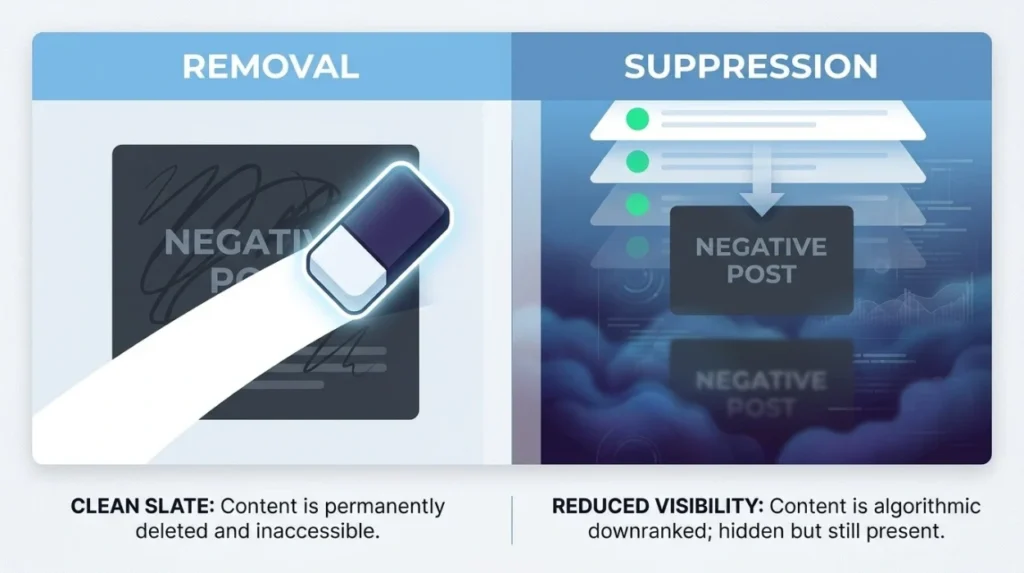
Removal addresses the original source, while negative content suppression focuses on reducing the prominence of information within search results. These approaches therefore operate at different stages of the search ecosystem. Source removal is directly relevant when the genealogy record qualifies for a legitimate deletion, correction or restriction procedure. Suppression becomes a separate consideration when the source remains accessible but its search visibility requires management.
The distinction has direct implications for outcomes. Removal changes source availability, while suppression changes the relative prominence of pages within the SERP. A removal strategy therefore provides a direct response to an eligible genealogy record when the objective is to remove family records, whereas negative content suppression works with the wider information environment. The two approaches can also operate separately when a source-level change does not immediately produce the expected search visibility outcome.
A decision based on the source rather than the desired headline result reduces risk. Not every unwanted genealogy record qualifies for removal, and search engines independently determine which indexed pages appear for a query. A professional assessment therefore establishes the available intervention before selecting the appropriate mechanism. This process protects the accuracy of the strategy while maintaining measurable search objectives.
What results can a professional genealogy removal strategy deliver?
A professional strategy delivers measurable outcomes through source status, search visibility and information-environment monitoring. The first outcome concerns whether the identified genealogy source has been changed, restricted or removed through an applicable procedure. The second concerns whether the associated page remains visible within relevant search results. The third concerns the wider SERP composition surrounding the individual’s name.
Key outcomes include:
- Reduce exposed personal details by addressing eligible information at its original genealogy source.
- Monitor search visibility by tracking relevant queries, indexed URLs and ranking positions.
- Improve SERP composition by evaluating how genealogy pages interact with other indexed reputation assets.
- Strengthen entity credibility by maintaining consistent and accurate information across relevant sources.
- Stabilise search perception through ongoing monitoring rather than relying on a single source-level change.
These outcomes create a clearer connection between intervention and measurable reputation signals. They also separate successful source removal from broader search-ranking changes, which are controlled by independent search systems. This distinction is essential for evaluating whether the strategy has achieved its defined objective.
How does the cost of removal compare with the long-term value of search control?
The cost of genealogy information removal relates to the complexity of source identification, evidence preparation, procedural requirements and ongoing monitoring. A single straightforward record requires a different level of work from an interconnected digital footprint containing duplicate profiles and linked family records. Evaluating cost therefore requires examining the number of sources, the complexity of the information and the level of search visibility involved. This produces a more meaningful assessment than considering removal as a simple one-page task.
Long-term value comes from reducing unnecessary exposure and establishing a clearer information environment around an identifiable person. A removed source no longer contributes the same information to users accessing that database, while monitoring establishes whether related pages remain visible elsewhere. This creates a measurable framework for assessing the continuing value of the intervention. The focus remains on information control rather than an unsupported promise of permanent search outcomes.
Professional involvement also reduces operational risk by creating a documented process. Evidence, source identification, procedural assessment and post-intervention monitoring provide an auditable sequence of actions. This improves accountability and makes future reputation analysis more efficient. The resulting value therefore combines the immediate intervention with stronger control over ongoing digital-footprint monitoring.
Dive Deeper With Our Expert Guides:
Remove UK Personal Data From US People-Search Sites With Our Help
Remove Your Email Address From Data Broker Sites With Our Help
How quickly can genealogy information removal affect search results?
Source-level changes can occur before corresponding changes become visible across search engines. After a genealogy website removes or updates information, search engines need to recrawl the affected page and process the new source state. The timing of search-result changes therefore depends on crawling, indexing and ranking systems rather than the removal request alone. Monitoring these stages provides a more accurate picture of progress.
The process begins with a documented baseline. Search queries, URLs and ranking positions establish what users encounter before intervention. After the source changes, the same indicators are reviewed to determine whether the relevant page remains indexed or visible. This creates measurable evidence instead of relying on assumptions about search perception.
Speed also depends on the complexity of the digital footprint. A single source provides a narrower monitoring requirement than a network of connected genealogy pages and historical databases. Where related records remain available, search visibility can persist through alternative URLs or sources. A professional strategy therefore prioritises accurate tracking over unsupported time guarantees.
How does the strategy reduce privacy and reputation risk?
Risk reduction begins with separating legitimate information-removal procedures from attempts to manipulate or misrepresent search results. Each genealogy record is assessed according to its source and applicable procedure before intervention. This evidence-led approach reduces the risk of submitting inaccurate or unsupported requests. It also protects entity credibility by keeping reputation management aligned with factual information.
The strategy then monitors residual exposure. If a source changes but a duplicate record remains indexed elsewhere, that separate exposure becomes identifiable through continued search monitoring. The same process applies to linked family trees and related profiles. This creates a continuous feedback loop between source-level action and search visibility analysis.
Clear Your Name also treats search perception as an information-management issue rather than simply a deletion exercise. The objective is to establish what information exists, where it originates, how it appears in search results and which reputation signals surround it. This broader view reduces the risk of overlooking connected sources. It also supports a more sustainable approach to personal information management.
Why does a structured process matter when choosing a removal service?
A structured process provides transparency at every stage of genealogy information removal. It defines the source, identifies the exposed information, records the baseline, assesses the available procedure and measures the outcome. This makes each intervention traceable rather than dependent on general claims about reputation improvement. Process clarity is therefore a central trust signal when evaluating professional support.
A reliable service also separates guaranteed actions from outcomes controlled by external platforms and search engines. Source-level requests can be documented and monitored, but search ranking systems independently determine how indexed pages appear. Clear Your Name maintains this distinction within its approach, connecting measurable actions with realistic outcome tracking. This creates a stronger basis for assessing performance and reducing uncertainty.
For users evaluating how genealogy information becomes exposed online, understanding the database structure, search indexing process and connected family records provides useful decision context before intervention. The removal strategy then builds on that understanding by identifying the specific sources requiring action. This connects informational analysis with practical decision-making without treating every genealogy record as identical.
Why choose a structured approach to removing personal details from genealogy sites?
A structured genealogy removal strategy combines source-level assessment, evidence-based intervention and search visibility monitoring. It addresses eligible personal details at their original source while recognising that connected records, indexing and SERP composition require separate analysis. This creates clearer control over what information changes and how those changes appear to search users.
Clear Your Name provides a process centred on source identification, procedural assessment, documented evidence and outcome monitoring. The approach strengthens reliability by distinguishing removal from suppression and by measuring source status alongside search visibility. It also reduces risk through a record-specific assessment rather than applying a generic removal method to every genealogy page.
The long-term objective is a more controlled and accurate digital information environment. Personal information removal becomes measurable through source changes, indexed-page monitoring, ranking observations and consistency checks across connected records. For individuals seeking professional support, this combination of process clarity, evidence and reputation-signal monitoring provides a credible framework for managing genealogy-related personal information.
How can I remove personal details from genealogy sites?
Start by identifying the genealogy website hosting the information and reviewing its privacy, correction or removal procedure. Personal Information Removal Services can involve documenting the record, assessing applicable grounds and monitoring the outcome after a request.
Can genealogy websites remove information about living relatives?
Genealogy websites have different policies for information relating to living people, so removal options depend on the platform and type of record. A request can focus on names, locations, family relationships or other personal details where an applicable procedure exists.
Does removing a genealogy record remove it from Google?
Removing a record from its original genealogy website does not automatically remove every search-engine reference. Google needs to recrawl and update its index, while separate search-result processes apply in specific circumstances.
How do Personal Information Removal Services handle genealogy records?
Personal Information Removal Services identify exposed records, assess the relevant platform’s removal procedures and document the information requiring attention. Search visibility can then be monitored to identify changes in indexed pages and related results.
Can Clear Your Name help remove personal details from genealogy sites?
Clear Your Name can assess genealogy-related personal information and identify available removal procedures for relevant records. The process distinguishes source-level removal from search visibility management and considers connected family records separately.



