Anonymous fake reviews damage business credibility when unverified allegations dominate search results and influence customer decisions. Clear Your Name provides Fake Reviews Removal Services to assess suspicious feedback, identify appropriate removal routes and strengthen search visibility through evidence-led reputation management.
Search visibility control matters because customers evaluate reputation signals before choosing a company, purchasing a product or entering a business relationship. Negative ratings, repeated allegations and suspicious review patterns influence entity credibility when they appear prominently across search engine results pages (SERPs). A structured removal process addresses reviews that breach platform policies or applicable legal requirements, while reputation enhancement strengthens the visibility of accurate business information. The objective is to reduce the impact of demonstrably inauthentic feedback without treating legitimate criticism as fraudulent or promising outcomes outside a platform’s control.
Which Fake Reviews Removal Services Deliver the Most Reliable Results?
Evidence-led Fake Reviews Removal Services deliver the clearest route to challenging suspicious reviews because they connect each removal request to a specific policy violation or legal basis. Anonymous feedback requires careful assessment because a missing public identity does not automatically establish that a review is fake. The relevant evidence includes transaction inconsistencies, duplicated wording, suspicious posting patterns and indications that the reviewer had no genuine customer experience. These indicators guide the investigation, but the removal decision depends on the available evidence and the rules governing the platform. A reliable process therefore prioritises substantiated claims over the volume of complaints submitted.
Clear Your Name approaches review disputes through a structured assessment of the content, its source and the evidence supporting a challenge. The process identifies the review URL, records the relevant publication details and evaluates the most appropriate reporting route. Platform policies, consumer protection rules and applicable legal standards determine which route fits the circumstances. This distinction reduces the risk of submitting an inaccurate allegation or pursuing a procedure that does not address the underlying issue. The result is a clearer basis for decision-making, with progress assessed through documented actions and review-status changes rather than unsupported promises.
How Can Businesses Identify Anonymous Fake Reviews Before Requesting Removal?
Businesses establish a stronger removal case by distinguishing suspicious review behaviour from genuine negative customer feedback. An anonymous profile, a low rating or a critical statement alone does not prove fraud. More meaningful indicators include demonstrably false transaction details, repeated text across unrelated accounts, coordinated publication patterns and evidence contradicting a claimed customer interaction. Reviewing these indicators together helps establish whether the content warrants a formal challenge. This evidence-led assessment also protects the business from treating legitimate criticism as a policy violation.
A review assessment examines the relationship between the published claim and the available records. Relevant evidence includes customer databases, booking details, order histories, previous correspondence and screenshots showing the review in context. Businesses can also compare the wording and publication timing of suspicious reviews to identify patterns that merit further investigation. Every finding needs to be recorded accurately, with assumptions separated from verified facts. This creates a defensible record for platform reporting and supports a more precise evaluation of the review’s authenticity.
Understanding why unverified review platforms allow anonymous negative feedback also helps businesses select the right response. Platforms balance privacy, accessibility and verification, so some permit anonymous submissions while applying moderation rules to identify prohibited conduct. The absence of a publicly visible name is therefore different from the absence of a genuine customer experience. A removal request becomes more credible when it identifies a specific policy breach and supplies relevant evidence. This distinction improves the quality of the assessment and reduces unnecessary disputes over legitimate opinions.
How Does the Review Removal Process Work?
A transparent removal process moves from evidence collection to policy assessment, formal submission and outcome monitoring. Each stage establishes what is known, which rules apply and what action the platform can reasonably take. This sequence improves accountability because the business can track the review’s status and the basis of each decision. It also helps separate work completed by the service provider from decisions reserved for the platform, regulator or court. No responsible process can guarantee that every challenged review will be removed.
The process follows four practical stages:
- Document the review URL, publication date, rating and relevant screenshots to preserve an accurate record of the disputed content.
- Assess the review against platform rules and applicable legal standards, using transaction records or other evidence to support the allegation.
- Submit a focused complaint through the appropriate reporting or legal channel, identifying the specific conduct that supports the request.
- Monitor the review status, platform response and relevant search results to measure the outcome and identify any remaining copies.
Each stage has a distinct purpose. Documentation preserves evidence before content changes, assessment identifies the strongest available grounds, submission places the issue before the responsible decision-maker and monitoring verifies what happened afterwards. Where a platform rejects a request, the reason for rejection informs the next decision rather than automatically justifying repeated submissions. Additional action depends on new evidence, an available appeal process or a separate legal basis. This process clarity makes performance easier to evaluate and reduces the risk of confusing an attempted removal with a confirmed result.
Which Legal and Platform Rules Support Fake Review Removal?
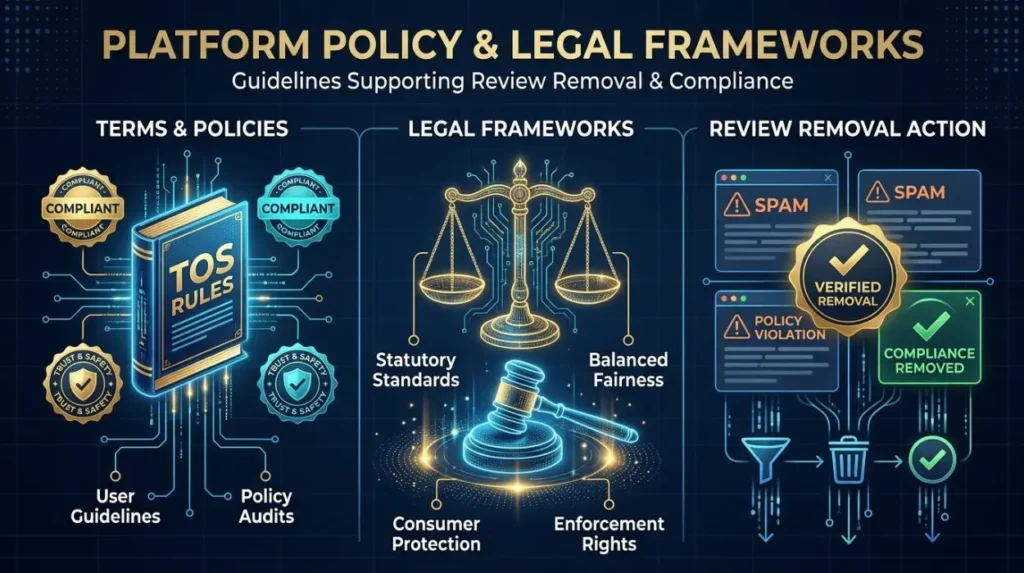
The strongest removal route is the one that matches the review’s specific conduct and the relevant rules. Review platforms prohibit defined forms of manipulation, including fake engagement, misleading content and other conduct identified in their policies. In the UK, the Digital Markets, Competition and Consumers Act 2024 introduced consumer protection provisions addressing fake reviews that came into force on 6 April 2025. The legal position depends on the facts, the applicable provisions and the responsibilities of the parties involved. Negative sentiment alone does not establish a legal violation.
The difference between a platform complaint and a legal claim matters when evaluating removal options. A platform complaint asks whether the content violates that platform’s rules, while a legal claim requires assessment against the applicable legal standard. Some reviews breach platform policies without necessarily meeting the threshold for a legal remedy. Other disputes involve potentially misleading commercial practices, false factual allegations or personal information, each of which requires a distinct analysis. Selecting the appropriate route reduces wasted effort and supports a more proportionate response.
Businesses evaluating their options benefit from understanding legal frameworks governing inauthentic and fraudulent online reviews before escalating a dispute. This analysis distinguishes fabricated customer experiences from genuine criticism and identifies the evidence relevant to the alleged conduct. It also explains why an anonymous review is not automatically unlawful and why a platform’s decision does not necessarily establish the truth of every claim. A well-supported complaint connects the available facts to a specific rule rather than relying on the review’s negative tone. That approach strengthens procedural clarity and helps manage legal and reputational risk.
How Do Removal and Negative Content Suppression Improve Search Visibility?
Review removal and negative content suppression address different parts of search visibility. Removal targets specific content that qualifies for deletion under platform rules or applicable law, whereas suppression seeks to improve the relative visibility of relevant, accurate information across search results. A successful removal can eliminate a particular review from its source, while suppression focuses on the broader SERP composition. Neither method guarantees that every reference to the review disappears from the internet. Copies, screenshots and third-party discussions can remain accessible even after the original content changes.
Search engines crawl, index and rank pages using multiple signals, including relevance and other characteristics of the content and source. They do not independently validate every claim simply because a page appears in a search result. A prominent review page can influence entity perception because users encounter it while researching a business, but its position does not establish that its allegations are accurate. Reputation management therefore measures visibility separately from factual validity. This distinction helps businesses set realistic goals and select methods that address the actual source of reputational harm.
Content enhancement supports suppression by making accurate information accessible for relevant name-based searches. Useful business profiles, authoritative service pages, clear company information and genuine customer feedback provide context for users evaluating the entity. Search engines independently determine whether these pages are relevant and where they appear, so publishing additional material does not ensure a specific ranking. The objective is a more informative and balanced search environment rather than the artificial removal of legitimate criticism. When eligible content is removed and accurate alternatives are strengthened, businesses gain a clearer basis for managing their digital footprint.
How Can Businesses Measure the Results of Fake Review Removal?
Businesses measure review removal through verified status changes, the accessibility of the original URL and the continuing presence of related content. These indicators distinguish a submitted complaint from a completed removal. A platform acknowledgement confirms receipt, but it does not confirm that the review has been deleted. Likewise, a review disappearing temporarily from a search result does not necessarily mean that the source content has been permanently removed. Accurate reporting separates each milestone so that the business understands the actual outcome.
A useful measurement framework includes:
- Track each disputed review by URL, platform, report date and current status to establish a documented case history.
- Verify whether the original review remains accessible after a platform decision to confirm the source-level outcome.
- Monitor relevant brand-name queries and SERP positions to observe changes in search visibility over time.
- Inspect related URLs and duplicate references to identify content that remains accessible outside the original platform.
- Compare review sentiment and legitimate customer feedback over a defined period to assess changes in the wider reputation picture.
These measures provide different types of evidence. Review status measures the platform outcome, URL checks establish source accessibility, ranking observations describe search visibility and sentiment analysis provides context about public feedback. No single measure proves that reputation has been fully restored. Combining them offers a more reliable picture of progress and highlights where additional work remains necessary.
Dive Deeper With Our Expert Guides:
Stop Competitor Fake Review Attacks with Our Review Removal Specialists
Clear Defamatory Fake Reviews Online with Our Specialized Removal Service
How Much Do Fake Reviews Removal Services Cost Compared with Long-Term Value?
The value of Fake Reviews Removal Services depends on the complexity of the dispute, the number of platforms involved, the strength of the evidence and the level of ongoing monitoring required. A single review with a clear policy violation requires a different level of investigation from a coordinated pattern spread across multiple websites. Legal assessment introduces additional complexity when the dispute involves potentially defamatory statements or misleading commercial practices. Pricing comparisons are meaningful when they define the work included, reporting frequency and boundaries of responsibility. A low fee without a clear process offers limited evidence of service quality.
Long-term value also depends on whether the work addresses the source of the problem. A one-off removal attempt can resolve a specific review when the platform accepts the complaint, but it does not automatically prevent future manipulation or remove copies elsewhere. Ongoing monitoring helps identify new suspicious activity, preserve evidence and maintain accurate business information. Organic reputation development supports this work by strengthening the visibility of reliable content and authentic customer feedback. These activities address different risks, so the appropriate balance depends on the business’s exposure and objectives.
Businesses assessing providers need clear information about deliverables, reporting, fees and limitations. A credible provider explains which platforms it can assess, how evidence is handled and what happens when a removal request is rejected. It also distinguishes confirmed outcomes from actions undertaken on the client’s behalf. Guarantees of universal or immediate removal are not reliable indicators of quality because third-party platforms retain control over their decisions. Transparent terms and evidence-based reporting offer a stronger basis for evaluating cost against long-term value.
Why Choose Clear Your Name for Fake Reviews Removal Services?
Clear Your Name provides Fake Reviews Removal Services focused on assessing suspicious feedback, identifying appropriate complaint routes and documenting progress. The process connects each proposed action to the available evidence and the relevant platform rules or legal considerations. This structure helps businesses understand why a review is being challenged, what action has been taken and which outcomes remain outside the provider’s control. It also reduces the risk of treating every anonymous negative review as fraudulent. The service is designed around substantiated review disputes and a clearer understanding of reputation signals.
Trust depends on process clarity as much as on the intended outcome. Businesses need to know how evidence is evaluated, how reports are submitted and how results are recorded. Clear communication also helps distinguish removal work from broader reputation management, including content enhancement and search visibility monitoring. Where a review does not meet the applicable removal threshold, the next step requires a separate assessment rather than an unsupported promise. This approach supports informed decisions and more responsible management of online credibility.
The wider objective is to strengthen entity credibility through accurate information, appropriate challenges and measurable progress. Removing a review that breaches a relevant rule can reduce the visibility of that specific content, while maintaining a credible digital footprint supports longer-term search perception. The effectiveness of each action is assessed through documented platform decisions and observed changes rather than assumed results. By combining evidence-led review assessment with transparent reporting, Clear Your Name gives businesses a structured way to evaluate suspicious reviews and manage the risks associated with online feedback.
Ready to Challenge Anonymous Fake Reviews with a Clear Process?
Effective fake review management begins with evidence, a suitable removal route and a clear definition of success. Businesses benefit from a process that distinguishes anonymous criticism from demonstrably inauthentic feedback, applies the relevant platform or legal standards and records each outcome. Removal, suppression and content enhancement serve different purposes, so each action needs to match the problem it is intended to resolve. This approach supports risk reduction without promising control over independent platform decisions or search engine rankings.
Clear Your Name delivers a structured approach to Fake Reviews Removal Services, helping businesses assess disputed reviews, document appropriate challenges and monitor the results. The emphasis remains on process clarity, evidence quality and measurable changes in review status and search visibility. Although no provider can guarantee removal in every case, a transparent, evidence-led method gives businesses a credible foundation for managing anonymous fake review concerns and protecting their online reputation.
How can businesses remove anonymous fake reviews?
Businesses can report anonymous reviews that violate platform policies by providing evidence such as fabricated transaction details, duplicated wording or suspicious review patterns. Fake Reviews Removal Services help assess the evidence, identify suitable reporting routes and monitor the platform’s decision.
Are anonymous negative reviews considered fake reviews?
No, anonymous negative reviews are not automatically fake because genuine customers can use pseudonyms to protect their privacy. A review requires evidence of fabrication, manipulation or a relevant policy violation before a removal request can be properly supported.
How long does it take to remove fake online reviews?
The removal timeline depends on the platform, the evidence provided and the complexity of the complaint. Clear review violations can be easier to assess, but no provider can guarantee immediate removal or a specific outcome.
Can fake reviews affect a business’s Google search rankings?
Fake reviews can influence customer trust, perceived credibility and the way people interpret search results. Their presence does not automatically cause a direct Google ranking penalty, but prominent negative review pages can affect search perception and customer decisions.
How does Clear Your Name help with anonymous fake reviews?
Clear Your Name provides Fake Reviews Removal Services to assess suspicious feedback, identify appropriate platform reporting or legal routes, and track review status. The outcome depends on the available evidence, applicable policies and the platform’s final decision.