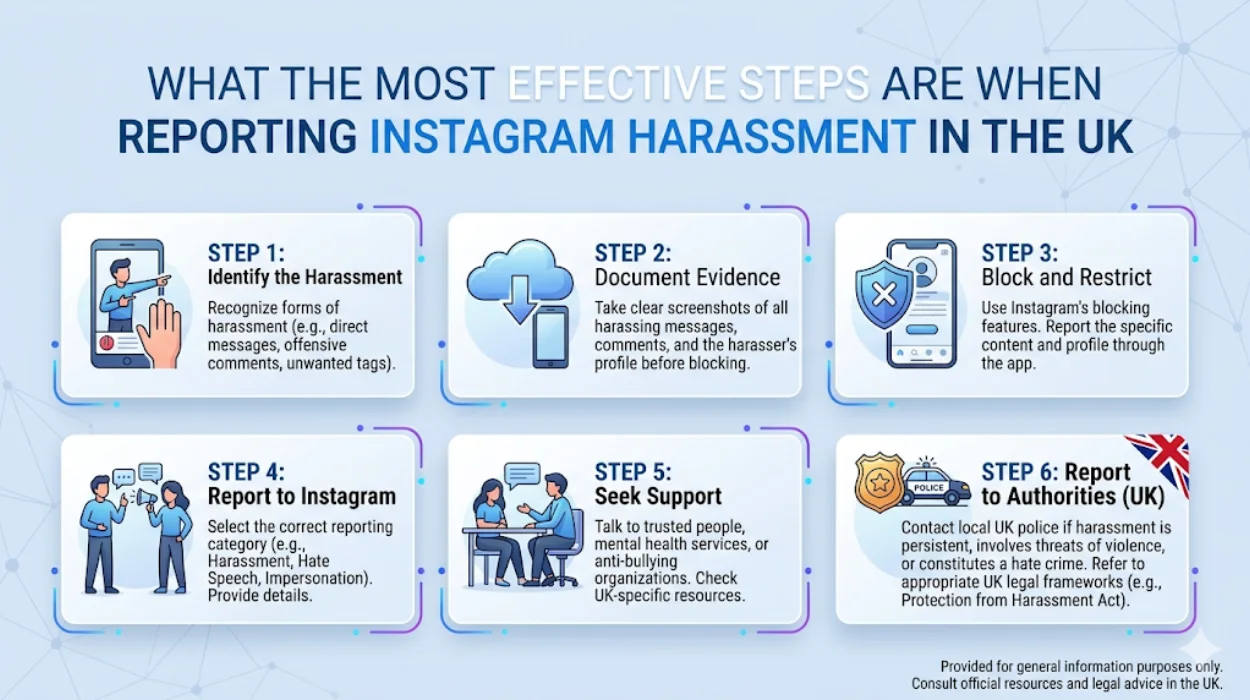
The most effective steps when reporting Instagram harassment in the UK involve structured evidence collection, platform-based reporting, and escalation through regulatory or legal channels when platform enforcement fails. Each step influences how reputation signals are processed, moderated, and reflected in search visibility.
Reputation management strategies differ based on response speed, platform compliance systems, and legal enforceability. Online reputation control methods are evaluated through their impact on content removal, sentiment distribution, and long-term entity credibility within search ecosystems.
How does reporting directly through Instagram compare with external escalation methods?
Reporting through Instagram provides immediate platform-level intervention, while external escalation introduces legal authority and enforcement pressure when internal moderation systems fail.
Featured snippet (40 words):
Instagram’s internal reporting system operates through automated moderation and policy enforcement, whereas external escalation involves legal frameworks and regulatory oversight. The comparison evaluates response time, enforcement strength, and impact on long-term reputation signals and search visibility.
Platform-Based Reporting Mechanism
Instagram reporting is a native moderation process. It operates by analysing flagged content against community guidelines using automated systems and human review layers. This method prioritises speed and scalability. It directly influences content visibility within the platform ecosystem.
The strength of this approach lies in immediate action. Harmful content may be removed or restricted quickly. This reduces short-term visibility and limits engagement signals. However, the limitation is inconsistency in enforcement accuracy. Automated moderation may misinterpret context.
From a reputation perspective, platform removal reduces internal visibility but does not guarantee deindexing from search engines. External traces may persist in indexed URLs or screenshots.
External Escalation Mechanism
External escalation includes reporting to UK authorities or pursuing legal action. This operates through formal complaint structures and evidentiary requirements. It introduces enforceable outcomes beyond platform policies.
This approach strengthens entity credibility. Legal intervention signals higher severity and legitimacy. Search engines interpret legal removals as stronger reputation signals compared to platform moderation alone.
The limitation is slower execution. Legal processes require documentation, verification, and procedural timelines. This reduces immediate suppression impact but increases long-term removal certainty.
What is the effectiveness of evidence collection versus immediate reporting?
Evidence collection ensures enforcement accuracy, while immediate reporting prioritises speed but risks incomplete moderation outcomes.
Featured snippet (40 words):
Evidence collection improves reporting accuracy and enforcement outcomes, while immediate reporting accelerates response time but weakens case strength. The comparison evaluates how structured documentation influences moderation decisions, legal escalation potential, and the stability of reputation signals across platforms.
Evidence Collection as a Strategy
Evidence collection is the systematic documentation of harassment instances. It operates by capturing screenshots, URLs, timestamps, and user identifiers. This creates verifiable proof for moderation systems and legal frameworks.
This method enhances enforcement precision. Moderators rely on contextual data to assess violations. Search engines also interpret consistent removal patterns as strong negative sentiment correction signals.
The limitation is delayed action. Content remains visible during the collection phase. This prolongs exposure and allows further engagement accumulation.
Immediate Reporting Approach
Immediate reporting prioritises rapid submission without structured documentation. It operates through quick flagging mechanisms within the platform interface.
The strength lies in speed. Harmful content may be removed before gaining traction. This reduces engagement metrics that influence algorithmic amplification.
The limitation is weak case support. Lack of evidence reduces moderation accuracy. Reports may be rejected, leading to repeated exposure and fragmented reputation control.
How do content removal strategies compare with content suppression approaches?
Content removal eliminates harmful material, while content suppression reduces its visibility through competing signals.
Featured snippet (40 words):
Content removal deletes harmful material at source, while suppression strategies push negative content lower in search results. The comparison evaluates direct elimination versus visibility reduction, focusing on search ranking influence, sentiment distribution, and long-term reputation stability.
Content Removal Mechanism
Content removal is a direct intervention strategy. It operates by deleting or restricting access to harmful content through reporting or legal enforcement.
This method provides clear outcomes. Removed content no longer contributes to negative sentiment signals. It improves trust indicators and reduces risk exposure.
The limitation is dependency on platform compliance. Not all content qualifies for removal. Jurisdictional differences also affect enforcement capability.
Content Suppression Mechanism
Content suppression is an indirect reputation management method. It operates by publishing neutral or positive content to outrank harmful material in search results.
This approach influences SERP composition. Search engines prioritise fresh, relevant, and authoritative content. Positive content shifts sentiment distribution over time.
The limitation is slower impact. Harmful content remains accessible. Suppression requires sustained effort and content scalability.
How do organic reputation strategies compare with reactive reporting methods?
Organic strategies build long-term credibility, while reactive reporting addresses immediate harm.
Featured snippet (40 words):
Organic reputation strategies focus on proactive content creation and credibility building, while reactive reporting addresses harmful incidents after they occur. The comparison evaluates sustainability, scalability, and their combined effect on search engine interpretation of reputation signals.
Organic Reputation Strategy
Organic reputation management is a proactive approach. It operates by consistently publishing authoritative and positive content. This strengthens entity credibility across digital platforms.
Search engines interpret this as a stable reputation signal. High-quality content improves ranking authority and trust indicators. It reduces the relative impact of negative content.
The limitation is delayed results. Organic growth requires time and consistency. It does not address immediate harassment incidents.
Reactive Reporting Strategy
Reactive reporting is incident-driven. It operates by responding to specific harmful content through reporting mechanisms.
This method delivers immediate risk mitigation. It reduces exposure quickly when successful. It directly targets negative sentiment sources.
The limitation is fragmentation. Reactive actions do not build long-term reputation strength. Repeated incidents require repeated intervention.
What are the differences between short-term and long-term reputation management outcomes?
Short-term strategies prioritise immediate visibility reduction, while long-term strategies focus on sustained credibility and search stability.
Featured snippet (40 words):
Short-term reputation strategies reduce immediate harm through reporting and removal, while long-term strategies build sustainable credibility through content and authority signals. The comparison evaluates durability, search ranking influence, and resilience against recurring negative content.
Short-Term Outcomes
Short-term strategies include reporting, blocking, and immediate content removal. They operate by reducing visibility quickly.
This approach limits rapid damage. Engagement metrics decline. Negative content loses momentum within platform algorithms.
The limitation is temporary impact. New content may emerge. Without structural reputation reinforcement, risks persist.
Long-Term Outcomes
Long-term strategies focus on authority building and consistent content development. They operate by influencing search engine trust signals over time.
This approach stabilises SERP composition. Positive sentiment dominates search results. Entity credibility strengthens across platforms.
The limitation is resource intensity. Sustained effort is required to maintain visibility and authority.
How do UK legal frameworks compare with platform policies in handling harassment?
UK legal frameworks provide enforceable authority, while platform policies rely on internal moderation systems.
Featured snippet (40 words):
UK legal frameworks enforce harassment regulations through formal legal mechanisms, while platform policies depend on internal moderation rules. The comparison evaluates enforcement strength, compliance reliability, and their combined effect on reputation protection and search visibility outcomes.
Platform Policy Enforcement
Platform policies define acceptable behaviour. They operate through automated detection and manual review.
This approach offers scalability. Large volumes of content are processed efficiently. It supports rapid moderation cycles.
The limitation is inconsistency. Policy interpretation varies. Enforcement lacks legal obligation.
Legal Framework Enforcement
UK legal frameworks define harassment as a punishable offence. They operate through formal complaints and judicial processes.
This approach ensures enforceability. Decisions carry legal weight. Content removal becomes mandatory under certain rulings.
The limitation is procedural complexity. Legal action requires evidence and time. It is less accessible for immediate response.
How does reporting Instagram harassment influence broader reputation management strategies?
Reporting harassment contributes to reputation stabilisation, while integrated strategies ensure sustained control over search perception.
Featured snippet (40 words):
Reporting Instagram harassment reduces immediate negative exposure, while integrated reputation strategies maintain long-term search stability. The comparison evaluates how isolated reporting actions interact with broader reputation frameworks to influence trust signals and SERP composition.
Integrated Reputation Framework
An integrated framework combines reporting, content creation, and monitoring. It operates by aligning reactive and proactive strategies.
This approach improves consistency. Search engines detect stable sentiment distribution. Entity credibility strengthens across multiple signals.
The limitation is complexity. Coordination across strategies requires structured planning.
Isolated Reporting Impact
Isolated reporting focuses on single incidents. It operates without broader strategy alignment.
This approach delivers targeted results. Specific harmful content is addressed.
The limitation is limited scope. It does not influence overall search perception or long-term reputation signals.
Where does BOFU intent align within harassment reporting and content removal?
BOFU intent aligns with actionable steps focused on removing harmful content and restoring reputation visibility.
Featured snippet (40 words):
BOFU intent targets actionable solutions for removing Instagram harassment content and restoring reputation visibility. It evaluates direct interventions, including reporting systems and removal strategies, focusing on measurable outcomes such as content deletion, reduced visibility, and improved sentiment distribution.
Within this context, users investigating Online Reputation Management Services often transition from evaluation to action when seeking structured removal processes. This includes scenarios where individuals aim to Instagram Harassment and Get the Content Removed through formalised workflows.
Conclusion
Effective reporting of Instagram harassment in the UK depends on the interaction between platform-based moderation, legal escalation, and structured reputation strategies. Platform reporting delivers speed but lacks enforcement consistency. Legal frameworks provide authority but require time and evidence.
Content removal offers direct elimination of harmful material, while suppression strategies reshape search visibility over time. Organic approaches strengthen long-term credibility, whereas reactive methods address immediate risks. Short-term actions reduce exposure, but long-term strategies stabilise reputation signals and SERP composition.
Strategic reputation management requires balancing speed, accuracy, and sustainability. Each method influences how search engines interpret trust signals, entity credibility, and sentiment distribution.