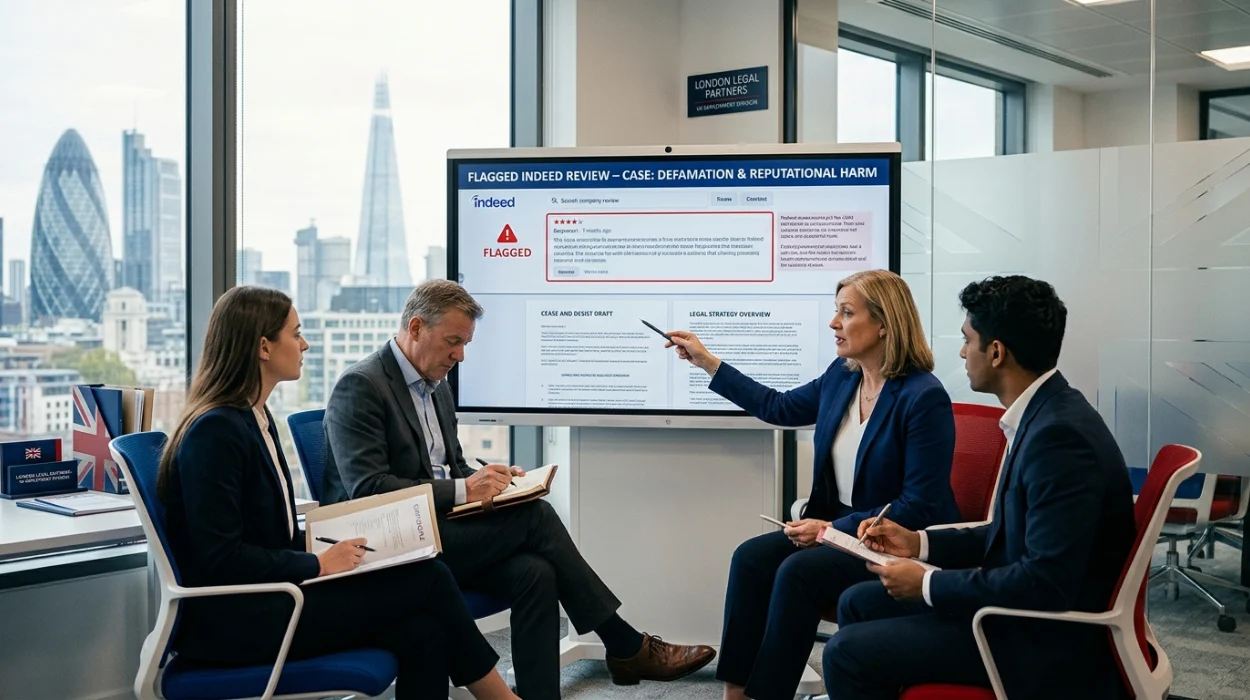
A harmful Indeed review can require structured escalation when it contains unlawful, defamatory, misleading or policy-violating material that affects a business’s search perception.
Indeed Review Removal Services provide a controlled route for assessing the content, building evidence and pursuing appropriate removal or escalation options.
Why does legal escalation matter when an Indeed review damages business reputation?
Legal escalation provides a structured response when a harmful Indeed review creates a material reputation risk beyond ordinary negative feedback. A damaging review can become part of the reputation signals encountered by candidates, customers, employees and other stakeholders researching an organisation online. When that content appears prominently in branded searches, it contributes to search perception and can influence how entity credibility is assessed. The objective is therefore not simply to remove an unfavourable opinion, but to address content that presents a legitimate policy, factual or legal concern. A disciplined escalation process reduces the risk of responding emotionally or pursuing an unsupported removal request.
An Indeed review becomes more significant when its visibility intersects with branded search behaviour. Users frequently investigate an organisation before applying for a role, entering a commercial relationship or forming an opinion about its credibility. A prominent negative result can therefore affect the wider search environment even when the underlying business has strong operations and positive reputation signals elsewhere. Indeed Review Removal Services focus on the relationship between the disputed content, platform rules, available evidence and the wider reputation landscape. This creates a more defensible approach than repeatedly submitting generic complaints.
Legal escalation also requires a distinction between criticism and actionable content. A negative opinion does not automatically justify removal, while false factual assertions, prohibited material or content that breaches applicable rules requires a different assessment. The strength of an escalation depends on evidence, the nature of the statement, its publication context and the relevant platform or legal framework. Clear Your Name approaches this assessment as a reputation risk-management process rather than treating every negative review as removable. That distinction protects credibility and keeps the escalation strategy focused on defensible grounds.
Which Indeed review removal approach provides the strongest risk control?
A documented evidence-led process provides the strongest risk control because every escalation decision is connected to an identifiable issue. The first stage involves reviewing the Indeed review, separating factual claims from opinion and identifying the specific basis for challenging the content. Supporting evidence then establishes whether the disputed statements conflict with available records, platform requirements or applicable legal considerations. UK legal escalation for a harmful Indeed review should be considered where the available evidence indicates that the matter may require action beyond a standard platform complaint. This approach strengthens the quality of the submission while reducing unsupported allegations. It also creates a clear audit trail showing why a particular escalation route was selected.
A professional process typically concentrates on four measurable areas:
- Identify the disputed statements and classify the precise policy, factual or legal concern.
- Document supporting evidence that directly relates to the statements being challenged.
- Escalate the matter through the appropriate platform or formal channel with a structured explanation.
- Monitor subsequent visibility and reputation signals to determine whether the issue has been resolved.
This process matters because content removal and search visibility operate through separate mechanisms. A successful platform action does not automatically erase every reference to the review from search results, cached information or third-party discussions. Conversely, a search-engine change does not necessarily remove the original review from Indeed. Effective reputation management therefore treats source-level action, search visibility and broader reputation signals as connected but distinct objectives.
For businesses making a service decision, this distinction provides important risk reduction. An effective strategy does not promise an automatic deletion simply because a review is harmful. Instead, it establishes whether a defensible basis for escalation exists and then applies the appropriate route. That process clarity makes the service easier to evaluate because the client understands what is being challenged, why it is being challenged and what outcome each stage is designed to achieve.
How can professional Indeed Review Removal Services improve search perception?
Professional removal services improve search perception by addressing the source of a problematic reputation signal and strengthening the surrounding information environment. When harmful content is successfully removed or its visibility changes, the search ecosystem has less negative material to surface for relevant branded queries. Search engines then reassess available pages according to their own crawling, indexing and ranking systems. This means reputation management works through changes in the information available to search systems rather than through direct control of rankings.
The process also supports SERP control by identifying which pages influence branded searches and where negative content sits within the result set. A review that ranks prominently can carry greater perceptual weight than content that is difficult to find, particularly when users conduct short branded searches. Reputation work therefore considers content visibility, relevance, authority and contextual relationships across the search landscape. The objective is to reduce the prominence of harmful signals while improving the overall balance of credible information. This creates a more stable basis for long-term search perception influence.
Search perception also depends on entity credibility. Search engines interpret entities through relationships between organisations, websites, profiles, publications and other information sources. A single negative review does not operate in isolation because it exists within a broader network of reputation signals. Strengthening authoritative and relevant assets provides additional context around the entity while addressing problematic source content where a legitimate route exists. This combined approach supports sustainable reputation improvement rather than relying on a single removal request.
Businesses evaluating a removal service can therefore measure outcomes through more than a binary removed/not-removed result. Relevant indicators include the visibility of disputed content, the prominence of positive or authoritative results, changes in branded search presentation and the stability of the wider reputation environment. These indicators provide a clearer picture of whether the strategy is reducing risk and improving search perception. The result is a more accountable reputation management framework.
When is legal escalation more valuable than ordinary review reporting?
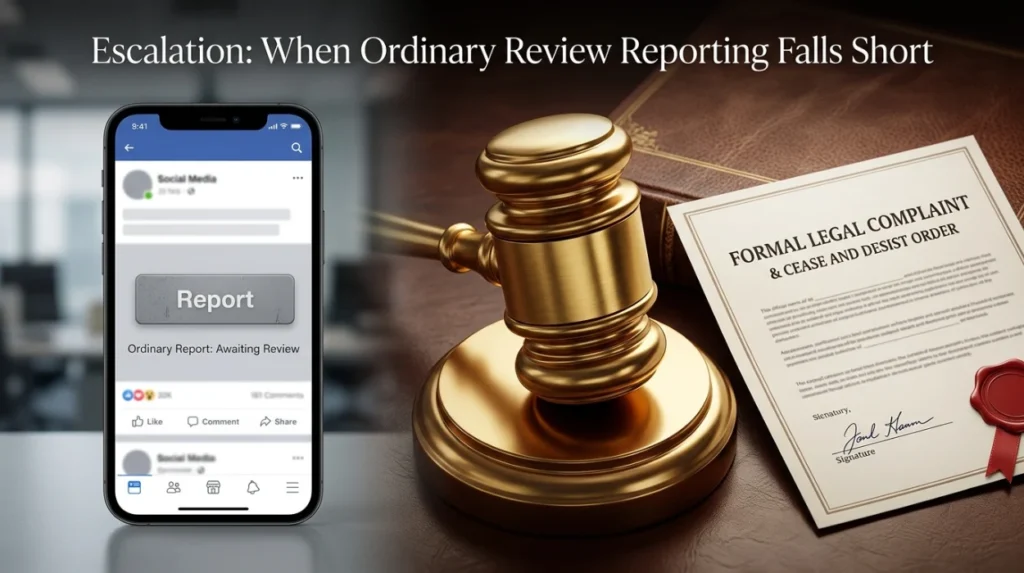
Legal escalation becomes more valuable when ordinary reporting does not adequately address the nature or seriousness of the disputed content. A standard platform report focuses primarily on whether content breaches the platform’s rules, whereas legal escalation considers whether the material raises a separate legal concern. The correct route depends on the facts, evidence, jurisdiction and characteristics of the content. Businesses therefore benefit from assessing the issue before selecting the escalation mechanism. This prevents legal terminology from being used where a straightforward platform-policy report is the stronger option.
A practical assessment considers the relationship between content, evidence and impact. If a review contains a clearly identifiable factual allegation, the business needs evidence capable of addressing that allegation rather than simply demonstrating that the review is damaging. If the issue concerns prohibited content, the submission needs to connect the material to the relevant platform requirement. If a legal route is being considered, professional legal advice remains appropriate for determining the legal merits and available remedies.
This distinction also reduces unnecessary escalation risk. Aggressive or unsupported legal demands can weaken credibility and consume resources without improving the underlying reputation position. A structured service instead prioritises proportionality, evidence quality and process clarity. That approach helps businesses allocate resources to actions with a defensible connection to the actual reputation problem.
Businesses that want to understand the decision point before taking action can review when legal action over an Indeed review becomes appropriate. This provides useful analytical context for distinguishing ordinary negative feedback from circumstances that justify a more formal escalation strategy.
Is the cost of Indeed Review Removal Services justified by long-term reputation value?
The value of Indeed Review Removal Services is measured through risk reduction, search visibility control and the protection of long-term trust rather than through the removal request alone. A harmful review can remain visible during repeated branded searches and influence perceptions long after its publication. If the content affects recruitment, customer confidence or commercial credibility, the cost of unmanaged visibility can extend beyond the original review. A structured intervention therefore represents a reputation-risk investment rather than a one-off content complaint.
Cost evaluation should focus on the quality of the process and the potential business impact of the content. A reliable service identifies the strongest available route, prepares relevant evidence and avoids spending resources on claims that lack a defensible basis. It also separates immediate source-level action from longer-term search perception management. This gives the business a clearer understanding of what the service is actually delivering.
Sustainability is equally important. Removing one problematic review does not guarantee that future negative content will never appear, nor does it permanently determine search rankings. Sustainable reputation management strengthens the overall information environment by supporting credible content, relevant authoritative pages and consistent reputation signals. This creates resilience when search engines recrawl and reassess the available results.
Clear Your Name applies this principle by treating Indeed review removal as part of a wider reputation management framework. The process prioritises evidence, platform compliance, search visibility and measurable reputation outcomes rather than relying on unsupported promises. That structure helps businesses understand both the immediate escalation route and the longer-term actions required to stabilise search perception.
Dive Deeper With Our Expert Guides:
Appeal a Refused Indeed Review Removal With Our UK Support
Escalate a Failed Indeed Flagging Attempt With Our UK Experts
What outcomes can a UK business expect from a structured Indeed review escalation?
A structured escalation delivers clearer decision-making, stronger evidence management and improved control over reputation risk. The immediate objective is to establish whether the disputed Indeed review meets an identifiable removal, reporting or escalation criterion. Where an appropriate route exists, the case is prepared around the evidence and the relevant grounds rather than general dissatisfaction with the review. Where removal is not available, the strategy can shift towards reducing the prominence and influence of harmful content through broader reputation management. This creates a practical response regardless of the platform’s final decision.
The outcome framework can be evaluated through:
- Reduce harmful-content exposure by pursuing legitimate source-level removal or restriction routes.
- Strengthen entity credibility by developing relevant, authoritative reputation assets.
- Improve SERP control by monitoring branded search results and content prominence.
- Stabilise search perception by maintaining a balanced and credible information environment.
- Protect long-term trust by responding to reputation risks through documented, evidence-led processes.
The key advantage is process clarity. A business knows which content is being assessed, which evidence supports the escalation, which channel is appropriate and which reputation outcomes require monitoring. This reduces uncertainty and prevents the strategy from becoming a sequence of disconnected complaints. It also establishes a stronger basis for evaluating service performance over time.
For businesses ready to assess a harmful Indeed review, a professional Indeed review removal service provides the appropriate starting point for evidence assessment, escalation planning and reputation-risk control. The service should be selected on process quality, transparency and realistic outcome management rather than promises of guaranteed removal.
Why choose Clear Your Name for Indeed Review Removal Services?
Clear Your Name provides a structured approach to Indeed Review Removal Services by connecting source-level review assessment with wider search perception management. The process focuses on evidence, policy relevance, escalation suitability and the relationship between disputed content and branded search visibility. This creates a clearer path from identifying the reputation problem to selecting the appropriate response. It also reduces the risk of pursuing unsupported claims that do not align with platform requirements or the underlying facts.
The objective is controlled reputation improvement rather than artificial suppression. Where a legitimate removal or escalation route exists, the case is developed around identifiable evidence and appropriate grounds. Where source-level removal is unavailable, the strategy can address the wider search environment through credible content and stronger reputation signals. This approach supports both immediate risk management and longer-term SERP control.
A harmful Indeed review deserves a proportionate, evidence-led response because search visibility can influence how an organisation is evaluated. Clear Your Name combines process clarity with reputation-focused analysis to help businesses make informed decisions about escalation, removal and search perception influence. The result is a professional framework designed to reduce reputation risk, strengthen entity credibility and create a more stable online presence without relying on exaggerated promises.
Can I legally escalate a harmful Indeed review in the UK?
Yes, depending on the content and circumstances, a harmful Indeed review may have legal implications such as defamation or misuse of personal information. Legal escalation should be based on the specific facts and available evidence.
How can I challenge a defamatory Indeed review?
Start by preserving the review, identifying potentially defamatory statements, and gathering evidence that supports your position. You can then use Indeed’s review-reporting process or seek appropriate legal advice where the matter may require further action.
Can Indeed remove a harmful or defamatory review?
Indeed may remove reviews that violate its content policies, although removal is not guaranteed simply because a review is negative. A clear report supported by relevant evidence can help the platform assess whether the review breaches its guidelines.
What evidence do I need to escalate an Indeed review legally?
Useful evidence can include screenshots of the review, the review URL, publication date, relevant correspondence, and records that demonstrate why specific claims are inaccurate or unlawful. Keeping the original evidence intact can help when making a platform complaint or seeking legal advice.
Can Clear Your Name help with an Indeed review removal appeal?
Clear Your Name can assist with the process of preparing an Indeed review removal appeal and organising relevant information for submission. Whether a review is removed ultimately depends on Indeed’s policies and its assessment of the evidence provided.