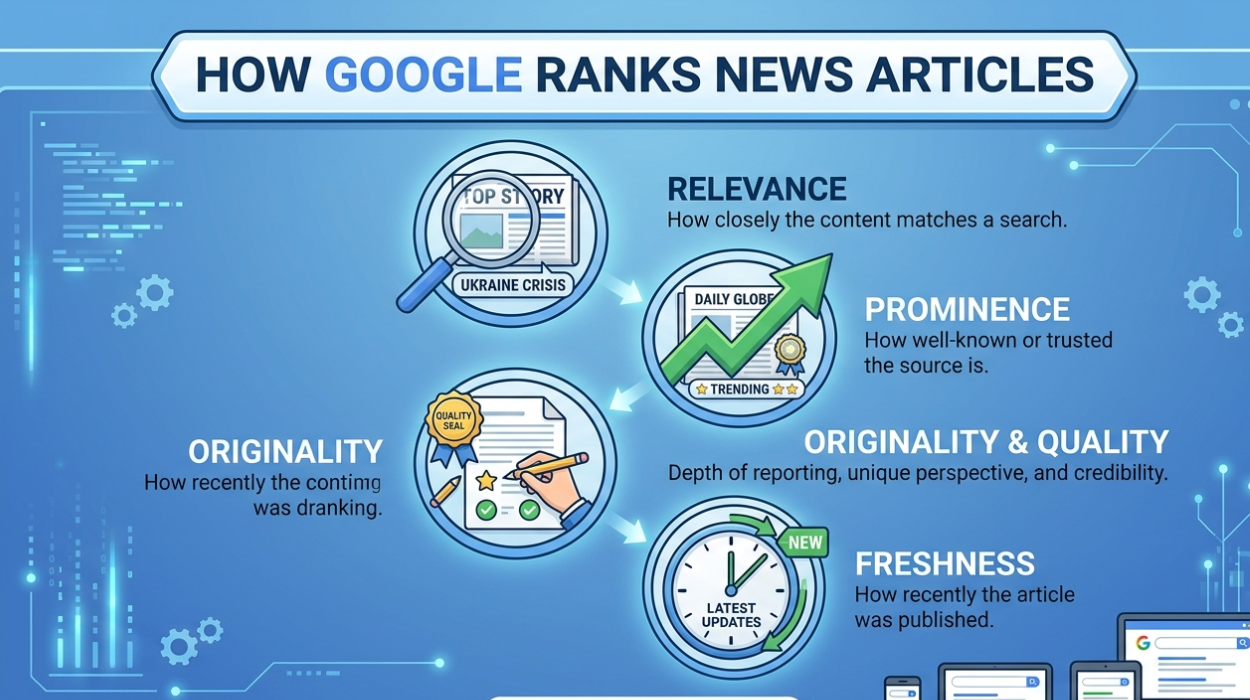
Google ranks news articles based on relevance, authority, freshness, and user‑intent alignment, then surfaces them in the SERP where they shape how an entity is perceived. Within search ecosystems, this ranking process determines which narratives dominate the first‑page view of a person or business, directly influencing reputation signals and entity credibility.
Reputation management strategies differ based on whether they prioritise content removal, content suppression, or content enhancement in the SERP. Online reputation control methods are evaluated through their impact on search visibility, the balance of sentiment distribution, and the long‑term stability of entity perception.
How does Google rank news articles by default?
Google ranks news articles by default by combining publisher‑level authority signals with topical relevance, freshness, and user‑intent patterns. Within reputation‑centric ranking, this means that established outlets and frequently linked stories are more likely to appear for branded or issue‑based queries.
News ranking operates by:
- Assessing publisher trust (domain history, editorial standards, citation volume).
- Matching article text and metadata to the likely intent behind search queries.
- Amplifying recent coverage for time‑sensitive topics through temporal weighting.
Each article is treated as a discrete information node; its SERP position then shapes how entity‑related events are interpreted. High‑ranking news links can dominate the first‑page narrative, especially when alternative or corrective content is sparse or poorly structured.
What are the main reputation‑management approaches to dealing with negative news?
The main reputation‑management approaches to dealing with negative news are content removal, content suppression, and content enhancement. Each method targets different points in the SERP and relies on distinct mechanisms to alter reputation signals.
Content removal operates by eliminating or de‑indexing damaging pages from search engines or publishers, reducing their presence in the digital footprint. Content suppression adds new, authoritative pages about the entity so that positive or neutral content occupies top‑ranking positions, diluting the influence of negative results. Content enhancement focuses on improving existing content—such as profiles, press releases, or thought‑leadership pieces—to strengthen trust signals and rewrite the dominant narrative without removing the original article.
Removal strategies can be powerful but are often constrained by legal, technical, and policy limitations. Suppression and enhancement are more scalable and sustainable over time, though they require longer‑term investment and consistent content production to shift sentiment distribution.
How do content removal and content enhancement strategies compare?
Content removal and content enhancement strategies differ in mechanism, risk profile, and long‑term impact on entity credibility. Both aim to improve online reputation, but they interact with search ecosystems in fundamentally different ways.
Content removal focuses on taking down or de‑indexing specific pages, directly reducing the number of negative signals in the SERP. It operates through legal claims, publisher negotiation, or technical takedown requests, and when successful it can quickly remove a source of ongoing reputational harm. However, its effectiveness is inconsistent and often limited by publisher resistance, jurisdictional constraints, and the risk of amplifying attention during the dispute.
Content enhancement, by contrast, builds new signals rather than deleting old ones. It operates by publishing factual, authoritative content that aligns with the entity’s attributes and then optimising each piece for search visibility and relevance. This approach is less legally risky and more sustainable, but it requires time, structured planning, and careful monitoring to ensure that the new content genuinely reshapes SERP‑level perception.
In evaluation terms, removal is more tactical and episode‑driven, while enhancement is strategic and reputation‑building. The choice between them depends on the severity of the content, the legal and policy environment, and the entity’s capacity for long‑term content investment.
What are the advantages and limitations of reactive versus proactive approaches?
Reactive approaches focus on responding to existing negative coverage, while proactive approaches build and maintain a controlled digital footprint before crises occur. Within reputation‑management analysis, each model has distinct strengths and exposure points.
Reactive approaches operate by:
- Responding to specific incidents (e.g., a damaging news article or viral post).
- Using removal, suppression, or direct‑response tactics to minimise short‑term damage.
- Concentrating effort on specific SERP clusters tied to branded or issue‑based queries.
These methods can be highly focused and measurable, but they are often resource‑intensive when applied to multiple incidents and can leave the broader reputation vulnerable to the next event.
Proactive approaches, in contrast, operate by:
- Mapping and securing key SERP clusters around the entity’s name, brand, and sector.
- Creating a sustainable content library that aligns with search‑intent patterns.
- Establishing early trust and authority signals so that incidental negative coverage is less likely to dominate the first‑page view.
Proactive strategies are more scalable and reduce long‑term risk exposure, but they demand consistent planning, resource allocation, and performance measurement. Reactive tactics are better suited to acute incidents, while proactive frameworks support long‑term reputation resilience.
How do short‑term suppression and long‑term enhancement influence search visibility?
Short‑term suppression and long‑term enhancement influence search visibility through different time horizons and signal‑weighting patterns. Each model affects which reputation signals receive the most exposure in the SERP.
Short‑term suppression focuses on quickly pushing down or displacing specific negative results. It operates by:
- Adding new pages or campaigns that target the same search queries as the negative article.
- Using on‑page signals, internal linking, and controlled backlinks to lift the ranking of these pages.
- Monitoring SERPs to ensure that the negative coverage moves below the first page or becomes less contextually prominent.
This approach can rapidly change the first‑page composition, but its effects may fade if the underlying content‑quality and authority signals are not sustained.
Long‑term enhancement, by comparison, builds a deeper content‑authority layer around the entity. It operates by:
- Creating topic clusters and pillar content that answer common user questions.
- Aligning this content with search‑intent patterns and semantic signals.
- Reinforcing trust through citations, authorship, and structured data.
Over time, enhancement shifts sentiment distribution so that positive or neutral narratives dominate the SERP footprint. This model is more sustainable and less vulnerable to individual incidents, but it requires continuous content investment and monitoring to remove negative news articles from Google legally.
How do different strategies affect trust signals and entity perception?
Different reputation strategies affect trust signals and entity perception by altering which information nodes receive the most prominence and how consistently they align with recognised credibility markers. Within search ecosystems, trust is inferred from patterns of content, authority, and coherence.
Removal‑based strategies can reduce the visibility of signals that contradict the entity’s desired portrayal, but they do not automatically rebuild trust. If the entity’s footprint becomes sparse or inconsistent after removal, search systems may interpret the remaining signals as weak or fragmented, which can constrain perceived credibility.
Suppression and enhancement strategies, by contrast, actively expand the pool of trust‑indicative content. Multiple high‑quality pages, consistent messaging, and authoritative references increase the perceived reliability of the entity. When news or review coverage is distributed across a richer, more balanced content landscape, SERP evaluation shifts toward a more stable and defensible reputation signal.
From a reputation‑management perspective, the most effective configurations combine short‑term suppression with long‑term enhancement, ensuring that the SERP reflects both factual accuracy and structural coherence. The choice of emphasis depends on the immediacy of the threat, the legal and policy environment, and the entity’s capacity for sustained content work.
FAQs:
How does Google rank news articles and why does it matter for my reputation?
Google ranks news articles using relevance, authority, freshness, and user‑intent signals, which determine how prominently certain stories appear for your name or brand. When negative articles rank highly, they can shape SERP‑level reputation signals and influence how people perceive your credibility and online presence.
How can I check what Google shows about me or my business?
To see what Google shows about you, search your exact name or business name in an incognito window and review the first‑page results, including news, profiles, and review snippets. You can also use Google’s “Remove information from Search” tool to identify indexed pages and analyse how they contribute to your overall online reputation.
Why do certain negative news results stay at the top of Google for so long?
Answer: Negative news articles often stay at the top of Google because they come from high‑authority publishers, match common search queries, and receive inbound links or social signals that reinforce their ranking.
What is the difference between removing an article and suppressing it in Google search?
Removing an article involves taking it down or de‑indexing it from Google so it no longer appears in search results, while suppressing it means pushing it down by ranking newer, positive or neutral pages above it.
Can I legally remove negative news articles from Google without paying a company?
Yes, you can sometimes request removal of certain articles from Google or the publisher if they violate data‑protection rules, contain outdated personal information, or breach defamation or privacy standards.