
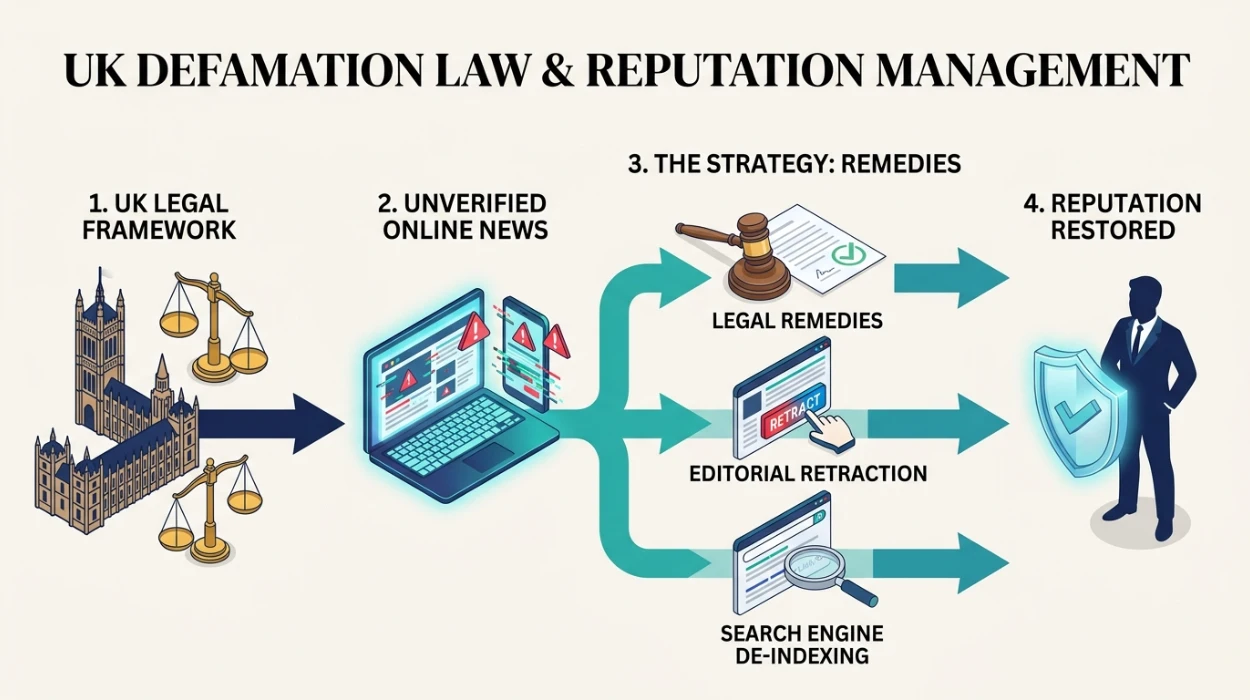
Defamation laws in the UK provide a statutory and common law framework that enables individuals to challenge, suppress, and rectify unverified online news coverage that damages their standing. Reputation management strategies differ based on whether an individual relies on legal remedies, editorial retraction requests, or search engine de-indexing protocols to mitigate digital exposure.
How Do UK Defamation Laws Regulate Online News Publishers?
UK defamation law regulates online news publishers primarily through the Defamation Act 2013, which balances freedom of expression with the protection of individual reputation. Under Section 1 of the Act, a statement is not defamatory unless its publication has caused or is likely to cause serious harm to the reputation of the claimant. For commercial entities, serious harm requires proof of serious financial loss, whereas individual claimants must demonstrate substantial damage to their social or professional standing. Online news outlets operating within UK jurisdiction are subject to these statutory requirements regardless of whether content is hosted on primary news domains, syndicated networks, or digital archives.
Online news coverage alters the application of limitation periods through the single publication rule defined in Section 8 of the Defamation Act 2013. The single publication rule dictates that the one-year limitation period for bringing a defamation claim begins when the material is first made available to the public. Subsequent views or downloads of the same digital article do not reset this statutory timeframe unless the content is republished in a materially different form. This mechanism prevents perpetual liability for online publishers while establishing a strict operational timeline for individuals seeking legal redress against unverified reports.
Search engine indexing introduces additional regulatory complexities regarding publisher responsibility and search engine liability. News publishers maintain direct control over hosted editorial content and bear primary liability for publishing unverified assertions. Search engines act as secondary distributors that index, aggregate, and display snippet previews of news coverage within search engine results pages. The legal framework distinguishes the primary editorial liability of a news publisher from the technical hosting responsibilities of an intermediary search engine, determining which legal mechanisms apply when requesting material modifications or content suppression.
How Does Legal Intervention Compare to Technical Article Removal Services?
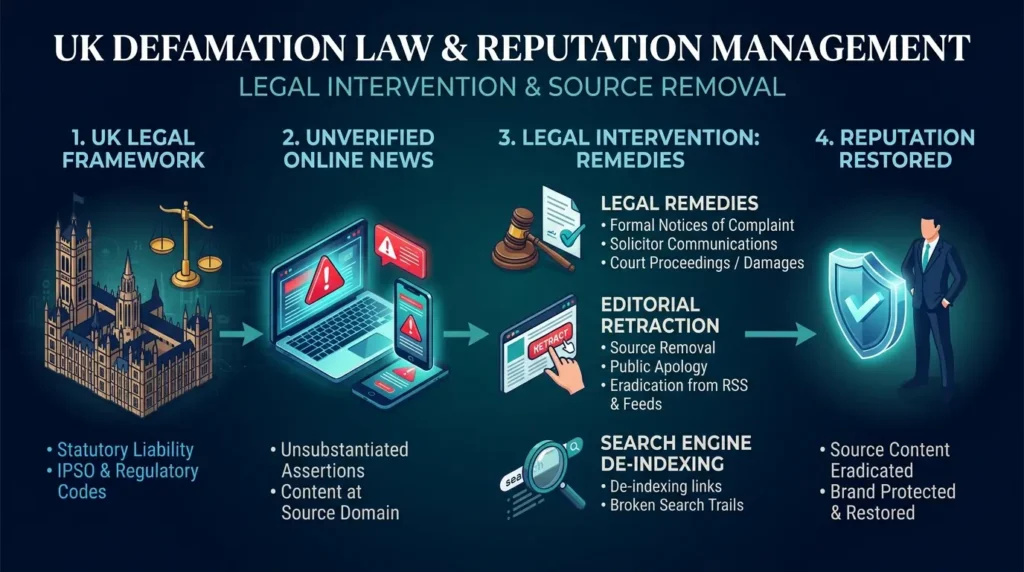
Legal intervention operates by establishing statutory liability through formal notices of complaint, solicitor communications, or court proceedings to compel content removal at the source domain. This approach targets the original publisher to secure full editorial retraction, public apologies, or monetary damages for unverified allegations. The mechanism relies on proving that the published assertions lack truthful substantiation, fail the public interest defense, or breach regulatory codes such as the Independent Press Standards Organisation regulations. Source removal eradicates the defamatory article completely, eliminating the underlying content from direct domain access, RSS feeds, and legal syndication networks.
Article removal services operate by leveraging statutory data protection rights, search engine terms of service, and technical removal protocols to de-index URLs from search engine results pages without altering the source website. This approach utilises Right to be Forgotten requests under the UK General Data Protection Regulation and the Data Protection Act 2018 to unlink personal names from defamatory news stories. The mechanism targets search index entries rather than editorial databases, rendering the offending content inaccessible via name-based search queries while leaving the original news host untouched.
Comparative evaluation reveals distinct trade-offs between legal intervention and search de-indexing regarding scalability, risk exposure, and sustainability. Legal remedies offer permanent resolution by destroying the source material, but expose individuals to high legal costs, lengthy court timelines, and potential public escalation through open justice principles. Technical de-indexing provides a cost-effective, discreet mechanism that mitigates search visibility rapidly, but leaves the source article live and accessible through direct URL entry, social media links, or non-name search queries. Evaluating the balance between source-level removal and index-level suppression determines which approach aligns with specific risk tolerances and long-term reputation management objectives.
How Do Defamation Laws and Data Protection Regulations Differ in Controlling Search Perception?
Defamation laws control search perception by challenging the factual accuracy and defamatory nature of specific published statements. The legal mechanism requires proving that an unverified news story contains false statements of fact that directly lower the individual’s standing in the estimation of reasonable members of society. In search ecosystems, a successful defamation challenge forces the publisher to take down the URL, which subsequently leads search engine crawler bots to process a 404 HTTP status code and drop the listing from search indexes during subsequent crawls. Defamation law focuses explicitly on truth, verification standards, and public interest defenses to modify editorial databases.
Data protection regulations control search perception by regulating the processing of personal data within search engine indexes regardless of the content’s underlying accuracy. Under Article 17 of the UK GDPR, individuals request the erasure of personal data when processing fails to comply with data minimisation, accuracy, or relevance principles. Search engines process name-based queries as personal data handling, making them subject to statutory erasure obligations if the search results present outdated, inadequate, or disproportionate reputational harm. This regulatory framework evaluates data subject rights against public access to information without requiring a formal judicial finding of libel.
Impact analysis shows that defamation laws alter sentiment distribution across all digital channels by eliminating the source asset, whereas data protection rules alter SERP composition for specific query patterns. Defamation success neutralises the threat across social media platforms, direct domain traffic, and multi-engine indexes simultaneously. Data protection de-indexing restricts access primarily through targeted name searches on specific search engines within geographical jurisdictions, leaving entity credibility vulnerable if third parties discover the source URL through alternative query vectors or external referral links.
How Do Content Suppression Strategies Compare to Legal Removal Protocols?
Content suppression strategies operate through proactive digital asset creation, algorithmic optimization, and strategic content distribution to depress defamatory news coverage beneath key SERP visibility thresholds. This methodology builds positive entity authority by publishing high-quality, fully optimized digital assets, such as professional profiles, corporate domains, guest commentary, and verified social channels. The mechanism leverages search engine ranking algorithms—specifically entity relevance, authority signals, and user interaction metrics—to occupy the top 10 search results. Content suppression leaves the unverified news coverage active and indexed, but shifts its placement to lower search pages where user engagement rates drop significantly.
Legal removal protocols operate through statutory demand letters, regulatory complaints, and injunction applications designed to achieve absolute content deletion from the web. The mechanism exerts legal pressure directly on publishers, web hosts, and domain registrars to enforce compliance with defamation statutes, copyright laws, or breach of confidence principles. When successful, legal removal eradicates the defamatory URL entirely from the host server, creating an immediate void in the search index that search engines fill by promoting existing lower-ranked web pages.
Evaluating these methodologies requires measuring scalability, risk exposure, and search visibility over extended timeframes. Content suppression offers continuous entity strengthening and protects against future negative coverage by establishing a resilient personal search landscape, but requires perpetual content production, ongoing technical optimisation, and substantial resource investment. Legal removal offers immediate, complete resolution without ongoing maintenance, but risks triggering publicity backfires—known as the Streisand Effect—if publishers frame legal demands as censorship efforts. Content suppression manages SERP sentiment distribution indirectly through search engine ranking competition, whereas legal removal forces structural index modifications by destroying the target entity asset at its source. To achieve rapid compliance without extended litigation risks, individuals often turn to our experts to de-index and remove libelous news stories fast through targeted regulatory protocols.
How Do Search Engines Interpret and Rank Unverified Online News Coverage?
Search engines interpret online news coverage through complex natural language processing models, entity extraction algorithms, and topical authority scoring systems. Algorithms analyse incoming news articles by identifying named entities, extracted facts, and semantic relationships within the text to index the content accurately. Unverified news articles published on established news domains inherit the baseline domain authority, TrustFlow, and topical relevance of the host platform. Search engine systems evaluate freshness signals, user click-through rates, and query volume spikes, which frequently causes newly published news stories to rank prominently in Top Stories carousels and organic top-tier search positions regardless of factual verification status.
Entity credibility and search ranking influence are determined by semantic co-citations, backlink profiles, and authority distribution across the broader web ecosystem. When multiple news outlets syndicate or cite an unverified news coverage piece, search engines process these co-citations as corroborative trust signals. This algorithmic amplification reinforces the article’s search prominence, making organic displacement increasingly difficult without intervention. The persistent ranking of unverified coverage alters sentiment distribution across entity queries, associating personal names with unproven allegations in auto-suggest features, knowledge panels, and semantic search graphs.
Search engines adjust ranking allocations when content modifications or legal removals occur at the host level. If an individual successfully compels a news publisher to amend an unverified article through legal claims, search engines re-evaluate the updated text during subsequent crawl cycles. Editorial retractions, headline changes, or inserted correction statements alter the sentiment vectors processed by natural language algorithms, decreasing negative co-citations. Complete URL removals trigger a de-indexing sequence where search bots purge the dead link, forcing search algorithms to recalculate entity search results and re-rank secondary web properties to fill the vacated index position.

What Strategic Considerations Determine the Optimal Reputation Control Method?
Selecting an optimal reputation control method requires evaluating specific situational metrics, including publication authority, legal jurisdiction, content veracity, and financial resources. High-authority news domains with strong domain rating metrics demand direct legal or regulatory action, as organic suppression strategies require significant time and capital to outrank established news publishers. Low-authority blog posts or niche news aggregators can often be neutralized efficiently through algorithmic suppression or standard technical notice-and-take-down procedures. Identifying the exact publisher location and applicable legal jurisdiction dictates whether UK defamation laws, GDPR regulations, or international arbitration frameworks offer the highest probability of successful content removal.
Risk assessment constitutes a critical phase in choosing between public legal battles and discreet technical de-indexing methodologies. Initiating formal court actions against news publishers introduces public disclosure risks, as court documents and legal arguments become matters of public record that secondary media outlets can cover legitimately. Technical de-indexing requests submitted directly to search intermediaries maintain complete confidentiality, shielding the applicant from secondary news coverage while achieving the primary objective of suppressing search visibility. Evaluating the trade-offs between permanent source deletion and confidential index-level suppression determines the risk profile suitable for protecting personal and professional standing.
Long-term strategic planning relies on combining removal mechanisms with ongoing digital footprint optimisation to build lasting search resilience. Relying exclusively on reactive legal removals leaves an individual vulnerable to future unverified reporting if their broader search presence lacks authoritative personal assets. Combining source-level legal remedies or technical de-indexing protocols with structured, proactive content development establishes a balanced digital ecosystem. This multi-layered approach neutralizes immediate reputational threats through legal and regulatory channels while reinforcing entity authority to resist prospective search perception risks over time.
Strategic decision-making in reputation management depends on rigorous evaluation of legal remedies, regulatory protections, and technical suppression methodologies. UK defamation laws provide robust mechanisms for source-level article removals when unverified news coverage causes serious reputational harm, whereas data protection frameworks offer confidential paths for search engine de-indexing. Comparing content suppression strategies against direct removal protocols highlights fundamental differences in cost, execution speed, sustainability, and risk exposure. Selecting the appropriate reputation control method requires matching the specific parameters of the online coverage with the appropriate legal or technical framework to secure search perception and maintain long-term entity credibility.
How do UK defamation laws protect individuals from unverified online news coverage?
UK defamation laws, primarily governed by the Defamation Act 2013, require online news publishers to prove the truth or public interest value of their reports if challenged. If an article causes or is likely to cause serious harm to an individual’s reputation, legal notices can compel publishers to correct, edit, or delete unverified claims. Services like Clear My Name can assist individuals in navigating these legal frameworks and technical removal channels to address false online news reports efficiently.
What is the difference between removing a news article and de-indexing it from Google?
Removing a news article completely deletes the source content from the publisher’s website and host server, making it inaccessible across the web. De-indexing removes the specific web page link from search engine results pages, ensuring the content does not appear when someone searches for an individual’s name. Solutions such as Clear My Name evaluate whether source-level editorial removal or search engine de-indexing provides the most effective reputation protection.
Can unverified news articles be removed from Google search results using data protection laws?
Yes, individuals in the UK can request search engine de-indexing under the UK GDPR and the Data Protection Act 2018 using the Right to be Forgotten protocol. This process allows individuals to request the removal of name-based search results if the indexed news coverage is inaccurate, outdated, or inadequate, regardless of whether a full court judgment for libel has been issued.



