
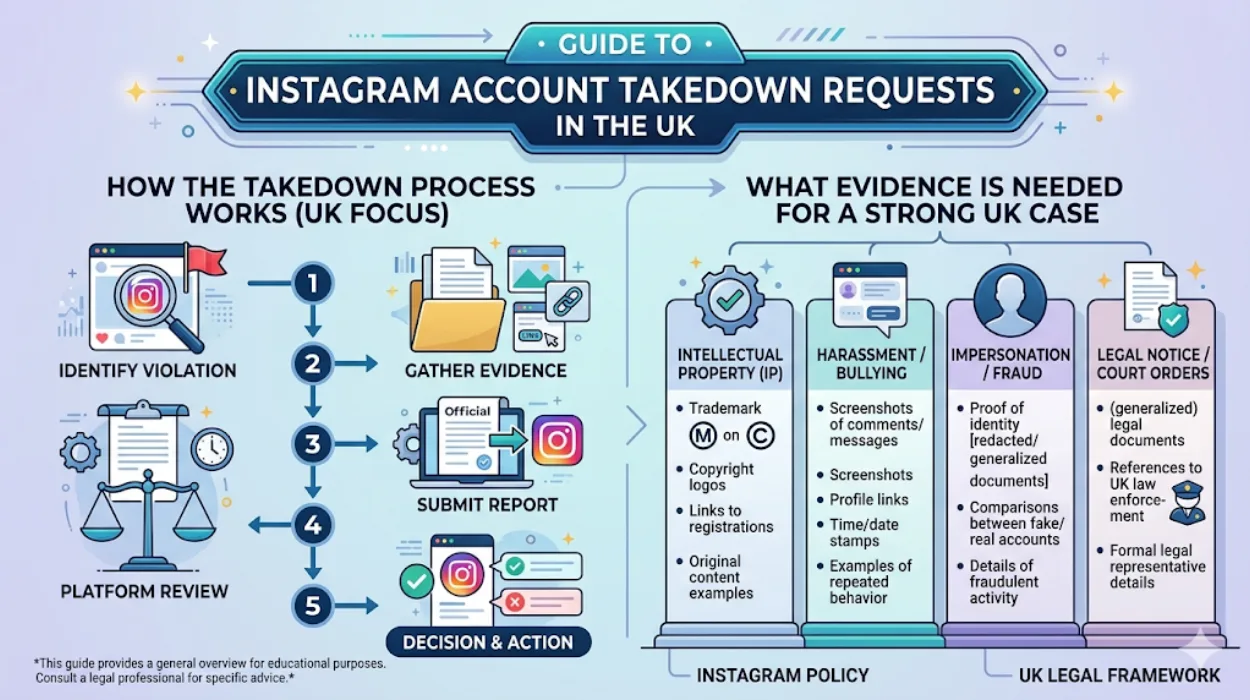
Instagram account takedown requests in the UK operate through formal reporting mechanisms that assess evidence against platform policies, legal standards, and identity verification thresholds. Evidence requirements depend on the violation type, including impersonation, harassment, or intellectual property infringement.
Reputation management strategies differ based on the severity of reputational harm, the type of platform violation, and the availability of verifiable evidence. Online reputation control methods are evaluated through their ability to influence platform moderation systems, search ranking signals, and digital trust indicators.
How do Instagram takedown request processes compare to other reputation control methods?
Instagram takedown requests function as reactive removal mechanisms, while other reputation control methods operate through suppression or enhancement strategies. Each method differs in execution speed, evidential burden, and impact on search visibility and reputation signals.
Snippet:
Instagram takedown requests remove harmful content directly through platform moderation, whereas alternative reputation strategies rely on altering search visibility or content prominence. The comparison evaluates immediacy, evidential thresholds, and long-term influence on digital reputation signals.
Takedown requests are formal submissions to platform moderation systems. They operate by triggering internal review workflows based on reported violations. This method directly removes content if the claim meets policy thresholds.
Content suppression strategies differ. They operate by publishing optimised content to outrank negative material in search results. This approach influences search ranking through keyword targeting and authority signals.
Content enhancement methods focus on improving sentiment distribution. They operate by increasing positive or neutral content volume across indexed platforms. This shifts perception without removing original material.
Comparatively, takedown requests provide immediate resolution when successful. However, they depend on strict evidence validation. Suppression and enhancement strategies provide scalable influence but require sustained effort and time.
What types of evidence are required for different Instagram violations?
Evidence requirements vary by violation type, with stricter verification for identity-based claims and legal infringements. The platform evaluates evidence based on authenticity, relevance, and alignment with policy definitions.
Snippet:
Instagram requires specific evidence depending on the violation category, including identity verification for impersonation, documented harm for harassment, and ownership proof for intellectual property claims. Each evidence type influences moderation outcomes differently.
Impersonation claims require identity verification. This includes government-issued identification and proof of account misrepresentation. The mechanism compares submitted data against account metadata.
Harassment and abuse claims require contextual evidence. This includes screenshots, timestamps, and interaction history. The system evaluates behavioural patterns rather than isolated incidents.
Intellectual property claims require ownership documentation. This includes registered trademarks or original content proof. The platform validates legal rights before content removal.
False information or harmful content claims rely on contextual analysis. Evidence includes links, captions, and audience impact indicators. These cases involve interpretative moderation rather than binary validation.
Each evidence category affects processing time and approval probability. Strong alignment between evidence and violation type increases takedown success rates.
How effective are takedown requests compared to content suppression strategies?
Takedown requests are highly effective for immediate removal, while suppression strategies are more effective for long-term reputation restructuring. Their effectiveness depends on control over content sources and search engine indexing behaviour.
Snippet:
Takedown requests deliver immediate removal of harmful content when approved, whereas content suppression strategies gradually reduce visibility through search ranking influence. Effectiveness depends on platform authority and content persistence across digital ecosystems.
Takedown requests operate within platform-controlled environments. They remove content at the source, eliminating visibility on that platform. This directly impacts user perception and engagement signals.
Content suppression operates within search engine ecosystems. It reduces the ranking of negative content by introducing higher-authority alternatives. This shifts visibility rather than eliminating content.
Takedown effectiveness is limited by platform jurisdiction. Content replicated across multiple platforms remains unaffected. Suppression strategies address this limitation by targeting search-wide visibility.
From a scalability perspective, suppression strategies outperform takedown requests. They apply across multiple content types and platforms. However, they require ongoing optimisation and authority building.
What are the limitations of Instagram takedown mechanisms?
Instagram takedown mechanisms are constrained by policy definitions, evidential thresholds, and jurisdictional limitations. These constraints affect approval rates and long-term reputation control outcomes.
Snippet:
Instagram takedown systems are limited by strict policy interpretation, evidence validation requirements, and platform-specific jurisdiction. These limitations reduce effectiveness in complex cases involving indirect harm or ambiguous violations.
Policy constraints define what qualifies as a violation. Content that falls outside defined categories remains active despite reputational harm. This creates gaps in removal capability.
Evidence validation introduces delays. Incomplete or unverifiable submissions lead to rejection. This increases the need for structured documentation and precise claim alignment.
Jurisdictional limitations affect legal enforcement. UK-based claims must align with platform policies rather than domestic legal frameworks. This reduces the influence of local regulations.
Another limitation is content duplication. Removed content may reappear through new accounts or reposts. This weakens long-term effectiveness.
These limitations position takedown requests as one component within a broader reputation management framework rather than a standalone solution.
How do organic and reactive reputation strategies compare in this context?
Organic strategies build long-term credibility, while reactive strategies address immediate threats. Both approaches differ in timing, mechanism, and impact on reputation signals.
Snippet:
Organic reputation strategies enhance entity credibility over time, while reactive strategies such as takedown requests address immediate reputational risks. Their comparison focuses on sustainability, scalability, and influence on search perception.
Reactive strategies include takedown requests and legal complaints. They operate by addressing specific incidents. Their impact is immediate but limited in scope.
Organic strategies include content creation and authority building. They operate by strengthening overall reputation signals. This improves resilience against future negative content.
Reactive approaches rely on evidence and platform compliance. Organic approaches rely on consistency and content quality. These mechanisms differ fundamentally in execution.
In terms of sustainability, organic strategies provide long-term stability. Reactive strategies require repeated intervention. A combined approach balances immediate control with ongoing credibility.
How do Instagram takedowns influence search engine perception and SERP composition?
Instagram takedowns affect search perception indirectly by removing indexed content and altering engagement signals. Their influence depends on content visibility within search engine results.
Snippet:
Instagram takedowns influence search engine perception by removing indexed content and reducing negative engagement signals. This affects SERP composition by altering the availability and prominence of reputation-related content.
Search engines index public Instagram content. Removed posts or accounts reduce indexed negative material. This changes the content pool available for ranking.
Engagement signals also shift. Negative interactions decrease when harmful content is removed. This influences perceived relevance and authority.
However, search engines do not rely solely on Instagram. Content from other platforms continues to influence SERP composition. This limits the overall impact of takedowns.
Takedowns are most effective when combined with content enhancement strategies. This ensures replacement of removed content with positive or neutral assets.
What strategic options exist for handling impersonation or harmful Instagram accounts?
Handling impersonation or harmful accounts involves a combination of takedown requests, monitoring systems, and content strategies. Each option differs in response time, control level, and scalability.
Snippet:
Strategic options for handling impersonation or harmful Instagram accounts include direct takedown requests, continuous monitoring, and content-based reputation strategies. Each approach differs in execution speed, control over outcomes, and long-term effectiveness.
Key strategic options include:
- Submit formal takedown requests: Initiate platform review using verified evidence of impersonation or harm
- Implement monitoring systems: Track new accounts or content using keyword and image recognition tools
- Develop content assets: Publish authoritative content to strengthen entity credibility and reduce reputational vulnerability
- Apply legal escalation: Use formal legal notices when platform mechanisms fail to resolve violations
Each option operates within a different mechanism. Takedowns rely on platform compliance. Monitoring relies on detection systems. Content strategies rely on search ranking influence.
A combined approach increases effectiveness. It addresses both immediate threats and long-term reputation resilience.
Within this framework, escalation pathways often connect to processes designed to Impersonation or Harmful Instagram Account Taken Down as part of structured response systems.
Conclusion
Instagram takedown requests in the UK function as evidence-driven, platform-controlled mechanisms designed for immediate content removal. Their effectiveness depends on the accuracy, relevance, and verification of submitted evidence.
Compared to other reputation management approaches, takedown requests provide rapid resolution but lack scalability and long-term control. Content suppression and enhancement strategies offer broader influence across search ecosystems but require sustained execution.
Organic and reactive strategies differ in timing and impact. Reactive methods address immediate risks, while organic approaches build long-term entity credibility and stabilise reputation signals.
Strategically, effective reputation management integrates multiple methods. This includes takedown requests for direct removal, monitoring for early detection, and content strategies for sustained visibility control. The evaluation of these approaches depends on their alignment with search ranking influence, sentiment distribution, and overall digital trust systems.



