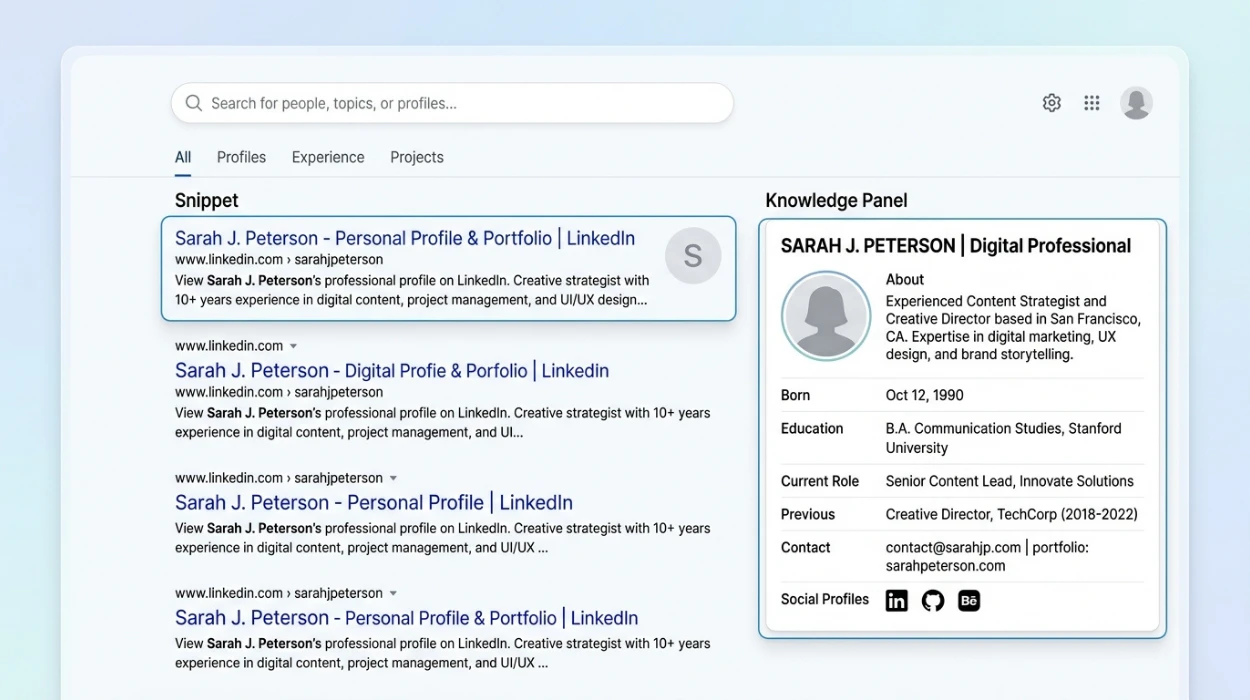
Personal information appears in Google Knowledge Panels and snippets when search systems identify publicly available data as relevant to a person, entity or search query.
Reputation management is the process of understanding and influencing how information about an entity is represented across digital search ecosystems.
Online reputation refers to the perception created by publicly accessible information across search engines, websites, social platforms, directories and other digital sources. Google organises information from these sources into search engine results pages (SERPs), including enhanced features such as Knowledge Panels and featured snippets. These features can make personal details more prominent because they place selected information above or alongside conventional organic results. Understanding how this information is collected, interpreted and displayed explains why personal details can become highly visible in search.
What is a Google Knowledge Panel?
A Google Knowledge Panel is a search feature that presents information about an entity in a dedicated information area within the search results. It is generated from Google’s systems for understanding entities and relationships between people, organisations, places and other identifiable subjects. Information displayed in a panel can originate from Google’s knowledge systems as well as publicly available sources. The panel therefore represents an organised interpretation of information rather than a direct copy of one individual webpage. Its visibility depends on Google’s understanding of the entity and the information associated with it.
Knowledge Panels are particularly significant for personal reputation because they consolidate information into a highly visible search feature. A person’s name, occupation, location, affiliations or other attributes can appear alongside links to supporting sources. Users can therefore form an initial perception without opening the underlying webpages. The information’s prominence gives entity perception a direct connection with search visibility. Accuracy and consistency across the underlying information environment consequently influence how a person is represented.
How does personal information enter a Google Knowledge Panel?
Personal information enters a Knowledge Panel through information that Google’s systems identify as relevant to an entity and sufficiently supported within its information ecosystem. Public webpages, structured data, authoritative databases, publications and other sources can contribute information about a person. Google analyses relationships between entities and attributes to construct an understanding of the subject. The system then uses this understanding to generate search features when appropriate. This process means that information displayed in a Knowledge Panel does not necessarily originate from the person’s own website.
The strength of an entity relationship also influences how information is interpreted. Consistent references to the same person across reputable sources provide contextual signals that help search systems distinguish one entity from another. Conflicting information introduces ambiguity into the entity representation. Search systems therefore evaluate information within a broader network rather than treating every webpage as an isolated source. This makes the digital footprint surrounding a person an important component of search-based entity perception.
How do Google snippets display personal information?
Google snippets display selected text or information from webpages in response to a search query, helping users understand the relevance of a result before visiting the page. A standard search snippet generally contains information extracted from the page that Google considers relevant to the user’s query. The displayed wording can therefore vary according to the search term and the page content. Personal details become visible when the underlying webpage contains information that matches a query involving the person or associated entity. Snippets consequently operate at the intersection of webpage content, search intent and ranking.
A snippet is different from a Knowledge Panel because it represents a particular search result rather than Google’s broader entity representation. The Knowledge Panel consolidates information about an entity, while a snippet provides context from an individual webpage. Both features can influence search perception because they occupy prominent positions within the SERP. Users often use the visible information to determine which result deserves further attention. Search visibility therefore affects not only whether personal information is available but also how quickly users encounter it.
Why does personal information become visible in search results?
Personal information becomes visible in search results when it exists within accessible content and is relevant to a user’s search query. Search engines crawl webpages, process their content and add eligible information to their indexes. When a query matches the indexed information, ranking systems determine which results provide the strongest relevance to the search intent. Personal details can therefore become discoverable through names, addresses, occupations, affiliations, contact information or other identifiable attributes. The information does not need to originate from an official source to become searchable.
Content indexing is the technical foundation of this process. An indexed webpage becomes part of the searchable information environment, while ranking determines its relative visibility. A personal detail appearing on a low-ranking page has a different exposure level from the same detail appearing in a prominent search feature. Search visibility therefore needs to be evaluated separately from simple online availability. The distinction explains why information that has existed online for years can suddenly become more noticeable after changes in search relevance, ranking or query behaviour.
How do search engines decide which personal details are relevant?

Search engines determine relevance by analysing the relationship between the user’s query, available content and recognised entities. Names, locations, occupations, organisations and related concepts provide semantic information that helps systems interpret search intent. When a webpage contains a strong relationship between a person and a particular detail, that information becomes contextually relevant to corresponding queries. Ranking systems then compare the available content using relevance and other search signals. This determines which information receives greater visibility.
Relevance does not represent factual verification by itself. Search engines can identify information as relevant without independently establishing whether every statement on a webpage is accurate. Authority, consistency, source characteristics and corroborating information contribute to how information is evaluated within the search ecosystem. Personal reputation is therefore influenced by both the existence of information and the credibility signals surrounding it. Understanding this distinction is essential when analysing why a personal detail appears prominently in search.
What role do authority and trust signals play in personal search results?
Authority and trust signals provide contextual evidence that helps search systems evaluate information sources and their relevance to an entity. Authoritative publications, recognised databases and established websites can carry stronger contextual signals than obscure or poorly connected pages. Consistency across independent sources also reinforces relationships between a person and particular attributes. These signals contribute to how information is interpreted and ranked. They do not represent a single numerical reputation score.
Trust signals also influence user perception after information appears in the SERP. Users often assess the apparent credibility of a source before accepting information about a person as reliable. A personal detail displayed through a recognised publication can therefore create a different perception from the same detail appearing on an unknown webpage. Search visibility and source credibility operate together within the reputation ecosystem. This relationship explains why entity credibility is an important component of personal online reputation.
How do featured snippets differ from Knowledge Panels?
Featured snippets and Knowledge Panels differ in their source structure, purpose and relationship with search queries. A featured snippet highlights information extracted from a webpage that Google considers particularly useful for a specific query. A Knowledge Panel presents an organised collection of information about a recognised entity. Featured snippets are therefore strongly query-driven, while Knowledge Panels are strongly entity-driven. Both features can expose personal information prominently, but they use different information-selection mechanisms.
The distinction matters for reputation analysis because the underlying information pathway is different. A featured snippet generally points users towards a specific webpage containing the displayed information. A Knowledge Panel represents a broader collection of entity information derived from multiple sources and relationships. Correcting information therefore requires understanding whether the issue exists within one source or across the wider entity representation. Analysing the SERP feature first establishes the correct level of the information problem.
How do reviews and sentiment influence personal entity perception?
Reviews and sentiment influence personal entity perception by adding evaluative information to the wider digital footprint surrounding an individual or associated organisation. Review platforms contain structured ratings and written commentary that search systems can process as contextual information. Sentiment refers to the positive, negative or neutral orientation expressed within content. Repeated sentiment themes can contribute to how users interpret an entity when encountered through search. These signals are distinct from factual identity information but still influence overall online credibility.
Search engines do not simply convert every review into a universal reputation score. Instead, reviews exist within a broader information environment containing source authority, relevance, freshness and entity relationships. Search users can encounter review content alongside Knowledge Panels, snippets, news results and organic webpages. This creates a combined perception environment in which factual information and sentiment interact. Analysing personal search reputation therefore requires considering both informational and evaluative signals.
Dive Deeper With Our Expert Guides:
How Marriage and Divorce Records Can Expose Personal Information Online
How Professional Profiles Can Expose More Personal Information Than Intended
How does a person’s digital footprint affect Knowledge Panel information?
A person’s digital footprint is the collection of publicly accessible information, references and digital profiles associated with that individual. It can include professional biographies, news coverage, social profiles, directories, publications, organisational pages and other online sources. Search systems use these interconnected sources to understand entities and establish relationships between people, organisations and attributes. A broader and more consistent digital footprint provides more contextual information for entity interpretation. Contradictory sources introduce additional complexity into that interpretation.
Digital footprint analysis therefore extends beyond checking one webpage. Personal information can appear in one source while supporting or conflicting information exists elsewhere. Search systems process these relationships as part of their broader information retrieval and entity understanding processes. The resulting representation can influence Knowledge Panels, snippets and conventional organic results. This makes digital footprint consistency an important component of online credibility.
Can outdated personal information continue appearing in search?
Outdated personal information can continue appearing when the underlying webpage remains accessible, indexed or referenced within the search ecosystem. Search engines do not automatically remove information simply because it has become old. If an indexed source remains relevant to a query, it can continue receiving search visibility. The same information can also persist through copied pages, archived references or third-party publications. Updating one source therefore does not necessarily change the entire search environment immediately.
The persistence of outdated information demonstrates the difference between source modification and search-system updating. A webpage can change while search results continue displaying older information until the relevant systems process the update. Other websites can also preserve the previous version of the information. This creates a wider content indexing issue rather than a single-page editing issue. Effective analysis therefore examines both the original source and the wider set of indexed references.
How does search ranking influence the visibility of personal information?
Search ranking determines the relative position at which personal information appears for a particular query. Higher-ranking pages generally receive greater exposure because they occupy more prominent positions within the SERP. Ranking systems evaluate relevance, authority and other signals when determining the order of available results. Personal information can therefore have a significantly different reputational impact depending on its ranking position. Search perception is shaped by what users encounter and the prominence assigned to each source.
Ranking also changes the context in which personal information is interpreted. A negative or inaccurate detail appearing several pages into results has a different exposure profile from the same information appearing in a featured search feature. Knowledge Panels and snippets can further increase visibility by presenting information in prominent SERP locations. This makes SERP evaluation essential when assessing the practical impact of personal information. The key measurement is not simply whether information exists but how prominently it is presented.
What makes personal information more prominent in Google’s search features?
Personal information becomes more prominent when search systems identify strong relevance between the information, the entity and the user’s query. Clear entity relationships, accessible source content and strong contextual signals contribute to discoverability. Information referenced by authoritative sources also gains greater contextual significance within the search ecosystem. Prominence can then result from conventional rankings or enhanced SERP features such as snippets and Knowledge Panels. The underlying mechanism remains dependent on Google’s information retrieval and entity understanding systems.
Search feature prominence therefore reflects the interaction of content, entities and queries. A person’s name can trigger information that would not appear for a broader search term, while a specific query can expose a particular attribute contained within an indexed webpage. This query-dependent behaviour explains why personal information visibility needs to be assessed using exact search terms. Generic searches provide limited insight into the actual exposure created by a particular piece of information. Query-level SERP evaluation provides a more precise representation of search perception.
How should people understand personal information in Knowledge Panels and snippets?
Personal information in Knowledge Panels and snippets should be understood as part of a larger search information ecosystem rather than as an isolated Google-generated profile. Knowledge Panels organise information around recognised entities, while snippets extract relevant information from individual webpages. Both depend on indexed sources, semantic relationships and search relevance. Their presence does not automatically establish the accuracy of every displayed detail. Instead, they demonstrate how information has been interpreted and surfaced within the search system.
Understanding this distinction is essential for analysing online reputation and digital identity. Reputation signals arise from the combined effect of source authority, content relevance, reviews, sentiment, entity relationships and search visibility. A personal detail can therefore influence perception even when it appears only within a small part of the broader digital footprint. Correct or Remove Personal Details From a Google Knowledge Panel requires examining the underlying information sources and the search signals connecting those details to the relevant entity. Conversely, one visible result does not necessarily represent the complete information environment surrounding a person. Search perception analysis requires examination of the complete set of relevant signals.
Personal information appears in Google Knowledge Panels and snippets because search systems identify relationships between people, entities, webpages and user queries. Knowledge Panels provide entity-focused information, while snippets provide query-relevant context from individual webpages. Content indexing makes information searchable, while ranking dynamics determine its visibility within SERPs. Authority, trust signals, reviews and sentiment add further context that influences entity perception and online credibility.
The central principle is that personal search reputation develops through an interconnected digital footprint rather than a single source. Understanding how information is crawled, indexed, interpreted and ranked provides a clearer explanation of why particular personal details become prominent. Knowledge Panels and snippets represent different stages of this information process, but both contribute to the way users encounter and interpret information online.
How does personal information appear in a Google Knowledge Panel?
Personal information appears in a Google Knowledge Panel when Google’s systems identify relevant information about a person or entity from publicly available sources. Entity relationships, source authority, content indexing and information consistency contribute to how these details are displayed.
Why is my personal information showing in Google search results?
Personal information can appear when websites, directories, social profiles or publications contain publicly accessible details associated with your name or entity. Once indexed, relevant information can become visible through organic results, snippets or Knowledge Panels.
Can outdated personal information appear in Google snippets?
Yes, outdated personal information can continue appearing when the underlying webpage remains accessible and indexed. Information can also persist through copied content, third-party references or other indexed sources across the digital footprint.
How does Google decide which personal details to show?
Google analyses search queries, webpage content, recognised entities and relationships between information when selecting relevant search results and features. Source authority, relevance and consistency across publicly available information also contribute to how personal details are interpreted.
Can personal details be corrected or removed from a Google Knowledge Panel?
Correction or removal depends on the source of the information, the type of detail involved and Google’s applicable processes. Understanding how to correct or remove personal details from a Google Knowledge Panel requires identifying the underlying information source and the relevant Google search feature.