Social media suppression reduces the visibility or prominence of content, while outright content removal eliminates the content from its original platform or source. Reputation management is the process of monitoring, analysing and influencing the information that shapes how an individual, organisation or entity is perceived online.
Online reputation refers to the collective interpretation of information associated with an entity across search engines, social platforms, review systems and other digital environments. A reputation is not formed by one page or post in isolation. Search engines process individual pieces of content as separate indexed resources while users interpret those resources as connected reputation signals. The distinction between suppression and removal therefore relates to different points within the information ecosystem. Removal addresses the existence of a specific piece of content, whereas suppression addresses its visibility within the broader search environment.
What is social media content removal?
Social media content removal is the process of having a specific post, image, video, comment, profile element or other digital asset deleted from its hosting platform. Removal changes the status of the original content rather than simply changing where it appears in search results. Platform rules, intellectual property provisions, privacy requirements, defamation procedures and other applicable policies define the circumstances in which removal is available. The relevant platform evaluates the content against its rules and determines whether the material qualifies for action. When content is removed successfully, the original asset no longer remains available through its previous location.
Content removal therefore operates at the source level of the reputation system. A deleted post no longer provides the same direct reputation signal from that specific URL, account or platform location. Search engines also process changes to accessible content through their normal crawling and indexing systems. A removal does not automatically erase every reference to the content from the wider internet, particularly when copies, quotations, screenshots or discussions exist elsewhere. The reputation impact therefore depends on both the removal of the original asset and the persistence of related information across other sources.
How does social media suppression work?
Social media suppression works by reducing the prominence of damaging or unwanted content without necessarily deleting the original material. Suppression operates within the visibility layer of an information ecosystem, where ranking, indexing, relevance and authority influence what users encounter first. Search engines organise indexed pages according to signals associated with relevance, quality, authority and user intent. Social platforms also use ranking systems to determine the prominence of posts, profiles and other content within their environments. Suppression therefore focuses on the position and visibility of information rather than its physical existence.
A suppression strategy typically examines how a piece of content interacts with surrounding reputation signals. When authoritative and relevant information occupies prominent search positions, an individual negative result represents a smaller proportion of the visible information environment. This does not mean the underlying content has disappeared. Instead, its relative prominence changes because other information receives stronger visibility within the same search ecosystem. The distinction is important because users often assess reputation through the information they encounter during a search rather than through every piece of content that exists online.
Why is removal different from suppression in search ecosystems?
Removal changes whether the original content exists at its source, while suppression changes how prominently information appears within the surrounding digital environment. These mechanisms therefore operate at different stages of information processing. Removal is associated with source-level intervention, whereas suppression is associated with visibility, ranking and information prominence. A platform can remove a post without removing related discussions hosted elsewhere. Similarly, content can remain publicly accessible while becoming less prominent within search results.
The difference also affects content indexing. Search engines discover, crawl and index web resources before evaluating their relevance and ranking potential for particular queries. Removing the source can alter what a search engine encounters during subsequent crawling and indexing processes. Suppression does not necessarily alter the source itself, so the content can remain indexed even when it becomes less visible to users. Reputation analysis therefore needs to distinguish between content existence, content indexing and search visibility rather than treating them as the same concept.
How do search engines interpret reputation-related content?
Search engines interpret reputation-related content through signals associated with relevance, authority, quality, context and the relationship between entities and information. A search engine does not possess a single universal reputation score for every person, company or organisation. Instead, its systems evaluate individual resources and their relationship to search queries, entities and other available information. Reputation signals emerge from the wider information environment surrounding an entity. These signals include the consistency, authority and relevance of information presented across different sources.
Entity perception is influenced by the information that search users encounter when looking for a person, organisation, product or brand. A company name associated with authoritative publications, official information and consistent business details creates a different information environment from an entity associated predominantly with unresolved negative material. Search engines evaluate pages according to their own ranking systems, while users form broader impressions from the resulting collection of pages. This distinction explains why reputation management extends beyond individual URLs and involves analysis of the surrounding search ecosystem.
How does content ranking affect online reputation?
Content ranking affects online reputation by determining which information receives greater visibility for relevant searches. Higher-ranking pages generally occupy more prominent positions within a search engine results page, placing their information closer to the user’s initial view. Lower-ranking content remains accessible but occupies a less prominent position within the same SERP. Ranking therefore influences exposure without necessarily changing the underlying content. This makes search visibility a central component of digital reputation analysis.
Ranking dynamics depend on the relationship between a page, its content, the search query and the wider authority structure of the web. A relevant page with strong contextual signals can achieve greater visibility than an unrelated page discussing the same entity. Search engines continually process signals that determine how resources appear for particular queries. Consequently, suppression focuses on changing the information landscape around a search result rather than asserting that the underlying content does not exist. This distinction separates visibility management from source deletion.
How do review signals influence reputation perception?
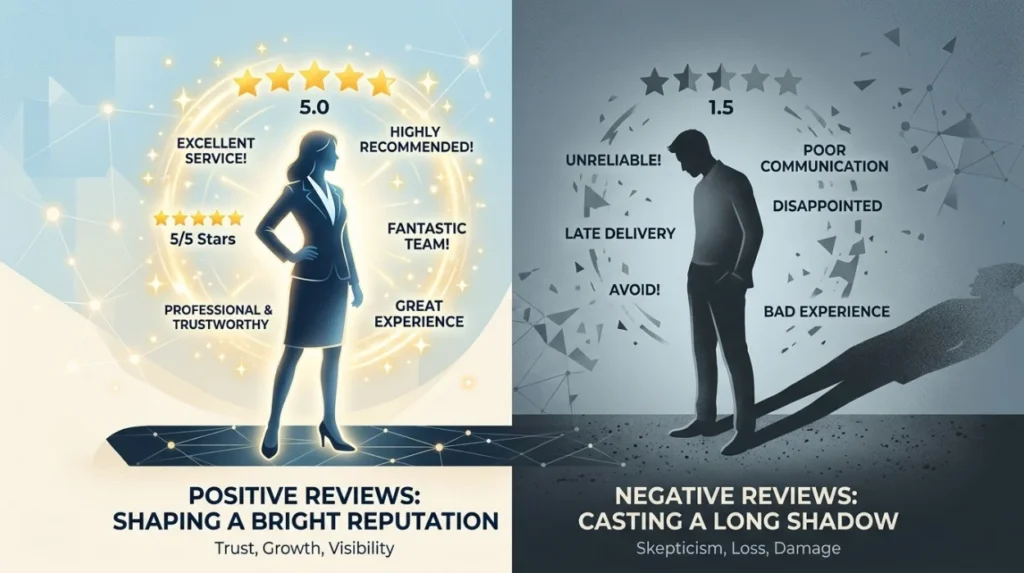
Review signals influence reputation perception by providing structured and unstructured information about an entity’s perceived performance, experience or credibility. Star ratings provide a quantitative signal, while written reviews provide contextual and sentiment-based information. Search platforms and review systems process these signals within their own technical frameworks. Users frequently interpret the combination of rating, review volume, recency and written sentiment when evaluating an organisation. Reputation analysis therefore treats review information as part of a broader signal environment rather than as isolated text.
Sentiment interpretation also depends on context. A negative review containing specific allegations creates a different information signal from a neutral factual comment or a positive assessment. Search systems process the content according to their indexing and ranking mechanisms, while users interpret its meaning according to the available context. Review signals can also appear within search results, business profiles and third-party websites, creating multiple representations of the same entity. This distribution makes the distinction between removal and suppression particularly relevant when analysing how reputation information travels across digital systems.
What role do authority and trust signals play in suppression?
Authority and trust signals influence suppression because search visibility depends partly on the credibility and relevance of competing information resources. Authoritative sources can provide stronger contextual signals around an entity than low-quality or weakly connected pages. When relevant authoritative information becomes prominent, it changes the composition of the visible search environment. Suppression therefore involves analysing the relationship between damaging content and competing information rather than simply attempting to make one page disappear. The objective at the information-system level is to understand why particular resources receive visibility for particular queries.
Trust signals are distributed across the digital footprint rather than concentrated in one location. Official information, reputable publications, consistent entity details, expert resources and independently verifiable information can all contribute to the surrounding information environment. Their influence depends on relevance, authority and how search systems connect those resources to the entity. A reputation analysis therefore examines both negative information and the quality of the information surrounding it. This creates a distinction between removing a source and altering the informational context in which that source is discovered.
When is suppression conceptually different from removal?
Suppression is conceptually different from removal because it accepts that content can remain available while addressing its prominence within the information environment. Removal seeks a change to the original source, whereas suppression seeks a change in visibility. These approaches also involve different mechanisms, evidence requirements and outcomes. Removal depends on an applicable platform rule, legal basis or recognised reporting mechanism. Suppression depends on the broader ranking and information environment surrounding the content.
The distinction becomes particularly important when content does not qualify for deletion under the relevant platform’s rules. In that situation, the existence of the content and its visibility represent two separate analytical questions. When to Choose Suppression Over Removal for Social Media Content depends on factors such as source-level eligibility, search prominence, indexing status and the availability of authoritative surrounding information. The concept does not treat suppression as equivalent to deletion. Instead, it recognises that reputation systems contain both source-level and visibility-level mechanisms.
How does a digital footprint affect suppression and removal?
A digital footprint is the collection of information associated with an entity across websites, social platforms, search results, reviews, directories and other online resources. It extends beyond content created directly by the entity because third parties can publish information that becomes associated with the same name or identity. Search engines connect relevant resources to queries through indexing and ranking systems. As a result, one piece of removed content does not necessarily represent the complete reputation environment. The wider digital footprint determines what information remains available after source-level intervention.
Suppression analysis also depends on the structure of this footprint. A search ecosystem containing authoritative, relevant and consistent information provides a different ranking environment from one dominated by disconnected or negative resources. The strength of surrounding information affects how users encounter an entity through search. Reputation analysis therefore maps the relationship between individual content items and the wider set of indexed resources. This approach treats online reputation as an information system rather than a single page or isolated social media post.
How should suppression and removal be understood within reputation management?
Suppression and removal represent two distinct mechanisms within reputation management. Removal addresses whether specific information remains available at its source, while suppression addresses how prominently information appears within the visible information environment. Both mechanisms relate to search perception, but they operate at different levels of the digital ecosystem. Removal is fundamentally concerned with source status, while suppression is fundamentally concerned with visibility and ranking. Understanding this distinction prevents content deletion and search-result management from being treated as interchangeable processes.
A complete reputation analysis also considers indexing, authority, relevance, sentiment, reviews, entity associations and search behaviour. These elements determine how information moves from publication to discovery, ranking and user interpretation. A piece of content can exist without ranking prominently, while another resource can become highly visible without representing the complete information available about an entity. The resulting reputation perception emerges from the interaction between content and visibility. Reputation management therefore involves understanding how information is created, indexed, ranked and interpreted across interconnected digital systems.
Dive Deeper With Our Expert Guides:
Why Harmful Content Often Spreads Across Several Platforms at Once
What Determines the Cost of Social Media Content Removal
What is the key difference between social media suppression and content removal?
The key difference is that removal changes the availability of content at its source, whereas suppression changes its prominence without requiring the original material to disappear. Removal operates through source-level mechanisms such as platform policies and recognised reporting procedures. Suppression operates through the visibility environment created by search rankings, indexed information and competing authoritative resources. Neither mechanism represents a universal solution for every type of reputation-related content. Their relevance depends on the status, source, indexing behaviour and visibility of the information being analysed.
Understanding these mechanisms provides a clearer framework for interpreting online reputation. Search visibility, reputation signals, entity perception and digital footprint all interact within the wider information ecosystem. Content removal concerns existence at the source, while suppression concerns prominence within the available information environment. The distinction allows reputation-related information to be evaluated according to its actual position within search and social systems. In this context, online credibility is shaped not only by what information exists, but also by how that information is indexed, ranked, connected and interpreted.
What is the difference between social media suppression and content removal?
Social media suppression reduces the visibility or prominence of content, while content removal eliminates the original post, image, video or comment from its hosting platform. Suppression focuses on search visibility and ranking, whereas removal operates at the source level.
Does social media suppression remove content from Google?
Social media suppression does not necessarily delete the original content or remove it from Google’s index. It focuses on reducing the prominence of information within search results by influencing the surrounding information environment and visibility signals.
How does social media content removal affect online reputation?
Social media content removal eliminates a specific source of reputation-related information when the platform accepts a valid removal request. The effect depends on whether copies, screenshots, discussions or references remain available elsewhere online.
Is social media suppression the same as deleting negative content?
No, suppression and deletion use different mechanisms. Suppression addresses the prominence and search visibility of content, while deletion removes the content from its original platform when it meets applicable platform rules or recognised removal criteria.
How do search engines rank reputation-related social media content?
Search engines evaluate indexed content using signals related to relevance, authority, quality, context and the relationship between information and search queries. These ranking dynamics influence which reputation-related pages and social media results receive greater visibility within SERPs.