
Comparing content removal service costs in the UK requires evaluating the mechanisms behind pricing rather than focusing solely on quoted figures. Cost differences are primarily influenced by content complexity, search visibility, platform governance, legal considerations, and reputation impact.
Reputation management strategies differ based on how information influences search visibility, entity credibility, and digital perception. Online reputation control methods are evaluated through their effect on reputation signals, search ranking influence, sentiment distribution, and long-term SERP composition.
What Factors Create Cost Differences Between Content Removal Approaches?
Cost differences are created by the complexity of the reputation environment surrounding the content.
Content removal is the process of reducing, restricting, de-indexing, or eliminating information from digital ecosystems. Not all removal cases require the same level of analysis because search engines interpret content differently depending on authority, relevance, and visibility. Content that appears on a low-authority website generally involves fewer reputation signals than content embedded within established publishing ecosystems. Comparing costs therefore requires understanding the amount of evaluation necessary before any action is considered.
Search ecosystems continuously assess relationships between content, entities, and user intent. Information associated with strong authority signals often contributes more significantly to entity credibility than isolated content. As a result, the effort required to analyse visibility patterns, indexing status, and search ranking influence becomes a major pricing variable. Comparing costs without evaluating these mechanisms creates an incomplete assessment.
The persistence of content within search environments also affects complexity. Older content often accumulates stronger indexing relationships and historical authority signals. This increases the amount of analysis required to understand how removal may affect broader reputation signals. Cost comparisons become meaningful only when complexity variables are considered alongside quoted figures.
How Does Platform Type Affect Cost Evaluation?
Platform type affects cost evaluation because each platform operates under different governance and moderation frameworks.
Search engines evaluate content independently from the platforms that host it. At the same time, platforms apply their own policies regarding privacy, harmful content, intellectual property, and community standards. The interaction between platform governance and search visibility determines how much evaluation is required during a content removal assessment.
How Do Social Platforms Compare With Publisher Websites?
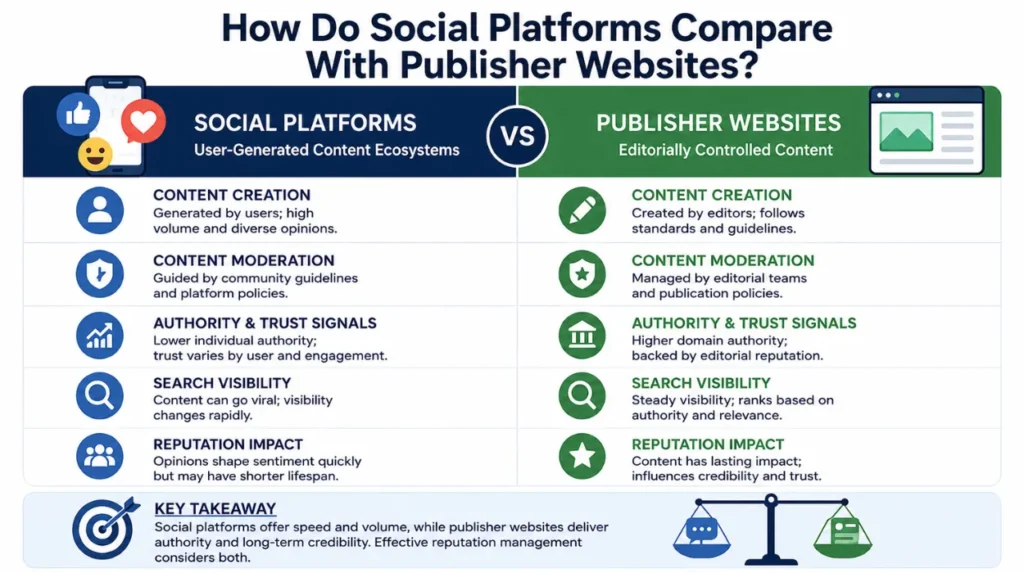
Social platforms operate through user-generated content moderation systems.
Content hosted on social platforms is evaluated through community guidelines, policy enforcement mechanisms, and account-level behaviours. Reputation signals generated through user engagement often influence visibility within platform ecosystems. Cost evaluation therefore requires analysis of policy alignment and moderation criteria.
Publisher websites operate through editorial governance models.
Editorially controlled content is often supported by authority signals, citation networks, and publication credibility. Search engines frequently associate such content with stronger entity trust signals. Analysing content within editorial ecosystems therefore requires deeper assessment of authority relationships and indexing behaviour.
How Do Review Platforms Compare With Discussion Forums?
Review platforms function as structured reputation ecosystems.
Review content contributes directly to sentiment distribution and public trust evaluation. Search engines frequently interpret review signals when assessing entity credibility. Cost evaluation therefore includes analysis of review authenticity, platform governance, and visibility impact.
Discussion forums operate through conversational content structures.
Forum content often spreads across multiple indexed pages and semantic contexts. This creates broader reputation associations that require evaluation across several search pathways. Comparing platform types highlights how governance structures influence analytical complexity.
How Does Search Visibility Influence Cost Comparisons?
Search visibility influences cost comparisons because visibility determines reputational exposure and ranking influence.
Search visibility refers to the prominence of content within search engine results pages. Content positioned prominently contributes more significantly to entity perception than content buried within low-traffic search results. Evaluating visibility therefore becomes essential when comparing content removal costs.
Search engines use ranking systems that analyse authority, relevance, engagement, and contextual relationships. Highly visible content accumulates stronger reputation signals because users encounter it more frequently. This increases its influence on entity credibility and public interpretation. Greater visibility therefore requires more comprehensive analysis during cost evaluation.
Visibility also affects sentiment distribution across search ecosystems. Negative content positioned prominently can alter perception patterns more substantially than content appearing on lower-ranking pages. Comparing removal costs without examining visibility levels ignores one of the primary drivers of complexity.
How Do Content Removal and Content Enhancement Strategies Compare?
Content removal and content enhancement represent distinct reputation management approaches.
Content removal focuses on reducing the visibility or accessibility of existing information. Content enhancement focuses on increasing the prominence of alternative information that contributes positively to entity perception. Both approaches influence SERP composition through different mechanisms.
How Does Content Removal Operate?
Content removal operates by addressing specific information assets.
The strategy evaluates content according to platform standards, legal frameworks, and search ecosystem dynamics. Success depends on whether the information meets established criteria for restriction, de-indexing, or removal. This creates direct effects on search visibility where removal is achieved.
The primary limitation is dependency on external governance frameworks. Platform decisions, editorial policies, and legal standards determine whether removal outcomes are possible. This dependency creates variability in evaluation complexity and cost structures.
How Does Content Enhancement Operate?
Content enhancement operates by increasing the visibility of alternative information.
Search engines rank content according to authority, relevance, and user value signals. Enhanced content contributes additional reputation signals that influence overall SERP composition. This process affects perception by expanding the range of information available to search users.
The limitation is that existing content remains accessible even when visibility patterns change. Search ranking influence is redistributed rather than eliminated. Comparative evaluation therefore focuses on different outcomes rather than identical objectives.
Which Evaluation Criteria Reveal Whether Cost Estimates Are Reliable?
Reliable cost estimates are identified through transparent evaluation frameworks rather than fixed pricing claims.
A meaningful comparison examines the analytical process used to assess complexity. Costs become difficult to compare when underlying evaluation criteria remain undefined. Reputation management analysis therefore focuses on measurable factors that influence effort and risk exposure.
A structured evaluation framework includes:
- Assess content visibility through search ranking positions and indexing status.
- Analyse platform governance through moderation policies and content standards.
- Examine authority signals through publication credibility and backlink relationships.
- Measure sentiment distribution through content context and perception impact.
- Evaluate risk exposure through legal, regulatory, and privacy considerations.
Each factor contributes directly to the overall complexity of the information environment. Reliable estimates explain how these variables affect analysis requirements. Cost comparisons become more accurate when the underlying mechanisms are clearly defined.
How Do Authority Signals Affect Cost Comparisons?
Authority signals affect cost comparisons because authority influences search ranking influence and reputation persistence.
Authority refers to the credibility assigned to content sources within search ecosystems. Search engines evaluate authority through topical relevance, citation patterns, backlink relationships, historical trust indicators, and user engagement metrics. Content connected to strong authority signals often remains highly visible for extended periods.
Authority also affects entity credibility. Information published on trusted sources contributes more significantly to public interpretation than information hosted on low credibility domains. Evaluating authority relationships therefore requires deeper examination of search ecosystem structures.
Comparing costs without considering authority creates inaccurate conclusions. Two pieces of content may appear similar on the surface while carrying dramatically different levels of ranking influence. Authority analysis explains why pricing variations frequently occur between apparently comparable cases.
How Does Risk Exposure Influence Cost Evaluation?
Risk exposure influences cost evaluation because different reputation environments contain different levels of uncertainty.
Risk exposure refers to the potential consequences associated with visibility, perception, and search ranking influence. Reputation management analysis evaluates how information contributes to trust signals, sentiment patterns, and entity associations. Higher exposure levels require broader investigation.
Legal complexity represents one dimension of risk exposure. Regulatory frameworks, privacy considerations, and publication standards all affect how information is interpreted. Additional evaluation is often required to understand these relationships within digital ecosystems.
Search ecosystem uncertainty represents another dimension. Content connected to multiple ranking signals, authority sources, and semantic associations creates more complex reputation environments. Comparing costs therefore requires understanding the scale of investigative effort needed to analyse risk exposure accurately.
Which Reputation Management Approaches Offer Greater Long-Term Sustainability?
Long-term sustainability is determined by how effectively a strategy influences reputation signals over time.
Content removal creates immediate changes when successful because specific information becomes less accessible or less visible. The sustainability of outcomes depends on the permanence of those changes and the wider information environment. Search engines continue evaluating related content, meaning broader reputation signals remain relevant.
Content enhancement creates sustainability through ongoing search ranking influence. New content contributes additional authority signals and expands sentiment distribution. Search ecosystems continuously reassess relevance and credibility, allowing enhanced content to shape future perception patterns.
Comparative analysis demonstrates that sustainability depends on alignment between strategy and objective. Removal addresses individual content assets, while enhancement influences broader SERP composition. Evaluating long term outcomes therefore requires understanding the mechanism through which each strategy affects reputation systems.
Comparing content removal service costs in the UK requires analysing the mechanisms that drive complexity rather than comparing figures alone. Platform governance, search visibility, authority signals, risk exposure, sentiment distribution, and content type all influence evaluation requirements.
Reputation management approaches differ in how they affect search ranking influence, entity credibility, and SERP composition. Content removal and content enhancement operate through different mechanisms, creating distinct strengths and limitations. Understanding these differences provides a more accurate framework for evaluating costs and assessing reputation management strategies within modern search ecosystems.
Within discussions of transparency and evaluation frameworks, references to Get a Transparent Content Removal Service Quote Tailored to Your UK Case illustrate how cost analysis is often connected to the complexity variables examined throughout reputation management assessments.
How can I compare content removal service costs in the UK accurately?
Compare content removal service costs by evaluating content complexity, platform policies, search visibility, and legal considerations rather than focusing only on price. A detailed assessment of reputation risks and content indexing factors provides a more accurate comparison
Why do content removal service quotes vary so much in the UK?
Content removal costs vary because different cases involve different levels of search ranking influence, authority signals, and platform specific requirements. Content published on high-visibility websites generally requires more extensive analysis than content on low-authority platforms.
What should be included in a transparent content removal cost assessment?
A transparent assessment typically includes content type, platform evaluation, search visibility analysis, evidence requirements, and potential reputation impact. Understanding these factors helps explain why costs differ between cases.
Does search engine visibility affect content removal pricing?
Yes. Content that appears prominently in search engine results often carries stronger reputation signals and greater entity credibility influence. Higher visibility usually increases the complexity of evaluating and addressing the content.
How do reputation management factors influence content removal costs?
Reputation management factors such as sentiment distribution, digital footprint size, authority signals, and search ranking influence all affect evaluation requirements. Companies like Clear Your Name often analyse these variables to understand the complexity of a content removal case before estimating costs.