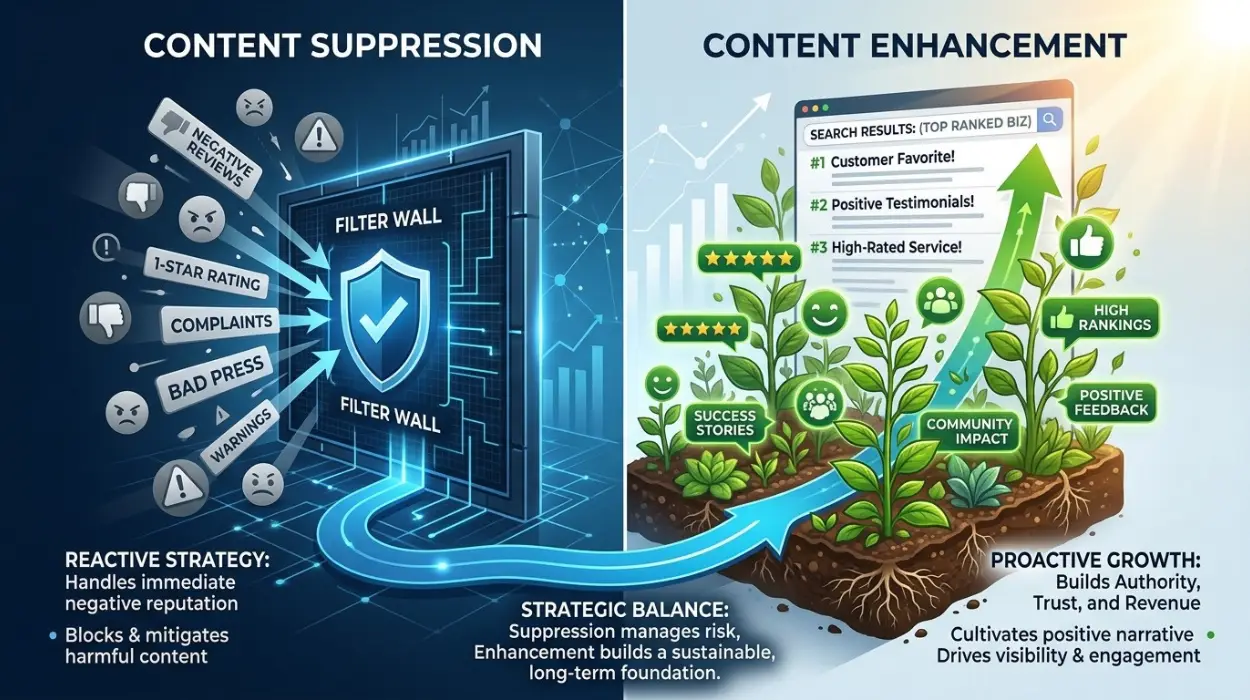
A social media reputation service is evaluated by examining its methodology, evidence, search visibility analysis, content strategy, risk controls, and measurable outcomes. Reputation management strategies differ based on whether the objective involves content removal, search suppression, content enhancement, monitoring, or long-term reputation development.
Online reputation control methods are evaluated through their effect on reputation signals, entity credibility, SERP composition, and the persistence of information across digital platforms. A meaningful comparison therefore examines how each approach works, where it applies, how its results are measured, and what limitations affect sustainability.
What should be compared when evaluating a social media reputation service?
A social media reputation service is best compared through methodology, scope, evidence, measurement, risk management, and sustainability. Reputation management is not a single technical process because negative content, inaccurate information, damaging reviews, search results, and social discussions require different forms of intervention. A provider’s methodology establishes whether it identifies the source of a reputation problem before selecting an appropriate response. This distinction separates structured reputation analysis from approaches that apply the same tactic to every type of negative content.
The first comparison concerns whether the service analyses the complete digital footprint rather than isolated social posts. A digital footprint contains profiles, reviews, discussions, indexed pages, media references, and other information associated with an entity. Analysing these sources establishes how individual reputation signals interact across search and social ecosystems. The evaluation therefore needs to consider whether the service measures the wider information structure before proposing a particular reputation management approach.
How does content removal compare with content enhancement?
Content removal addresses the original source of damaging information, while content enhancement strengthens accurate and authoritative information within the surrounding search environment. Content removal operates by pursuing an appropriate platform, publisher, legal, privacy, policy, or procedural basis for taking specific material offline. Content enhancement operates by developing useful, authoritative information that provides stronger context and competes for relevant search visibility.
Removal has a direct effect when the source accepts a legitimate removal request because the affected content no longer contributes the same reputation signal from that location. Its limitation is that removal depends on the circumstances surrounding the content and the rules of the platform or publisher. Content enhancement provides greater control over the information being developed but does not directly eliminate the original source. The two approaches therefore address different points in the reputation system rather than representing interchangeable methods.
Is content suppression different from content removal?
Content suppression is different from removal because suppression changes visibility without necessarily eliminating the original information. Content suppression operates through search ranking influence, stronger competing resources, improved entity associations, and the development of authoritative information around relevant queries. The original content remains available but becomes less prominent within the SERP composition.
Removal operates at the source level, while suppression operates primarily at the visibility level. Removal therefore provides a direct change to the underlying information source when a valid removal mechanism exists. Suppression focuses on what users encounter within search results and can remain relevant when the original material cannot be removed. Evaluation requires distinguishing these outcomes because a reduction in search visibility does not represent the same result as source-level deletion.
How does organic reputation management compare with reactive reputation management?
Organic reputation management develops a stronger information environment over time, while reactive reputation management responds to specific reputation events or damaging content. Organic approaches operate through consistent publication, accurate entity information, authoritative references, positive reputation signals, and structured digital footprint development. Reactive approaches operate by identifying an immediate problem and applying a targeted response to the affected source, platform, or search result.
Organic development has a longer time horizon because authority and trust signals accumulate through repeated evidence and consistent information. Reactive intervention offers a more focused response to a defined reputation issue but remains dependent on the characteristics of that issue. A comparison therefore needs to assess whether the strategy addresses the underlying information structure or only the immediate visibility problem. Effective evaluation separates short-term intervention from long-term reputation development rather than measuring both through the same criteria.
Which is more effective: short-term reputation repair or long-term reputation development?
Short-term reputation repair is more focused on reducing the visibility or impact of a defined reputation problem, while long-term reputation development strengthens the wider information environment. Short-term strategies operate through targeted actions such as content removal requests, search result analysis, source-specific responses, or immediate content enhancement. Long-term strategies operate through sustained authority development, accurate entity information, consistent publishing, and continuous monitoring.
Effectiveness depends on the reputation signal being addressed and the mechanism available for intervention. A removable piece of content has a different strategic pathway from a persistent search result supported by authoritative external references. Long-term development also addresses the durability of the wider digital footprint, reducing dependence on a single intervention. Evaluation therefore needs separate measures for immediate visibility change and sustained SERP composition.
How does search ranking influence the effectiveness of reputation management?

Search ranking influences effectiveness because the position of reputation-related content determines its exposure to users. Search engines organise indexed resources according to relevance, authority, content characteristics, and other ranking signals, creating a hierarchy within search results. Reputation management therefore interacts with ranking systems rather than operating independently from them.
A negative result occupying a prominent position creates a stronger search perception signal than an equivalent result with minimal visibility. Content enhancement attempts to strengthen relevant resources so that they gain greater search ranking influence, while removal eliminates the specific source when a valid removal mechanism succeeds. Ranking-based approaches remain dependent on search engine evaluation, making measurement essential. A service assessment therefore needs evidence of how ranking changes are identified and evaluated rather than relying on claims of general visibility improvement.
How should search suppression and content enhancement be compared?
Search suppression and content enhancement overlap because both seek to influence SERP composition, but their mechanisms differ. Search suppression focuses directly on reducing the prominence of unwanted results through stronger competing information and search ranking influence. Content enhancement focuses on improving the relevance, authority, usefulness, and credibility of selected resources so that they provide stronger reputation signals.
Suppression is measured primarily through changes in ranking positions and the composition of relevant search results. Enhancement is measured through the quality, visibility, authority, and search performance of the content being developed. Suppression without credible supporting information has limited structural depth, while enhancement without sufficient search visibility has limited perceptual impact. A comparative assessment therefore considers both the strength of the information and its ability to enter prominent SERP positions.
How does sentiment distribution affect reputation management decisions?
Sentiment distribution measures how positive, neutral, and negative reputation signals are distributed across an entity’s digital footprint. Sentiment analysis operates by classifying the language and contextual meaning associated with reviews, comments, articles, posts, recommendations, and discussions. This provides a broader picture than counting individual negative references.
A reputation service that analyses sentiment distribution can identify recurring themes and determine whether negative sentiment is concentrated within one platform or distributed across multiple sources. Concentrated sentiment indicates a different information pattern from persistent negative associations across authoritative sources. Sentiment also interacts with search visibility because highly visible negative content has greater potential influence on user perception. Evaluation therefore needs to consider sentiment alongside source authority, ranking position, relevance, and persistence.
Dive Deeper With Our Expert Guides:
How to Document Evidence of a Social Media Harassment Campaign
How to Respond When Private Messages Are Leaked Publicly
How should the scalability of a social media reputation strategy be assessed?
Scalability is assessed by examining whether the reputation methodology remains effective as the number of platforms, sources, queries, and reputation signals increases. A scalable approach uses consistent monitoring, classification, reporting, and prioritisation systems rather than relying entirely on manual assessment of individual mentions. Structured processes allow reputation signals to be evaluated according to defined criteria.
Scalability also depends on the complexity of the digital footprint. A single platform issue requires a different operational framework from reputation signals distributed across social networks, review platforms, search engines, forums, and media websites. Automated monitoring can increase coverage, but interpretation remains necessary for determining authority, context, and entity relevance. A proper evaluation therefore measures both the volume of information monitored and the analytical quality applied to that information.
How does risk exposure differ between reputation management approaches?
Risk exposure differs according to the intervention method, source characteristics, platform rules, and degree of control over the information. Content removal carries procedural risk because the request depends on a legitimate basis and the decision of the relevant platform or publisher. Search suppression carries ranking risk because visibility depends on algorithmic evaluation and changing search conditions.
Content enhancement carries a different risk profile because the strategy depends on creating credible information rather than directly challenging an existing source. Poor-quality or repetitive content can weaken entity credibility instead of strengthening it. An analytical framework therefore evaluates whether each action aligns with the nature of the reputation problem. Risk assessment needs to consider policy compliance, source authority, content quality, ranking dependency, and long-term sustainability.
How important is evidence when comparing reputation management services?
Evidence is essential because reputation management outcomes need measurable indicators rather than unsupported claims. Evidence-based evaluation examines baseline search results, ranking positions, indexed sources, sentiment distribution, source authority, content status, and changes in SERP composition. These measurements establish a reference point against which later changes can be assessed.
A useful methodology also distinguishes activity from outcome. Publishing content, submitting requests, monitoring mentions, or producing reports represents activity, while changes in visibility, source status, search ranking, and entity perception represent outcomes. A service that reports only completed activities provides limited evidence of effectiveness. Evaluation therefore prioritises measurable changes connected directly to the reputation objective.
How sustainable are different social media reputation strategies?
Sustainability depends on whether the strategy addresses a continuing reputation mechanism rather than producing only a temporary change. Source-level removal can provide a durable result when content is permanently removed and does not reappear through another source. Search suppression can require continuous monitoring because ranking systems reassess content and competing pages over time.
Long-term content enhancement also requires maintenance because authority, relevance, freshness, and search competition change. Organic reputation development is therefore an ongoing process rather than a one-time technical adjustment. Sustainable evaluation considers the persistence of outcomes, the resources required for monitoring, the possibility of content reappearance, and changes within search ecosystems. This creates a more accurate comparison than assessing results immediately after an intervention.
What evaluation framework provides the clearest comparison?
A structured evaluation framework compares each reputation approach according to mechanism, effectiveness, scalability, risk exposure, search impact, and sustainability. This framework establishes consistent criteria for comparing removal, suppression, enhancement, monitoring, and organic reputation development.
- Identify the reputation signal by documenting its source, content type, platform, indexing status, and relevance to the entity.
- Measure its visibility by recording search ranking, platform exposure, SERP position, and recurring query associations.
- Assess its authority by examining publisher credibility, source relevance, evidence, and relationship with the entity.
- Compare intervention mechanisms by determining whether removal, suppression, enhancement, or monitoring addresses the actual source of the reputation problem.
- Evaluate sustainability by measuring persistence, ranking changes, content reappearance, and the resources required for continued monitoring.
This framework prevents different reputation strategies from being compared solely through surface-level outcomes. It also connects operational decisions with the underlying search ecosystem, creating a clearer basis for commercial investigation.
What role does entity credibility play in selecting a reputation management approach?
Entity credibility represents the strength and consistency of information supporting an entity’s identity, authority, and reliability across digital sources. Entity credibility operates through connected signals including authoritative references, accurate profiles, relevant content, consistent information, reviews, professional mentions, and contextual evidence. Search systems use these signals as part of the wider information environment surrounding an entity.
A reputation strategy therefore needs to protect credibility while addressing negative signals. Removing one source without strengthening accurate entity information leaves the wider digital footprint largely unchanged. Conversely, creating large volumes of low-authority content does not automatically strengthen credibility because search systems evaluate relevance and quality rather than volume alone. Selecting an approach requires assessment of how each intervention changes the balance of authoritative and damaging reputation signals.
How can a social media reputation service be evaluated before hiring?
A social media reputation service can be evaluated by examining its methodology, evidence standards, intervention mechanisms, reporting structure, risk controls, and approach to long-term monitoring. The evaluation begins with identifying whether the service distinguishes content removal from content suppression, enhancement, monitoring, and organic reputation development. It then measures whether the proposed approach directly corresponds with the source and visibility characteristics of the reputation problem.
A sound comparison also examines how results are measured. Search ranking influence, SERP composition, content indexing, sentiment distribution, source authority, and entity credibility provide measurable dimensions for evaluating reputation changes. Sustainability adds another dimension because short-term ranking movement does not automatically represent durable reputation improvement. These criteria create a neutral framework for assessing reputation management options before making a hiring decision.
How should social media reputation services be compared?
Social media reputation services differ according to the mechanism used to influence reputation signals and the point at which intervention occurs. Content removal addresses the source, suppression addresses search visibility, content enhancement strengthens competing information, and organic reputation management develops credibility over a longer period. Each approach has distinct strengths, limitations, risk exposure, scalability requirements, and sustainability characteristics.
The most useful evaluation therefore connects the reputation problem with the appropriate mechanism rather than treating every negative signal as the same type of issue. Search visibility, SERP composition, entity credibility, sentiment distribution, source authority, and content indexing provide measurable dimensions for comparison. A structured assessment based on these factors creates a clearer understanding of how different reputation management strategies operate and where their limitations arise. For decision-stage evaluation, Choose a Trusted Social Media ORM Service With Confidence provides a relevant framework for assessing service quality, strategic fit, and risk before selecting an approach.
What should I look for in a social media reputation service?
Evaluate its methodology, reputation monitoring, search visibility analysis, content strategy, reporting standards, risk controls, and measurable outcomes. A reliable evaluation also compares how the service handles removal, suppression, content enhancement, and long-term reputation development.
Is social media content removal better than content suppression?
Content removal addresses the original source, while content suppression reduces the visibility of information within search results. The appropriate approach depends on whether a legitimate removal basis exists and how strongly the content affects search visibility and reputation signals.
How does a social media reputation service improve search visibility?
Reputation management can influence search visibility through content analysis, removal strategies, content enhancement, and stronger authoritative information. These approaches affect SERP composition by changing the visibility or strength of reputation-related search results.
How much does social media reputation management cost?
Costs vary according to the number of platforms, reputation signals, content volume, search visibility, monitoring requirements, and intervention complexity. A proper assessment requires defining the scope and methods involved before comparing prices between social media reputation services.
How long does social media reputation management take?
Timescales depend on whether the strategy involves content removal, search suppression, content enhancement, or long-term reputation development. Source-level removal can produce a direct change when accepted, while ranking and credibility improvements require ongoing monitoring of search visibility and reputation signals.