
Removing personal data from people search sites in the UK involves evaluating data protection rights, platform policies, and search visibility factors. GDPR rights provide structured mechanisms for requesting data removal, restriction, or review when personal information processing does not meet legal requirements.
Reputation management strategies differ based on how personal information influences digital footprints, search perception, and entity credibility within search ecosystems. Online reputation control methods are evaluated through content visibility, data accuracy, legal compliance, and the impact of indexed information on search results. People search sites collect and display personal information through data aggregation systems that connect public records, directories, and online databases. Search engines interpret this information through content indexing, authority signals, and relevance evaluation. Understanding removal approaches requires analysing how data publication, search visibility, and privacy rights interact.
Which personal data removal approach provides stronger search visibility control?
Personal data removal approaches provide stronger search visibility control when they combine legal evaluation, platform procedures, and search ecosystem analysis. Data removal is the process of restricting or eliminating publicly accessible personal information from websites that publish searchable profiles. These methods operate by assessing whether information processing complies with applicable privacy regulations and platform requirements. Search engines respond to changes in indexed content through crawling, evaluation, and ranking updates. Reputation management evaluates these mechanisms because data visibility directly influences digital identity and online credibility.
A legal rights-based approach focuses on GDPR principles, including accuracy, lawful processing, and individual control over personal information. A platform-based approach relies on website-specific removal procedures and internal review systems. Both methods influence search visibility differently because legal requests address processing obligations while platform requests focus on content availability. Effective evaluation requires understanding the limitations of each pathway. Search perception changes when successful removal actions alter the amount of indexed personal information available to users.
GDPR rights influence personal data removal by establishing legal frameworks for controlling how personal information is processed. These rights define circumstances where individuals can request access, correction, restriction, or deletion of personal data. Within search ecosystems, GDPR compliance affects how websites evaluate data processing activities and removal requests.
Search engines and people search platforms analyse removal requests through legal criteria and operational procedures. Reputation management examines these interactions because legal compliance forms an important reputation signal connected to digital trust. Data protection frameworks therefore influence both information visibility and search perception.
How do people search sites collect and display personal information?
People search sites collect and display personal information through automated data aggregation systems that organise information from accessible sources. Data aggregation is the process of combining information from public records, directories, databases, and other available resources into searchable profiles. These profiles become part of digital footprints because search engines index and evaluate them as informational assets.
The collection process operates through structured databases that connect names, locations, historical information, and associated records. Search engines interpret this structured content through semantic relationships and authority signals. Profile visibility increases when information architecture supports search relevance and technical accessibility. Reputation management analyses these mechanisms to understand how personal data becomes discoverable across search engine results pages.
Dive Deeper With Our Expert Guides:
How the UK’s New Fake Review Laws Affect What Businesses Can Have Removed
How the CMA Fake Review Law Changes What Businesses Can Demand Be Removed
Which method is more effective: data removal or content suppression?
Data removal and content suppression represent different reputation management approaches with different mechanisms and limitations. Data removal operates by reducing the availability of specific personal information at the source, while content suppression operates by influencing the visibility and prominence of information within search results. Both approaches affect SERP composition but achieve results through different pathways.
Data removal provides direct control over specific information when applicable legal or platform criteria are satisfied. Content suppression focuses on improving the balance of search results by strengthening authoritative information and reducing the prominence of unwanted content. Search engines evaluate these changes through ranking systems, relevance signals, and authority assessment.
The effectiveness of each approach depends on the nature of the information, indexing status, and search ecosystem conditions. Removal strategies address the existence of content, while suppression strategies address visibility and perception. Reputation management compares these methods by measuring search ranking influence, sustainability, and risk exposure.
Content suppression differs from content removal because it does not eliminate the original information source. Instead, it focuses on changing the search landscape by increasing the visibility of relevant and authoritative content. Search engines then evaluate a wider range of information when generating search results.
Content removal directly targets availability, while suppression targets search prominence. Both methods contribute to reputation control, but their effectiveness depends on technical factors, legal considerations, and the structure of search results.
How do search engines interpret personal information within SERPs?
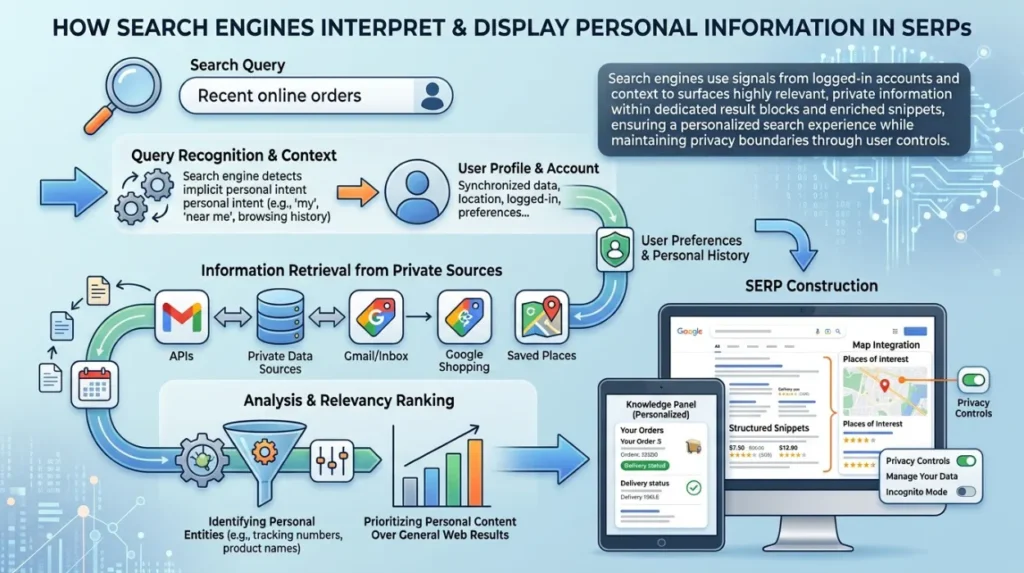
Search engines interpret personal information within SERPs by analysing relevance, authority, content quality, and relationships between indexed entities. SERP evaluation involves continuous assessment of webpages to determine which information best satisfies user search intent. People’s search profiles become visible because they often contain structured information that matches identity-based queries.
Search algorithms do not evaluate information through personal preference but through measurable ranking factors and contextual relationships. Authority signals, semantic relevance, and content indexing influence how prominently information appears. Reputation management analyses these ranking dynamics because search visibility directly affects digital perception.
Personal information therefore becomes part of a larger search ecosystem where multiple sources contribute to entity understanding. Managing visibility requires evaluating how search engines connect, rank, and display information across indexed resources.
Which approach provides better long-term reputation protection?
A long-term reputation protection approach depends on balancing data removal, search visibility control, and sustainable digital footprint management. Personal data removal addresses the source of unwanted information, while reputation enhancement focuses on improving the overall quality and balance of indexed content. These approaches operate differently because removal changes content availability, whereas enhancement influences how search engines interpret an entity. Reputation management evaluates both methods by measuring effectiveness, scalability, and long-term search perception.
A removal-focused strategy provides direct control when personal information meets applicable removal criteria. Its limitation is that search visibility can remain affected by duplicated information, cached pages, or related indexed sources. A content enhancement strategy strengthens authoritative information by improving contextual relevance across search ecosystems. Its limitation is that it does not directly remove the original data source. Comparing these approaches requires analysing both immediate visibility changes and sustainable reputation outcomes.
Which factors determine the effectiveness of GDPR data removal requests?
The effectiveness of GDPR data removal requests depends on legal eligibility, evidence quality, processing justification, and platform response procedures. GDPR-based removal operates through established data protection principles that evaluate whether personal information processing remains lawful and appropriate. Reputation management analyses these factors because successful removal depends on procedural accuracy rather than simple submission.
Evidence quality influences how organisations assess requests because clear documentation supports accurate evaluation. Data accuracy, relevance, retention periods, and lawful processing requirements form important assessment factors. Search ecosystems respond after source-level changes occur because search engines require updated crawling and indexing cycles. Therefore, effective removal requires both legal assessment and technical understanding.
GDPR removal outcomes are influenced by several measurable factors:
- Demonstrate data processing concerns through relevant evidence that explains why information requires review.
- Evaluate accuracy and relevance by identifying outdated or incorrect personal information within indexed profiles.
- Analyse lawful processing conditions to determine whether continued publication aligns with data protection requirements.
- Monitor indexing changes after approved actions to measure updates in search visibility.
These factors determine how effectively personal information visibility changes within search ecosystems.
How do personal data removal methods influence SERP composition?
Personal data removal methods influence SERP composition by changing the availability of indexed information that search engines evaluate. SERP composition refers to the arrangement and visibility of webpages displayed for specific search queries. When indexed personal profiles are removed or altered, search engines reassess available content and adjust rankings according to relevance and authority signals.
Search visibility does not change instantly because search engines require time to discover, process, and index updates. Content indexing cycles determine when changes become visible within search results. Reputation management evaluates these technical processes because search perception depends on both successful removal actions and search engine responses.
Removal methods therefore influence the information environment surrounding an entity. Reducing unnecessary personal data improves control over digital footprints while allowing search engines to reassess available information. This process supports improved search visibility management and more accurate entity perception.
Which risks should be considered before choosing a personal data removal strategy?
Personal data removal strategies require evaluation of legal, technical, and search-related risks before implementation. Removing information from one source does not automatically remove every related reference across the internet. Search ecosystems contain interconnected resources, making comprehensive analysis essential for understanding visibility patterns.
A removal-only approach can provide limited results when duplicate information exists across multiple platforms. A suppression-focused approach can improve visibility balance but does not eliminate the original source. Reputation management therefore evaluates risk exposure by analysing content distribution, indexing behaviour, and authority relationships.
Organisations measure reputation control sustainability through ongoing evaluation of search visibility, reputation signals, and content consistency. Sustainable control depends on maintaining accurate information, monitoring indexed content, and evaluating changes within search ecosystems. Search perception requires continuous assessment because algorithms regularly update rankings and information relationships.
Long-term sustainability develops through balanced reputation management rather than single-action interventions. Combining appropriate removal procedures with digital footprint optimization creates stronger control over future search visibility. This approach supports stable entity credibility by maintaining consistent and authoritative information.
How does professional privacy management support decision-making?
Professional privacy management supports decision-making by providing structured analysis of data visibility, legal considerations, and search ecosystem behaviour. A clear evaluation process helps identify suitable approaches based on information type, publication source, and visibility impact. Reputation management strategies differ according to whether the objective involves removal, restriction, or improved search balance.
Privacy-focused evaluation considers the relationship between personal data, search ranking influence, and digital trust. Understanding these connections allows organisations and individuals to select methods aligned with specific reputation objectives. The process focuses on evidence, compliance, and measurable outcomes rather than assumptions.
Further evaluation of Remove Your Information From UK People Search Sites provides additional insight into how privacy-focused approaches address personal data visibility within search ecosystems.
Removing personal data from people search sites in the UK requires analysis of GDPR rights, platform procedures, search visibility factors, and digital footprint management. Data removal and content suppression represent different reputation management approaches, each operating through separate mechanisms within search ecosystems. Removal strategies focus on reducing information availability, while suppression strategies focus on influencing search perception and SERP composition.
Effective reputation management evaluates legal eligibility, evidence quality, search indexing behaviour, and long-term sustainability. Understanding how search engines interpret reputation signals, authority signals, and entity credibility provides a clearer framework for managing personal information visibility. Strategic evaluation ensures that privacy decisions align with search ecosystem behaviour and digital trust requirements.
How can I remove my data from people search sites in the UK?
You can request data removal from people search sites in the UK by using available platform removal processes and applicable GDPR rights. The process involves reviewing how personal information is collected, processed, and displayed online.
Does GDPR allow me to remove personal information from people search websites?
GDPR provides rights that allow individuals to request access, correction, restriction, or deletion of personal data in specific circumstances. Removal requests are assessed based on lawful processing, data accuracy, and the purpose of information publication.
Why does my personal information appear on people search sites?
Personal information appears on people search sites because these platforms aggregate data from public records, directories, and other accessible sources. Search engines index these profiles when they meet relevance, authority, and content indexing criteria.
How long does it take to remove personal data from people search sites?
The timeframe depends on the website’s review process, the type of information involved, and whether additional verification is required. Search engines also require time to recrawl and update indexed search results after removal.
Can removing data from people search sites improve my online reputation?
Removing unnecessary personal data can improve digital privacy and reduce unwanted search visibility. It also helps manage digital footprints by improving control over the information associated with an individual across search ecosystems.