

Removing your name from online directories in the UK depends on the legal basis for processing personal data, the applicability of UK GDPR rights, and the publishing practices of each directory. Reputation management strategies differ based on the source of the information, the controller’s lawful basis, and the search visibility created through indexed directory pages.
Online reputation control methods are evaluated through legal compliance, search ranking influence, entity credibility, and the sustainability of information removal. Different approaches produce different outcomes because search ecosystems interpret removed, retained, and updated content according to independent indexing and authority signals.
Which UK GDPR rights are most relevant when removing your name from online directories?
UK GDPR rights provide structured legal mechanisms for requesting changes to personal data, but their effectiveness depends on how information is processed and why it is published. The right relied upon varies according to the directory’s legal justification for holding personal information rather than the individual’s preference alone.
The right to erasure, commonly known as the Right to Be Forgotten, operates by requesting deletion where continued processing no longer satisfies UK GDPR requirements. Other rights, including the right to object, the right to rectification, and the right to restrict processing, operate through different legal tests and therefore produce different outcomes. Search visibility changes only when the underlying directory content changes or becomes unavailable for indexing.
Entity credibility within search ecosystems also influences the practical effect of exercising these rights. Removing one indexed directory listing reduces one source of reputation signals, but search ranking influence depends upon the complete collection of indexed references associated with an individual.
How do UK GDPR rights compare?
Different rights operate through distinct legal mechanisms.
- Exercise the right to erasure when processing no longer satisfies lawful requirements.
- Use the right to rectification where published information contains factual inaccuracies.
- Invoke the right to object when processing relies upon legitimate interests.
- Request restriction where legal disputes concerning processing remain unresolved.
Each right evaluates different legal circumstances and therefore produces different practical outcomes.
How does the Right to Be Forgotten compare with direct directory opt-out requests?
The Right to Be Forgotten evaluates legal compliance under UK GDPR, whereas directory opt-out requests operate according to the publisher’s internal privacy policies. Although both approaches seek reduced visibility of personal information, they function through different administrative mechanisms.
A GDPR request requires the organisation to assess whether lawful grounds continue to justify processing personal data. An opt-out process instead follows procedures voluntarily established by the directory operator. Some directories provide automated removal forms, while others require formal identity verification before evaluating requests.
Search ranking influence differs between these approaches because removal depends upon the publisher’s final decision and the timing of search engine recrawling. Deleted content remains visible temporarily if search engines continue displaying cached or previously indexed pages until content indexing is refreshed.
From a reputation management perspective, GDPR rights provide statutory protection, whereas opt-out systems provide operational procedures established by individual organisations. Their effectiveness therefore depends upon different legal and administrative frameworks.
Which types of online directories respond differently to GDPR requests?
Directory categories differ significantly because they obtain and process personal information using different lawful bases. Evaluation of removal requests therefore varies according to the nature of the organisation rather than the request itself.
People-search directories frequently aggregate information obtained from publicly available sources and commercial datasets. Professional directories commonly publish information connected with regulated occupations or publicly available professional registers. Company information platforms often display information required under statutory transparency obligations. These differences affect how each controller evaluates UK GDPR requests.
Search ecosystems interpret all indexed directory pages similarly during crawling and ranking, yet the legal obligations of each publisher remain different. Consequently, identical requests submitted to different directories frequently produce different responses despite similar search visibility.
Comparing directory categories demonstrates that removal effectiveness depends upon legal purpose, regulatory obligations, and the balance between privacy rights and public interest.
How does lawful basis affect the success of removal requests?
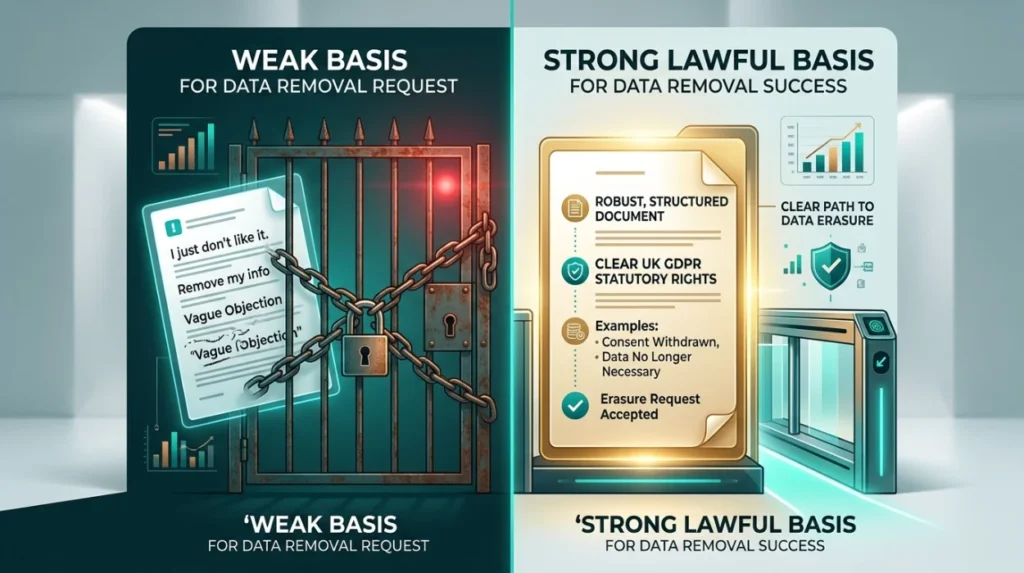
Lawful basis determines whether continued processing satisfies UK GDPR requirements. Every controller identifies a specific legal ground for processing personal information, and that ground directly influences how removal requests are evaluated.
Processing based upon consent differs fundamentally from processing based upon legitimate interests or legal obligations. Where consent forms the lawful basis, withdrawal changes the legal framework supporting continued processing. Legitimate interests require balancing privacy rights against organisational purposes, while legal obligations often require continued publication regardless of individual preference.
Search visibility reflects the outcome of these legal assessments rather than the submission of a request alone. If processing continues lawfully, directory pages remain eligible for content indexing and ongoing search ranking influence. If processing ceases, removal from indexed search results depends upon recrawling and index updates.
Entity credibility within search ecosystems therefore evolves according to both legal compliance and technical indexing processes.
Which approach produces broader reductions in search visibility?
Broader reductions in search visibility result from addressing multiple indexed sources rather than focusing on a single webpage. Search engines evaluate overall entity perception by analysing the complete collection of indexed references associated with an individual.
Removing one directory entry reduces one reputation signal, yet numerous additional indexed sources often continue contributing similar information. Reputation management strategies therefore compare isolated removal with wider directory evaluation across the search ecosystem. The broader approach analyses how different websites contribute to cumulative search ranking influence.
Organic content development and reactive removal also differ substantially. Organic approaches gradually expand positive indexed content through continued publication, while reactive approaches concentrate on reducing existing visibility. Each mechanism influences SERP composition differently and therefore produces distinct long-term outcomes.
How does search engine indexing affect the visibility of removed directory information?
Search engines maintain independent indexes that update according to crawling schedules rather than immediately following content changes. Removal from a directory website therefore does not automatically produce immediate changes within search results.
Content indexing operates through discovery, evaluation, storage, and retrieval. When directory content changes, search engines revisit the affected pages before updating indexed information. This delay explains why removed names occasionally remain visible for a period after successful deletion from the originating website.
Search ranking influence consequently depends upon both publisher action and search engine processing. Reputation signals diminish only after updated indexing reflects the revised directory content, illustrating the relationship between legal removal mechanisms and technical search ecosystem behaviour.
Dive Deeper With Our Expert Guides:
How Removing Your Name From Search Engines in the UK Works Across Bing and Google
What Steps Are Involved in Removing Your Name From the Internet Completely
How do reactive and proactive reputation management approaches compare?
Reactive reputation management focuses on reducing the visibility of information that has already entered search ecosystems. Proactive reputation management operates by improving the quality, consistency, and authority of future indexed information before visibility issues become established. Both approaches influence search perception differently because they address different stages of the content lifecycle.
Reactive methods analyse existing directory listings, legal removal options, and indexed content that contributes to current reputation signals. Their principal strength is targeted intervention against identified sources of search visibility. Their limitation is scalability, because each directory often requires an independent evaluation and separate removal process.
Proactive methods strengthen entity credibility through consistent information management, accurate public records, and controlled publication practices. This approach supports sustainable reputation signals but generally develops over a longer timeframe because search engines require repeated crawling and indexing before changes influence SERP composition.
Comparing these approaches demonstrates that reactive measures address immediate visibility issues, while proactive measures strengthen long-term digital footprint management.
Which characteristics distinguish reactive and proactive approaches?
The differences become clearer when comparing their operational focus.
- Address existing directory listings through legal or administrative removal procedures.
- Improve future reputation signals by maintaining accurate public information.
- Reduce duplicated personal data through ongoing directory monitoring.
- Strengthen entity credibility by limiting inconsistent information across indexed sources.
Each method contributes differently to search visibility, sustainability, and reputation control.
How do search engines interpret changes after directory information is removed?
Search engines evaluate updated directory content through continuous recrawling rather than instant replacement. Once information is removed from a directory, algorithms must rediscover the updated page before changes appear consistently across search results.
Search ranking influence changes gradually because indexed information is refreshed according to crawl frequency, domain authority, and technical accessibility. High-authority directories often receive more frequent crawling, allowing updated information to be reflected more quickly than lower-authority websites. Nevertheless, the timing varies between domains because each website receives independent indexing treatment.
Entity credibility also evolves gradually. Removing one directory listing changes one set of reputation signals, but algorithms continue evaluating all remaining indexed references associated with the individual. Consequently, search visibility reflects cumulative evidence rather than isolated removals.
This comparison highlights the distinction between successful data removal and visible SERP changes. Administrative completion and search engine recognition are separate processes operating on different timelines.
Which strategy offers the most sustainable long-term outcome?
Long-term sustainability depends upon combining legally appropriate removal mechanisms with continuous management of publicly available information. Sustainable reputation management operates by reducing unnecessary exposure while maintaining consistency across legitimate public records and authoritative sources.
Single removal requests address individual data sources but rarely eliminate every indexed reference connected with a person’s name. Comprehensive evaluation analyses how multiple directories contribute collectively to reputation signals, entity credibility, and search ranking influence. This broader perspective supports more durable improvements in search visibility.
Scalability also becomes an important consideration. Evaluating one directory at a time remains practical for isolated cases, whereas broader digital footprint assessments become increasingly valuable where personal information has been replicated across numerous platforms. The comparison demonstrates that sustained outcomes depend upon understanding the entire search ecosystem rather than focusing exclusively on individual webpages.
Readers interested in practical implementation can continue exploring Remove Your Name From UK Online Directories Through Our Proven Opt-Out Service, which examines the operational stages involved in structured directory opt-out processes.
Removing a name from online directories in the UK requires evaluating the legal basis for processing, the appropriate UK GDPR rights, and the independent policies followed by each directory. Different approaches operate through distinct legal and administrative mechanisms, producing varying effects on search visibility, reputation signals, and entity credibility.
Comparing GDPR rights, directory opt-out procedures, reactive strategies, and proactive information management demonstrates that no single approach applies universally. Effectiveness depends upon lawful processing, directory category, indexing behaviour, and the interaction between legal compliance and search engine evaluation.
Understanding these strategic differences provides a stronger foundation for assessing removal options within search ecosystems. Evaluating legal rights alongside search ranking influence, content indexing, and digital footprint management supports informed decisions about reducing the visibility of personal information while recognising the limitations and sustainability of each available approach.
Can I remove my name from online directories using UK GDPR rights?
Yes, UK GDPR provides rights such as the Right to Erasure, the Right to Object, and the Right to Rectification, depending on the lawful basis for processing your personal data. Whether a directory removes your information depends on its legal obligations and the circumstances of your request.
Why does my name still appear in Google after it has been removed from a directory?
Google updates its index after recrawling webpages, so removed information can remain visible temporarily in search results. Search visibility usually changes once the updated directory page has been re-indexed.
Which online directories are most likely to publish personal names?
People-search websites, business directories, professional registers, and public record directories commonly publish personal names obtained from lawful public sources or licensed datasets. Each directory follows its own privacy and data processing policies.
Can Name Removal Services help reduce the visibility of personal information?
Name Removal Services evaluate where personal information appears online and identify appropriate GDPR or directory opt-out routes. Clear Your Name assists individuals in understanding available removal options while following UK data protection requirements.
Does removing directory listings improve online reputation?
Removing eligible directory listings can reduce reputation signals associated with publicly available personal information and improve search visibility over time. The overall impact depends on how many indexed sources continue displaying the same information across search engine results.



