Reporting and removing content from a Facebook group depends on the platform’s moderation mechanisms, the nature of the content, and the available evidence supporting a policy violation. Reputation management strategies differ based on whether the objective is source removal, search visibility control, or long-term improvement of an entity’s digital footprint.
Which Facebook content removal approach is most effective?
Direct platform reporting is the most immediate content-removal approach because it addresses the original source rather than its search visibility. Reporting operates by submitting potentially violating content to the platform for review against applicable community standards, group rules, or other enforcement criteria. The strength of this approach is source-level intervention, since successful action changes the availability of the original post or material. Its limitation is that enforcement depends on the platform’s policies, review process, and assessment of the reported content. From a reputation perspective, source removal has a stronger direct relationship with the original content than search suppression because it addresses the information at its publication point.
Search visibility strategies operate differently because they focus on what users encounter rather than solely on whether the original content remains available. Search systems evaluate accessible and indexable documents according to relevance, authority, query intent, and other ranking signals. Content suppression therefore seeks to reduce the prominence of harmful information within SERPs rather than necessarily removing the source. This creates an important distinction between content removal and content suppression. Removal changes source availability, while suppression changes the relative visibility of information within search results.
How does reporting differ from removing harmful Facebook group content?
Reporting is a procedural mechanism for requesting platform review, while removal is the resulting change in content availability when the platform takes enforcement action. Reporting begins with identifying the relevant post, comment, image, or other material and selecting an applicable reporting category. The platform then evaluates the submission against its governing policies and available contextual information. Removal occurs only when the platform determines that enforcement criteria are satisfied or an authorised administrator takes appropriate action. This makes reporting an input into a moderation process rather than a guaranteed removal mechanism.
The distinction matters for reputation analysis because unsuccessful reporting leaves the original content available within its existing environment. A removed post, by contrast, changes the source-level information landscape and limits continued access to the specific material. Neither process automatically addresses copies, screenshots, quotations, or independent references published elsewhere. Search ranking influence therefore requires separate assessment from platform moderation. A complete evaluation examines whether the harmful information remains available, whether it has migrated to another source, and whether related content has entered search indexes.
Is content removal more effective than search suppression?
Content removal provides a more direct intervention when the original publication violates platform rules because it addresses the source itself. Search suppression operates at a different level by reducing the prominence of selected information relative to other indexed results. Removal therefore has a stronger source-control effect, while suppression has a stronger SERP-composition effect. The two approaches also produce different evidence requirements because platform reporting centres on policy violations whereas search visibility analysis centres on ranking relationships. Evaluating effectiveness requires identifying which part of the reputation problem remains active after each intervention.
Removal also has limitations that suppression does not directly address. A post can be removed from its original location while copies remain available elsewhere, preserving the underlying reputation signal. Suppression can reduce exposure to a harmful result without changing the underlying source, leaving the information accessible through direct searches or other pathways. This creates different risk profiles for each method. Source removal reduces the availability of the specific content, whereas suppression changes the probability that users encounter it through search. The most appropriate analytical framework therefore separates source availability from search visibility rather than treating them as equivalent outcomes.
How do organic reputation strategies compare with reactive removal?
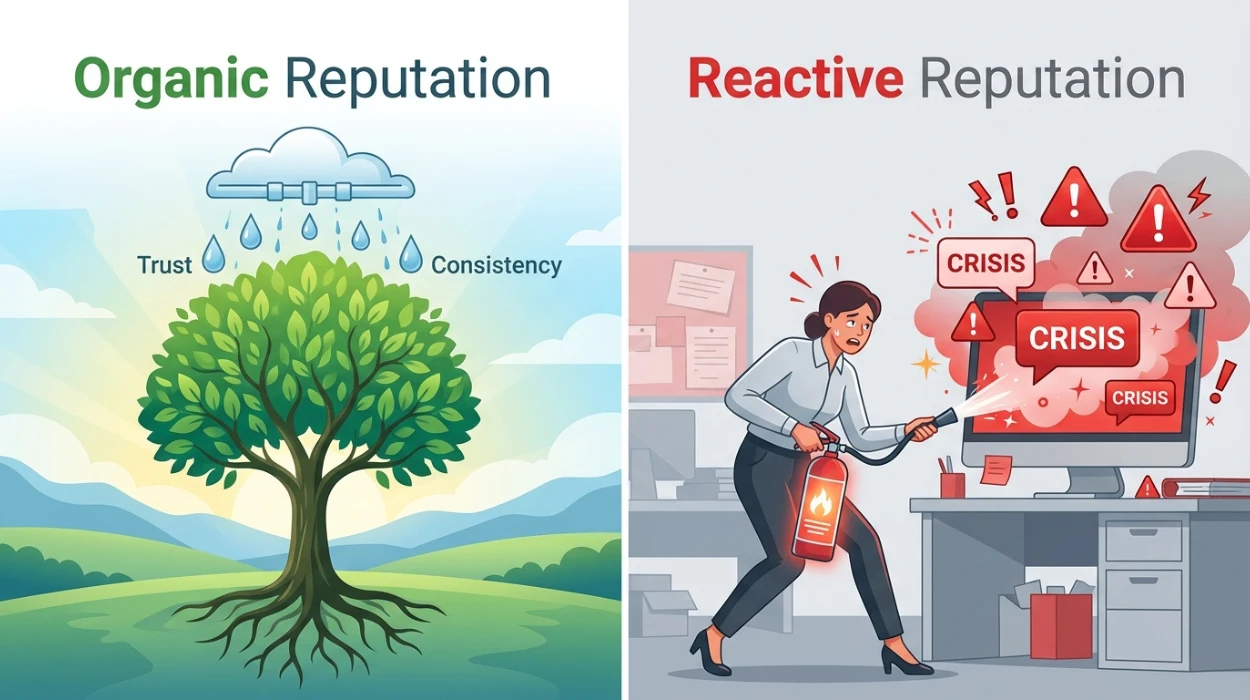
Organic reputation strategies build a stronger information environment over time, while reactive removal strategies respond to specific harmful content after publication. Organic methods include creating authoritative content, maintaining accurate entity information, strengthening relevant pages, and developing a consistent digital footprint. These activities influence SERP composition by increasing the quantity and relevance of information associated with an entity. Reactive removal focuses instead on an identified source and seeks a specific intervention against that material. The approaches therefore differ in timing, mechanism, scalability, and dependency on third-party decisions.
Organic reputation development has greater long-term sustainability when authoritative information remains useful and relevant to users. Its limitation is that it does not directly eliminate inaccurate or harmful source material. Reactive removal provides a more immediate source-level objective but depends on the policies and decisions of the platform or publisher controlling the content. The two approaches therefore address different layers of reputation risk. Organic activity influences the surrounding information environment, while reactive action targets a defined reputation signal at its source.
How does content creation compare with content removal?

Content creation strengthens the informational context surrounding an entity, while content removal reduces the availability of a specific negative source. Content creation operates by publishing useful, accurate, relevant information that search engines can crawl, index, and evaluate. Content removal operates by changing whether a particular item remains accessible within its original platform. The first method influences the composition of available information, whereas the second modifies one component of that information set. Their effects on entity credibility therefore operate through different mechanisms.
Content creation also has a compounding characteristic because useful pages can establish additional contextual relationships over time. However, newly created content does not automatically outrank established sources, particularly when competing pages have stronger authority or relevance. Removal produces a more direct change when successful because the affected source becomes unavailable at its original location. The limitation is that removal does not necessarily improve the overall SERP environment. A sustainable reputation strategy therefore evaluates both source-level risk and the quality of the remaining search landscape.
What is the difference between short-term and long-term reputation impact?
Short-term reputation impact is primarily determined by immediate exposure, while long-term impact depends on persistence, repetition, indexing, and information relationships. A harmful Facebook group post can create immediate perception effects among people who have access to the group. If the information remains restricted, its direct search visibility remains limited compared with publicly indexed content. If the information is copied or republished publicly, its exposure pathway changes and search ranking influence becomes more relevant. The duration and distribution of the information therefore determine its long-term reputation significance.
Long-term reputation analysis also considers whether negative information becomes connected with an entity across multiple sources. Repeated references can strengthen the visibility and contextual relevance of a particular claim, while authoritative information can provide alternative context for users evaluating the entity. Search systems assess individual documents and their relationships to queries rather than assigning a single universal reputation score. Consequently, long-term reputation impact depends on the interaction between content persistence, source authority, relevance, and user search behaviour. A short-term removal action and a long-term digital footprint strategy therefore serve different analytical objectives.
Dive Deeper With Our Expert Guides:
What Evidence Supports Removing a Damaging LinkedIn Post in the UK
How to Build a Case for Removing a Harmful Reddit Post
How do reputation signals influence SERP composition?
Reputation signals influence SERP composition by contributing information that search systems evaluate when matching documents to entity-related queries. These signals include source relevance, content quality, authority, contextual relationships, freshness, sentiment, and references across the digital ecosystem. Search engines do not simply rank content according to whether it is positive or negative. Instead, ranking systems evaluate whether a document satisfies the query and how it relates to other available information. This means that negative sentiment alone does not determine search position.
SERP composition refers to the set and ordering of results presented for a particular search query. Content removal changes this composition by potentially eliminating one source from the available information environment. Content enhancement changes it by introducing or strengthening alternative sources that satisfy relevant search intent. These mechanisms produce different forms of search ranking influence. Removal reduces the number of available documents containing a particular signal, while enhancement attempts to increase the relevance and authority of competing information.
How should sentiment distribution be evaluated during reputation analysis?
Sentiment distribution is evaluated by examining how positive, neutral, and negative expressions are distributed across relevant sources rather than counting isolated statements. Sentiment describes the directional attitude expressed towards an entity, while distribution describes how that sentiment appears across platforms, sources, topics, and levels of visibility. A single negative post inside a restricted group has a different exposure profile from negative content repeated across publicly indexed webpages. Search visibility therefore determines how strongly a sentiment signal enters the user-facing information environment. Reputation analysis requires both sentiment classification and visibility assessment.
Context also changes the meaning of sentiment signals. A negative review represents a different information type from an allegation in a discussion post, and an opinion differs from a verifiable factual statement. Source authority, publication context, topical relevance, and corroboration influence how users interpret these forms of information. Treating every negative expression as an equivalent reputation signal produces an inaccurate assessment of entity credibility. A structured evaluation therefore analyses sentiment alongside source quality, accessibility, indexing, and search position.
Which approach offers greater scalability for reputation management?
Scalability depends on whether the strategy can address an expanding information environment without requiring proportionally greater manual intervention. Organic content enhancement can scale through structured publishing, consistent entity information, technical optimisation, and systematic content development. Reactive removal is less scalable when the reputation problem involves content distributed across multiple platforms, because each source has its own reporting mechanisms and enforcement criteria. However, source-level action remains more direct when the problem is concentrated in a specific piece of content. Scalability therefore depends on the number of sources, platform restrictions, content types, and required interventions.
A scalable reputation framework also requires consistent monitoring and classification. Monitoring identifies new reputation signals, classification separates source types and sentiment, and prioritisation identifies content with the greatest search visibility or entity relevance. This process creates a repeatable method for evaluating risk across different information environments. Organic strategies benefit from repeatable content structures, while reactive strategies benefit from repeatable reporting and evidence processes. Neither approach provides universal scalability because their efficiency depends on the structure of the underlying reputation problem.
How should the risks of removal and suppression be compared?
Removal and suppression carry different risk profiles because each intervenes at a different point in the information ecosystem. Removal depends on the platform or publisher recognising a valid basis for taking down content, making policy interpretation an important dependency. Suppression does not necessarily alter the source and therefore leaves the underlying information available through alternative discovery paths. An aggressive suppression strategy also requires careful attention to relevance and authenticity because search systems evaluate content independently. Risk assessment therefore examines source control, search exposure, policy dependency, sustainability, and residual visibility.
The strongest evaluation separates legitimate content removal from attempts to manipulate search perception without addressing underlying information quality. Accurate information and transparent source relationships support stronger long-term credibility than strategies based solely on reducing visibility. At the same time, legitimate platform reporting remains an appropriate mechanism when content breaches applicable rules. Reputation management therefore operates within both information-governance and search-visibility boundaries. Evaluating risk requires understanding which intervention changes the source and which changes the user’s discovery pathway.
How can Facebook group content removal be evaluated strategically?
Facebook group content removal can be evaluated through four criteria: source control, effectiveness, scalability, and residual search impact. Source control measures whether the original material becomes unavailable. Effectiveness measures whether the specific reputation risk is actually reduced rather than simply moved to another location. Scalability measures whether the same approach remains workable when content appears across multiple groups or platforms. Residual search impact measures whether copies, references, or related documents continue influencing SERP composition.
A practical evaluation framework begins by identifying the content location and access conditions, then distinguishes platform-level visibility from public search visibility. The next stage assesses the applicable reporting mechanism and the evidence supporting the relevant policy concern. The final stage examines whether related content exists outside the original group and whether those sources are indexed or discoverable. This framework prevents platform removal from being treated as a complete reputation solution. It also clarifies when content removal and search visibility strategies address separate components of the same digital reputation problem.
What is the most sustainable approach to Facebook group reputation issues?
The most sustainable approach combines accurate source assessment with an understanding of the wider digital information environment. Source-level reporting addresses content that violates applicable platform rules, while organic reputation development strengthens relevant and authoritative information surrounding the entity. Search suppression focuses on SERP composition and does not replace legitimate content governance. Long-term sustainability therefore depends on maintaining accurate information, monitoring new reputation signals, and addressing harmful material through appropriate channels. The objective is not simply to reduce one negative result but to understand how information continues to circulate across interconnected platforms.
Sustainability also depends on distinguishing temporary visibility changes from durable improvements in entity credibility. Removing one Facebook group post has a defined source-level effect, but it does not automatically alter related search results or eliminate duplicated information. Creating authoritative information can influence the broader digital footprint, but its impact depends on relevance, quality, indexing, and search ranking dynamics. These differences demonstrate why reputation strategies require continuous evaluation rather than a single intervention. A sustainable framework measures source availability, search visibility, reputation signals, and entity credibility as connected but distinct variables.
Reporting and removing Facebook group content is primarily a source-level reputation intervention, while search suppression and content enhancement operate at the level of search visibility and SERP composition. Remove Harmful Facebook Group Content provides direct control over an identified source when platform policies support enforcement, whereas suppression changes the relative visibility of information without necessarily changing its source. Organic content development offers a longer-term mechanism for strengthening the surrounding digital footprint, but it does not directly eliminate harmful material. Reactive removal offers greater immediacy but depends on platform rules, evidence, and enforcement decisions.
The most useful comparison therefore considers effectiveness, scalability, risk exposure, sustainability, and residual visibility rather than treating one method as universally superior. Reputation signals develop across public and restricted environments, and search engines evaluate accessible information according to relevance, authority, context, and query intent. A complete assessment separates content removal, content suppression, and content enhancement while examining how each affects trust signals, sentiment distribution, entity credibility, and search ranking influence.
How do I report harmful content in a Facebook group?
Use Facebook’s reporting tools to submit the post, comment, image, or other content for review under the relevant platform policy. Provide accurate information about the content so the platform can assess whether it violates its rules.
Can a Facebook group post be removed after it is reported?
A reported post can be removed when Facebook or an authorised group administrator determines that it breaches applicable rules or policies. Reporting itself does not guarantee removal, as the content is subject to review.
Can I remove a post from a Facebook group if I did not publish it?
A person who did not publish the post generally cannot directly delete another member’s content. The available options involve reporting the content or contacting an authorised group administrator where appropriate.
Does removing a Facebook group post remove it from Google?
Removing the original Facebook post does not automatically remove copies, screenshots, quotations, or references published on other websites. Search visibility therefore requires separate consideration of publicly accessible and indexed content.
What is the difference between Facebook content removal and search suppression?
Facebook content removal addresses the original material on the platform, while search suppression focuses on reducing the visibility of information within search engine results. These approaches operate at different levels of online reputation management and do not produce identical outcomes.