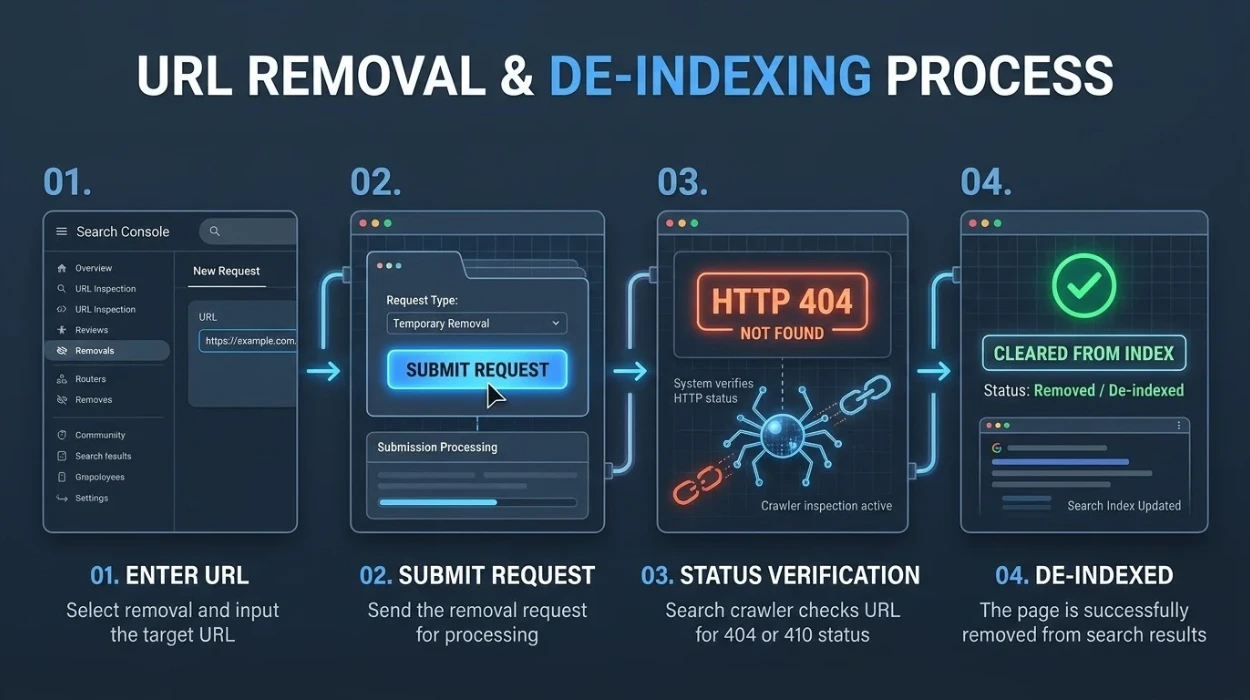
Immediate URL de-indexing requests help address search results that remain visible after the original content has been deleted, although removal from search results is not guaranteed instantly. The appropriate method depends on whether the source returns a genuine removal status, the content remains accessible, or the search engine retains an outdated indexed version.
Reputation management strategies differ based on whether the objective is to remove unavailable content from search results or improve the wider composition of a search engine results page (SERP). Online reputation control methods are evaluated through their effectiveness, speed, risk exposure and long-term influence on search visibility. Understanding these differences helps determine which technical or content-based approach addresses the underlying indexing problem.
Which URL De-Indexing Method Is More Effective: Google’s Removal Tool or Source Deletion?
Google’s removal tool and source deletion address different stages of the search visibility process, so their effectiveness depends on the condition of the original URL. Source deletion removes the content from the publisher’s website, while a search engine removal request addresses the appearance of a result within Google Search. Removing content at source establishes the underlying change, whereas submitting a request can accelerate the handling of eligible search results. Neither action automatically removes copies hosted on independent websites. Evaluating the methods requires distinguishing content availability from index visibility.
Source deletion is the primary approach when a publisher controls the original article and agrees to remove it. The server’s response provides a technical signal that helps search engines interpret the page’s status. A genuine 404 Not Found or 410 Gone response indicates that the requested content is unavailable, allowing the search engine to process the URL for removal from its index. However, the old result can remain visible until Google recrawls and updates its index. Source deletion therefore addresses the content itself, but it does not guarantee immediate changes to the SERP.
Google’s removal tools address search visibility more directly. The Refresh Outdated Content tool is relevant when a page or a substantial part of its content has disappeared or changed, but Google Search still displays outdated information. The Removals tool in Google Search Console provides eligible site owners with a temporary removal mechanism for URLs they manage. These tools serve different purposes and do not permanently replace the need to resolve the source page’s status. A temporary removal request also does not erase the original content from the web.
The most appropriate method follows the actual condition of the URL. When content is deleted and the page returns a genuine 404 or 410 response, recrawling and an outdated-content request address the remaining search visibility issue. When the content is still available, a removal request alone does not resolve the source-level problem. When a URL contains legally prohibited or sensitive material, separate policies and legal procedures apply. Accurate diagnosis prevents a technical indexing request from being used to address a problem it was not designed to solve.
How Does a 404 or 410 Response Compare with a Noindex Directive?
A 404 or 410 response and a noindex directive communicate different information to search engines. A 404 response indicates that the requested resource cannot be found, while a 410 response indicates that it has been removed and is expected to remain unavailable. A noindex directive tells a search engine not to include an accessible page in its search results. The first two responses concern resource availability, whereas noindex concerns eligibility for indexing. Choosing between them depends on whether the page has been deleted or remains available but is intended to stay out of search results.
A 404 response is appropriate when a URL no longer maps to an available resource. It allows the search engine to recognise that the requested page is missing and process the URL accordingly. A 410 response communicates removal more explicitly, but it does not provide an instant de-indexing guarantee. Both responses are suitable for permanently deleted content when the server is configured correctly. Their effectiveness depends on the URL returning the intended status rather than redirecting to an unrelated page or displaying a misleading error template.
A noindex directive is suitable when the page remains accessible to users but must not appear in search results. It is typically implemented through a robots meta tag or an appropriate X-Robots-Tag HTTP header. Search engines must be able to crawl the page to discover and process the directive. Blocking the URL in robots.txt can prevent a crawler from seeing the noindex instruction, which undermines the intended outcome. This method is therefore less appropriate for content that has already been permanently deleted.
The technical distinction matters for reputation signals because an incorrect response can delay the intended indexing outcome. A deleted article that returns HTTP 200 despite displaying an empty template can be interpreted as an existing page. A page that redirects to an irrelevant destination can also create confusing signals about the original URL. Technical validation confirms whether the source communicates the intended status to search engines. It also reduces the risk of repeatedly submitting requests while the underlying configuration remains incorrect.
Should You Use a Temporary Removal Request or Wait for Organic De-Indexing?
A temporary removal request prioritises the reduction of search visibility, while organic de-indexing depends on the search engine processing the page’s changed status through its normal systems. The temporary approach is designed to hide eligible results more quickly, whereas organic processing updates the index in response to crawling and other signals. The methods differ in speed, duration and technical requirements. A temporary request is not equivalent to permanent removal from an index. The correct evaluation considers both immediate visibility and the long-term status of the source URL.
Google Search Console’s Removals tool allows verified site owners to request temporary hiding of eligible URLs from Google Search. This is useful when a site owner needs to reduce the visibility of a result while resolving the underlying issue. However, a temporary removal generally lasts for a limited period, commonly around six months. If the page remains accessible and indexable after the temporary period, it can return to search results. The source must therefore be deleted, restricted or configured appropriately to support a lasting outcome.
Organic de-indexing follows the search engine’s normal crawling and indexing processes. After a publisher removes a page, Google revisits the URL and processes the response it receives. A genuine 404 or 410 response provides evidence that the resource is no longer available. The URL then drops from the index when Google processes the change, but the timing varies. Organic processing avoids reliance on a temporary hiding mechanism, although it does not offer the same level of immediate intervention.
The distinction also affects risk exposure. A temporary removal request without a permanent source-level change can create a false sense of completion because the result remains eligible to return. Organic de-indexing without a temporary request leaves the outdated result visible until the search engine processes the deletion. For an eligible URL controlled by a verified site owner, using a temporary request alongside a correct source response can address both short-term visibility and long-term index status. This combination still does not guarantee immediate or permanent removal across every search engine.
How Do Content Removal and Content Enhancement Compare in Reputation Management?
Content removal targets the availability or search visibility of specific material, while content enhancement improves the quality and context of information appearing across a SERP. Removal is appropriate when a page has been deleted, violates a platform policy or qualifies for a recognised removal process. Enhancement addresses a different problem: an incomplete or unbalanced search result landscape in which existing material dominates the available information. These approaches operate through different mechanisms and are not interchangeable. Their effectiveness depends on whether the underlying issue concerns an individual URL or the broader digital footprint of an entity.
Content removal operates through publisher action, technical status changes, search engine procedures or applicable legal and policy routes. Its direct objective is to eliminate a source or prevent an eligible result from appearing in search. When the source has genuinely disappeared, correct indexing signals support the removal process. When a page remains accessible and does not qualify for a removal policy, a request alone does not establish grounds for exclusion. This makes source control and eligibility central to removal strategy.
Content enhancement operates by publishing useful, accurate and relevant material that contributes additional context to an entity’s search results. Examples include complete professional biographies, authoritative organisational pages and accurate information on established platforms. Search engines evaluate each page according to their retrieval and ranking systems rather than automatically rewarding newly published content. As a result, enhancement does not guarantee that an existing negative article will lose visibility. Its value lies in building a more complete digital footprint over time.
The two approaches also differ in scalability. A valid source-level fix can address one deleted URL directly, while a content enhancement programme involves publishing, maintaining and monitoring information across multiple sources. Removal can have a direct effect on a particular result when the request succeeds, but it does not automatically address related copies. Enhancement can improve SERP composition, but it does not erase inaccurate material or resolve a technical indexing problem. Effective evaluation starts by identifying which of these conditions defines the reputation issue.
How Do Organic and Reactive Reputation Strategies Differ in Long-Term Impact?
Reactive reputation strategies respond to an existing problem, such as a deleted article remaining visible in a name search. Organic strategies develop accurate, relevant information and maintain the technical quality of owned digital assets over time. Reactive methods prioritise diagnosis and intervention, while organic methods focus on the continuing quality and breadth of available information. The distinction is one of timing and objective rather than a choice between mutually exclusive techniques. Both approaches influence search visibility through different mechanisms.
A reactive strategy begins by identifying the affected URL, checking its current status and determining whether the result is outdated, accessible or duplicated elsewhere. This approach limits unnecessary action because the intervention follows a specific diagnosis. For example, a deleted URL returning 404 requires a different response from a live page carrying a noindex directive. Reactive work is easier to measure when the target URL and intended outcome are clearly defined. Its limitation is that it addresses the identified issue rather than the entire reputation environment.
An organic strategy focuses on maintaining accurate website information, strengthening relevant entity references and publishing material that serves genuine user needs. These activities contribute to the wider set of documents available for a name search. Their influence depends on relevance, authority, indexing and competition from existing results. Publishing additional pages does not automatically suppress negative content, and search engines do not guarantee rankings based on publication volume. Sustainable enhancement requires useful information and ongoing technical maintenance rather than repetitive content production.
A combined approach separates urgent visibility problems from long-term reputation development. Reactive action addresses a specific technical or policy issue, while organic work improves the completeness and accuracy of the wider search environment. The balance depends on the severity of the issue, the publisher’s control over the content and the presence of copies elsewhere. Measuring each activity against its own objective prevents an improvement in SERP composition from being mistaken for successful de-indexing. It also avoids treating a single removed URL as proof that the broader reputation issue has been resolved.
How Can You Evaluate the Effectiveness and Risks of a De-Indexing Request?

The effectiveness of a de-indexing request is measured by whether the intended URL stops appearing in relevant search results and whether the underlying source condition supports a lasting outcome. A submitted request is an action, not evidence of completed removal. Evaluation therefore requires checking the URL response, the status of the request and the actual search results. Search visibility can differ between queries, locations and search engines, so a single search does not establish universal removal. A structured assessment makes the outcome more reliable and easier to verify.
A practical evaluation framework focuses on the following steps:
- Verify the original URL by checking its HTTP response and confirming that the deleted article is no longer served.
- Identify the correct Google process by distinguishing an outdated result from a live page, policy violation or third-party copy.
- Submit the eligible request through the relevant Google tool, using the exact URL and following the tool’s requirements.
- Monitor the result by checking the URL and relevant name queries after the search engine processes the change.
- Investigate persistent visibility by checking for redirects, alternative URLs, syndicated copies or references on other domains.
Each step addresses a distinct source of failure. Verification prevents a request from being based on an incorrect assumption about the page’s status. Correct tool selection aligns the request with the search engine’s stated process. Monitoring distinguishes a pending request from an actual change in search visibility. Investigating duplicates identifies cases where the original URL is no longer the only source of the information.
Risk evaluation also requires distinguishing technical removal from legal or policy-based removal. A deleted article that remains in a search index is not automatically unlawful, and the presence of a negative result does not itself establish grounds for removal. Legal rights, privacy rules, copyright claims and platform policies each have their own eligibility criteria. Submitting an inaccurate or unsupported request does not guarantee action and can divert attention from the relevant technical problem. A defensible process records the source status, the basis for the request and the observed outcome.
When Is URL De-Indexing More Suitable Than Broader Search Reputation Management?
URL de-indexing is more suitable when the problem centres on a specific page that is unavailable at source but remains visible in search results. Broader search reputation management is more relevant when the concern involves the overall balance, accuracy or prominence of information associated with a person or organisation. The distinction depends on the scope of the issue, not simply on how negative a result appears. A single outdated URL presents a narrower technical problem than a SERP containing multiple articles, reviews and third-party references. Correctly defining the scope prevents unrelated strategies from being treated as equivalent solutions.
A URL-level assessment focuses on the exact address, the server response, indexing eligibility and the relevant removal process. Its outcome is comparatively straightforward to verify because the target is a specific result. However, removing one URL does not necessarily change other pages associated with the same entity. Duplicate articles and independent references retain their own indexing status. This limits the scope of a successful de-indexing request.
Broader reputation analysis evaluates SERP composition, source diversity, sentiment distribution and the prominence of authoritative information. It considers how news coverage, reviews, profiles and other pages collectively shape entity perception. This approach measures the wider digital footprint rather than the status of one document. It offers a more complete view of search reputation, but its results depend on multiple ranking and publishing systems. It cannot substitute for a technical removal request when a specific outdated URL is the central issue.
The decision therefore rests on whether the problem is localised or systemic. A deleted page that remains indexed calls for source-status verification and the appropriate de-indexing procedure. A wider pattern of negative or incomplete search results requires analysis of the sources and reputation signals shaping the SERP. When both conditions exist, each needs a distinct objective and measurement method. This distinction provides a more accurate basis for evaluating scrubbing dead news article links from search engine indexing without confusing removal with broader search visibility management.
Dive Deeper With Our Expert Guides:
What Factors Cause Google to Retain Deleted Pages in Search Indexing
Comparing Self-Service Search Console Removals vs. Managed Dead Link Erasure
What Is the Most Reliable Way to Assess URL De-Indexing Outcomes?
The most reliable assessment combines technical verification, correct use of search engine procedures and continued monitoring of relevant search results. Source deletion establishes that the original content is no longer available, while de-indexing confirms that a particular search engine has stopped presenting the URL in its results. These outcomes are related but separate. A temporary hiding request can reduce visibility without resolving the source, and a source-level deletion can take time to appear in the index. Reliable measurement therefore treats source status and search visibility as distinct indicators.
The main strategic difference is between correcting the underlying page condition and changing the wider information environment. Source deletion, 404 or 410 responses, noindex directives and search engine removal tools each address different technical circumstances. Content enhancement contributes additional accurate information but does not guarantee suppression of an existing result. Reactive strategies target a defined problem, while organic strategies support ongoing digital footprint quality. Scrub dead news article links from search engine indexing by identifying outdated URLs and applying the appropriate de-indexing process. Evaluating effectiveness, sustainability and risk requires matching each method to the problem it actually resolves.
Online reputation is shaped by the interaction between content availability, indexing, ranking and user interpretation. A successful de-indexing outcome applies to the specific search engine and URL involved, not automatically to every copy or reference across the web. Continued monitoring helps distinguish a lasting change from a temporary visibility reduction. This evidence-based approach supports clearer decisions about technical indexing issues and broader reputation signals.
How do I request immediate URL de-indexing after content is deleted at source?
Confirm that the deleted URL returns a genuine 404 or 410 response, then use Google’s Refresh Outdated Content tool if the search result still displays outdated information. Verified site owners can also use Google Search Console’s Removals tool for eligible URLs requiring temporary hiding.
How long does Google take to de-index a deleted URL?
Google’s de-indexing timeline depends on crawling, indexing and the status of the original page. A removal request does not guarantee instant or permanent exclusion from search results.
What is the difference between URL removal and de-indexing?
URL removal refers to making content unavailable at its original address, while de-indexing means a search engine excludes that URL from its results. A deleted page can remain visible in search results until the search engine processes the change.
Can a deleted news article still appear in Google search results?
Yes, a deleted news article can remain visible when Google retains an outdated indexed version or has not yet processed the page’s removal. Syndicated copies, duplicate URLs and third-party references can also keep related information visible.
How can dead links removal services help with outdated search results?
Dead links removal services assess whether a URL is genuinely unavailable, identify outdated search listings and determine the appropriate removal or de-indexing process. The outcome depends on the page’s status, search engine eligibility rules and whether copies remain accessible on other websites.