
Reposted screenshots can be tracked by mapping duplicate images, copied text, URLs, account references, and indexed pages across the platforms where the content appears. Removal effectiveness depends on whether the approach targets the original source, individual reposts, search visibility, or the wider network of derivative copies.
Reputation management strategies differ based on whether the objective is content removal, search visibility control, or long-term reputation development. Online reputation control methods are evaluated through their ability to identify reputation signals, address harmful content at its source, and influence the composition of search results without confusing removal with suppression.
How Do Screenshot Tracking and Screenshot Removal Differ?
Screenshot tracking identifies where duplicated content exists, while screenshot removal focuses on reducing or eliminating specific copies from their hosting locations. Tracking is an information-discovery process that connects an original post with screenshots, reposts, quoted text, image duplicates, and related URLs. Removal is an intervention applied after those locations have been identified and assessed. The two functions therefore operate at different stages of reputation management.
Tracking provides visibility into the distribution of a piece of content, whereas removal changes the availability of individual copies. A screenshot hosted on a social network requires a different assessment from one embedded in an article or published on a forum. Each platform has its own ownership structure, reporting mechanisms, and content policies. A removal strategy that ignores this distinction produces incomplete coverage because eliminating one copy does not address independent versions elsewhere.
The difference also affects search visibility. A removed screenshot no longer contributes directly from its original URL, but another indexed copy can continue appearing in search results. Tracking therefore establishes the scope of the problem, while removal addresses individual information nodes. Effective evaluation requires measuring both the number of identified copies and the extent to which those copies remain discoverable.
Which Tracking Methods Are Most Effective for Reposted Screenshots?
Effective tracking combines text-based discovery, image matching, platform-specific searches, and URL analysis rather than relying on one search technique. Text-based discovery identifies distinctive phrases from the original post, while image matching identifies visually similar copies that contain modified or cropped versions of the screenshot. Platform-specific searches examine individual social networks, forums, websites, and other publishing environments. URL analysis then determines which discovered pages are independently indexed and connected to the entity.
Search queries are particularly useful when a screenshot contains distinctive wording. Exact phrases, usernames, hashtags, captions, and unusual combinations of terms provide identifiable search signals. Image-based discovery adds another layer because a repost can change the surrounding text while retaining the same visual content. Combining these methods improves coverage because textual duplication and visual duplication operate differently.
The main limitation is that no single tracking method provides complete visibility across every digital environment. Private accounts, closed groups, unindexed pages, deleted profiles, and dynamically loaded content reduce discoverability through conventional search. A screenshot can also be altered through cropping, resizing, editing, or reformatting. Tracking therefore functions as an iterative discovery process rather than a one-time search.
Is Content Removal More Effective Than Creating New Positive Content?
Content removal directly addresses the source of an unwanted reputation signal, while content creation strengthens alternative information around an entity. Removal operates by reducing the availability of a specific page, image, post, or publication. Content creation operates by introducing relevant, accurate, and authoritative information that can compete for search visibility. The two approaches therefore address different components of SERP composition.
Removal has a direct mechanism when a platform accepts a valid deletion request. Once the relevant content disappears from its hosting location, that specific URL loses its ability to serve the content to users. The limitation appears when independent copies remain elsewhere. Content creation does not depend on the removal of those copies, but its effect depends on search relevance, source authority, indexing, and competitive ranking conditions.
The distinction between content suppression vs content enhancement is therefore important. Suppression focuses on reducing the visibility of unwanted information, while enhancement focuses on increasing the visibility of credible and relevant information. Removal provides source-level intervention, whereas content creation provides search-level competition. Evaluating the two requires examining whether the primary problem is the existence of harmful content, its search prominence, or both.
How Does Organic Tracking Compare With Reactive Content Removal?
Organic tracking is a continuous monitoring approach that identifies new or changing references before intervention becomes necessary. Reactive removal begins after a screenshot or repost has already been identified and assessed. Organic monitoring provides broader visibility into the development of an entity’s digital footprint, while reactive removal concentrates resources on specific discovered instances. The approaches therefore differ in timing and operational scope.
Continuous tracking supports earlier identification of new copies. A monitoring system can detect recurring phrases, image matches, account mentions, and new indexed URLs associated with previously identified content. Reactive removal then addresses the specific pages that meet defined removal criteria. Combining monitoring with intervention creates a feedback loop between discovery and action.
The main difference concerns sustainability. Reactive removal alone treats each discovered copy as a separate event, which becomes less efficient as duplication increases. Organic tracking creates a persistent record of known sources and recurring distribution patterns. It therefore provides stronger visibility into content propagation, while requiring ongoing monitoring and consistent classification of new results.
Which Approach Provides Greater Short-Term Impact: Removal or Search Optimisation?
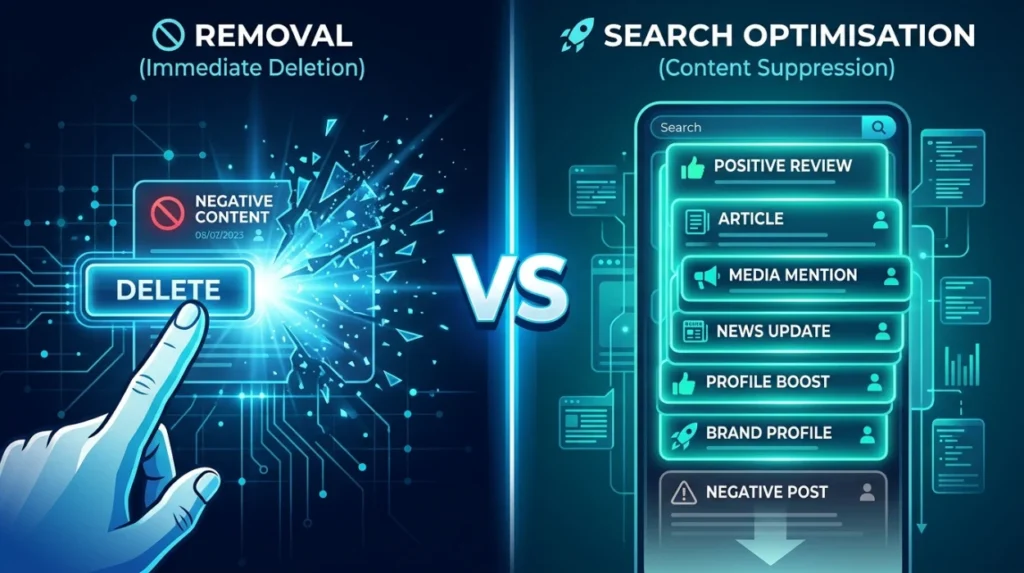
Removal generally creates the most direct short-term change when the specific source is successfully taken offline. Search optimisation produces a different type of impact by changing the relative visibility of content within search results over time. Removing an indexed webpage addresses the underlying URL, while optimisation attempts to alter SERP composition through relevance, authority, and content quality. The two mechanisms therefore operate on different time horizons.
A successful removal can immediately prevent users from accessing the content through the affected source. Search engines then process changes to the underlying page and update their indexes according to their crawling and indexing processes. Search optimisation requires competitive ranking signals to develop and gain visibility. Its impact therefore depends on the wider search environment rather than a single deletion event.
Short-term evaluation consequently focuses on source availability and immediate search presence. Long-term evaluation measures whether unwanted content remains discoverable through alternative URLs and whether credible information occupies relevant search positions. Removal provides a discrete intervention, while optimisation represents an ongoing visibility strategy. Measuring both prevents short-term disappearance from being confused with sustained search reputation improvement.
How Does SERP Composition Change After a Screenshot Is Removed?
SERP composition changes when a removed screenshot was hosted on a page that previously ranked for relevant queries. The removal eliminates or changes one information source within the search ecosystem, after which search engines reassess the affected URL and competing pages. Other pages can then occupy positions previously associated with the removed result. The resulting SERP therefore reflects the remaining indexed content rather than the deletion alone.
The effect depends on the authority and relevance of the removed source. A highly relevant page can have greater search ranking influence than an obscure page with limited visibility. Removing a low-ranking screenshot page produces a different SERP change from removing a highly visible article that contains the same image. Evaluation therefore requires measuring the position, traffic relevance, indexing status, and entity association of each identified source.
SERP composition also changes through duplication. If the same screenshot appears across ten URLs, removing one URL does not remove the remaining nine. Each copy represents an independent ranking opportunity where the content remains publicly accessible and relevant. Screenshot removal therefore requires source-by-source analysis rather than assuming that one successful removal resolves the complete search visibility problem.
How Does Content Authority Affect the Visibility of Reposted Screenshots?
Content authority affects screenshot visibility because search engines evaluate the source hosting the image as part of the broader document and website context. Authority is not a simple reputation score attached to an image; it relates to the characteristics and relevance of the source where the information appears. A screenshot embedded within a high-authority publication therefore exists within a different search environment from the same screenshot on a low-authority page.
Authority also interacts with relevance. A highly authoritative webpage that has little relevance to the search query does not automatically outrank every competing source. Search engines evaluate relationships between the query, page content, entities, and other ranking signals. The screenshot becomes part of this contextual evaluation through surrounding text, headings, links, captions, and page structure.
This distinction is important for risk evaluation. Removing a screenshot from one low-visibility page has limited impact if an authoritative publication continues displaying the same material. Conversely, a screenshot with limited source authority can still become significant when duplicated across relevant pages. Tracking therefore needs to evaluate both distribution volume and source characteristics.
How Do Search Engines Interpret Reputation Signals From Reposted Screenshots?
Search engines interpret reposted screenshots through the broader information associated with their host pages, entities, topics, and contextual references. A screenshot itself does not function as a definitive statement of factual accuracy. Instead, it forms part of a document that contains textual and structural signals. Search systems use those relationships to assess relevance and determine which pages satisfy user queries.
Reputation signals therefore operate collectively rather than as isolated reputation scores. Text surrounding an image can associate it with a person’s name, organisation, event, or topic. Links and references can reinforce those relationships, while contradictory or authoritative information can provide additional context. Entity credibility is consequently evaluated through a wider information environment.
Sentiment distribution adds another layer to this process. Positive, neutral, and negative references surrounding an entity can create different patterns in the available search landscape. A screenshot accompanied by critical commentary produces a different contextual signal from the same screenshot embedded within a neutral historical discussion. Evaluating reposted screenshots therefore requires analysing the content itself and the sentiment and authority of the pages distributing it.
Dive Deeper With Our Expert Guides:
How to Slow the Spread of a Viral Harmful Post
What Legal Routes Exist to Remove Deepfake Content in the UK
How Does Short-Term Removal Compare With Long-Term Reputation Control?
Short-term removal focuses on eliminating specific sources, while long-term reputation control evaluates the stability of the entire digital information environment. A removal action addresses an identifiable URL, image, post, or page. Long-term control examines whether similar information continues appearing through new publications, reposts, reviews, discussions, or search results. The difference is therefore between discrete intervention and sustained information management.
Short-term removal provides measurable outcomes such as a page becoming inaccessible or a screenshot disappearing from a particular platform. Long-term evaluation measures changes in search visibility, content distribution, sentiment patterns, source authority, and entity associations. These metrics reveal whether the original information problem has been contained or simply redistributed. The distinction is particularly relevant when screenshots have already propagated across independent platforms.
Sustainability depends on the persistence of the underlying information network. A strategy that addresses one URL without monitoring related sources has limited visibility into future duplication. A strategy that continuously tracks the entity’s digital footprint provides stronger detection of emerging copies. Long-term reputation control therefore requires measurement beyond the initial removal event.
Which Factors Determine Whether Screenshot Removal Is Sustainable?
Sustainable screenshot removal depends on source identification, legitimate removal grounds, platform responsiveness, duplication levels, and continued monitoring. Source identification determines whether all significant copies have been located. Removal grounds determine whether each platform has a recognised basis for taking action. Duplication levels determine how many independent information nodes require assessment.
Platform responsiveness also affects the time and consistency of removal outcomes. A screenshot hosted on one platform is subject to that platform’s policies, while an identical copy on another platform is evaluated independently. This creates operational variation between sources. Monitoring remains necessary because a removed screenshot can reappear through a new upload or derivative copy.
A structured evaluation can therefore assess screenshot removal through four measurable dimensions:
- Map each known copy by recording its URL, platform, publication date, account reference, and indexing status.
- Classify each source by determining whether it represents an original publication, direct screenshot, edited duplicate, quotation, or contextual reference.
- Evaluate visibility by measuring search position, source authority, query relevance, and relationship to the affected entity.
- Monitor changes by checking whether removed material disappears, remains indexed, or reappears through another independent URL.
This framework separates discovery from intervention and prevents the number of identified copies from being confused with their actual search ranking influence.
How Should Content Removal and Content Enhancement Be Evaluated Together?
Content removal and content enhancement are best evaluated as complementary mechanisms rather than interchangeable methods. Removal reduces the availability of a specific reputation signal, while enhancement increases the visibility of alternative information. Neither approach automatically resolves every part of a distributed digital footprint. Their effectiveness depends on the underlying cause of the search visibility problem.
Removal has stronger source-level precision because it directly targets a specific publication. Enhancement has broader search-level applicability because it introduces additional relevant information that can compete within the SERP. However, enhancement does not erase the underlying source, and removal does not automatically eliminate independent copies. A combined assessment therefore examines whether both source availability and search prominence require attention.
The appropriate comparison depends on measurable objectives. If the primary issue is a policy-violating or otherwise removable screenshot, source-level intervention has greater relevance. If the issue concerns an indexed narrative distributed across legitimate publications, content enhancement and broader search analysis become more relevant. Evaluating these methods through mechanism, risk exposure, scalability, and sustainability provides a more accurate basis for strategic selection.
What Is the Most Reliable Framework for Evaluating Reposted Screenshot Management?
The most reliable framework evaluates the complete content lifecycle from discovery through indexing, distribution, intervention, and monitoring. Tracking establishes where the information exists, classification determines what type of copy each source represents, and visibility analysis establishes its search importance. Removal then addresses eligible sources according to their platform and legal context. Monitoring evaluates whether the intervention produces a lasting change.
This framework also distinguishes search ranking influence from content existence. A screenshot can exist online without receiving meaningful search visibility, while another copy can become prominent because of source authority and query relevance. Treating every copy as equally significant creates inefficient prioritisation. Risk evaluation therefore requires weighting sources according to visibility, authority, relevance, duplication, and entity association.
The framework remains sustainable when it incorporates both reactive and organic processes. Reactive action addresses identified sources, while ongoing tracking detects new copies and changes in SERP composition. This combination provides a clearer view of whether a reputation signal has actually been reduced or simply moved to another location. The result is a more precise model of digital footprint management.
The decision between tracking, removal, and search-focused approaches also depends on the distribution pattern of the screenshots. When a deleted post has generated independent copies across multiple platforms, Remove Circulating Screenshots of Deleted Posts represents a distinct source-level approach that differs from simply improving the visibility of alternative content. Evaluating the distribution first establishes whether removal, monitoring, or content enhancement addresses the dominant source of search visibility.
Tracking and removing reposted screenshots involve distinct but connected reputation management functions. Tracking maps the distribution of content, while removal targets individual information sources; content enhancement operates differently by strengthening alternative search-visible information. Organic monitoring provides continuity, whereas reactive intervention addresses identified risks. Short-term removal produces direct source-level changes, while long-term reputation control evaluates whether those changes remain stable across the wider digital ecosystem.
The effectiveness of each approach depends on search visibility, authority, duplication, sentiment distribution, platform conditions, and the relationship between content and entity credibility. SERP composition changes according to the information that remains indexed and relevant after an intervention. A sustainable evaluation therefore measures both source-level outcomes and wider search ranking influence rather than treating a single deletion as a complete reputation outcome.
How can I track reposted screenshots across different platforms?
Reposted screenshots can be tracked using exact-text searches, image-matching tools, platform-specific searches, usernames, URLs, and distinctive phrases from the original post. Combining these methods helps identify duplicate images and indexed copies across social networks, websites, forums, and search results.
Can reposted screenshots be removed from social media platforms?
Reposted screenshots can be removed when they violate a platform’s content policies, privacy rules, copyright requirements, or other applicable grounds. Each copy requires separate assessment because removing the original post does not automatically remove independently uploaded screenshots.
Does removing the original social media post remove all screenshots?
No, deleting the original post only affects the content hosted on that particular platform. Screenshots, reposts, quotations, and archived copies can remain available on other websites or social media platforms.
How do reposted screenshots affect online reputation?
Reposted screenshots can become reputation signals when they are associated with a person, business, or organisation in search results and online discussions. Their influence depends on factors such as search visibility, source authority, context, sentiment distribution, and entity relevance.
How long does it take to remove reposted screenshots from the internet?
Removal time varies according to the platform, reason for removal, verification requirements, and number of independent copies. A screenshot removed from one source can remain visible elsewhere, so tracking and monitoring are important for evaluating the wider digital footprint.