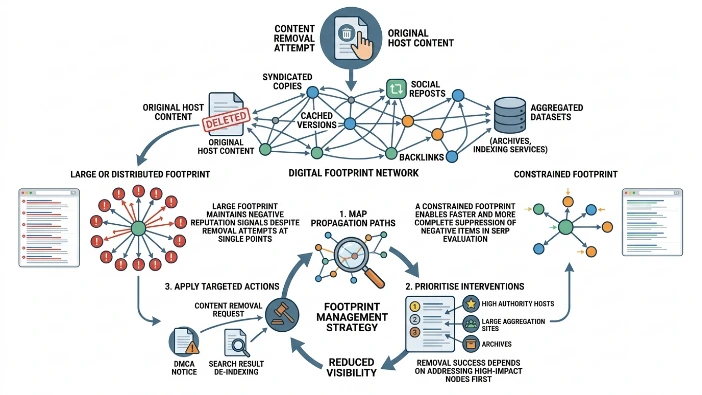
Professional Content Removal Services for Online Reputation Protection relate to the management of online information that influences visibility, credibility, and trust within search ecosystems. Content visibility affects how search engines and users evaluate entities, making information control an important component of digital reputation analysis.
Reputation management is the process of analysing how information influences trust, authority, and credibility across digital environments. Online reputation refers to the collection of reputation signals associated with an entity that search engines, publishers, users, and platforms interpret during search evaluation and content ranking processes.
What Are Professional Content Removal Services Within Reputation Management?
Professional content removal services are reputation management mechanisms that focus on reducing the accessibility or visibility of information across digital ecosystems. These processes relate to content indexing, search visibility, and information governance rather than content creation.
Content removal refers to the restriction, deletion, deindexing, or management of specific information assets that exist online. Within search ecosystems, content removal affects how information becomes available for discovery and evaluation. Search engines rely on indexed information to generate search results, making content accessibility a key factor in visibility.
Search visibility is influenced by the amount, quality, and accessibility of indexed information. When information becomes inaccessible or removed, search systems adjust retrieval processes accordingly. This directly affects how entities appear within search engine results pages (SERPs).
Professional content removal services therefore represent a category of reputation management activities that focus on controlling information exposure and search discoverability.
How Is Online Reputation Formed Through Search Ecosystems?
Online reputation is formed through the interaction between indexed information, search algorithms, user interpretation, and authority signals. Search engines organise information and present it through ranking systems that influence perception.
Entity perception refers to the understanding users and search systems develop about a person, organisation, or business. This perception is influenced by the information available within search results. Articles, reviews, images, videos, and social content all contribute to reputation signals.
Search engines evaluate content using relevance, authority, and trust indicators. These signals help algorithms determine which information receives greater visibility. Highly visible content often exerts greater influence on online credibility because users encounter it more frequently.
The formation of online reputation therefore depends on content indexing, ranking mechanisms, and information accessibility across search environments.
Why Does Content Visibility Influence Reputation Signals?
Content visibility influences reputation signals because information must first be discoverable before it can affect perception. Visibility determines exposure, and exposure shapes interpretation.
Reputation signals refer to the indicators search engines and users use to assess credibility, authority, and trustworthiness. Search visibility amplifies the influence of these signals by increasing access to information associated with an entity.
Content ranking dynamics determine which information receives prominent placement within SERPs. Information that occupies highly visible positions contributes more significantly to entity perception than information located deeper within search results.
Search perception therefore emerges from the relationship between visibility and interpretation. Content that achieves strong visibility becomes an influential component of online reputation regardless of whether the information is positive, neutral, or negative.
How Does Search Exposure Affect Entity Perception?
Search exposure affects entity perception because repeated visibility increases informational influence. Users frequently interpret visible information as relevant evidence when evaluating credibility and authority.
Search algorithms contribute to this process by prioritising information they determine to be relevant and authoritative. As visibility increases, the influence of associated reputation signals also increases.
How Do Search Engines Evaluate Content for Ranking and Visibility?

Search engines evaluate content through relevance analysis, authority assessment, content indexing, and user-focused ranking systems. These mechanisms determine whether information becomes visible within search results.
Content indexing is the process of storing and organising information for retrieval. Once content becomes indexed, search engines can evaluate it against search queries and ranking criteria.
Authority signals are indicators of credibility and expertise. Search systems analyse source reliability, topical relevance, citation relationships, and historical performance when evaluating authority. These factors influence ranking outcomes.
SERP evaluation combines relevance and authority indicators to determine content visibility. Information that satisfies ranking requirements receives greater exposure, influencing how users interpret associated entities.
The evaluation process demonstrates that visibility results from algorithmic assessment rather than random placement.
What Is the Relationship Between Content Removal and Search Visibility?
Content removal influences search visibility because inaccessible information cannot contribute to search retrieval in the same way as accessible information. Visibility depends on content availability within searchable environments.
Content accessibility refers to whether search engines can discover, process, and retrieve information. When content availability changes, search visibility changes accordingly. This relationship forms a central component of reputation management analysis.
Search ecosystems continuously update indexed databases to reflect content changes. Removal, deindexing, and access restrictions alter the available information pool that search engines evaluate.
As a result, content removal affects how information contributes to digital footprints, entity perception, and reputation signals within search ecosystems.
Why Do Authority and Trust Signals Matter in Reputation Analysis?
Authority and trust signals matter because search engines use them to evaluate credibility and determine ranking potential. These signals influence both search visibility and user interpretation.
Authority refers to the perceived expertise and reliability of a source. Trust signals refer to indicators that support confidence in information accuracy and authenticity. Together, these factors influence search ranking outcomes.
Search systems analyse authority through source reputation, content quality, citation patterns, and topical consistency. Trust indicators strengthen credibility assessments and contribute to SERP evaluation processes.
The influence of authority and trust signals extends beyond rankings. They also affect how users interpret visible information and evaluate online credibility.
How Do Digital Footprints Influence Online Credibility?
Digital footprints influence online credibility because they represent the cumulative information associated with an entity across digital environments. Search engines and users analyse these information patterns when evaluating reputation.
Digital footprints consist of indexed content, reviews, articles, images, videos, and other publicly accessible information. Each component contributes to entity perception and reputation signals.
Search visibility determines which elements of a digital footprint receive greater attention. Highly visible information influences credibility assessments more strongly because it becomes part of the immediate evaluation process.
Within reputation management analysis, understanding Online Reputation & Content Removal helps explain how information accessibility, search visibility, and content control contribute to broader reputation outcomes.
How Do Review Signals and Sentiment Interpretation Affect Reputation?
Review signals affect reputation because they provide searchable indicators that contribute to credibility evaluation and entity perception. Search engines analyse review-related information as part of broader reputation assessment frameworks.
Sentiment interpretation refers to the analysis of positive, neutral, and negative information associated with an entity. Search systems evaluate sentiment distribution to understand how users and publishers describe specific subjects. This process contributes to reputation signals and influences search perception.
Reviews become part of digital footprints when they are indexed and made accessible through search environments. The visibility of review content affects how users interpret credibility and authority. Highly visible review information often contributes significantly to online reputation assessment.
The relationship between review signals and sentiment interpretation demonstrates how user-generated information influences both search visibility and perception across digital ecosystems.
How Do Search Engine Results Pages Shape Online Credibility?
Search engine results pages shape online credibility because they function as information gateways that determine which content users encounter first. SERPs organise indexed information according to ranking systems designed to maximise relevance and usefulness.
Online credibility refers to the perceived trustworthiness and authority associated with an entity. Search visibility contributes directly to credibility because users frequently evaluate information based on its prominence within search results.
SERP evaluation determines which content receives priority placement. Information appearing in highly visible positions often carries greater influence during credibility assessments because it becomes part of the user’s initial impression.
Search ecosystems therefore shape online credibility through ranking mechanisms that control information exposure. The visibility of content influences how reputation signals are interpreted and understood.
What Role Does Content Indexing Play in Reputation Management?
Content indexing plays a central role in reputation management because indexed information forms the foundation of search visibility. Without indexing, information remains largely inaccessible within search environments.
Content indexing refers to the organisation and storage of information for future retrieval. Search engines analyse indexed content to determine relevance, authority, and ranking potential. This process influences how entities are represented online.
Reputation management analysis frequently focuses on indexed information because visibility depends on retrieval eligibility. Content that remains outside searchable databases contributes less directly to search perception than content that is actively indexed.
The relationship between indexing and visibility demonstrates why information accessibility remains a key factor in reputation systems. Indexed content becomes part of the reputation signals available for user evaluation.
Why Is Information Control Relevant to Search Perception?
Information control is relevant to search perception because search engines rely on accessible information when constructing search results. The information available for indexing and retrieval directly influences how entities are evaluated online.
Search perception refers to the interpretation of an entity based on visible search results. This perception develops through exposure to indexed information, authority signals, and credibility indicators. Information control affects which content contributes to these evaluations.
Content accessibility, visibility, and indexing status all influence perception outcomes. Information that is highly accessible and prominently ranked contributes more strongly to reputation signals than information with limited visibility.
The relevance of information control demonstrates how content management practices influence broader reputation systems. Search ecosystems continuously process available information, making accessibility an important factor in perception formation.
Professional Content Removal Services for Online Reputation Protection relate to the management of information visibility within search ecosystems. Content accessibility, indexing status, authority signals, and ranking dynamics all influence how information contributes to reputation signals and entity perception.
Online reputation develops through the interaction of indexed content, search visibility, trust indicators, review signals, and credibility assessments. Search engines organise and evaluate information using structured ranking systems that determine exposure and influence.
Understanding the relationship between content removal, visibility management, digital footprints, and search perception provides a clearer view of how reputation systems operate. These mechanisms demonstrate that online credibility is shaped by information accessibility, content evaluation, and search ecosystem dynamics rather than by any single reputation factor.
What are professional content removal services for online reputation protection?
Professional content removal services focus on managing the visibility of online information that affects reputation signals, search visibility, and entity perception. These processes may involve content removal, deindexing, or accessibility management within search ecosystems.
How does content removal affect online reputation?
Content removal can influence online reputation by changing the information available within search engine results pages (SERPs). Reduced visibility of specific content affects reputation signals, digital footprints, and search perception.
Why is search visibility important in reputation management?
Search visibility determines how easily information can be discovered and evaluated online. Highly visible content contributes more significantly to online credibility, entity perception, and reputation assessment.
What is the difference between content removal and content deindexing?
Content removal focuses on eliminating information from its source location, while deindexing focuses on reducing visibility within search results. Deindexed content may remain online but becomes less accessible through search engines.
How do Online Reputation & Content Removal strategies influence digital credibility?
Online Reputation & Content Removal strategies influence digital credibility by affecting content accessibility, search visibility, and reputation signals. These factors help shape how users and search engines evaluate trust, authority, and online credibility.