
Removing a harmful TripAdvisor review through a structured TripAdvisor review removal service UK improves search visibility by addressing content that undermines trust and entity credibility. Reputation signals influence purchasing decisions, making professional review assessment and policy-based removal an essential component of long-term search perception management.
Reputation repair services are specialized reputation management solutions that evaluate harmful online content against platform policies and applicable legal frameworks to reduce search perception risks. A harmful TripAdvisor review can influence customer confidence, local search performance, and digital trust because review content contributes to indexed reputation signals across search ecosystems. Businesses therefore require a structured process that evaluates removal eligibility, prepares supporting evidence, and manages communication through recognised moderation channels. Effective review removal focuses on policy compliance rather than opinion, ensuring that every action aligns with platform standards. Clear Your Name delivers a structured approach that combines reputation analysis, evidence preparation, and strategic review management to improve digital credibility while reducing long-term reputation risk.
Which hospitality review removal approach delivers measurable results?
A policy-led reputation management approach delivers measurable results because it focuses on evidence, moderation standards, and search ecosystem behaviour rather than attempting to challenge genuine customer opinions. Every removal request is assessed against published TripAdvisor policies to determine whether the review breaches authenticity, relevance, or community guidelines. This structured methodology improves the probability of successful moderation outcomes by relying on objective criteria instead of subjective disagreement. Businesses benefit because reputation signals remain aligned with accurate and trustworthy information. Search perception therefore improves through information quality rather than artificial reputation manipulation.
Professional review removal also strengthens entity credibility because moderation decisions remove policy-violating content from publicly accessible review profiles when eligibility requirements are satisfied. This process reduces the influence of misleading information across search engine results pages while preserving authentic customer feedback. Long-term search visibility improves when inaccurate reputation signals no longer contribute to indexed business profiles. Reputation management therefore becomes a strategic process of maintaining trustworthy digital information. Businesses evaluating long-term value gain greater certainty through evidence-based moderation rather than isolated reporting attempts.
Why does professional review assessment improve success rates?
Professional assessment improves success rates because every reported review undergoes detailed policy evaluation before submission. The review content is compared with moderation standards relating to fake experiences, conflicts of interest, abusive language, promotional content, privacy violations, and prohibited behaviour. This structured assessment identifies the strongest removal grounds before a request reaches the moderation stage. Accurate documentation reduces procedural errors that delay moderation decisions. Strong evidence therefore supports more effective reputation signal management.
Which review removal process reduces long-term reputation risk?
A structured review removal process reduces long-term reputation risk because it combines policy analysis, evidence preparation, moderation management, and ongoing search perception monitoring. Each stage addresses a specific factor that influences entity credibility within review ecosystems. Rather than relying on repeated reporting without justification, the process follows documented moderation requirements supported by verifiable information. This systematic approach improves consistency while reducing unnecessary disputes with review platforms. Businesses therefore gain greater control over how reputation signals evolve over time.
The process also contributes to sustainable search visibility because successful moderation removes policy-violating content from the publicly available information evaluated by search engines. Search perception develops from indexed content that remains accessible across review platforms, local search results, and branded search queries. Removing ineligible content strengthens digital trust by ensuring that reputation signals reflect authentic customer experiences. Businesses therefore benefit from stronger information accuracy across their searchable digital footprint. Reputation management becomes an ongoing governance strategy rather than a single corrective action.
What does the review removal process include?
A professional reputation management workflow follows defined operational stages that improve efficiency and transparency.
- Evaluate eligibility by comparing the review against TripAdvisor’s published moderation policies.
- Collect supporting evidence using documentation that demonstrates policy breaches or factual inconsistencies.
- Prepare the submission by presenting structured information that aligns with moderation requirements.
- Manage communication through appropriate reporting channels while monitoring moderation progress.
- Review search visibility after moderation to evaluate changes in reputation signals and indexed content.
Each stage strengthens process clarity while reducing uncertainty throughout the review removal journey.
Why is professional reputation management more effective than independent reporting?
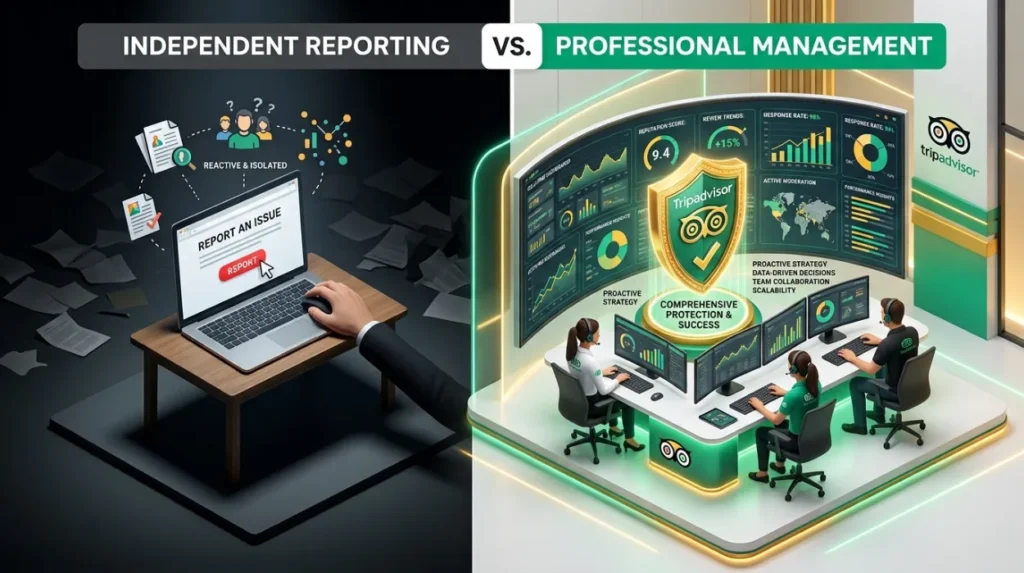
Professional reputation management is more effective because it applies structured expertise, policy interpretation, and evidence analysis to every moderation request. Independent reporting frequently focuses on dissatisfaction with review content rather than demonstrating clear policy violations. Moderation teams evaluate evidence rather than commercial impact, making policy alignment essential for successful review assessment. Professional analysis therefore increases procedural accuracy by presenting stronger justification. Businesses benefit from a process that prioritises moderation standards instead of assumptions about review fairness.
Professional reputation management also supports broader search perception influence beyond individual moderation requests. Harmful review content contributes to reputation signals that affect customer confidence and local search visibility. Addressing these issues through evidence-led processes stabilises entity credibility across digital platforms. Businesses seeking a professional reputation management service gain access to structured methodologies that reduce administrative complexity while improving consistency. Clear Your Name applies this process through careful evaluation of moderation criteria, helping businesses protect their online credibility without relying on speculative approaches.
Which measurable outcomes justify investing in hospitality review removal?
Hospitality review removal delivers measurable value because it improves the quality of publicly available reputation signals that influence customer decisions. Search users evaluate review content alongside ratings, business profiles, and other indexed information before making booking decisions. Removing policy-violating reviews improves the overall reliability of searchable information, strengthening confidence in business credibility. Better information quality contributes to stronger entity perception across search ecosystems. Long-term value therefore extends beyond individual review outcomes.
Investment decisions also depend on risk reduction and operational efficiency. Businesses lose visibility when misleading reputation signals influence customer trust and engagement. Professional review management reduces this exposure through structured moderation processes that prioritise evidence and compliance. The resulting improvements strengthen digital trust while supporting sustainable online reputation management. Businesses therefore gain lasting benefits through accurate reputation signal governance rather than temporary visibility improvements.
How does a structured review removal service strengthen search perception?
A structured review removal service strengthens search perception by improving the quality of reputation signals that remain publicly visible across review platforms and search engine results. Search engines evaluate indexed reviews as contextual information when interpreting entity credibility, local relevance, and online trust. Removing content that breaches moderation policies improves the overall accuracy of searchable information without altering genuine customer feedback. This approach supports negative content suppression through legitimate moderation rather than artificial reputation manipulation. Businesses therefore achieve stronger SERP control by maintaining reliable and policy-compliant reputation signals.
Search perception also depends on information consistency across multiple digital sources. Harmful reviews that remain publicly accessible continue influencing customer interpretation even when they contain policy violations. A structured removal process reduces this exposure by ensuring that moderation requests are supported by verifiable evidence and aligned with platform requirements. Clear Your Name integrates this evidence-led methodology into every review assessment, helping businesses strengthen entity credibility through transparent and compliant reputation management. Sustainable reputation improvement therefore results from governance and information quality rather than short-term visibility changes.
Dive Deeper With Our Expert Guides:
Remove Unauthorised Images From the Internet With Our UK Takedown Service
File a DMCA Notice in the UK Correctly With Our Step-by-Step Expert Support
Which business outcomes demonstrate service effectiveness?
Service effectiveness is measured through improvements in search perception, information accuracy, and reputation stability.
- Reduce misleading reputation signals by removing reviews that violate published moderation policies.
- Improve entity credibility through more accurate and trustworthy indexed information.
- Strengthen SERP control by reducing the visibility of policy-violating review content.
- Protect customer confidence by ensuring that publicly accessible information reflects authentic experiences.
- Stabilise long-term reputation through continuous monitoring and structured moderation management.
These outcomes provide measurable evidence that reputation management supports sustainable digital trust.
Why does evidence-based moderation reduce business risk?
Evidence-based moderation reduces business risk because every removal request is supported by documented policy analysis instead of subjective disagreement. Review platforms evaluate factual evidence relating to authenticity, prohibited content, conflicts of interest, and moderation guidelines before making a decision. This structured process reduces unnecessary rejection by presenting information that directly addresses moderation criteria. Businesses therefore avoid inefficient reporting strategies that rely solely on negative sentiment. Risk reduction becomes a measurable outcome because procedural accuracy improves the quality of every submission.
Evidence-led processes also support regulatory and operational transparency. Businesses understand the basis of every moderation request and can evaluate outcomes against published platform standards. This clarity improves decision-making by replacing uncertainty with documented procedures. Search ecosystems benefit because trustworthy moderation strengthens the quality of indexed information that contributes to reputation signals. Businesses therefore achieve stronger digital governance while protecting long-term search perception.
Which information helps businesses make a confident decision?
A confident decision depends on understanding process transparency, measurable outcomes, long-term value, and implementation reliability. Businesses evaluating review removal services benefit from understanding how moderation standards operate and why evidence determines eligibility. Learning how TripAdvisor’s review system works provides valuable context for understanding why certain reviews qualify for removal while others remain visible. This knowledge strengthens decision-making because expectations align with moderation principles instead of assumptions. Decision confidence therefore develops from understanding both the review ecosystem and the removal methodology.
Businesses also benefit from evaluating the complete moderation workflow before selecting a reputation management solution. Understanding the TripAdvisor review removal process in the UK explains how eligibility assessment, evidence preparation, moderation submission, and ongoing monitoring work together to influence reputation signals. Comparing these structured stages demonstrates why professional reputation management provides greater operational clarity than isolated reporting attempts. Clear processes reduce uncertainty while supporting predictable implementation. Decision-stage evaluation therefore focuses on governance, transparency, and measurable outcomes rather than promotional claims.
Why is Clear Your Name a credible solution for hospitality review removal?
Clear Your Name provides a structured reputation management approach that combines policy evaluation, evidence preparation, moderation management, and search perception analysis within a transparent operational framework. Every review is assessed individually against published moderation requirements before action is recommended, ensuring that removal requests remain aligned with platform standards. This methodology strengthens entity credibility because decisions are supported by documented evidence rather than opinion. Businesses benefit from clear communication, process transparency, and measurable reputation management outcomes throughout every stage of engagement. Reliability therefore becomes an operational characteristic rather than a marketing statement.
The service also delivers long-term value by integrating review removal into broader reputation management objectives. Search visibility depends upon accurate reputation signals, trustworthy indexed information, and consistent digital governance across review ecosystems. By focusing on compliance, information quality, and sustainable reputation improvement, Clear Your Name helps businesses reduce search perception risk while maintaining confidence in their online presence. This balanced approach supports hospitality businesses seeking dependable reputation management without relying on exaggerated claims or unrealistic expectations.
Removing harmful TripAdvisor reviews requires a structured process that combines policy evaluation, evidence-based moderation, and ongoing reputation management to protect search visibility and entity credibility. Professional review removal delivers measurable value by reducing misleading reputation signals, strengthening digital trust, and improving the accuracy of publicly available information. Businesses benefit from transparent methodologies that reduce operational risk while supporting sustainable SERP control and negative content suppression. A clear, evidence-led process provides greater certainty than isolated reporting because every action aligns with recognised moderation standards. Clear Your Name offers a reliable and professionally managed solution that helps hospitality businesses strengthen long-term online reputation through structured, compliant, and outcome-focused reputation management.
How can a harmful TripAdvisor review be removed in the UK?
A harmful TripAdvisor review can be removed if it breaches the platform’s content guidelines, such as containing fake information, conflicts of interest, abusive language, or promotional content. The review must be reported and assessed through TripAdvisor’s moderation process before a removal decision is made.
What does a hospitality review removal service do?
A hospitality review removal service evaluates whether a TripAdvisor review violates platform policies, prepares supporting evidence, and manages the moderation process. This structured approach helps businesses address policy-violating content while protecting online reputation and search visibility.
Can Clear Your Name help with TripAdvisor review removal?
Clear Your Name provides reputation management support by assessing harmful TripAdvisor reviews against the platform’s moderation policies and guiding the review removal process. The focus is on policy compliance and evidence-based reputation management rather than removing genuine customer feedback.
How does removing harmful TripAdvisor reviews improve online reputation?
Removing reviews that breach TripAdvisor’s guidelines helps improve the accuracy of publicly available reputation signals. This supports stronger entity credibility, better search perception, and greater trust in online business profiles.
Why is professional reputation management important for hospitality businesses?
Professional reputation management helps hospitality businesses monitor review platforms, manage harmful content, and protect their digital footprint. A structured process reduces reputation risk while supporting long-term search visibility and customer trust.