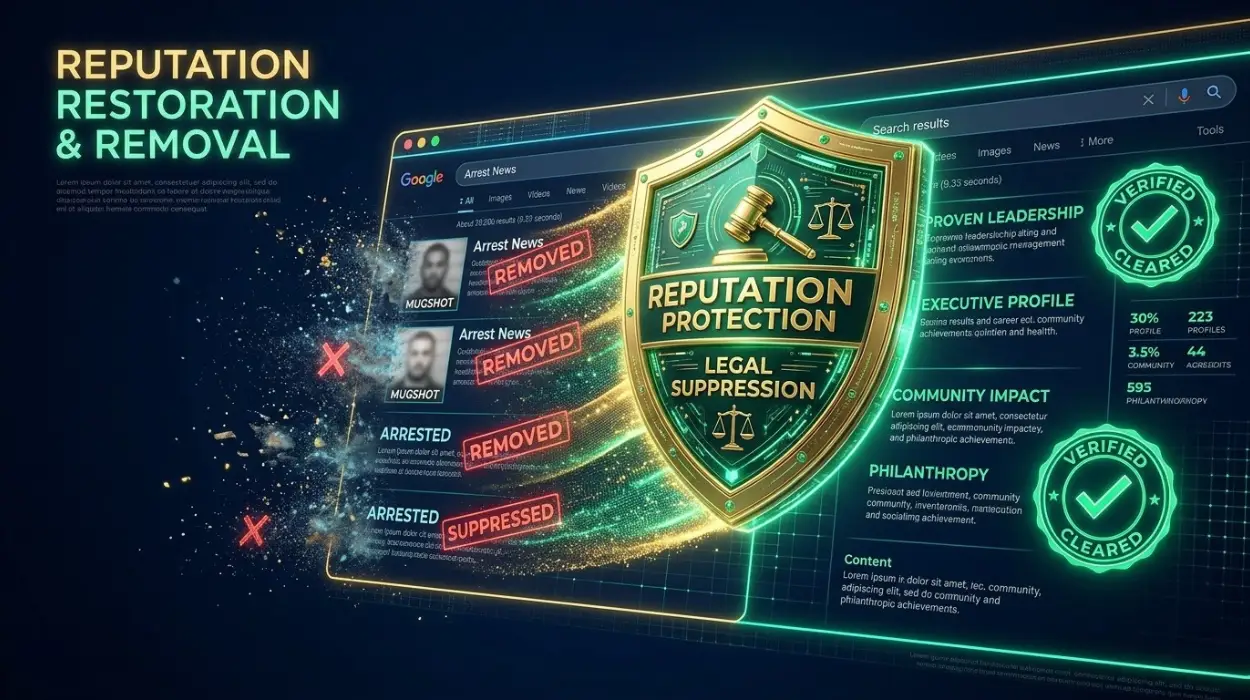
Professional criminal record removal services help individuals challenge eligible arrest-related content, correct misleading reporting and improve the visibility of accurate information. Clear search visibility control strengthens reputation signals, supports informed decision-making and reduces the influence of outdated or incomplete arrest reports on public perception.
An arrest report can remain prominent in search results after an acquittal, dismissal or other favourable legal outcome because publishers and search engines manage content independently. Effective reputation management addresses the specific source of the problem, establishes which remedies are available and measures changes in search visibility over time. The objective is not to erase lawful history indiscriminately, but to address eligible content, strengthen entity credibility and improve the accuracy of the information people encounter when searching a name.
Which criminal record removal service delivers the most reliable results?
A professional criminal record removal service delivers a structured assessment of arrest-related content, evidence-based action and measurable monitoring of search results. The process begins by identifying the URLs, publishers and search listings associated with the issue. Each item is assessed for factual accuracy, legal context, publication status and eligibility for correction or removal. This establishes whether the strongest route involves a publisher complaint, a formal removal request or a wider reputation management strategy. A defined process also prevents resources being spent on actions that do not address the actual source of the reputational problem.
Clear Your Name provides a focused route for assessing online reputation issues involving past arrest reporting and related search results. The service approach centres on identifying the content, organising supporting evidence and determining the appropriate action for each eligible URL. This matters because an accurate report that omits a later acquittal presents a different problem from an article containing demonstrably false information. Matching the remedy to the evidence improves procedural clarity and reduces the risk of unrealistic expectations. Progress is assessed through documented actions and observable changes rather than promises of guaranteed deletion.
A reliable service also distinguishes source-level outcomes from search-level outcomes. A publisher may correct or remove an article, while a search engine separately updates its index and displays the revised page or removes an eligible result. These changes do not always occur simultaneously, so the process requires verification at each stage. A service that records the original URL, the requested remedy, the response and the resulting search status gives clients a clearer account of progress. This evidence-based approach supports trust and makes decisions about further action more informed.
How can cleared arrest news articles be removed from search results?
Cleared arrest news articles are addressed through a review of the original reporting, the legal outcome and the policies governing publication or search visibility. The first step is to establish exactly what the article says and compare it with reliable records of the case. Court documents, official statements and documented corrections help establish whether the report contains an error or omits material context. The assessment then identifies the organisation responsible for the content and the rules relevant to the requested remedy. This creates a defensible basis for action instead of relying on the negative impact of the article alone.
The removal process typically follows these steps:
- Identify the relevant URLs by recording publisher pages, duplicate reports, archive copies and search results associated with the person’s name.
- Verify the legal outcome by gathering reliable documents that establish an acquittal, dismissal, correction or other material development.
- Assess the available remedy by checking publisher policies, applicable legal grounds and the search provider’s removal criteria.
- Submit a focused request that identifies the disputed content, explains the factual or procedural issue and attaches relevant supporting evidence.
- Monitor the outcome by checking publisher responses, page availability, indexing status and the appearance of relevant search results.
The distinction between an arrest and a conviction is central to this assessment. An article accurately reporting an arrest does not automatically become false when proceedings end without a conviction. However, a report that omits a material legal outcome can present an incomplete picture of the case. A correction request can ask the publisher to add relevant context, while deletion requires a sufficient basis under the publisher’s standards or applicable law. Clear evidence and a proportionate request improve the quality of the review, although no service can guarantee that a publisher or search engine will approve every request.
Why does search visibility control matter after an acquittal?
Search visibility control matters because the first page of results often shapes a reader’s initial understanding of a person before direct contact takes place. Recruiters, prospective clients, employers and professional contacts use name-based searches to check identity and assess reputation signals. When an old arrest report appears prominently without a clear account of the case outcome, readers can form an incomplete impression. That impression can affect trust even when the search listing does not reflect the person’s current circumstances. Managing the accuracy and visibility of relevant information therefore supports a more balanced presentation of the individual’s digital footprint.
The process begins with a review of the search engine results page (SERP), including the URLs, headlines, snippets and other visible information associated with the name. This review identifies whether the main issue is a factual error, an outdated snippet, a prominent but accurate report or a lack of authoritative contextual information. Each problem requires a different response because search engines rank pages using multiple signals, including relevance, quality and authority. Reputation management influences the search environment by addressing eligible content and improving the availability of reliable information. It does not give a service direct control over ranking algorithms or guarantee a particular position.
A useful first step is understanding why old arrest reports remain visible after an acquittal. Publisher archives can preserve historical reporting, and search engines can continue displaying indexed pages independently of later developments in a case. Recognising these mechanisms helps establish whether the next action belongs with the publisher, the search provider or the wider reputation strategy. It also prevents the mistaken assumption that a favourable legal outcome automatically removes every related URL. The resulting assessment makes the proposed action more targeted and the expected outcome easier to evaluate.
How does Clear Your Name reduce reputational risk?
Clear Your Name reduces reputational risk through a process that prioritises evidence, remedy eligibility and verification of outcomes. Each case begins with an assessment of the content and the effect it has on search visibility. Supporting documentation is then matched to the specific issue, such as a factual error, omitted legal outcome or qualifying removal ground. This approach helps ensure that requests address identifiable problems rather than making broad demands for negative information to disappear. Clear communication about the available routes also enables clients to understand the purpose and limitations of each action.
Risk mitigation requires particular care when content concerns criminal proceedings. An unsupported demand for removal can be rejected and consume time without changing the result. A well-prepared request identifies the exact statement or omission, explains why it matters and supplies reliable evidence for review. The process also distinguishes between correcting an article, removing a source page and restricting a URL from appearing in a particular search service. These are different outcomes, and recording them separately reduces confusion about what has actually been achieved.
A structured service can also help clients decide when to pursue a publisher complaint and when to focus on the wider search environment. For example, a report that incorrectly states a conviction presents a different issue from a report that accurately describes an arrest but fails to mention a later acquittal. In the first case, the priority is correcting the factual error; in the second, an update that adds the missing legal context can be more appropriate. Where a URL meets the relevant search removal criteria, a separate application can be assessed. This case-specific approach strengthens process reliability without promising an outcome outside the service’s control.
Is professional criminal record removal worth the cost?

Professional criminal record removal is worth evaluating against the complexity of the case, the evidence required and the long-term consequences of leaving misleading or incomplete information unaddressed. Cost depends on factors such as the number of URLs, the number of publishers involved, the documentation available and the procedures required. A single correction request differs substantially from a case involving syndicated articles, archive pages and multiple search listings. A transparent service explains the scope of work, the proposed actions and the limits of the available remedies before work proceeds. This gives clients a clearer basis for comparing fees with the work involved.
The long-term value comes from accurate assessment, appropriate action and consistent monitoring rather than from a single promise of removal. An eligible correction can improve the context readers encounter at the original source, while an approved search removal can reduce visibility through the relevant search service. Reputation management can also improve the availability of accurate professional information that helps readers understand the person’s current identity. Each outcome has a distinct scope, and ongoing monitoring helps establish whether the change persists. This makes the value assessment more meaningful than judging a service solely by its initial price.
Before committing to a service, clients benefit from confirming the following:
- Request a clear scope of work identifying the URLs, publishers and search services included in the assessment.
- Confirm the evidence requirements and the grounds used to assess each proposed correction or removal request.
- Compare the quoted fee with the number of actions, reporting arrangements and monitoring activities included.
- Establish how progress will be documented, including publisher responses and verified changes in search visibility.
- Review the limitations of the service, including the possibility of refusal, delayed indexing and continued availability of copies elsewhere.
A credible provider explains what it can control and what remains subject to an external decision. No legitimate service can guarantee that every historical arrest report will be deleted or that all negative search results will disappear within a fixed timeframe. Clear scope and realistic expectations reduce financial risk and help clients make an informed decision. They also provide a reliable standard for assessing the quality of the service throughout the engagement.
How quickly can reputation management improve search visibility?
The speed of improvement depends on the remedy, the organisation reviewing the request and the search engine’s subsequent processing of the page. A publisher correction requires editorial review and implementation, while a formal removal request follows the relevant provider’s process. Even after a page is changed, a search engine can continue displaying an older title or snippet until it refreshes the indexed information. Requests involving multiple publishers or duplicate URLs require separate tracking because each source has its own status. A responsible service reports these stages individually instead of presenting submission as proof of completion.
Early progress is measured through verifiable milestones. These include completing the content audit, assembling evidence, submitting the request, receiving a decision and confirming the resulting page or search status. Search-result monitoring then records whether the relevant URL remains visible and whether its displayed information reflects the updated content. This reporting method gives clients a practical view of progress even when the final outcome depends on an external organisation. It also identifies unresolved items that require a different remedy or further evidence.
Long-term performance requires continued attention because online information changes. Publishers can update archives, third-party sites can reproduce reports and search engines can alter rankings as their systems process new information. A successful action against one URL does not automatically resolve every copy of the same report. Regular checks of the affected URLs and relevant name-based searches help identify changes that require attention. This ongoing process supports more stable reputation management and reduces the risk of mistaking a temporary change for a complete resolution.
Dive Deeper With Our Expert Guides:
Scrub Historical Court Case Listings from Google with Our Takedown Team
Clear Unproven Arrest Records Online Using Our Expert Removal Services
Which reputation management solution offers the clearest next step?
The clearest next step is a documented assessment that connects each arrest-related search result to an evidence-based action. This begins by identifying the content, establishing the legal outcome and determining whether the issue concerns accuracy, missing context, eligibility for removal or broader search visibility. The proposed remedy then follows the evidence and the rules governing the relevant publisher or search service. This approach provides greater clarity than a generic promise to erase negative results. It also establishes measurable objectives for progress reporting and follow-up.
Clear Your Name offers a route for individuals seeking professional support with online reputation concerns involving historical arrest reporting. A focused review identifies the relevant content, organises the supporting evidence and clarifies which actions are available. Clients can then assess the proposed scope, likely process, costs and limitations before deciding how to proceed. Where correction or removal is unavailable, a wider strategy can focus on improving the accuracy and discoverability of legitimate information without misrepresenting the historical record. This balances search perception influence with evidence, transparency and realistic expectations.
If an old arrest report presents an incomplete or misleading picture, begin with a review of the relevant URLs and available documentation. Contact Clear Your Name for a professional criminal record removal assessment to establish the appropriate route, understand the evidence requirements and define how outcomes will be verified. Reliable reputation management depends on clear procedures, proportionate action and measurable changes in content availability and search visibility. No responsible provider can guarantee every removal, but a transparent, evidence-led process gives clients a credible basis for reducing reputational risk and strengthening entity credibility over time.
Can cleared arrest news articles be removed from Google?
Cleared arrest news articles can be removed from Google Search when they meet the relevant legal or policy criteria. An acquittal alone does not guarantee removal, and removing a search result does not automatically delete the original article from the publisher’s website.
How can I remove an old arrest report after an acquittal?
Gather official court records or other reliable evidence confirming the outcome, then contact the publisher to request a correction or removal where justified. If the URL meets the relevant criteria, a separate search engine removal request may also be appropriate.
How much do criminal record removal services cost in the UK?
The cost of criminal record removal services depends on the number of URLs, the evidence required and the procedures involved. A clear quote should explain the scope of work, proposed actions, monitoring arrangements and any additional costs.
How long does it take to remove cleared arrest news from search results?
The timeframe depends on the publisher’s response, the applicable removal process and how quickly search engines update their indexes. Each stage requires verification because submitting a request does not guarantee removal or an immediate change in search visibility.
How can Clear Your Name help with negative arrest news online?
Clear Your Name can help assess arrest-related content, organise supporting evidence and identify appropriate routes for correction or eligible removal. Its reputation management approach also considers search visibility and accurate online information to help reduce the impact of incomplete or misleading reporting.