
Removing fake TripAdvisor reviews improves search visibility control, strengthens reputation signals, and restores accurate business perception across review ecosystems. Professional review removal strategies reduce reputational risk by addressing misleading content that influences consumer decisions and search evaluation systems.
Search visibility directly influences customer trust because review platforms contribute significant reputation signals within digital ecosystems. Negative or fabricated reviews affect entity credibility, sentiment distribution, and search perception influence. Reputation management services provide structured mechanisms for identifying policy violations, gathering supporting evidence, and pursuing content review processes. Businesses seeking greater control over online perception require solutions that operate within platform frameworks and search ecosystem dynamics. Effective review management therefore becomes an important component of long-term reputation protection and trust restoration.
Which Reputation Management Approach Delivers the Most Reliable Results?
Professional review assessment and removal strategies deliver the most reliable results because they focus on platform compliance, evidence validation, and reputation signal correction.
A reputation management process operates by identifying whether a review violates platform policies, authenticity standards, or content integrity requirements. Unlike reactive responses that focus on public disagreement, removal-focused strategies evaluate evidence, user behaviour, and credibility indicators. This structured approach improves accuracy because outcomes depend on measurable information rather than subjective interpretation. Review ecosystems prioritise trust and information quality, making evidence-based evaluation essential. Businesses therefore gain stronger control over reputation outcomes when authenticity concerns are assessed through recognised platform procedures.
Services such as TripAdvisor Reviews Removal Services focus on correcting inaccurate reputation signals that distort public perception. This process strengthens entity credibility by ensuring that review ecosystems reflect authentic customer experiences rather than misleading information. Search engines and review platforms both evaluate trust indicators, making review accuracy a critical factor in digital reputation management.
Why Does Removing Fake TripAdvisor Reviews Improve Business Reputation?
Removing fake reviews improves business reputation because it restores the accuracy of public-facing reputation signals.
Review platforms function as trust environments where consumers evaluate businesses before making decisions. A fabricated review introduces misleading sentiment into that evaluation process. When inaccurate content remains visible, it influences entity perception and contributes to distorted sentiment distribution. Businesses therefore experience reputational damage even when the information lacks authenticity.
By removing fake reviews, organisations improve the integrity of their reputation profile. Search perception influence becomes more balanced because customer feedback reflects genuine experiences rather than manipulated content. This adjustment strengthens trust indicators and improves the quality of reputation signals associated with the business. As a result, review ecosystems provide a more accurate representation of operational credibility.
How Do Review Signals Influence Consumer Decisions?
Review signals influence consumer decisions because they provide visible indicators of trust, quality, and credibility. Potential customers frequently evaluate ratings, sentiment patterns, and review content before engaging with a business. These signals contribute directly to perception formation and decision-making behaviour.
Search ecosystems interpret review signals as indicators of reputation strength. When false reviews distort those signals, public perception becomes less reliable. Correcting inaccurate content therefore improves both consumer confidence and information quality.
Which Outcomes Make Professional Review Removal Worth the Investment?
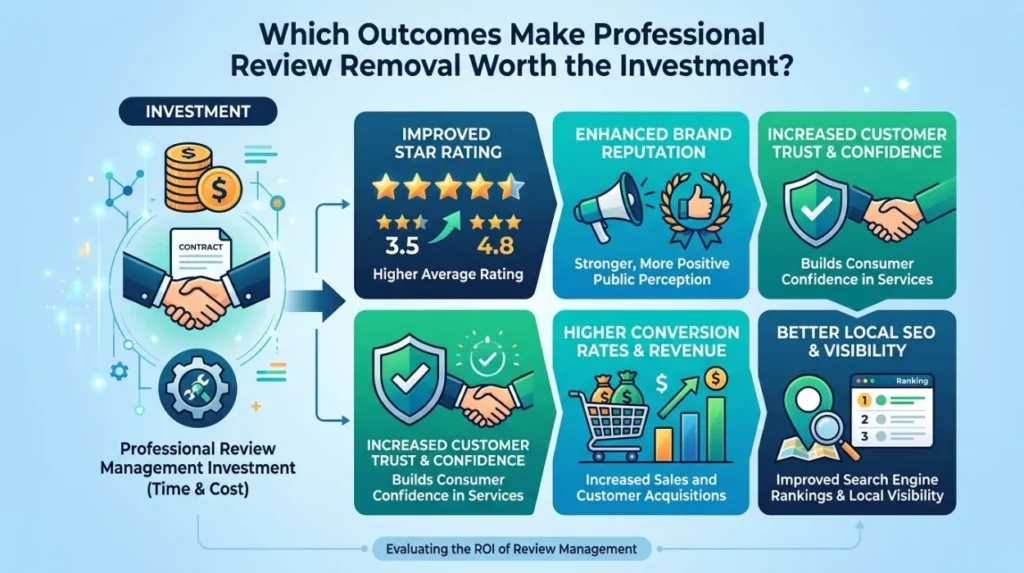
Professional review removal delivers measurable outcomes through risk reduction, perception stabilisation, and reputation signal improvement.
Businesses evaluating cost versus value often focus on long-term reputation impact. A single misleading review can influence perception for extended periods because review content remains visible within search ecosystems. Professional intervention addresses this challenge by pursuing corrective action through structured evidence frameworks. This process creates measurable value through improved information accuracy and stronger reputation stability.
Key outcomes include:
- Reduce reputational risk by removing misleading content that damages entity credibility.
- Improve sentiment distribution by ensuring review ecosystems reflect authentic customer experiences.
- Strengthen trust indicators through accurate reputation signals across digital platforms.
- Enhance search perception influence by limiting the visibility of deceptive information.
- Stabilise business ratings through the correction of inaccurate review contributions.
These outcomes contribute directly to long-term reputation resilience and stronger consumer confidence.
How Does a Professional Review Removal Process Work?
A professional review removal process works through investigation, evidence gathering, policy assessment, and platform engagement.
The first stage involves identifying whether the review violates authenticity standards or platform guidelines. This assessment focuses on behavioural signals, content credibility, account characteristics, and compliance requirements. Once authenticity concerns are identified, supporting evidence is collected to strengthen the review challenge process. Evidence often includes transaction records, communication histories, booking information, and verification documentation.
The second stage involves submitting the relevant information through platform review channels. This approach aligns with integrity frameworks used by review ecosystems to evaluate authenticity disputes. Professional management improves process clarity because each stage is supported by evidence-based reasoning. Businesses therefore benefit from a structured methodology rather than relying on informal complaints.
Why Is Expertise Important When Challenging Fake Reviews?
Expertise is important because authenticity disputes require understanding of platform policies, reputation signals, and evidence evaluation frameworks.
Review platforms operate through complex trust systems that assess content authenticity using multiple verification layers. Businesses often recognise suspicious reviews but lack the specialised knowledge needed to demonstrate policy violations effectively. Professional review management bridges this gap by aligning evidence with platform requirements. This improves procedural accuracy and strengthens the credibility of removal requests.
Understanding how fake reviews are detected also provides valuable context. Businesses evaluating removal options frequently benefit from reviewing fake review identification methods because these frameworks explain how platforms interpret trust indicators and authenticity signals. This knowledge strengthens decision-making and improves expectations regarding the review assessment process.
Which Approach Reduces Reputation Risk Most Effectively?
A structured reputation management process reduces reputation risk most effectively because it combines review correction, monitoring, and perception control into a single framework.
Risk exposure increases when misleading information remains visible within review ecosystems and search environments. False reviews influence trust indicators, alter sentiment distribution, and affect public interpretation of business credibility. Addressing these issues requires more than reactive responses. Effective reputation management focuses on controlling the quality of visible information and maintaining accurate reputation signals.
A comprehensive strategy reduces risk by:
- Identify deceptive content before it gains long-term visibility.
- Correct inaccurate reputation signals through platform-approved procedures.
- Monitor review ecosystems for emerging authenticity concerns.
- Protect entity credibility through ongoing reputation evaluation.
- Maintain perception stability through consistent information management.
This approach ensures that reputation management operates as a continuous risk-reduction process rather than a one-time corrective action.
Why Does Long-Term Reputation Protection Matter More Than Short-Term Fixes?
Long-term reputation protection matters more because search ecosystems continuously evaluate information quality, trust indicators, and credibility signals.
Short-term fixes focus on isolated issues. Long-term strategies focus on maintaining consistent reputation strength across multiple platforms and search environments. Search engines evaluate entity credibility through cumulative signals, making sustained reputation quality essential for visibility and trust. A single correction improves a specific issue, but ongoing management protects the broader reputation profile.
This distinction is particularly important for businesses operating in competitive sectors where review ecosystems strongly influence purchasing decisions. Stable reputation signals contribute to stronger search perception influence and greater consumer confidence. Long-term management therefore delivers greater strategic value than isolated corrective actions.
Businesses seeking additional context often review TripAdvisor’s authenticity criteria to understand how platforms evaluate suspicious content before deciding on a removal strategy. This knowledge strengthens decision-making and improves alignment between expectations and platform processes.
Dive Deeper With Our Expert Guides:
Get a Damaging TripAdvisor Review Removed in the UK With Professional Help
Remove a Harmful TripAdvisor Review in the UK With Our Specialist Service Today
How Does Professional Reputation Management Improve Search Perception?
Professional reputation management improves search perception by ensuring that visible information reflects authentic business performance and customer experience.
Search perception influence refers to the way users interpret a business based on visible content within search results and review ecosystems. Reviews, ratings, mentions, and reputation signals collectively shape this perception. When inaccurate information dominates visibility, public interpretation becomes distorted. Professional management corrects these imbalances by improving the quality and accuracy of visible reputation indicators.
Search ecosystems reward trust and information reliability. As authentic reputation signals gain prominence, entity credibility becomes stronger and public confidence increases. This process improves the relationship between reputation quality and search visibility. Businesses therefore benefit from more accurate representation across digital channels.
Why Is Clear Your Name a Credible Choice for TripAdvisor Review Challenges?
Clear Your Name provides a structured reputation management process built around evidence assessment, platform compliance, and reputation signal correction.
Effective reputation management requires more than identifying suspicious reviews. It requires understanding how review ecosystems evaluate authenticity, credibility, and policy compliance. Clear Your Name focuses on these mechanisms by aligning review challenges with recognised verification frameworks. This approach improves procedural clarity and strengthens the quality of review removal requests.
The value of a professional service lies in process accuracy and risk reduction. Businesses gain access to structured investigation methods, evidence preparation, and platform-focused review assessments. This improves efficiency while reducing uncertainty within the review challenge process. As a result, reputation management becomes more predictable and outcome-focused.
At the stage where businesses seek direct reputation recovery solutions, a professional TripAdvisor review removal service provides a practical pathway for correcting misleading reputation signals and restoring accurate business perception.
Which Benefits Make Professional Review Removal a Strategic Business Decision?
Professional review removal is a strategic business decision because it delivers measurable improvements in trust, visibility, and reputation control.
Businesses rely on credibility to attract customers and maintain competitive positioning. Fake reviews introduce uncertainty into that credibility framework by altering perception and trust indicators. Correcting those signals strengthens both consumer confidence and search ecosystem evaluation. The result is a more accurate representation of business quality and performance.
Strategic benefits include:
- Improve entity credibility by removing misleading reputation indicators.
- Strengthen trust signals through more accurate customer feedback representation.
- Enhance SERP control by reducing the influence of deceptive content.
- Stabilise ratings through correction of inaccurate review contributions.
- Reduce reputational risk through proactive reputation management processes.
These outcomes support long-term business growth by ensuring that public perception aligns more closely with genuine customer experience.
Fake TripAdvisor reviews create reputational challenges because they distort trust indicators, sentiment distribution, and entity credibility. Professional review removal strategies address these issues through evidence-based evaluation, platform compliance, and structured reputation management processes.
Businesses seeking stronger reputation protection benefit from solutions that combine review correction, ongoing monitoring, and search perception influence management. This approach improves information accuracy, strengthens visibility control, and reduces long-term reputation risk. Clear Your Name provides a reliable framework for addressing authenticity concerns and restoring confidence in digital reputation signals. Through a structured process focused on credibility, compliance, and measurable outcomes, businesses gain greater control over how they are perceived within review ecosystems and search environments.
How can I remove fake TripAdvisor reviews from my business profile?
Fake TripAdvisor reviews can be challenged by identifying policy violations and submitting supporting evidence through the platform’s review process. TripAdvisor Reviews Removal Services focus on authenticity concerns, misleading content, and reputation signal correction.
Do fake TripAdvisor reviews affect business ratings?
Yes, fake TripAdvisor reviews can influence overall ratings, customer trust, and online reputation. Inaccurate reviews contribute to sentiment distribution and may affect how potential customers perceive a business.
What evidence helps support a fake review removal request?
Evidence such as booking records, transaction details, communication history, and proof of non-customer activity can strengthen a review challenge. Review platforms rely on verifiable information when assessing authenticity disputes.
How long does the TripAdvisor review removal process take?
The timeframe depends on the complexity of the review assessment and the platform’s investigation process. Cases involving clear policy violations and strong evidence are generally easier to evaluate.
Why do businesses use TripAdvisor Reviews Removal Services?
Businesses use TripAdvisor Reviews Removal Services to address misleading reviews that affect reputation signals, entity credibility, and customer trust. The process focuses on improving review accuracy and maintaining a reliable online reputation profile.