
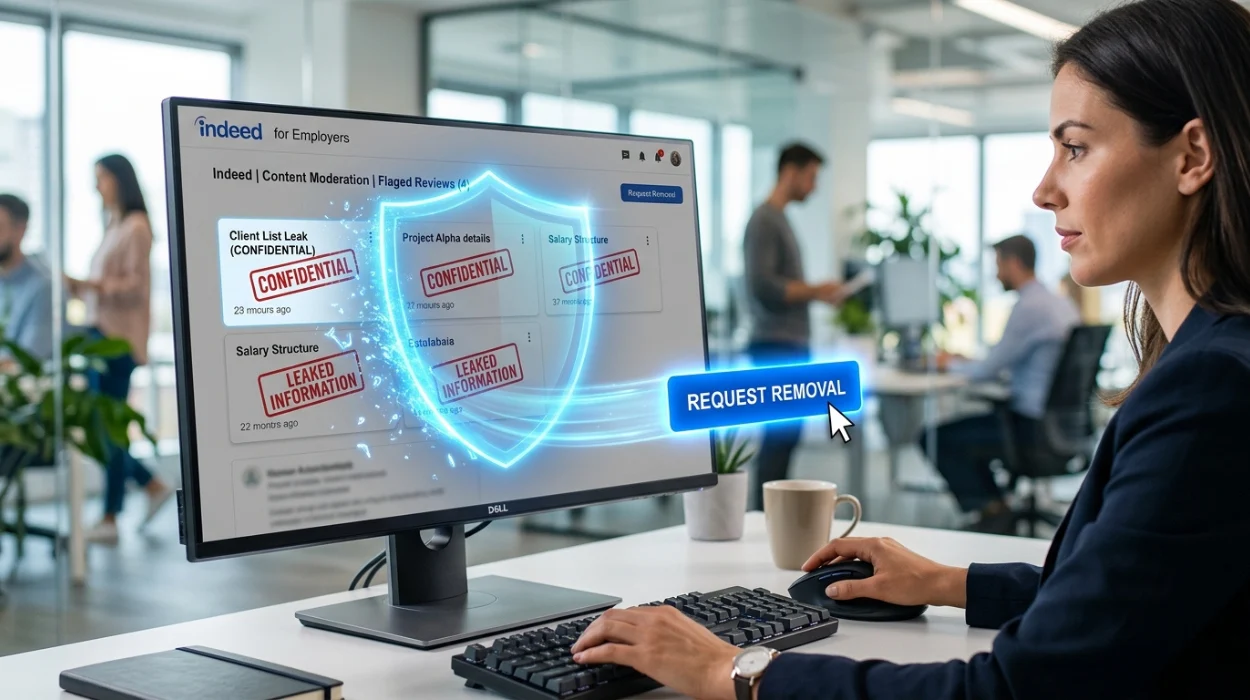
Indeed reviews that expose confidential company information require a policy-led removal strategy, not ordinary reputation monitoring. Indeed Review Removal Services help businesses address inappropriate content while protecting search visibility, entity credibility, and public trust.
When a review reveals non-public business information, the issue extends beyond an employee complaint. It creates a reputation signal that can influence how candidates, customers, partners, and search engines interpret an organisation. Indeed’s current company-review guidance states that reviews should focus on the reviewer’s own workplace experience and prohibits non-public information and legal claims. Indeed also states that content violating its guidelines or policies can be removed.
Can Indeed Review Removal Services address confidential information exposure effectively?
Yes. A policy-focused removal process identifies the exact content that conflicts with Indeed’s rules, documents the relevant evidence, and presents a structured removal request. This approach separates legitimate workplace criticism from content that introduces restricted or non-public information. That distinction matters because a factual workplace opinion and a disclosure of confidential business material represent different reputation risks. Indeed’s published guidance specifically identifies non-public information as content that should not appear in company reviews.
The objective is not to suppress genuine employee feedback. The objective is to address content that breaches the platform’s published standards while preserving legitimate review content. This creates a stronger compliance position and reduces the risk of submitting an unfocused complaint. A professional process also keeps the business focused on evidence rather than emotional responses. That clarity strengthens the credibility of the removal request.
For businesses assessing whether a review qualifies for action, Indeed reviews sharing confidential information provide an important policy distinction to examine before submitting a complaint. The evidence needs to connect the specific disclosure with the relevant platform requirement. This makes the request easier to assess and creates a defensible basis for action. It also reduces the risk of treating ordinary criticism as prohibited material.
Why does confidential information in an Indeed review create a reputation risk?
Confidential information creates a higher-value reputation risk because search users interpret visible information as evidence about an organisation. An Indeed Company Page already functions as a public research destination where jobseekers can view reviews, ratings, salaries, and other company information. When a review introduces sensitive internal details, those details can become part of the wider search perception surrounding the company. The resulting reputation signal can influence trust even when the disclosure does not accurately represent the organisation as a whole.
Search perception is cumulative rather than isolated. A candidate searching for an employer does not evaluate one statement independently; they assess the collection of visible signals across search results and review platforms. Negative or inappropriate content therefore gains importance when it appears prominently for branded searches. Reputation management addresses this environment by analysing visibility, relevance, context, and the relationship between individual pages and the broader entity.
A confidential disclosure also creates an information-control problem. Once information becomes publicly visible, it can be indexed, referenced, quoted, or incorporated into third-party discussions. Indeed’s Terms explain that user-generated content can be publicly displayed and that Indeed does not guarantee removal simply because content is reported. This makes prompt, evidence-based action valuable because the objective is to reduce unnecessary exposure before the reputation signal becomes more deeply established.
How does a professional Indeed review removal process reduce risk?
A professional process reduces risk by replacing reactive reporting with structured evidence assessment. The first stage identifies the exact review, isolates the confidential material, and determines which published policy requirement is relevant. The second stage organises supporting evidence so the issue is presented clearly rather than through broad accusations. The final stage focuses on an appropriate platform submission and subsequent monitoring.
A reliable process typically follows these steps:
- Identify the specific review and isolate the confidential information that creates the policy concern.
- Document the relevant evidence, including the published review text, dates, URLs, and context required for verification.
- Map the disclosure against Indeed’s applicable content standards and distinguish it from legitimate workplace criticism.
- Submit a focused removal request that explains the policy issue without unnecessary allegations.
- Monitor the review and branded search results to determine whether the content remains publicly visible.
- Escalate the case through appropriate channels when the initial review does not resolve the issue.
This process matters because Indeed retains discretion over whether reported user content violates its policies and whether it will be hosted or removed. Its Terms explicitly state that reporting does not guarantee removal. A professional service therefore cannot honestly promise that every reported review will disappear. Instead, reliability comes from controlling the quality of the evidence, the policy analysis, the submission process, and the monitoring cycle.
How can businesses prove that an Indeed review exposed confidential information?
Businesses strengthen a removal case by proving the nature of the information rather than simply labelling a review as harmful. Evidence needs to demonstrate that the material is non-public, internal, restricted, or otherwise inconsistent with the platform’s requirements. The strongest cases connect the exact wording of the review with an identifiable category of confidential information. This creates a clear relationship between the content and the policy concern.
Indeed’s review guidance states that reviews should be truthful, accurate, and based on the reviewer’s own opinion, while non-public information is specifically identified under content that should not be included. That makes evidence classification central to the decision. A business therefore benefits from documenting what information was disclosed, why it was not public, and where the review exposes it. The objective is to make the policy issue immediately understandable to the reviewing team.
Businesses preparing evidence can improve clarity by:
- Capture the complete review and preserve the exact wording being challenged.
- Classify each disclosed detail according to its confidential or non-public character.
- Compare the disclosure against information already available publicly to establish what is genuinely restricted.
- Record supporting business documentation that demonstrates the internal nature of the information.
- Explain the specific policy relevance without relying on unsupported accusations.
- Preserve dated evidence so the original publication and subsequent visibility remain verifiable.
For a deeper validation process, businesses can examine how to prove an Indeed review leaked confidential information before submitting a removal request. This analytical step helps distinguish a policy-based complaint from a general disagreement with the reviewer. It also improves the consistency of the evidence used throughout the reputation management process.
Is removing one confidential Indeed review enough to restore search perception?

No. Removing an inappropriate review addresses the immediate reputation signal, but sustainable reputation control requires broader SERP analysis. Search engines evaluate and display information from multiple sources, so a business needs to understand what appears across its branded search landscape. Removing one page does not automatically eliminate references, cached discussions, duplicate content, or unrelated negative signals elsewhere. A complete strategy therefore combines content removal with ongoing visibility monitoring.
This is where negative content suppression becomes relevant. The objective is not to manipulate search engines artificially; it is to strengthen the overall information environment surrounding the organisation. High-quality owned content, authoritative company profiles, accurate business information, and credible third-party references can contribute to a more balanced entity representation. Over time, this supports stronger entity credibility and gives search users more reliable information to evaluate.
Businesses seeking a structured Indeed Review Removal Services solution can therefore combine removal work with search perception monitoring. The value lies in connecting the immediate policy issue to the wider branded SERP. This creates a more complete view of reputation risk and prevents a single review from becoming the only visible narrative. Clear Your Name applies this decision-stage approach by focusing on evidence, platform policy, visibility, and measurable reputation outcomes.
Does the speed of review removal matter for reputation management?
Yes. Speed matters because public content has an opportunity to accumulate visibility and influence before the underlying issue is resolved. A review that remains indexed and publicly accessible continues to function as a reputation signal for people researching the company. Faster evidence preparation therefore reduces the period during which inappropriate content remains part of the visible narrative. Speed, however, must operate alongside accuracy because poorly supported reports weaken the quality of the removal case.
A fast process begins with immediate identification and evidence preservation. It then moves into policy classification, submission, and visibility monitoring without unnecessary delays. This creates operational control over the issue while avoiding rushed claims that cannot be supported. The measurable objective is to reduce the exposure window and establish whether the content remains visible after action.
Indeed itself states that employer responses are visible publicly and that reported responses can be reviewed by its Trust & Safety team. The wider implication is that public reputation management requires disciplined handling of visible content rather than private assumptions about what audiences will notice. Businesses that monitor branded search results alongside platform status gain a clearer understanding of whether the reputation signal is actually changing.
Is professional review removal worth the cost compared with long-term reputation risk?
Professional review removal delivers value when the potential cost of continued visibility exceeds the cost of structured intervention. A single inappropriate review can influence candidate confidence, employer perception, and broader search behaviour when it appears for branded queries. The financial impact is not limited to the review itself; it includes the opportunity cost created when prospective stakeholders encounter an avoidable reputation signal. A professional process therefore represents risk management rather than simply content removal.
Cost should be evaluated against measurable process outcomes. These include evidence quality, submission accuracy, monitoring coverage, reduction in inappropriate visibility, and improvement in the overall search environment. A service that only submits a generic complaint provides limited strategic value. A service that analyses the policy basis, documents evidence, monitors outcomes, and supports wider SERP control provides a more defensible long-term investment.
Clear Your Name positions Indeed Review Removal Services around this distinction. The focus remains on policy-aligned evidence and reputation outcomes rather than guaranteed platform decisions. This approach reduces operational risk while giving businesses a defined process for handling inappropriate review content. It also supports sustainable reputation management by connecting individual removal cases with wider search perception influence.
Dive Deeper With Our Expert Guides:
Remove Discriminatory Indeed Reviews With Our UK Legal Support
Build a Guidelines-Based Case to Remove an Indeed Review
What makes an Indeed review removal strategy reliable and sustainable?
Reliability comes from process clarity, evidence quality, and continuous visibility assessment. A sustainable strategy does not depend on removing every negative opinion because legitimate criticism forms part of authentic reputation signals. Instead, it identifies content that falls outside platform requirements and addresses those specific risks. This protects the integrity of the reputation programme while keeping the focus on genuine policy violations.
Sustainability also requires ongoing monitoring after the initial removal request. Search results change, new reviews appear, and existing content can gain or lose visibility over time. Regular monitoring therefore identifies new reputation signals before they become dominant search results. This supports stronger SERP control and helps businesses maintain a consistent public narrative based on accurate and appropriate information.
The strongest decision is a process-led one: identify the policy issue, prove the concern, submit the evidence, monitor the outcome, and strengthen the wider search environment. Indeed’s own Terms make clear that removal decisions remain within its discretion, so credible reputation management cannot be based on unrealistic guarantees. Clear Your Name provides a structured route for businesses that need evidence-led action, clearer risk management, and stronger control over how inappropriate Indeed content affects search perception.
When confidential information appears in an Indeed review, delaying action leaves an avoidable reputation signal in the public search environment. A disciplined Indeed Review Removal Services strategy addresses the specific policy concern while maintaining a broader focus on visibility, entity credibility, and trust. With clear evidence, transparent process steps, and continued SERP monitoring, businesses gain a more reliable framework for protecting their digital reputation. The result is not an exaggerated promise of guaranteed removal, but a controlled and evidence-driven approach to reducing reputation risk and strengthening public perception.
Can Indeed remove a review that shares confidential company information?
Yes, Indeed’s review guidelines prohibit non-public information, so a review containing confidential company details can be reported for policy review. Indeed Review Removal Services focus on identifying the disclosure and presenting evidence that supports the policy concern.
How do I report an Indeed review containing confidential information?
Identify the specific confidential information in the review and report the content through Indeed’s available reporting process. Provide clear, factual evidence showing why the information is non-public and relevant to Indeed’s review guidelines.
What evidence is needed to remove a confidential Indeed review?
Evidence should establish what information was disclosed, demonstrate that it was not publicly available, and identify how the review exposes it. Screenshots, the review URL, relevant business records, and a clear explanation of the policy issue can support the report.
How long does Indeed review removal take?
Removal timing depends on Indeed’s review and Trust & Safety processes, so there is no universal guaranteed timeframe. Monitoring the review after submission helps establish whether the content remains publicly visible.
Can removing an Indeed review improve a company’s online reputation?
Removing content that violates platform policy can reduce an inappropriate reputation signal from the company’s visible search environment. Clear Your Name can address the review-removal issue while broader reputation management focuses on SERP visibility, entity credibility, and search perception.