
Removing outdated information from Google improves search visibility control, strengthens reputation signals, and restores accurate public perception.
Search visibility directly influences trust, credibility, and decision-making. Reputation signals displayed within search results shape how individuals, employers, clients, and stakeholders evaluate entity credibility, making SERP control an essential component of modern reputation management.
Which Reputation Management Solution Delivers the Most Effective Control Over Outdated Search Results?
Article Removal Services deliver the most direct and measurable method for controlling outdated information within search ecosystems. They target content visibility, search indexing status, and reputation signals that influence public perception.
Outdated content remains visible because search engines evaluate authority, relevance, and entity associations alongside freshness. When historical articles continue ranking for branded searches, they influence search perception long after their informational value declines. Article Removal Services address this issue by assessing content ownership, publisher policies, privacy regulations, and indexing eligibility. The objective is to reduce visibility, remove eligible content, or limit search accessibility where justified. This process delivers stronger SERP control than relying solely on passive content creation strategies.
The effectiveness of this approach is measured through ranking changes, reduced visibility of negative search results, and improved sentiment distribution across branded search queries. As search ecosystems respond to updated content availability, entity credibility becomes less influenced by outdated information and more aligned with current circumstances.
How Does the Service Operate Within Search Ecosystems?
Article Removal Services operate through structured evaluation and implementation processes.
- Identify outdated content that influences branded search visibility.
- Evaluate publisher policies and content ownership requirements.
- Assess legal, privacy, and indexing considerations.
- Execute removal, amendment, or de-indexation requests where applicable.
- Monitor search results to measure visibility improvements.
Each stage focuses on reducing reputation risk while improving search perception influence across relevant queries.
Dive Deeper With Our Expert Guides:
Clean up your online reputation and remove negative articles to improve job prospects
Remove false news articles from Google and protect your name legally and effectively
Why Does Removing Outdated Information Improve Trust and Entity Credibility?
Removing outdated information improves trust because search users evaluate visible information before conducting deeper research. Search result composition influences first impressions, credibility assessments, and decision-making behaviour.
Entity credibility represents the level of trust assigned to a person, organisation, or professional identity within digital environments. When search results display outdated articles, historical controversies, or obsolete information, they create friction between current reality and public perception. This discrepancy weakens reputation signals and introduces uncertainty into evaluation processes.
Article Removal Services improve credibility by reducing the prominence of information that no longer reflects present circumstances. Search users encounter a more accurate representation of current activities, achievements, and professional standing. This alignment strengthens trust indicators and supports consistent perception across search ecosystems.
For individuals and businesses seeking greater visibility control, a professional reputation management service provides a structured framework for managing content exposure, search perception influence, and long-term reputation stability.
Which Outcomes Make Article Removal Services a Valuable Investment?
Article Removal Services provide measurable outcomes that influence both reputation performance and long-term visibility control. Their value is determined through risk reduction, trust restoration, and search result optimisation.
Search visibility affects recruitment decisions, partnership evaluations, customer acquisition, investment considerations, and professional opportunities. When outdated information dominates branded searches, these opportunities become influenced by incomplete or irrelevant narratives. Effective removal strategies reduce this exposure and improve information accuracy.
The value proposition extends beyond removing a single article. Successful reputation management improves sentiment distribution, strengthens entity credibility, and creates a more balanced search landscape. These improvements contribute to long-term digital trust rather than short-term visibility adjustments.
Which Benefits Deliver the Greatest Impact?
Key benefits include:
- Reduce exposure to outdated or misleading search results.
- Improve sentiment distribution across branded queries.
- Strengthen entity credibility through accurate representation.
- Stabilise reputation signals across search ecosystems.
- Increase control over search perception influence.
- Protect professional and commercial opportunities from historical content bias.
Each benefit contributes directly to stronger digital trust and improved search visibility management.
How Does Article Removal Compare with Negative Content Suppression?
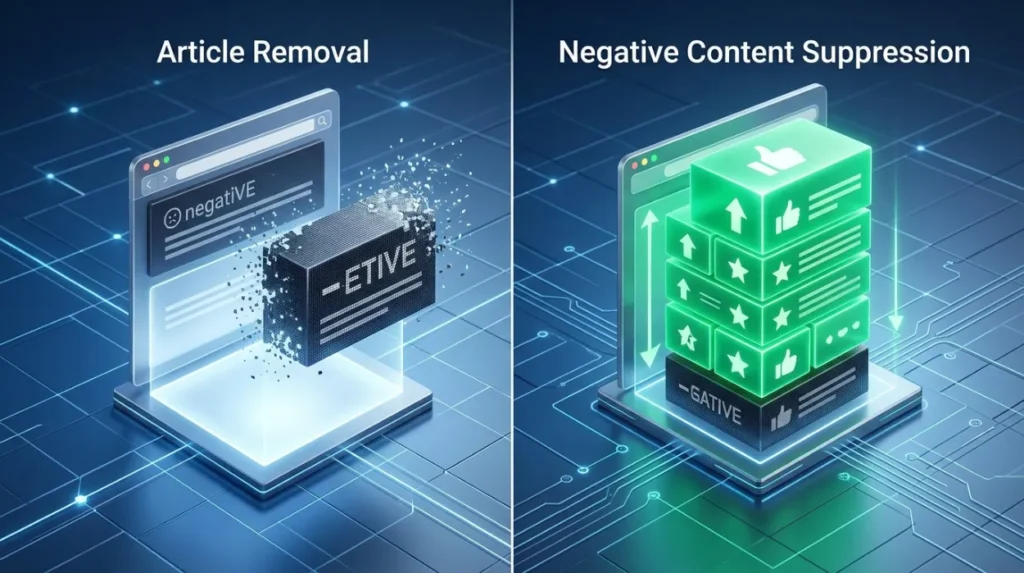
Article Removal Services deliver direct visibility reduction, while negative content suppression focuses on ranking competition. Both strategies influence SERP composition, but they operate through different mechanisms.
Negative content suppression introduces positive or neutral content designed to compete with unwanted search results. Search engines evaluate this content against existing rankings, authority signals, and user engagement metrics. The process changes visibility distribution but does not eliminate underlying content.
Article removal focuses on reducing accessibility to the content itself. When successful, the information becomes less visible or disappears entirely from relevant search results. This direct approach creates stronger control over reputation signals because it addresses the source of visibility rather than competing against it.
Businesses and professionals frequently combine both approaches to maximise outcomes. Removal reduces unwanted exposure while suppression strengthens positive search visibility. Together, they create a more balanced and sustainable search environment.
How Quickly Can Search Results Change After Outdated Information Is Addressed?
Search result changes occur after search engines recrawl, reprocess, and update indexed content. The speed of impact depends on content status, publisher response times, indexing frequency, and search engine processing schedules.
Article Removal Services improve efficiency by following established procedures and identifying the most appropriate removal pathways. Rather than relying on trial-and-error tactics, structured workflows accelerate the process of visibility correction and search ecosystem updates.
Although search engine updates vary, the most significant advantage comes from process certainty. Clear documentation, targeted implementation, and continuous monitoring improve outcome predictability. This reduces wasted effort and increases visibility control over time.
What Factors Influence Speed of Results?
Several factors affect implementation timelines:
- Determine whether content removal eligibility exists.
- Evaluate publisher response requirements.
- Monitor search engine recrawling frequency.
- Track index updates and ranking adjustments.
- Measure ongoing visibility changes after implementation.
Each factor influences how quickly outdated information loses prominence within search results.
Which Risks Are Reduced Through Professional Reputation Management?
Professional reputation management reduces search-related risks by addressing inaccurate perception, outdated narratives, and persistent visibility challenges. These risks influence both personal and commercial outcomes.
Reputation damage often originates from search result exposure rather than direct user experience. Individuals and organisations are increasingly evaluated through search engines before meetings, applications, purchases, and partnerships occur. Outdated information therefore becomes a reputational liability when it shapes perception disproportionately.
Article Removal Services reduce this liability by improving search result relevance and limiting the influence of obsolete content. Search users receive information that reflects current circumstances rather than historical events detached from present reality. This shift strengthens trust and reduces decision-making friction.
The team at Clear Your Name focuses on identifying visibility risks and implementing structured solutions that align search results with accurate, current information. This process reduces uncertainty and strengthens digital trust across key audiences.
Why Is Long-Term Reputation Sustainability Important?
Long-term sustainability ensures that reputation improvements remain effective as search ecosystems evolve. Visibility management is not limited to immediate corrections; it requires continuous alignment between search results and current reputation signals.
Search engines constantly reassess content authority, relevance, and user engagement. New content enters the index, rankings change, and search demand patterns evolve. Sustainable reputation management accounts for these changes by creating resilient search visibility structures.
Article Removal Services contribute to sustainability by eliminating or reducing problematic visibility sources. Combined with ongoing reputation monitoring, this creates a stronger foundation for maintaining positive search perception. Sustainable strategies deliver greater value because they reduce recurring reputation challenges.
Professionals evaluating solutions often benefit from understanding how to find out what Google says about you and your online reputation before implementing corrective action. Accurate assessment supports better strategic decisions and clearer visibility goals.
Which Factors Demonstrate the Reliability of a Reputation Management Provider?
Reliability is demonstrated through process transparency, strategic clarity, measurable outcomes, and consistent execution. Effective providers explain how visibility improvements occur and how results are monitored.
Reputation management is fundamentally a search ecosystem discipline. Providers must understand indexing behaviour, content authority, search perception influence, and entity credibility frameworks. Technical knowledge combined with procedural consistency delivers stronger outcomes than generic marketing approaches.
Clear Your Name approaches reputation management through structured analysis, implementation planning, and measurable performance monitoring. This methodology ensures that reputation improvement efforts remain aligned with visibility objectives and trust-building goals.
Decision-makers evaluating providers benefit from reviewing analytical resources such as why old news still ranks and how it affects your online visibility and trust, as these insights explain the mechanisms behind persistent search visibility challenges.
Which Reputation Management Approach Delivers the Greatest Long Term Value?
The highest long term value comes from combining direct visibility correction with strategic reputation management. Article Removal Services provide immediate control over problematic content, while broader reputation strategies strengthen future resilience.
Value is determined by the durability of outcomes rather than the completion of a single action. Effective reputation management reduces ongoing risk, improves search visibility, strengthens trust signals, and enhances entity credibility. These outcomes influence professional opportunities, commercial performance, and public perception long after implementation.
When outdated information remains visible, it continues shaping digital narratives regardless of its relevance. Removing or reducing that visibility improves search result accuracy and creates a stronger foundation for long-term reputation stability. This combination of visibility control, trust restoration, and risk reduction explains why Article Removal Services remain a critical component of modern reputation management.
Controlling outdated information within Google search results improves reputation signals, strengthens entity credibility, and creates a more accurate public representation. Article Removal Services deliver direct visibility management, measurable search result improvements, and sustainable reputation protection.
Effective reputation management depends on process clarity, strategic implementation, and continuous evaluation of search perception influence. By addressing outdated content at its source and supporting long-term SERP control, Clear Your Name provides a reliable framework for improving digital trust, reducing reputational risk, and maintaining stronger search visibility outcomes.
How can I remove outdated information from Google search results?
Removing outdated information from Google typically involves requesting content removal from the source website or seeking de-indexing where applicable. Article Removal Services evaluate eligibility and help reduce the visibility of outdated content that affects online reputation.
Does deleting a webpage automatically remove it from Google?
No, deleting a webpage does not instantly remove it from Google search results. Search engines must recrawl and update their index before visibility changes appear in search results.
How does outdated information affect my online reputation?
Outdated information can influence reputation signals, search perception, and entity credibility when it appears prominently in search results. Users often form opinions based on visible search listings before reviewing current information.
What is the difference between content removal and negative content suppression?
Content removal focuses on eliminating or reducing access to specific information, while negative content suppression improves SERP control by promoting more relevant content. Both strategies influence online visibility through different mechanisms.
How long does it take for Google to update removed content?
The timeframe depends on search engine recrawling schedules, indexing updates, and the status of the original content. Once changes are recognised, Google gradually updates search visibility and ranking signals to reflect the new content status.