Glassdoor reviews that disclose protected confidential information require a precise, evidence-led removal strategy based on platform policies and applicable legal obligations. Professional Glassdoor review removal focuses on protecting search visibility, addressing substantiated NDA breaches and strengthening reputation signals without treating legitimate employee criticism as unlawful content.
Search visibility directly influences how prospective employees, customers and business partners evaluate an organisation. Negative reviews containing confidential information affect more than an individual employer rating when they appear prominently in branded search results. Reputation signals, including review content, sentiment distribution and third-party references, contribute to entity credibility and public perception. A structured removal process addresses the specific content at issue while supporting wider SERP control. This approach combines evidence assessment, platform reporting and reputation management to reduce risk and improve the accuracy of an organisation’s online presence.
Why choose professional Glassdoor reviews removal services for NDA violations?
Professional Glassdoor reviews removal services provide a structured way to assess and challenge reviews that disclose protected information or breach applicable platform policies. The process focuses on identifying the specific violation, preparing supporting evidence and submitting a clearly reasoned complaint. This is more reliable than submitting general requests based solely on negative sentiment or reputational damage.
An NDA establishes contractual confidentiality obligations, but it does not automatically make every employee statement removable. The relevant information must fall within the agreement’s scope or raise another recognised legal or policy concern. Trade secrets also have specific legal requirements, including secrecy, commercial value arising from secrecy and reasonable steps to preserve confidentiality. These distinctions determine whether a complaint has a defensible basis.
A specialist removal process examines the review against these requirements before preparing a submission. It separates legitimate workplace opinions from potentially protected information, such as unpublished financial details, confidential customer records or proprietary business processes. This classification reduces the risk of presenting ordinary criticism as a confidentiality violation. It also gives the platform a clearer explanation of why the disputed material requires assessment.
A professional approach delivers value through:
- Identifying the exact review passages that disclose potentially protected information.
- Assessing relevant NDA clauses and platform policies against the content in question.
- Organising supporting evidence to explain the confidentiality concern clearly.
- Submitting a targeted complaint through the appropriate platform reporting route.
- Monitoring the review status and documenting the outcome for further assessment.
This process creates accountability at each stage. It also ensures that removal requests focus on identifiable violations rather than attempts to control legitimate employee feedback.
How does our legal removal process address Glassdoor NDA breaches?
A structured legal-removal process addresses NDA-related reviews through evidence assessment, legal issue classification and platform complaint preparation. Each stage establishes why the disclosed information raises a genuine confidentiality concern and identifies the appropriate route for requesting review moderation.
The first stage involves reviewing the disputed Glassdoor content. The assessment identifies statements containing confidential business information, personal data, trade secrets or other potentially restricted material. It also distinguishes factual disclosures from subjective opinions about management, working conditions and employment experiences. This distinction prevents a complaint from treating the entire review as a violation when only a specific passage raises concern.
The second stage examines the confidentiality obligation. Relevant NDA clauses establish the categories of information covered by the agreement and the restrictions placed on disclosure. Where trade secrets are involved, the assessment also considers whether the information meets the relevant legal criteria. Evidence of access controls, confidentiality markings and internal handling procedures helps explain how the organisation protected the information.
The third stage converts the findings into a clear platform complaint. The submission identifies the review, the specific disputed passage, the relevant policy or legal concern and the evidence supporting the request. A focused explanation gives the moderation team a defined issue to assess. It also avoids unsupported statements that a review is unlawful simply because it damages the employer’s reputation.
The final stage involves monitoring the platform’s response and reviewing the remaining online visibility. A submitted complaint does not guarantee removal because Glassdoor retains control over its moderation decisions. Where content remains published, the next assessment considers the available reporting options and the organisation’s wider search presence.
Clear Your Name approaches this work through a defined review and evidence process, giving organisations clarity about the grounds for a complaint and the steps involved. The objective is to pursue justified removal requests while maintaining a clear distinction between protected information and legitimate employee commentary.
What makes a Glassdoor review eligible for removal under an NDA?
A Glassdoor review becomes a stronger removal candidate when it contains identifiable information that breaches a relevant platform policy or raises a substantiated legal concern. An employer’s confidentiality label is not sufficient by itself. The content, contractual terms and supporting evidence determine the strength of the complaint.
Examples of potentially sensitive disclosures include unpublished commercial strategies, confidential customer information, internal financial records and proprietary technical processes. These categories require individual assessment because not every internal business detail qualifies as a trade secret. The information must meet the applicable legal requirements, and the organisation needs to establish the relevant confidentiality measures.
By contrast, statements about poor management, workplace culture, salary dissatisfaction or negative employee experiences generally represent commentary rather than trade secret disclosure. An NDA does not automatically remove an employee’s ability to describe their employment experience. A complaint that fails to distinguish between these categories creates unnecessary risk and weakens the credibility of the removal request.
Organisations also need to consider whether the review includes personal information or other material covered by Glassdoor’s content policies. Different policy concerns require different evidence and reporting grounds. Classifying the issue correctly improves the accuracy of the submission and reduces the risk of relying on an irrelevant removal category.
Understanding whether a company can force Glassdoor to remove reviews containing trade secrets provides an important foundation for deciding whether a complaint is justified. The central question is not whether the review is damaging, but whether the specific information disclosed meets a recognised removal threshold. This distinction supports a defensible process and protects the organisation from making overly broad claims.
How do Glassdoor review removal and negative content suppression improve search visibility?
Review removal and negative content suppression improve search visibility through different mechanisms. Removal addresses the original publication when a valid policy or legal basis exists, while suppression strengthens the visibility of accurate and relevant information across branded search results. Combining these approaches creates a broader reputation management strategy without confusing content moderation with search ranking activity.
When Glassdoor removes a qualifying review, the original content becomes unavailable or changes according to the platform’s moderation process. This reduces the direct visibility of that specific publication. However, removal does not automatically erase copies, external references or previously indexed information from every search engine. Search engines process changes through their own crawling and indexing systems.
Negative content suppression addresses the wider search environment. It involves improving the quality, relevance and visibility of credible information associated with the organisation. Accurate corporate pages, professional profiles, useful resources and legitimate third-party references contribute to a more complete digital footprint. Search engines evaluate available pages using relevance, quality and other ranking signals when composing results.
A balanced strategy focuses on measurable outcomes:
- Reduce the visibility of qualifying harmful content through legitimate platform removal routes.
- Strengthen authoritative company pages with accurate information about the organisation and its activities.
- Improve branded search coverage by developing relevant resources that answer users’ queries.
- Monitor search results to identify changes in content visibility and sentiment distribution.
- Evaluate reputation signals to understand how reviews and independent references influence public perception.
These activities support SERP control without promising fixed rankings or guaranteed suppression. Their value comes from addressing both the source of a substantiated content problem and the wider information environment in which users evaluate the organisation.
How quickly can Glassdoor NDA-related reviews be removed?
The time required to remove a Glassdoor review depends on the nature of the complaint, the quality of supporting evidence and the platform’s moderation process. A clearly documented report provides a stronger basis for assessment than a general request, but no independent service can guarantee Glassdoor’s decision or completion date.
The evidence preparation stage affects how efficiently a complaint moves forward. Organisations with the relevant NDA, precise review references and documented confidentiality controls have a clearer foundation for submission. Missing information creates additional assessment work because the alleged breach needs to be explained before the platform can evaluate the request.
The platform’s response also depends on its internal procedures. Glassdoor determines whether the reported content violates its policies, and the outcome can involve removal, no action or further assessment. A legal concern does not automatically override platform rules, and a contractual dispute between an employer and former employee does not itself establish a platform violation.
Search visibility changes follow a separate timeline. Even after content removal, search engines need to process the updated page and refresh their indexes. Third-party copies and independent discussions also require separate consideration. For this reason, an effective process tracks both the moderation decision and the subsequent search results rather than treating them as a single outcome.
A transparent service provides progress updates based on completed actions, outstanding evidence and platform responses. This gives organisations a realistic view of the process and prevents unsupported promises about immediate removal.
What does professional Glassdoor review removal cost, and what value does it deliver?
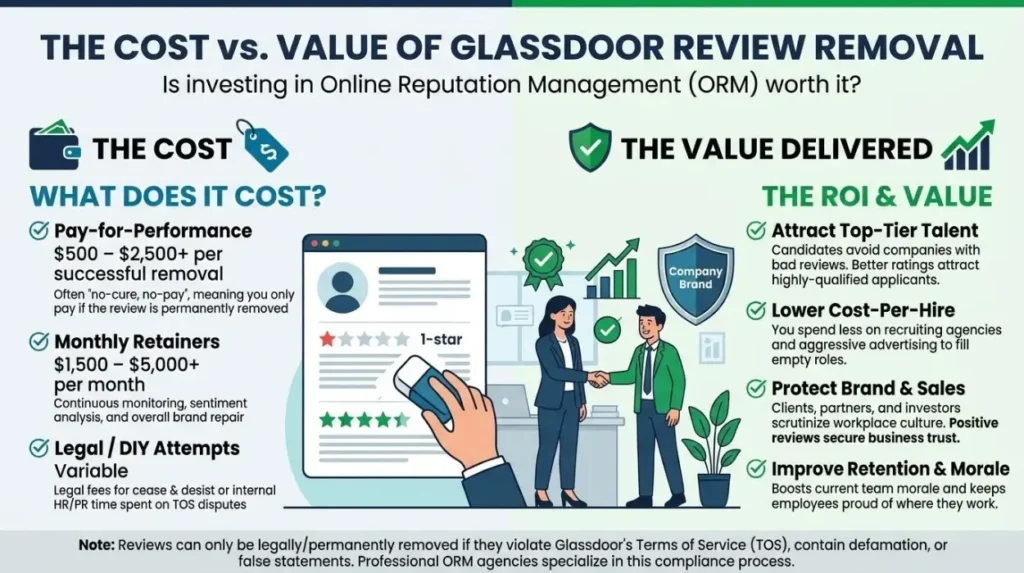
The cost of professional Glassdoor review removal depends on the complexity of the complaint, the volume of disputed material and the evidence required to support the case. A straightforward policy report involves a different level of assessment from a complaint involving trade secrets, multiple NDA clauses or related legal concerns.
The value assessment needs to consider more than the initial removal fee. A damaging review that appears prominently for an employer’s name can influence candidate research, recruitment decisions and wider business perception. Its impact depends on the content, search position, review context and relevance to the people evaluating the organisation.
Professional support provides value through structured assessment and reduced administrative uncertainty. Specialists organise the evidence, identify the appropriate complaint grounds and maintain a record of the submission process. This reduces the risk of poorly supported reports and repeated submissions that fail to address the actual issue.
Long-term value also depends on what happens after the complaint. Organisations need to monitor branded search results, maintain accurate company information and assess recurring employee feedback themes. These activities help distinguish an isolated confidentiality issue from a wider employer reputation concern.
The appropriate investment therefore reflects the complexity of the case and the level of ongoing reputation management required. Clear pricing, defined deliverables and transparent reporting provide a stronger basis for evaluating service value than promises of guaranteed removal.
How does Clear Your Name reduce the risks of Glassdoor review removal?
Clear Your Name reduces removal-related risk through a process that prioritises evidence, accurate classification and clear communication. Each complaint requires a specific basis, and the assessment distinguishes confidential disclosures from legitimate employee opinions. This approach protects the integrity of the request and keeps the removal strategy aligned with the relevant platform requirements.
The first risk is submitting a complaint without sufficient evidence. A general claim that a review contains confidential information does not establish an NDA breach or trade secret disclosure. A documented assessment identifies the exact passage, the relevant obligation and the measures used to protect the information.
The second risk is confusing legal concerns with platform moderation requirements. Glassdoor applies its own content policies, while legal professionals assess contractual and statutory issues. These processes can overlap, but they remain separate. A reliable removal strategy recognises the distinction and avoids presenting a legal allegation as an automatic platform instruction.
The third risk is damaging wider employer credibility through an overly aggressive response. Employees and prospective candidates use independent reviews to evaluate workplace conditions and organisational behaviour. Challenging legitimate criticism as confidential information creates additional trust concerns. A focused approach addresses qualifying disclosures while leaving lawful employee feedback outside the scope of the complaint.
A dependable service process provides:
- Clear case assessment to identify the content and policy or legal grounds under review.
- Evidence-led submissions to connect the disputed information with the relevant confidentiality obligation.
- Transparent communication to explain completed actions, platform responses and outstanding requirements.
- Risk-aware handling to distinguish protected disclosures from legitimate employee feedback.
- Ongoing visibility monitoring to assess how the review and related content appear in branded search results.
These controls strengthen process reliability and support informed decisions throughout the case. They also provide a clear record of the work completed, the evidence considered and the outcome received.
Dive Deeper With Our Expert Guides:
Clear Damaging Glassdoor Reviews Fast with Our Employer Reputation Team
Remove Unfair Glassdoor Reviews with Our Specialized Takedown Services
Why is a specialist Glassdoor removal service a stronger long-term decision?
A specialist Glassdoor removal service provides a more structured approach to complex NDA-related complaints than an isolated reporting attempt. Its value comes from combining content assessment, evidence preparation, platform policy understanding and wider reputation monitoring. This integrated process addresses the immediate publication and the search environment surrounding it.
An organisation needs more than a request to remove a negative review. It needs an assessment that identifies whether the review contains protected information, whether the evidence supports the allegation and which reporting route applies. Where the complaint is justified, a precise submission creates a clearer basis for moderation. Where the review represents legitimate employee feedback, wider reputation management focuses on accurate information and credible search visibility rather than unsupported removal demands.
For organisations requiring professional Glassdoor reviews removal services, the priority is a process that balances confidentiality protection with platform compliance. Clear Your Name provides a structured route for assessing disputed reviews, preparing evidence-led complaints and evaluating the wider effect on online reputation. The service focuses on justified action, transparent communication and realistic outcomes rather than guaranteed platform decisions.
Businesses also benefit from treating reputation management as an ongoing activity. Monitoring review sentiment, branded search results and third-party references identifies changes that a single removal request cannot address. Consistent information and credible digital assets strengthen entity credibility and support a more stable search presence.
Glassdoor reviews involving alleged NDA breaches require precise evidence, a clear legal or policy basis and an accurate understanding of platform moderation. Professional removal services help organisations distinguish protected confidential information from legitimate employee feedback, prepare focused complaints and monitor the resulting search visibility. Negative content suppression and authoritative content enhancement address the wider reputation environment when removal alone does not resolve the issue.
Clear Your Name combines structured assessment, evidence-led reporting and reputation visibility monitoring to support organisations facing complex Glassdoor review concerns. The process prioritises clarity, confidentiality and realistic outcomes at every stage. This creates a reliable basis for addressing qualifying content while protecting long-term employer credibility.
Can a company legally remove Glassdoor reviews that violate an NDA?
A company can request Glassdoor to review content that discloses protected confidential information or breaches applicable platform policies. Removal depends on the evidence, the relevant NDA terms and Glassdoor’s moderation decision.
How can you get a Glassdoor review removed for disclosing trade secrets?
Identify the specific confidential information, provide the relevant NDA clauses and document the steps taken to protect the information. Submit a focused complaint explaining how the disclosure raises a legal or policy concern.
How long does it take to remove a Glassdoor review for an NDA breach?
The timeframe depends on the complexity of the complaint, supporting evidence and Glassdoor’s moderation process. A complete submission improves clarity, but no removal service can guarantee a specific decision or timeframe.
Can Glassdoor remove a negative employee review because it contains confidential information?
Glassdoor assesses whether the review violates its content policies or raises a substantiated confidentiality concern. Negative opinions about management, salary or workplace culture are not automatically removable simply because an employer considers them damaging.
What do Glassdoor reviews removal services do for NDA violations?
Glassdoor reviews removal services assess disputed content, examine relevant confidentiality obligations and prepare evidence-led platform complaints. Clear Your Name focuses on identifying qualifying NDA-related disclosures while distinguishing them from legitimate employee feedback.