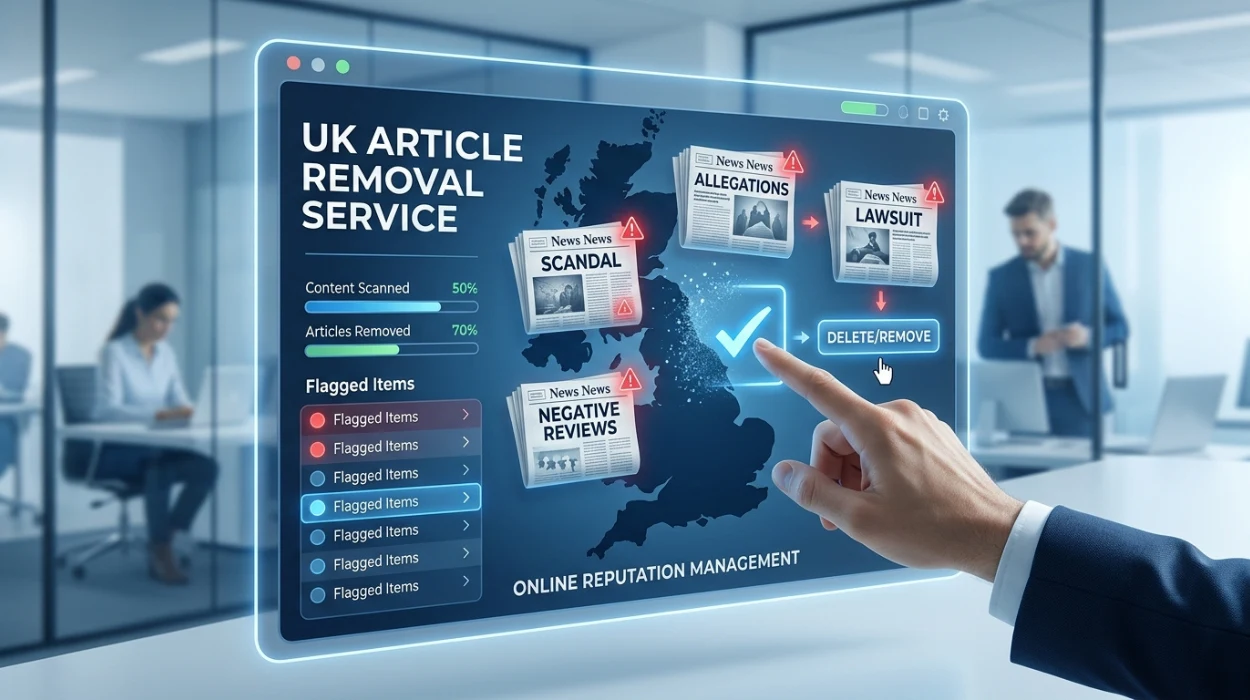
Damaging press coverage reduces trust, weakens credibility, and influences how customers, employers, investors, and partners evaluate an individual or organisation. A professional article removal service delivers greater control over search visibility, strengthens reputation signals, and restores confidence across search ecosystems.
Search results function as a public trust layer. When negative articles dominate branded searches, they shape perception before direct engagement occurs. Effective reputation management focuses on controlling visibility, reducing risk, and improving entity credibility through structured removal and suppression strategies.
Which article removal strategy delivers the strongest reputation recovery outcome?
A professional article removal strategy delivers the strongest outcome because it addresses both content visibility and search perception influence. Removing damaging articles directly from publisher platforms creates a measurable reduction in negative reputation signals. This process improves the quality of branded search results and strengthens entity credibility across digital channels. Unlike reactive responses, structured removal campaigns focus on long-term SERP control. The objective is not merely to respond to negative content but to eliminate its influence where possible.
Article Removal Services operate within search ecosystems where visibility determines perception. Search engines evaluate content relevance, authority, and user engagement. Negative press often acquires strong visibility due to publisher authority rather than factual importance. A removal strategy targets the source of the visibility problem and reduces the prominence of damaging narratives. This creates a cleaner search environment that supports trust restoration.
Key outcomes include:
- Remove harmful content directly from publisher-controlled environments to reduce visibility.
- Improve branded search results by eliminating negative reputation signals.
- Strengthen entity credibility through enhanced content quality across search results.
- Reduce reputational risk by limiting exposure to damaging narratives.
- Stabilise perception through greater control over search visibility.
Why does damaging press continue influencing public perception long after publication?
Damaging press continues influencing public perception because search engines prioritise discoverability rather than recency alone. High-authority articles often maintain rankings for extended periods, allowing negative narratives to influence decisions repeatedly. Every search impression reinforces existing perception signals and affects trust formation. This creates ongoing reputational exposure even when the content no longer reflects current circumstances.
Search behaviour demonstrates that users often review only the first page of results before making decisions. Negative articles occupying prominent positions therefore become influential reputation assets. Their presence affects recruitment outcomes, commercial opportunities, customer acquisition, and stakeholder confidence. Effective removal services focus on breaking this cycle by addressing the content directly rather than relying solely on reputation monitoring.
The relationship between visibility and trust remains central to reputation management. Search results represent an external validation layer. When damaging content remains highly visible, it weakens positive reputation signals and creates friction during decision-making processes. Removing that content restores balance and improves overall search perception influence.
How does an article removal service achieve greater SERP control?
An article removal service achieves greater SERP control by evaluating publisher policies, legal considerations, platform guidelines, and search visibility factors before action begins. This structured assessment ensures resources target the most effective route for removal. Each case receives a strategy aligned with content type, publisher authority, and potential resolution pathways.
The process generally follows a defined framework:
- Assess content impact using visibility metrics and reputation signal analysis.
- Identify publisher policies that support content review or removal requests.
- Evaluate legal grounds where applicable to strengthen removal requests.
- Engage publishers through structured communication processes.
- Monitor search results to confirm visibility reduction after removal.
This methodology improves efficiency because actions are based on evidence rather than assumptions. When a removal request aligns with publisher standards or legal frameworks, success rates improve significantly. The outcome is greater SERP control and reduced reputational exposure.
Professionals at Clear Your Name use structured evaluation processes to determine the most effective route before engaging publishers. This ensures every action contributes to measurable reputation outcomes rather than isolated content management activities.
Which factors determine whether article removal is possible?

Article removal potential depends on content accuracy, publisher policies, legal considerations, editorial standards, and platform-specific requirements. Each factor influences the available pathways for resolution. A professional evaluation identifies opportunities that generic outreach often overlooks.
Publishers operate according to editorial policies and risk frameworks. Some maintain correction procedures, while others review content that creates disproportionate reputational harm. Legal considerations also influence outcomes when content breaches privacy rights, contains inaccuracies, or conflicts with applicable regulations. Effective removal strategies examine every available route before selecting a course of action.
A comprehensive assessment delivers:
- Identify policy-based opportunities that support content review.
- Establish legal justification where applicable.
- Strengthen publisher communication through evidence-backed requests.
- Reduce wasted effort by prioritising viable removal pathways.
- Improve resolution efficiency through structured case analysis.
Decision-makers benefit from this process because it replaces uncertainty with clarity. Understanding realistic options enables informed reputation management decisions and supports efficient resource allocation.
How does professional expertise reduce the risk of failed publisher outreach?
Professional expertise reduces risk because publishers receive structured requests supported by evidence, policy alignment, and strategic communication. Failed outreach often results from incomplete information, weak justification, or misunderstanding of editorial processes. Professional management eliminates these weaknesses.
Publishers evaluate requests according to internal standards. Requests lacking credibility or supporting evidence often receive rejection or no response. Article removal specialists understand how publishers assess risk and compliance concerns. This knowledge improves engagement quality and increases the likelihood of productive outcomes.
Reputation management success depends on process discipline. Every communication influences future opportunities for resolution. Poorly executed outreach can weaken credibility and limit available options. Structured engagement preserves professionalism and supports stronger negotiation positions.
Businesses researching article removal service processes often discover that publisher outreach alone frequently fails when strategic preparation is absent. Understanding these limitations supports more informed decision-making and reduces unnecessary delays.
How quickly can article removal efforts influence reputation signals?
Article removal efforts begin influencing reputation signals as soon as content visibility changes. Once damaging content is removed, search engines eventually recrawl and update indexed results. This reduces exposure and improves the quality of branded search experiences. The speed of visible impact depends on publisher actions, indexing cycles, and search engine processing.
Immediate perception benefits often occur when stakeholders can no longer access damaging content directly. Search-related improvements follow as search engines refresh indexed information. Over time, the removal contributes to stronger reputation signals and improved entity credibility.
The most significant advantage is the reduction of ongoing reputational damage. Every day harmful content remains visible and creates additional exposure. Removal therefore functions as both a corrective action and a preventative measure. It limits future perception risks while supporting long-term reputation recovery.
Why does article removal deliver stronger long-term value than reactive reputation responses?
Article removal delivers stronger long-term value because it addresses the root visibility issue rather than managing its consequences. Reactive responses often attempt to explain, counterbalance, or contextualise damaging content. Removal strategies focus on eliminating the source of reputational friction wherever viable.
Search ecosystems reward relevance and authority. Negative content that remains accessible continues generating reputation signals regardless of responses. Removing the content eliminates those signals and improves the overall quality of branded search environments. This creates sustainable benefits that extend beyond immediate perception management.
Long-term value includes:
- Eliminate recurring visibility risks at the source.
- Improve trust indicators across branded searches.
- Strengthen positive reputation signals over time.
- Reduce ongoing monitoring and response requirements.
- Support sustainable SERP control strategies.
For organisations and individuals facing persistent reputational challenges, removal represents a strategic investment in trust restoration rather than a temporary reputation defence mechanism.
Dive Deeper With Our Expert Guides:
Remove negative press about your business and build a strong and trusted online reputation
Remove negative news articles from Google and take control of your online reputation
How do legal and platform-based evaluations improve removal success rates?
Legal and platform-based evaluations improve success rates because they identify the strongest available justification before action begins. Successful reputation management depends on selecting the most appropriate route rather than applying a single solution to every case. Structured evaluation increases efficiency and improves outcome predictability.
A detailed review examines legal rights, publisher obligations, privacy considerations, and platform governance frameworks. These factors determine which actions carry the greatest probability of success. Professional assessment prevents ineffective outreach and focuses effort on evidence-supported opportunities.
Decision-makers seeking deeper insight into legal and platform routes often discover that outcome quality depends heavily on pre-action evaluation. The strongest campaigns begin with structured analysis rather than immediate publisher contact. This creates greater process clarity and supports informed reputation management decisions.
Clear Your Name emphasises evaluation-driven strategies because effective reputation management relies on evidence, process discipline, and measurable outcomes. This approach strengthens reliability and improves confidence throughout the removal process.
Which reputation management solution provides the most reliable path to trust restoration?
An article removal service provides the most reliable path to trust restoration when damaging press actively influences search visibility and public perception. By reducing exposure to harmful content, improving reputation signals, and strengthening entity credibility, removal strategies address the factors that directly influence trust formation.
Reliable reputation recovery depends on transparency, structured processes, and measurable objectives. Effective services focus on visibility reduction, perception stabilisation, and long-term SERP control. These outcomes create a stronger foundation for sustainable reputation management than reactive reputation responses alone.
When negative press continues influencing branded search results, decisive action becomes essential. A professional Article Removal Services strategy provides a clear pathway toward improved visibility, reduced risk, and restored confidence. Through structured evaluation, targeted publisher engagement, and outcome-focused execution, Clear Your Name delivers a reliable solution for organisations and individuals seeking greater control over their digital reputation.
What does a UK article removal service do?
A UK article removal service works to remove damaging online articles by assessing publisher policies, legal considerations, and content removal options. The goal is to reduce negative content visibility and improve search result quality.
Can damaging press articles be removed from Google search results?
Damaging press articles can often be removed from Google search results if the original content is deleted, updated, or qualifies for removal under specific policies. An Article Removal Service evaluates the most effective route based on the content and publication source.
How long does article removal take?
The timeframe depends on publisher response times, content complexity, and search engine indexing processes. Some cases progress within weeks, while others require a longer structured removal strategy.
Is article removal better than negative content suppression?
Article removal directly eliminates harmful content when a valid removal pathway exists, making it one of the strongest reputation management approaches. Negative content suppression focuses on reducing visibility when removal is not achievable.
How does article removal improve online reputation?
Article removal improves online reputation by reducing negative reputation signals that influence public perception and decision-making. This strengthens entity credibility, improves SERP control, and supports long-term trust restoration across search ecosystems.