
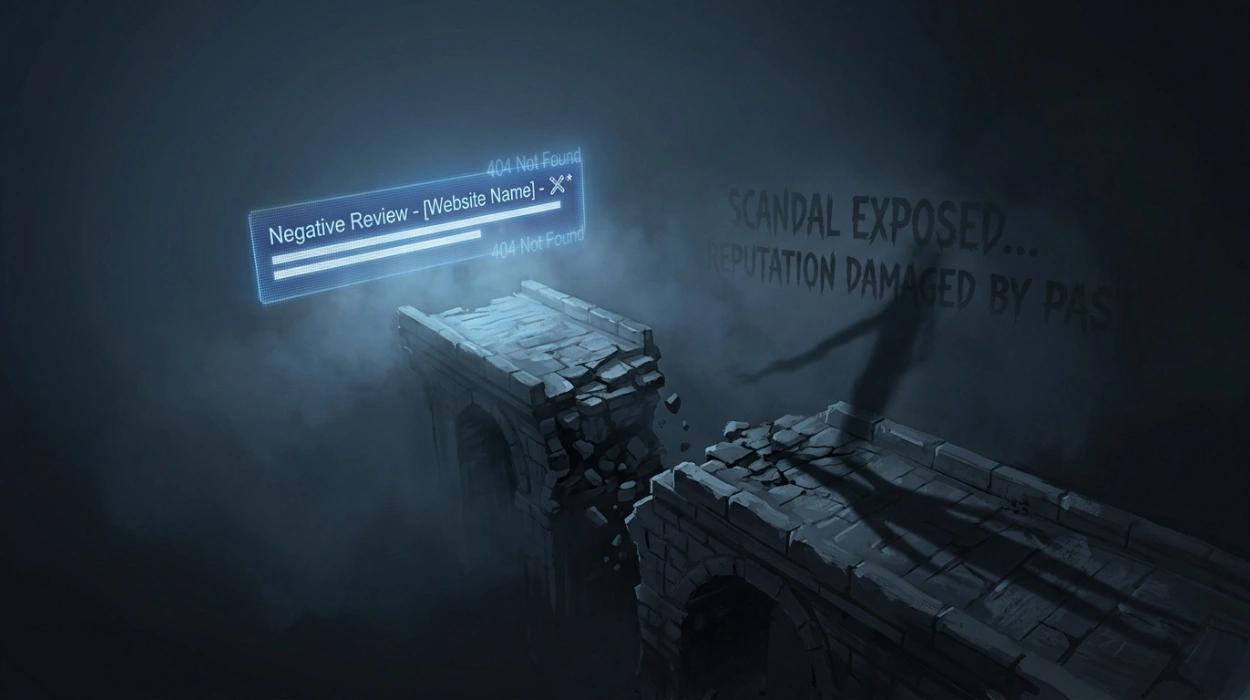
A dead link is a URL that no longer resolves to accessible content but can remain visible within search ecosystems through indexing, references, and historical signals. Dead link reputational harm occurs when these inaccessible URLs continue influencing search perception, trust signals, and entity credibility despite the destination page no longer functioning. Search engines and users can still encounter associated reputation signals, allowing outdated or broken content references to affect online credibility and search visibility.
Reputation management is the process of analysing, monitoring, and understanding how information influences trust, credibility, and perception within digital environments. Online reputation refers to the collective interpretation of content, entities, and signals that appear across search engines, websites, and digital platforms.
What Is a Dead Link in Search Ecosystems?
A dead link is a hyperlink that points to a resource that no longer exists or cannot be accessed by users and search engine crawlers. Within search ecosystems, dead links represent disconnected information pathways that interrupt content accessibility and entity verification.
A dead link typically returns status codes such as 404 (Not Found) or 410 (Gone). Search engines identify these responses during crawling and evaluate whether the destination content remains available. Although the page becomes inaccessible, associated references, backlinks, citations, and indexed records often remain visible within search databases.
The concept extends beyond technical website maintenance. Search engines continuously analyse relationships between content sources, entities, and information references. When a dead link was previously connected to indexed content, traces of that content remain embedded within search systems through historical indexing records and external references.
From a reputation perspective, dead links influence how users evaluate credibility. A search result that leads to unavailable information creates uncertainty regarding content reliability, source accuracy, and entity trustworthiness.
Why Do Dead Links Continue Appearing in Search Results?
Dead links continue appearing in search results because search engines retain historical indexing information while reassessing content availability and relevance. Search visibility does not disappear immediately after content becomes inaccessible.
Search engines maintain extensive databases containing previously crawled content. When a page becomes unavailable, the removal process depends on crawl frequency, indexing schedules, and the persistence of external references. During this period, search results can continue displaying URLs that no longer function.
The persistence of dead links is also connected to link-based authority signals. External websites often continue linking to unavailable pages. These references provide evidence that the content existed and held informational value within the broader content ecosystem.
Search engines evaluate content freshness, authority, and accessibility as separate signals. A page can lose accessibility while retaining historical authority indicators. This separation explains why dead links continue appearing within search engine results pages even after the destination content disappears.
The result is an information gap between search visibility and user experience. Users encounter a visible result but fail to access the expected content, creating a negative perception of information reliability.
How Do Search Engines Interpret Dead Links?
Search engines interpret dead links as indicators of content unavailability while simultaneously analysing their historical relevance and authority signals. The evaluation process involves crawling, indexing, and entity assessment systems.
When a crawler encounters a dead page, it records the server response and updates the page’s status within indexing databases. The search engine then evaluates whether the page remains referenced by external sources or connected to significant entity relationships.
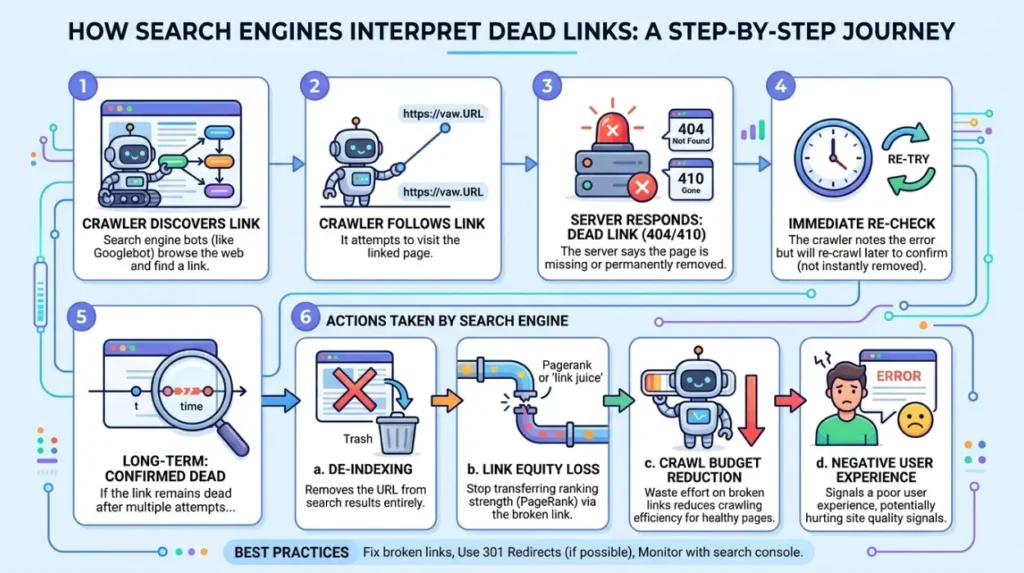
How Crawlers Assess Link Status
Crawlers verify accessibility through HTTP responses. A persistent 404 response indicates missing content, while a 410 response explicitly signals permanent removal. These signals inform indexing decisions and content evaluation processes.
How Indexing Systems Preserve Historical Signals
Indexing systems retain information regarding previously discovered content. Metadata, anchor text references, backlink profiles, and entity associations often remain available for evaluation even after accessibility is lost.
How Entity Systems Evaluate Relevance
Entity-based search systems analyse relationships between content and recognised entities. A dead link connected to an identifiable organisation, person, or subject retains contextual relevance within search knowledge structures.
This layered interpretation explains why dead links continue contributing to search visibility assessments long after content removal.
How Can Dead Links Affect Online Reputation?
Dead links affect online reputation by disrupting information accessibility, weakening trust signals, and creating inconsistencies within an entity’s digital footprint. Reputation systems rely heavily on information accuracy and continuity.
Online reputation refers to the interpretation of available information across search environments. When users encounter inaccessible content, they receive incomplete information regarding the associated entity. This interruption reduces confidence in information quality and reliability.
Dead links also influence authority perception. Search users expect credible entities to maintain accessible and current content resources. Broken pathways signal weak information governance, reducing perceived trustworthiness.
From a search perspective, reputation signals emerge through user interactions, content quality evaluations, and authority assessments. Dead links negatively affect each of these dimensions by limiting content accessibility and disrupting information verification processes.
Entity perception becomes fragmented when important supporting content disappears. Search users cannot evaluate context, evidence, or source credibility when the referenced content no longer exists.
What Is the Relationship Between Dead Links and Digital Footprints?
Dead links remain part of a digital footprint because they represent historical records of content existence and entity activity. A digital footprint refers to the total collection of information associated with an entity across digital environments.
Search engines construct entity understanding through accumulated content references, mentions, links, and indexing records. Even after content disappears, evidence of its existence often remains visible through citations, archived references, and backlink networks.
Dead links therefore function as residual footprint components. They demonstrate that information previously existed but no longer remains accessible. This distinction influences how search engines and users evaluate content continuity.
A fragmented digital footprint reduces information consistency. Consistency is a recognised reputation signal because it supports accurate entity identification and verification. Dead links introduce discontinuity into this process.
The relationship between dead links and digital footprints highlights the importance of content lifecycle management. Search ecosystems continuously evaluate both existing and historical information when determining relevance and credibility.
How Do Dead Links Influence SERP Evaluation?
Dead links influence SERP evaluation by affecting the relationship between search result expectations and user experience outcomes. SERP evaluation refers to how search engines assess the usefulness and reliability of results displayed to users.
Search engines aim to provide accessible and relevant information. When users select a result that leads to unavailable content, the information retrieval process fails. This outcome reduces the usefulness of the search result.
Search systems analyse behavioural indicators connected to result quality. Accessibility forms a foundational component of content usefulness because users must access information before evaluating relevance.
Dead links also affect content ecosystem integrity. Search engines interpret interconnected content as evidence of authority and topical depth. Broken connections reduce informational continuity and weaken contextual understanding.
The impact extends beyond a single URL. When multiple dead links appear within a connected content network, overall perception of information quality declines. Search ecosystems favour environments where information remains accessible, verifiable, and interconnected.
Why Do Authority and Trust Signals Matter When Dead Links Exist?
Authority and trust signals matter because search engines evaluate credibility through evidence of reliability, accessibility, and information quality. Dead links weaken these signals by interrupting content verification pathways.
Authority signals refer to indicators demonstrating expertise, recognition, and relevance. Trust signals refer to indicators demonstrating accuracy, transparency, and dependability. Both contribute to reputation assessment within search systems.
When supporting content becomes inaccessible, users lose access to evidence that validates claims, expertise, or historical context. The inability to verify information reduces perceived trustworthiness.
Search engines also analyse the structure of information networks. Accessible references strengthen semantic relationships between topics and entities. Dead links weaken these relationships by removing supporting informational nodes.
The result is diminished confidence in content ecosystems. Trust and authority rely on information continuity, while dead links represent interruptions within that continuity framework.
How Does Dead Link Removal Affect Search Reputation Maintenance?
Dead link removal affects search reputation maintenance by restoring information accuracy and improving content ecosystem integrity. Reputation maintenance refers to the ongoing management of information quality and accessibility within search environments.
Search ecosystems favour accurate representations of entities and topics. Removing obsolete references reduces ambiguity and improves content clarity. This process strengthens information consistency across indexed resources.
Evaluate Inaccessible Resources
Identify broken URLs and analyse their indexing status. Search systems use accessibility data to assess content quality and relevance.
Update Content References
Replace obsolete references with valid information sources. Updated references strengthen semantic relationships and preserve informational continuity.
Improve Content Accessibility
Maintain accessible pathways between related resources. Accessibility supports user experience and reinforces trust signals.
Preserve Entity Consistency
Align content references with current information structures. Consistent information strengthens entity perception and reduces ambiguity.
These mechanisms demonstrate why How a Dead Link Removal Service Cleans Up Broken Links That Still Rank represents a relevant operational topic within broader reputation maintenance discussions.
Can Dead Links Influence Long-Term Entity Perception?
Yes. Dead links influence long term entity perception because search ecosystems accumulate historical information over extended periods. Entity perception refers to how search engines and users interpret an identifiable subject based on available information.
Search engines continuously analyse content relationships, authority indicators, and informational consistency. Dead links introduce gaps within these relationships, reducing contextual completeness.
Historical references often remain visible through backlinks, citations, and archived records. Even when the destination content disappears, associated reputation signals continue contributing to entity understanding.
Long-term perception depends on informational coherence. Coherent content ecosystems provide clear evidence of expertise, relevance, and credibility. Dead links reduce coherence by disconnecting supporting information from the broader content network.
As a result, dead links function as both technical and reputational artefacts within search ecosystems. Their influence extends beyond accessibility and into the interpretation of trust, authority, and digital credibility.
Dead links are inaccessible URLs that continue influencing search ecosystems through historical indexing records, authority signals, backlinks, and entity associations. Their significance extends beyond technical website maintenance because search engines evaluate content accessibility as part of broader reputation assessment processes.
Within reputation management, dead links affect digital footprints, SERP evaluation, authority signals, trust indicators, and long-term entity perception. Search ecosystems rely on information continuity, accessibility, and consistency when determining credibility and relevance. Understanding how dead links persist and influence search perception provides a clearer view of how online reputation is formed, interpreted, and maintained within modern search environments.
What is a dead link in search engine results?
A dead link is a URL that leads to a page that no longer exists or cannot be accessed. Even when the page is unavailable, search engines can continue displaying the URL due to historical indexing, backlinks, and cached data.
Can a dead link harm online reputation?
Yes. Dead links can create negative user experiences and reduce trust when visitors encounter inaccessible content. Within reputation management, broken pages can affect credibility, entity perception, and search visibility.
Why do dead links still appear on Google after content is removed?
Search engines retain indexed information and evaluate historical authority signals before fully removing URLs from search results. External backlinks and references can also keep dead links associated with an entity’s digital footprint.
How do search engines evaluate dead links?
Search engines analyse HTTP status codes, content indexing records, backlink profiles, and entity relationships. These signals help determine whether the dead link still holds relevance within search ecosystems and SERP evaluation processes.
What role does dead link removal play in reputation management?
Dead link removal helps improve content accuracy, information accessibility, and digital footprint consistency. Clear Your Name recognises that removing broken links can support stronger reputation signals by reducing outdated or inaccessible search results.