Evidence that directly connects a review to an applicable Indeed content rule provides the clearest basis for a removal request. A specific policy breach is more relevant than simply showing that a review is negative, damaging or disputed.
Reputation management strategies differ based on whether the objective is content removal, search visibility management or reputation enhancement. Online reputation control methods are evaluated through policy relevance, evidence quality, search ranking influence, sustainability and risk exposure.
What Makes Evidence Relevant to an Indeed Review Removal Request?
Policy relevance provides the strongest starting point because Indeed states that reviews remain available unless they breach its content guidelines. A removal request therefore operates differently from a general complaint about criticism or negative sentiment. Evidence becomes relevant when it demonstrates a connection between the review and a specific rule governing company reviews or user-generated content.
A useful evidence framework evaluates the content itself, rather than attempting to prove that the reviewer was unfair. Indeed’s published guidance identifies issues including false information, discriminatory language, obscenities, spam, defamatory content and allegations of illegal activity as reasons for reporting reviews.
The distinction between disagreement and policy violation is important. A review expressing an unfavourable opinion about workplace culture does not automatically create a removal basis simply because an employer disputes the assessment. By contrast, evidence showing that specific statements fall within a prohibited content category gives the platform a defined issue to evaluate.
How Does Policy-Based Evidence Compare With Evidence of Factual Inaccuracy?
Policy-based evidence directly addresses the platform’s moderation criteria, while factual-dispute evidence focuses on whether individual statements are accurate. The two approaches overlap when an inaccurate statement also breaches a relevant content rule. However, proving that a company disagrees with a statement is not equivalent to demonstrating that the content violates Indeed’s guidelines.
Indeed’s company-review guidance states that reviews are intended to reflect the reviewer’s experience and that content should be truthful and accurate. Its guidance also distinguishes reviews from places for reporting crimes, sharing internal company details or making claims of illegal activity.
A factual challenge therefore requires careful classification. Evidence such as employment records, published company information or documented timelines can help identify a factual inconsistency, but the significance of that inconsistency depends on the applicable policy. A removal request becomes more precise when it explains the exact statement, identifies the supporting evidence and connects the issue to the relevant guideline.
Which Evidence Carries More Weight Than Simply Calling a Review Defamatory?
Evidence that identifies a concrete policy issue is more useful than a general assertion that a review is defamatory. Indeed’s own employer guidance specifically lists defamatory content among reasons a review can be reported, but the platform retains discretion over whether reported user content violates its policies.
The word “defamatory” therefore does not operate as an automatic removal trigger. A request that only states that a review damages reputation provides limited analytical information. A stronger evidence structure isolates the disputed statement, explains the factual basis for the objection and identifies the applicable content rule.
Legal evidence and platform-policy evidence also serve different functions. A court order, formal legal finding or other authoritative documentation has a different evidential character from an employer’s internal disagreement with a review. Indeed’s Terms of Service state that the company retains discretion over whether user content violates its Terms or policies and whether content is hosted, published or removed.
How Does Removal Compare With Content Enhancement for Reputation Management?
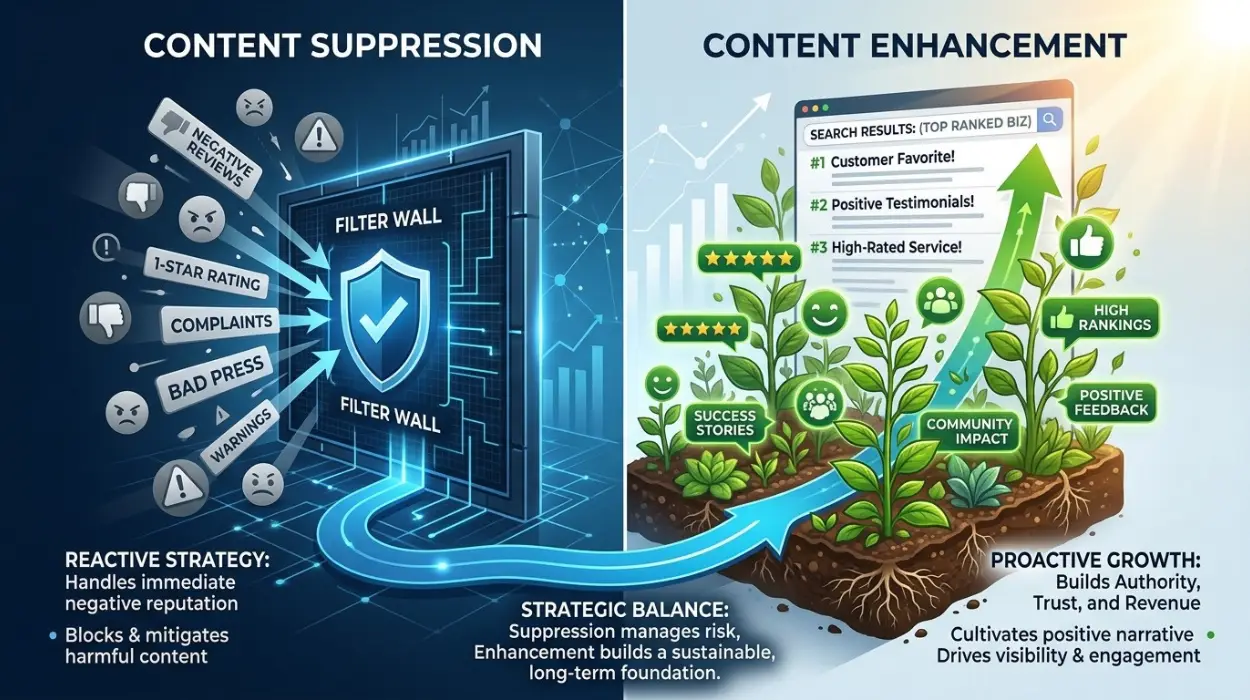
Removal strategies address potentially non-compliant content, while content enhancement addresses the wider information environment surrounding an entity. These approaches therefore operate through different mechanisms and produce different reputation signals.
Content removal operates by reducing or eliminating a specific piece of user-generated content when it falls within an applicable policy category. Content enhancement operates by increasing the availability of accurate, relevant and useful information that contributes to the broader entity profile. The first is reactive and policy-dependent, while the second is generally proactive and dependent on sustained content activity.
Search ecosystems interpret the resulting information environment rather than relying on one isolated page. A removed review can alter the content composition of a platform, but it does not automatically control every search result mentioning the organisation. Conversely, publishing accurate information can strengthen the available information ecosystem without removing a problematic third-party result.
This distinction is important when evaluating search perception. Content suppression reduces the presence of a particular signal, whereas content enhancement increases the availability of alternative signals. Effective reputation analysis therefore considers SERP composition, source authority, relevance, sentiment distribution and the persistence of third-party content rather than treating removal as the sole mechanism.
Does an Organic Reputation Strategy Work Differently From a Reactive Removal Strategy?
Organic reputation management builds reputation signals before a specific negative event becomes the central focus, while reactive removal responds to an identified piece of problematic content. Organic methods generally focus on creating, maintaining and distributing accurate information across relevant digital properties. Reactive methods focus on assessing whether existing content breaches platform rules.
The two approaches differ in scalability. A single removal request addresses one defined item, whereas an organic strategy can influence a broader collection of pages, profiles and information sources. However, organic content does not provide a substitute for reporting content that actually breaches a platform’s rules.
Search ranking influence also operates differently. Search engines evaluate numerous signals when determining which pages appear for a query, including relevance, authority and the relationship between queries and indexed content. Reputation enhancement can therefore influence SERP composition over time, while content removal primarily affects the availability of the specific source that has been removed.
Dive Deeper With Our Expert Guides:
What a Sustainable Indeed Review Generation Strategy Looks Like
How to Set Up Alerts for New Indeed Reviews
How Should the Strength of an Indeed Review Removal Request Be Evaluated?
A structured evaluation measures policy relevance, evidence specificity, source reliability and the relationship between the evidence and the reported statement. This approach reduces the risk of confusing reputational dissatisfaction with an identifiable policy issue.
A practical evaluation framework includes:
- Identify the exact review statement that creates the issue rather than referring to the entire review generally.
- Match the statement to the relevant Indeed content guideline or policy category.
- Document factual evidence that directly addresses the disputed statement.
- Separate opinion from factual assertion when analysing the wording.
- Record the original content and surrounding context so the report can be assessed accurately.
- Compare the evidence against alternative explanations before treating an allegation as established fact.
This framework also improves consistency when multiple reviews are assessed. Each item can be evaluated independently instead of applying the same removal argument to every negative review. That distinction matters because one review can contain a policy-relevant violation while another simply expresses an unfavourable personal experience.
What Are the Limitations of Evidence-Based Review Removal?
Evidence does not guarantee removal because the final decision remains with the platform. Indeed states that reporting user content does not create an obligation to remove it and that it retains discretion to determine whether content violates its Terms or policies.
A second limitation concerns evidence interpretation. A document can establish that a company disputes a statement without establishing that the statement violates an Indeed policy. Similarly, evidence showing that a reviewer had a particular employment relationship does not automatically establish that the review itself breaches the guidelines.
A third limitation involves platform-specific procedures. Indeed provides reporting mechanisms for reviews and states that reported content is reviewed by its team. Its UK online-safety framework also provides separate reporting and complaint mechanisms for suspected illegal content, which means that policy complaints and legal-content reports are not necessarily identical processes.
How Does Short-Term Removal Compare With Long-Term Reputation Management?
Short-term removal focuses on changing the immediate content environment, while long-term reputation management focuses on the persistence and distribution of reputation signals. Removing a policy-violating review can address one source, but it does not automatically remove references to the same issue from search engines, social platforms, forums or other websites.
Long-term strategies therefore evaluate the entity’s overall digital footprint. This includes the balance between positive, neutral and negative content, the authority of competing sources, the consistency of business information and the visibility of relevant pages. The objective is analytical rather than purely subtractive: understand how individual signals contribute to the wider search perception of the entity.
Content suppression and content enhancement also have different sustainability characteristics. Suppression depends on a platform recognising a policy violation, while enhancement depends on continued publication, relevance and search visibility. A sustainable reputation framework therefore treats removal as one potential intervention within a wider information ecosystem rather than as a universal solution.
How Can Search Visibility Affect the Assessment of an Indeed Review?
Search visibility determines how easily a review or Indeed Company Page can be discovered through branded or employment-related searches. Indeed itself notes that company-review ratings can appear with search results connected with jobs, meaning review information can form part of the information users encounter while researching an employer.
Search perception is broader than the visibility of a single review. Search engines construct result pages from multiple sources, so the removal of one item does not establish that the same reputation signal disappears from the wider SERP. A complete assessment therefore considers indexed copies, third-party references, branded queries and the authority of competing results.
This is where entity credibility becomes relevant. Entity credibility represents how consistently an organisation is described across accessible information sources. When different authoritative sources provide consistent factual information, the overall information environment becomes easier for search systems and users to interpret.
What Is the Difference Between Removal, Suppression and Enhancement?
Removal eliminates or restricts access to content under a platform’s applicable rules, suppression reduces the prominence of content within a search environment, and enhancement increases the visibility of alternative relevant information. These mechanisms should not be treated as interchangeable.
Removal is platform-dependent because the host decides whether its policies have been breached. Suppression is search-environment dependent because rankings determine which pages receive visibility for particular queries. Enhancement is content-dependent because new or improved information must demonstrate sufficient relevance and authority to compete within search results.
The distinction also affects risk exposure. A removal approach can fail when evidence does not establish a policy violation, while a suppression approach can fail when authoritative third-party pages remain prominent. Enhancement has a different limitation because newly created content does not automatically achieve strong search visibility.
Which Strategy Is More Sustainable for Long-Term Search Perception?
Long-term sustainability comes from combining accurate information management with appropriate responses to policy-violating content rather than relying on a single mechanism. A removal strategy is strongest when a specific piece of content has a clearly identifiable policy issue and supporting evidence. An enhancement strategy is broader because it addresses the composition and quality of the information available about an entity.
The most important distinction is between reputation repair and reputation representation. Repair addresses a problem that already exists, while representation determines how accurately an organisation’s broader digital presence reflects its current identity and activities. Both influence trust signals, but they operate at different stages of the reputation lifecycle.
For consideration-stage analysis, the appropriate method depends on the underlying problem. A policy violation calls for evidence-led reporting, a search visibility problem calls for SERP analysis, and a broader digital-footprint problem calls for sustained information management. Indeed Review Removal Services can therefore be analysed as one specific removal-oriented approach within the wider set of reputation management methods, rather than as a replacement for organic reputation strategies.
What Should Be Considered Before Choosing an Indeed Review Removal Approach?
The strongest approach depends on the relationship between the content, the platform’s rules, the available evidence and the desired reputation outcome. A removal request is primarily a compliance assessment, whereas content enhancement is primarily an information and visibility strategy.
A useful decision framework compares four dimensions: effectiveness, scalability, risk exposure and sustainability. Effectiveness measures whether the method addresses the actual source of the reputation problem. Scalability measures whether the same process can address multiple relevant signals. Risk exposure measures the possibility of unsupported allegations or inappropriate reporting. Sustainability measures whether the resulting reputation environment remains useful after the immediate issue has been addressed.
This comparison prevents a negative review from being treated as automatically removable. Indeed’s published guidance makes clear that negative reviews can remain when they comply with its content guidelines, while reviews that violate applicable rules can be reported for assessment.
How Should Evidence for an Indeed Review Removal Request Be Assessed?
The strongest evidence for an Indeed review removal request directly identifies a potential policy violation and supports that assessment with specific, relevant documentation. A negative opinion, reputational impact or disagreement with a reviewer does not independently establish that removal is appropriate.
Removal, suppression and content enhancement operate through different mechanisms. Removal addresses platform-level content compliance, suppression addresses search visibility, and enhancement builds a broader information environment. Evaluating these approaches through effectiveness, scalability, risk exposure and sustainability provides a clearer framework for managing search perception and digital trust.
Ultimately, an Indeed review removal request is best assessed as a policy-and-evidence question rather than simply a reputation question. The quality of the evidence, the relevance of the cited rule and the distinction between factual claims and personal opinion determine how clearly the issue can be evaluated. Indeed retains discretion over moderation decisions, so evidence strengthens the analytical basis of a request without guaranteeing a particular outcome.
What evidence can support an Indeed review removal request in the UK?
Evidence such as screenshots, review URLs, employment records, internal correspondence, or other documentation can help show that an Indeed review may breach the platform’s review guidelines. The strongest evidence directly supports a specific issue, such as false claims, personal information, conflicts of interest, or content unrelated to genuine workplace experience.
Can screenshots help with Indeed review removal?
Yes, screenshots can preserve the exact wording, reviewer details, date, and context of an Indeed review. They can be useful when submitting an Indeed review removal request, particularly if the review is later edited or deleted.
Does proof that an Indeed review is false guarantee its removal?
No. Evidence that a statement is inaccurate can support a complaint, but Indeed will generally assess the review against its own content policies and available information before deciding whether removal is appropriate.
What documents can support an Indeed review removal request?
Relevant documents may include employment records, correspondence, job descriptions, or other material that helps establish whether the review relates to a genuine workplace experience. Only evidence directly connected to the disputed review should normally be included, while confidential or unnecessary personal information should be protected.
How should evidence be presented for an Indeed review removal request?
Evidence should be organised clearly, with the specific part of the review identified and a brief explanation of why it may violate Indeed’s guidelines. Clear screenshots and supporting documents can make the complaint easier to understand and assess.