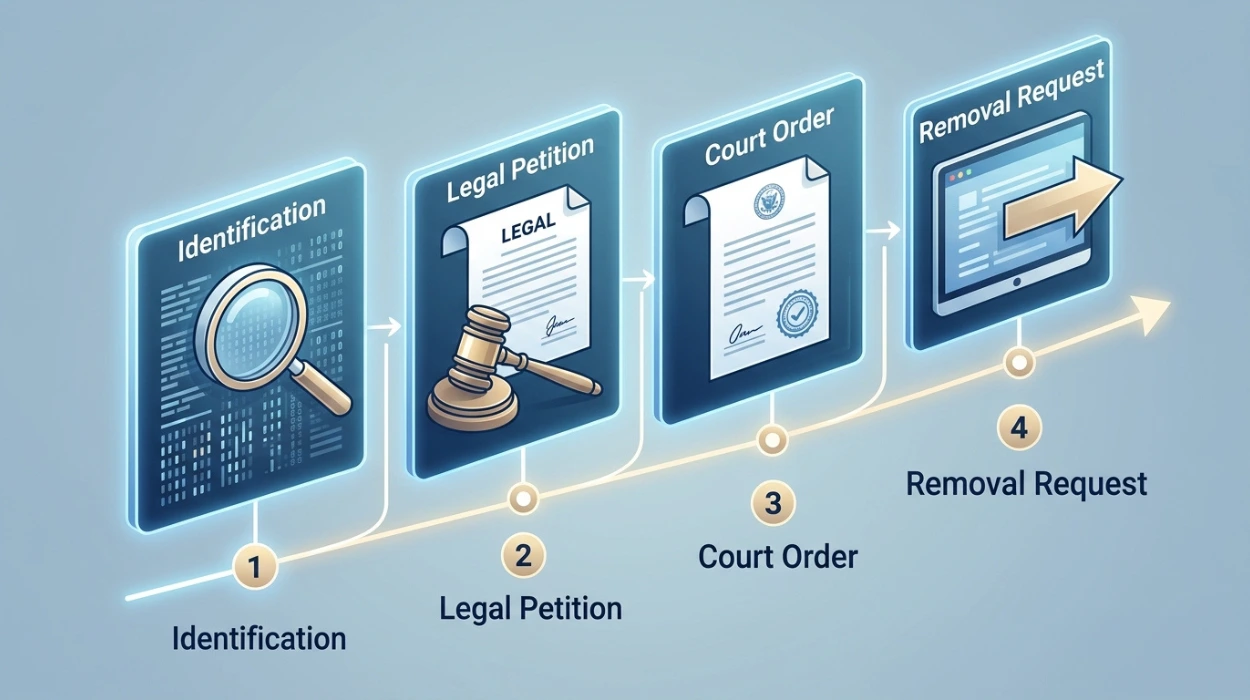
The ability to remove a criminal record from the internet depends on legal status, publication source, data accuracy, privacy rights, and search ecosystem policies. Different removal approaches operate through distinct mechanisms and produce different outcomes for search visibility and reputation signals.
Reputation management strategies differ based on how information is indexed, interpreted, and ranked across search ecosystems. Online reputation control methods are evaluated through their impact on search visibility, entity credibility, sentiment distribution, and long-term SERP composition.
Which Factors Have the Greatest Influence on Criminal Record Removal Eligibility?
Legal status, information accuracy, and publication authority exert the strongest influence on criminal record removal eligibility. These factors determine whether content qualifies for deletion, de-indexing, correction, restriction, or continued publication.
Removal eligibility is the assessment process used to determine whether online content satisfies legal, regulatory, or platform-specific requirements for reduced visibility. Search ecosystems evaluate information according to governance standards rather than reputation concerns alone.
Publicly accessible court records typically receive stronger protection because they originate from authoritative institutional sources. Information classified as expunged, sealed, inaccurate, outdated, or unlawfully published often undergoes a different evaluation process.
Search ranking influence increases when content originates from highly trusted domains. Consequently, removal eligibility often depends not only on the content itself but also on the authority signals associated with its source.
How Does Legal Record Status Compare With Content Accuracy in Removal Decisions?
Legal record status determines whether information remains publicly accessible, whereas content accuracy evaluates whether the published information correctly reflects reality. Both factors influence removal eligibility through separate mechanisms.
Legal status refers to classifications such as public, sealed, expunged, restricted, or protected records. These classifications define whether information remains eligible for public distribution within legal frameworks.
Content accuracy focuses on factual integrity. Incorrect names, mistaken identities, outdated outcomes, and inaccurate legal descriptions weaken trust signals because search ecosystems prioritise informational reliability.
Legal status operates through regulatory authority, while accuracy operates through credibility assessment. Removal decisions frequently evaluate both dimensions simultaneously because legal accessibility does not automatically guarantee informational accuracy.
This distinction explains why some publicly available records remain online while inaccurate information becomes subject to correction or removal review.
How Do Court Records Compare With News Articles in Removal Evaluations?
Court records function as primary legal sources, whereas news articles operate as secondary interpretive sources. Their differences significantly affect removal evaluation processes.
Court records derive authority from institutional publication. Search engines interpret these documents as highly credible because they originate from recognised governmental entities and formal judicial systems.
News articles analyse, report, and contextualise legal events. Although reputable news sources also generate strong authority signals, journalistic content represents interpretation rather than official documentation.
From a removal perspective, court records often rely on legal status changes to alter accessibility. News content frequently undergoes evaluation through accuracy reviews, editorial standards, privacy considerations, and public interest assessments.
The comparison demonstrates how source type influences the mechanisms available for reducing search visibility.
What Is the Difference Between Content Removal and Search De-Indexing?

Content removal eliminates information from the publishing source, whereas de-indexing reduces visibility within search results while the original content remains accessible.
Content removal is the complete deletion of information from a website or database. Once removed, search engines eventually update indexed records to reflect the content’s absence.
De-indexing operates by restricting search engine visibility without deleting the underlying page. The content continues to exist but becomes less discoverable through standard search queries.
Content removal generally produces broader visibility reduction because the source itself no longer exists. De-indexing primarily affects search accessibility rather than content availability.
This distinction highlights the difference between altering information availability and altering information discoverability.
How Does Source Authority Affect the Likelihood of Successful Removal?
Source authority affects removal outcomes because authority signals influence how information is evaluated within digital ecosystems. Higher-authority sources generally maintain stronger publication protections.
Authority signals refer to indicators that establish reliability, credibility, and trustworthiness. Government portals, recognised media organisations, and official databases generate significant authority due to institutional legitimacy.
Lower-authority websites often depend on aggregated or republished information. Their content sometimes receives greater scrutiny because authority signals are less robust.
Search engines evaluate trusted sources differently from low-authority publishers because source credibility contributes directly to ranking and indexing decisions. As a result, authority influences both content persistence and removal evaluation complexity.
The relationship between authority and visibility explains why identical information can experience different outcomes across separate publishing environments.
Which Reputation Management Approaches Influence Criminal Record Visibility Most Effectively?
Content removal strategies, content suppression strategies, and content enhancement strategies influence visibility through different mechanisms. Each approach produces distinct effects on reputation signals and SERP composition.
Evaluate Content Removal Strategies
Content removal strategies operate by eliminating information from its publication source. This approach directly reduces the content available for indexing and retrieval.
The primary strength of removal lies in visibility reduction. The limitation involves eligibility requirements because not all content satisfies removal criteria.
Evaluate Content Suppression Strategies
Content suppression is the process of reducing the prominence of negative content through the publication of competing information.
Suppression influences search ranking distribution rather than information existence. Its strength lies in SERP diversification, while its limitation is the continued availability of original content.
Evaluate Content Enhancement Strategies
Content enhancement focuses on strengthening positive and neutral reputation signals associated with an entity.
This method operates by expanding authoritative information ecosystems. Its strength is long-term sustainability, while its limitation is slower visibility impact.
Comparing these approaches demonstrates the difference between reducing content availability and reshaping search result composition.
How Do Privacy Rights Compare With Public Interest Considerations?
Privacy rights protect personal information, whereas public interest considerations evaluate societal value derived from information accessibility. Removal decisions often balance these competing principles.
Privacy protections focus on limiting unnecessary exposure of personal information. Regulatory frameworks assess whether publication creates disproportionate visibility or conflicts with recognised privacy standards.
Public interest evaluates whether information contributes to transparency, accountability, public awareness, or legal understanding. Content possessing substantial public interest often receives stronger publication protections.
Search ecosystems analyse both dimensions because unrestricted privacy protections and unrestricted public disclosure create conflicting governance outcomes. Effective evaluation therefore requires balancing informational rights with accessibility concerns.
This comparison explains why identical content can produce different eligibility outcomes under different contextual circumstances.
Dive Deeper With Our Expert Guides:
What Legal Routes Support a Criminal Record Removal Request From Google
How Do Search Engines Evaluate Reputation Signals Related to Criminal Records?
Search engines evaluate criminal record content through authority analysis, entity association, relevance assessment, and sentiment distribution patterns. These factors influence visibility and perception simultaneously.
Entity credibility refers to the trustworthiness associated with an individual or entity based on indexed information. Criminal record content contributes to entity credibility assessments through repeated associations and contextual references.
Sentiment distribution measures the balance between positive, neutral, and negative content appearing across search results. A concentrated distribution of negative information influences user interpretation even when ranking positions remain unchanged.
Search ranking influence emerges from relevance signals, content authority, semantic relationships, and engagement indicators. Criminal record information frequently achieves visibility because legal content possesses strong informational relevance.
The evaluation process demonstrates how algorithms interpret information independently from human judgement while still affecting perception outcomes.
Which Factors Create Long-Term Versus Short-Term Visibility Outcomes?
Content permanence, source authority, and indexing depth contribute to long-term visibility, whereas temporary ranking fluctuations primarily influence short-term outcomes.
Long-term visibility refers to sustained search presence over extended periods. Official records, authoritative publications, and highly referenced content often maintain durable visibility because search ecosystems continuously recognise their relevance.
Short-term visibility changes occur when indexing updates, ranking adjustments, or temporary search trends alter result composition. These fluctuations affect positioning without necessarily changing overall information availability.
Evaluating long-term and short-term outcomes provides a clearer understanding of sustainability. Strategies that influence source-level information generally create more durable effects than strategies focused exclusively on ranking dynamics.
This distinction is important when assessing how different approaches influence reputation signals over time.
The ability to remove a criminal record from the internet depends on multiple interconnected factors, including legal status, information accuracy, publication authority, privacy rights, and platform governance standards. Each factor influences removal eligibility through a distinct evaluation mechanism.
Content removal, de-indexing, suppression, and enhancement strategies operate differently within search ecosystems. Their effectiveness varies according to source authority, visibility objectives, risk exposure, and long-term sustainability. Understanding these differences provides a more accurate framework for evaluating how criminal record information affects search visibility, entity credibility, sentiment distribution, and overall online reputation.
Within broader reputation management analysis, discussions surrounding Remove Your Criminal Record From the Internet With Confidential UK Assistance often focus on how eligibility criteria, visibility controls, and information governance frameworks interact across modern search ecosystems.
What factors determine whether you can remove a criminal record from the internet?
Removal eligibility depends on factors such as the legal status of the record, information accuracy, privacy rights, and the website publishing the content. Search engines and publishers evaluate criminal record removal requests according to specific legal and platform policies.
Can an expunged or sealed criminal record be removed from search results?
Expunged or sealed records often have stronger grounds for removal because they are no longer intended for public access. The outcome depends on where the information is published and whether the content remains indexed by search engines.
Does inaccurate criminal record information qualify for removal?
Inaccurate criminal record information may qualify for correction, de-indexing, or removal if it contains factual errors or outdated legal details. Accuracy is an important trust signal in online reputation and search visibility systems.
How does the source of a criminal record affect removal options?
Content published on court websites, news platforms, and data aggregation sites is evaluated differently due to varying authority and publication standards. Source authority often influences how criminal record removal requests are reviewed.
What is the difference between criminal record removal and de-indexing?
Criminal record removal deletes content from the original website, while de-indexing reduces its visibility in search engine results. Criminal Record Removal Services, including those evaluated by Clear Your Name, often assess which approach aligns with the content’s legal and publication status.