

GDPR provides legal rights that allow eligible individuals to request the removal or restriction of personal information from search results and online sources when defined legal conditions are satisfied.
Reputation management strategies differ based on the legal basis for removal, the origin of published information, and the relationship between content indexing and search visibility. Online reputation control methods are evaluated through reputation signals, entity credibility, search ranking influence, and the way search engines interpret lawful requests alongside ranking systems. GDPR forms one part of the wider reputation management framework because it regulates personal data processing rather than search rankings themselves. Understanding how GDPR operates within search ecosystems helps evaluate its effectiveness alongside technical, editorial, and reputation-based approaches.
Which GDPR Rights Apply When Removing Personal Information From Google UK?
GDPR rights apply according to the type of personal data, the legal basis for processing, and whether continued publication satisfies UK data protection requirements.
The UK General Data Protection Regulation defines personal data as information relating to an identifiable individual. Within reputation management, GDPR operates by regulating how organisations collect, process, store, and publish personal information. Search engines do not generate personal information independently but index content published by external websites. GDPR therefore evaluates the lawfulness of data processing, while search engines evaluate content indexing and ranking independently. This distinction explains why legal rights and search visibility interact without operating as identical systems.
The most recognised GDPR provisions include the right to access personal data, the right to rectification, the right to erasure, and the right to object to certain forms of processing. Each right operates through defined legal criteria rather than automatic removal. Reputation management evaluates these rights because successful requests reduce unnecessary exposure of personal information while influencing overall sentiment distribution within branded search results. The legal framework therefore contributes to search perception without directly controlling ranking algorithms.
How GDPR Rights Operate Within Search Ecosystems
GDPR rights influence online reputation through legal rather than algorithmic mechanisms.
- Evaluate whether personal information qualifies as personal data under UK GDPR.
- Assess the lawful basis supporting continued publication by the website.
- Determine whether legal rights support restriction, correction, or erasure requests.
- Measure how approved actions influence indexed search visibility and reputation signals.
How Does GDPR Compare With Google’s Own Removal Policies?
GDPR regulates personal data processing, whereas Google’s removal policies regulate eligibility under platform-specific standards.
Google evaluates removal requests according to its published policies concerning sensitive information, explicit material, financial details, identity documents, and legally recognised requests. These policies exist independently from GDPR because Google applies operational standards alongside applicable legal obligations. Reputation management compares these mechanisms because both influence search visibility through different decision-making processes. One evaluates legal rights, while the other evaluates platform policy compliance.
GDPR examines whether personal data continues to be processed lawfully by organisations responsible for publication. Google’s policies examine whether indexed content meets internal removal criteria within search results. An individual may qualify under one framework without qualifying under the other because each system evaluates different legal and operational factors. Search ranking influence therefore changes through separate but interconnected mechanisms. Understanding these differences improves evaluation of appropriate reputation management strategies.
Which Reputation Management Approaches Complement GDPR Rights Most Effectively?
GDPR functions most effectively when evaluated alongside broader reputation management approaches rather than as an isolated legal mechanism.
Reputation management refers to the structured evaluation and improvement of searchable information influencing public perception. GDPR addresses lawful processing of personal information, whereas reputation management analyses the wider balance of reputation signals across search ecosystems. Personal Information Removal Services are frequently evaluated within this broader context because they examine legal eligibility together with technical indexing behaviour and publisher responsibility rather than focusing on one regulation alone. This comparison demonstrates that GDPR addresses one component of digital reputation while wider reputation strategies examine overall SERP composition.
Content removal represents a reactive approach that focuses on identified information requiring legal or policy review. Content enhancement represents an organic approach that strengthens authoritative and relevant information across trusted digital assets. Reputation management analyses content suppression vs content enhancement because each influences sentiment distribution through different mechanisms. Reactive methods reduce existing visibility, whereas organic methods improve the proportion of positive reputation signals appearing within search results. Their effectiveness depends upon different objectives rather than direct competition.
Comparing Reputation Management Approaches
Different approaches operate through distinct mechanisms within search ecosystems.
| Approach | Primary Mechanism | Strength | Limitation |
|---|---|---|---|
| GDPR rights | Regulates lawful personal data processing | Legal protection of personal information | Applies only where legal criteria exist |
| Content removal | Removes or restricts identified content | Immediate reduction in visibility | Requires legal or policy eligibility |
| Content enhancement | Improves authoritative digital assets | Strengthens entity credibility | Develops gradually over time |
| Content suppression | Alters SERP composition through competing visibility | Improves sentiment distribution | Original content frequently remains accessible |
How Do Search Engines Interpret GDPR-Based Reputation Signals?
Search engines interpret the consequences of GDPR actions rather than GDPR rights themselves.
Search algorithms continue evaluating authority, relevance, technical quality, and user intent after legal requests are processed. When eligible information is removed or de-indexed, search visibility changes because indexed content available for evaluation changes. Reputation signals adjust as SERP composition evolves following successful legal action. Entity credibility benefits when accurate and relevant information represents a larger proportion of indexed search results. Search engines therefore respond to changes in available content rather than evaluating legal rights directly.
This distinction is important when analysing reputation systems. GDPR establishes the legal framework governing data processing, while Google’s algorithms continue ranking remaining indexed information according to search quality signals. Reputation management evaluates this relationship because legal removal does not automatically create positive search visibility. Instead, search perception develops through the interaction of lawful content management, authority signals, and ongoing indexing processes. Understanding this mechanism provides a more accurate evaluation of GDPR’s role within search ecosystems.
Dive Deeper With Our Expert Guides:
What Google’s Privacy Tools Allow When Requesting Phone Number Removal
How Data Broker Removal in the UK Works Under GDPR and Data Protection Law
Is GDPR More Effective Than Organic Reputation Management?
GDPR and organic reputation management achieve different objectives and therefore require comparative evaluation rather than direct substitution.
GDPR operates through statutory legal rights designed to regulate personal data processing. Organic reputation management operates through continuous improvement of reputation signals, authoritative publishing, structured information, and search visibility. Comparing these approaches demonstrates that one addresses legal compliance while the other influences long-term entity credibility within search ecosystems. Their mechanisms differ because one removes or restricts qualifying information, while the other improves the prominence of trusted content. Effectiveness therefore depends upon the objective being evaluated rather than the existence of a single preferred method.
Organic approaches generally influence search perception over a longer period because search engines continuously reassess authority and relevance through recurring indexing cycles. GDPR-based action produces targeted legal outcomes where qualifying conditions exist, while organic reputation management contributes to broader SERP development over time. Reputation management therefore analyses both methods according to scalability, sustainability, and their respective influence on reputation signals instead of treating them as interchangeable strategies.
How Does GDPR Compare With Other Legal Routes for Removing Personal Information?
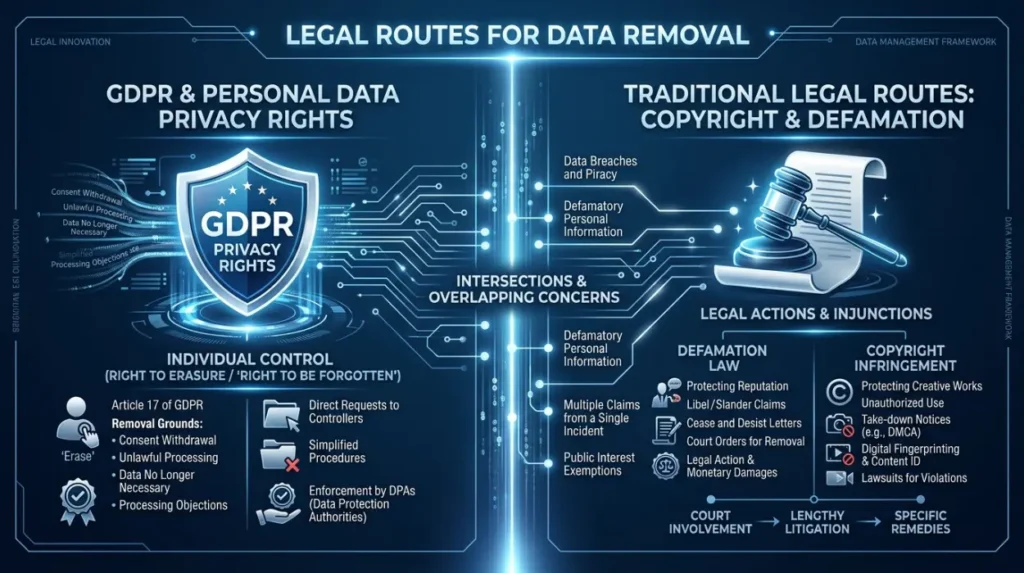
GDPR evaluates the lawful processing of personal data, while other legal frameworks address different legal rights and responsibilities relating to published information.
Privacy law, defamation law, copyright law, and court-ordered removals each operate through separate legal principles. GDPR focuses on whether organisations process personal information lawfully, accurately, and proportionately. Defamation evaluates false statements that damage reputation, whereas copyright protects original creative works instead of personal data. Reputation management compares these legal routes because each influences search visibility through different mechanisms within search ecosystems. Selecting the relevant legal framework depends upon the nature of the indexed information rather than applying a universal legal solution.
Search engines also process legal requests differently depending on their legal basis. A GDPR request examines data protection obligations, while a copyright notice examines ownership rights and a court order examines judicial authority. Reputation signals change only after search visibility changes following successful legal or platform action. Entity credibility therefore develops through the interaction between legal compliance, content indexing, and search ranking influence. Comparing legal frameworks demonstrates that each contributes differently to online reputation management.
Evaluating Legal Frameworks Within Reputation Management
Legal mechanisms operate according to distinct objectives.
- Assess GDPR where personal data processing forms the central issue.
- Evaluate privacy law when publication interferes with recognised privacy rights.
- Apply copyright law where ownership of protected material determines eligibility.
- Review court decisions where judicial authority governs removal requirements.
Which Factors Influence the Success of GDPR-Based Requests?
The success of GDPR-based requests depends upon legal eligibility, the source of publication, and the continued justification for processing personal data.
Organisations responsible for publishing personal information evaluate requests according to UK GDPR requirements before deciding whether processing remains lawful. Search engines separately evaluate whether corresponding search results require review following legal action or recognised requests. Reputation management analyses this process because search visibility changes only after both legal and technical conditions are satisfied. Content indexing continues until qualifying actions alter the searchable information available within the search ecosystem. This relationship demonstrates that legal rights and indexing mechanisms operate alongside one another rather than replacing each other.
Evidence also influences the outcome of GDPR requests. Accurate identification of personal data, clear explanation of the legal basis relied upon, and appropriate documentation improve the consistency of the assessment process. Reputation management compares successful and unsuccessful requests by examining the quality of evidence rather than the volume of submissions. Entity credibility benefits when lawful removals reduce unnecessary exposure while authoritative information continues supporting search visibility. This evidence-based process reflects the structured nature of UK data protection law.
Which Strategic Considerations Matter When Evaluating GDPR Within Reputation Management?
Strategic evaluation requires balancing legal eligibility, search ecosystem behaviour, long-term sustainability, and the wider distribution of reputation signals.
GDPR provides a defined legal mechanism for addressing qualifying personal information, but it does not determine how search engines rank the remaining indexed content. Search visibility continues to depend upon authority, relevance, technical quality, and reputation signals after qualifying removals occur. Reputation management therefore evaluates legal rights alongside broader search ecosystem analysis rather than considering GDPR in isolation. This comparison demonstrates that legal compliance and search ranking influence operate through complementary systems. Sustainable reputation management depends upon understanding both.
Long-term evaluation also considers scalability and future search perception. Legal requests resolve identified issues where statutory rights apply, whereas broader reputation management analyses how entity credibility develops across multiple authoritative sources. Search engines reassess indexed information continuously, meaning SERP composition changes as content evolves. Analysing these relationships explains why long-term reputation outcomes depend upon both lawful information management and the continuing development of trusted digital assets. Strategic evaluation therefore extends beyond a single legal request.
Within this broader framework, understanding Remove Your Personal Information From Google UK helps connect legal rights with practical reputation management considerations. Evaluating both legal mechanisms and search ecosystem behaviour provides a more complete understanding of how personal information influences online reputation over time.
GDPR establishes legal rights that regulate how personal information is processed, while search engines continue organising indexed content through content indexing, authority evaluation, and search ranking systems. Reputation management compares GDPR with other legal, technical, and organic approaches because each influences search visibility, entity credibility, and sentiment distribution through different mechanisms.
Evaluating GDPR within the wider reputation management framework demonstrates that legal rights, content removal strategies, content enhancement, and search ecosystem behaviour each contribute to long-term online reputation. Understanding these relationships provides a clearer view of how personal information is managed across search environments and why different situations require different combinations of legal and reputation-based approaches.
What GDPR rights help remove personal information from Google UK?
UK GDPR provides rights such as the right to erasure, the right to rectification, and the right to object to certain data processing activities. These rights apply when personal information meets the legal criteria under UK data protection law.
Does GDPR automatically remove personal information from Google Search?
No. GDPR establishes legal rights relating to personal data, but each request is assessed individually against UK GDPR requirements and Google’s review processes. Eligibility depends on the nature of the information and the legal basis for processing it.
What is the difference between GDPR removal requests and Google’s removal policies?
GDPR focuses on whether personal data is processed lawfully by organisations, while Google’s removal policies assess whether content meets its own eligibility standards for removal from search results. Both can affect search visibility, but they operate through different frameworks.
Can Personal Information Removal Services help with GDPR-based requests?
Personal Information Removal Services evaluate whether personal information qualifies for removal under UK GDPR, Google’s policies, or other applicable legal frameworks. Companies such as Clear Your Name assess the available options based on the source of the information and the relevant legal criteria.
How does removing personal information from Google affect online reputation?
Removing eligible personal information can reduce unnecessary search visibility and improve the balance of reputation signals within search results. When combined with broader reputation management, it supports stronger entity credibility and a more accurate online presence.