
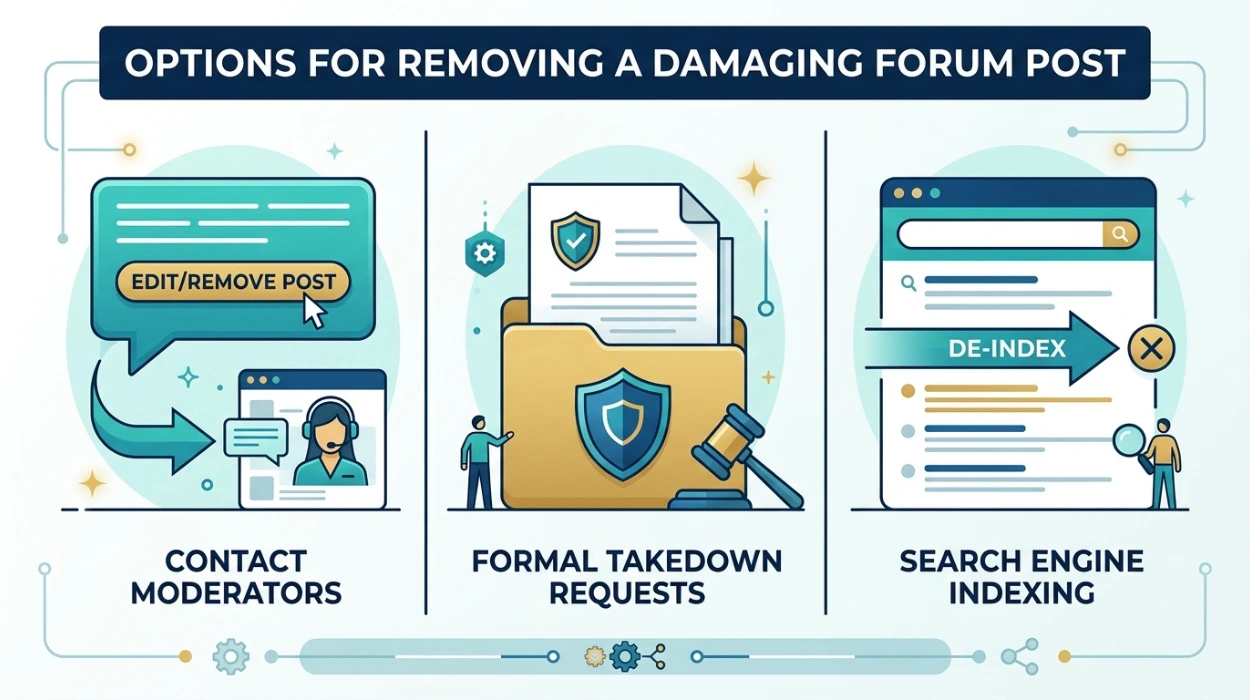
Removing a forum post that is damaging your reputation depends on the authority controlling the content, the legal basis for removal, and how search engines interpret indexed pages. Reputation management strategies differ based on platform policies, legal rights, search engine behaviour, and the relationship between content visibility and reputation signals. Online reputation control methods are evaluated through search ranking influence, entity credibility, content ownership, and sentiment distribution across search ecosystems.
Online reputation management within this context focuses on evaluating the mechanisms available for reducing the visibility or existence of harmful forum content. Forum discussions often remain indexed because search engines recognise them as independently published material with established authority. The effectiveness of any response depends on the interaction between content removal, content suppression versus content enhancement, search engine indexing, and platform governance. Understanding how each approach operates provides a clearer basis for selecting an appropriate reputation management strategy.
What removal options exist for damaging forum posts?
Several removal options exist, but each operates through a different mechanism and produces different outcomes for search visibility. Some methods eliminate the original content, while others influence how prominently it appears in search results. The appropriate approach depends on ownership, platform moderation rules, legal standing, and indexing behaviour.
Content removal is the direct elimination of published material from its original source. This approach operates by persuading or requiring the platform administrator to remove the content entirely. Once deleted, search engines gradually update their indexes, although cached versions and references may temporarily remain visible. Removal produces the strongest reduction in search visibility because the source page no longer exists.
Content suppression versus content enhancement follows a different mechanism. Rather than removing the original page, additional authoritative material changes the balance of search results through improved entity credibility and diversified reputation signals. This approach analyses search ranking influence instead of focusing exclusively on deletion.
Both strategies influence SERP composition differently. Removal changes the available indexed content, whereas suppression changes how search engines evaluate competing pages within the same topic or entity.
How does requesting removal from the forum compare with other approaches?
Forum administrator requests represent the most direct option because they target the source itself. Every discussion platform establishes moderation policies governing harassment, privacy violations, copyright infringement, defamation, impersonation, or prohibited conduct. Evaluating those policies determines whether administrative intervention is possible.
A platform request operates through internal moderation rather than search engine intervention. Moderators review reported content against published rules before deciding whether removal, editing, or retention is appropriate. The effectiveness of this route depends entirely on policy compliance rather than public perception or search ranking influence.
Alternative approaches operate outside platform governance. Search engine requests evaluate indexed content rather than forum moderation decisions. Legal procedures evaluate statutory rights rather than community guidelines. Reputation management methods therefore differ according to the authority responsible for making the decision.
Forum requests often provide quicker outcomes when clear policy violations exist. Their limitation lies in the absence of enforcement where published content remains consistent with platform rules despite causing reputational harm.
How do legal removal routes compare with platform moderation?
Legal removal routes evaluate statutory obligations, whereas platform moderation evaluates community policies. These mechanisms function independently despite sometimes producing similar outcomes.
How do legal rights influence removal decisions?
Legal removal operates through recognised legal frameworks addressing unlawful publication. Defamation, privacy violations, copyright infringement, misuse of personal information, or court orders provide examples of legal mechanisms capable of supporting removal requests. These frameworks define whether continued publication breaches applicable legal standards.
Platform moderation does not require unlawful content before taking action. Forum operators remain free to enforce broader behavioural standards covering abusive language, misinformation, impersonation, or disruptive conduct. Consequently, content retained under legal analysis may still violate internal moderation policies.
The comparative strength of legal routes lies in enforceability. Their limitation involves evidential requirements, procedural complexity, jurisdictional variation, and legal thresholds that determine whether removal qualifies under applicable legislation.
How does search engine removal differ from deleting the original forum post?
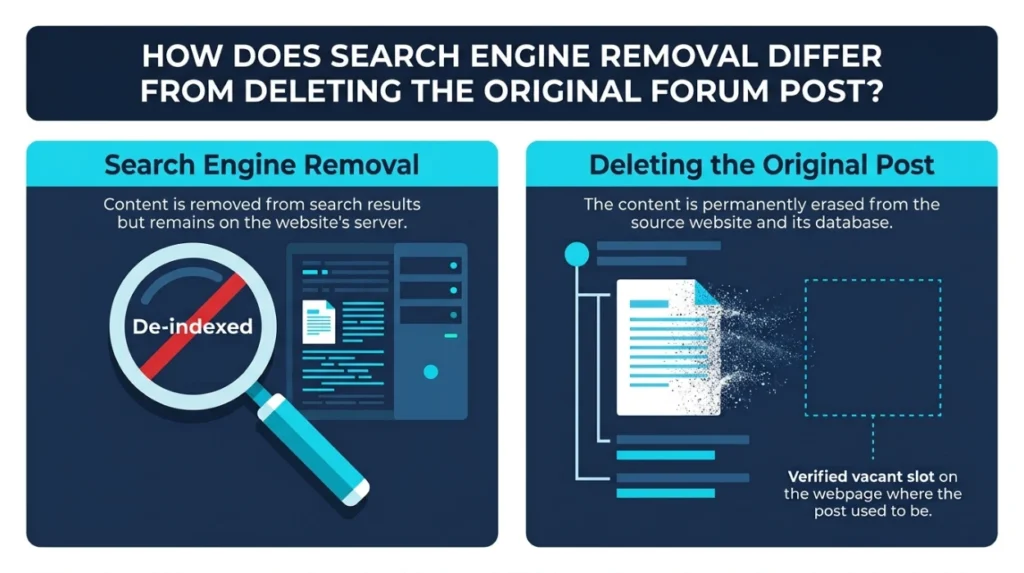
Search engine removal and source removal represent distinct processes with different outcomes. Search engines index content created elsewhere but rarely control its publication.
Removing indexed results operates by limiting visibility within search results rather than deleting the original discussion. When eligibility criteria apply, search engines evaluate whether certain pages qualify for restricted visibility according to established policies. The original page generally continues existing on the hosting forum unless independently removed.
Deleting the original forum post produces broader consequences because search engine crawlers eventually recognise that the source content no longer exists. Index updates progressively remove or revise search listings according to crawling schedules and indexing frequency.
Search visibility therefore depends upon both publication status and indexing status. Understanding this distinction allows reputation management strategies to compare removal mechanisms more accurately.
Which reputation management approaches produce the most sustainable outcomes?
Long-term sustainability depends on strengthening reputation signals rather than relying upon a single intervention. Search ecosystems continuously evaluate authority, freshness, relevance, entity credibility, and content relationships.
Reactive removal strategies focus primarily on eliminating immediate reputational risks. Organic approaches strengthen authoritative content across owned and earned digital properties, improving sentiment distribution over time. Comparing these methods demonstrates different sustainability profiles despite serving related objectives.
Organic reputation enhancement generally produces broader resilience because additional authoritative content continues supporting positive entity perception after initial publication. Reactive interventions remain valuable when clearly defined harmful material requires direct attention.
Both approaches influence SERP composition differently. Sustainable reputation management analyses how search engines reassess competing information over extended indexing cycles rather than evaluating isolated ranking movements alone.
Dive Deeper With Our Expert Guides:
What Routes Are Available for Removing a Court Case From Google in the UK
Which approach carries the lowest reputation risk?
Risk exposure differs according to the chosen reputation management strategy, the nature of the forum content, and the authority responsible for reviewing removal requests. Every option operates within different procedural, legal, and technical boundaries that affect predictability and long-term search visibility.
Reactive approaches reduce immediate exposure when unlawful or policy-violating content exists. Their limitation appears when content remains lawful but continues influencing reputation signals. Organic reputation enhancement carries lower long-term dependency because it improves entity credibility across multiple digital assets rather than relying on a single removal decision. Content suppression versus content enhancement therefore represents a comparison between reducing visibility through competition and removing visibility through elimination.
Evaluating reputation risk also involves considering scalability. A single harmful forum thread rarely exists in isolation, particularly when discussions spread across multiple domains or become referenced by other websites. Broader strategies that strengthen authoritative content provide greater resilience against repeated reputation challenges while maintaining a balanced search ecosystem.
How do search engines interpret forum discussions within reputation systems?
Search engines evaluate forum discussions using ranking signals rather than subjective opinions. Algorithms analyse relevance, authority, engagement, freshness, content indexing, and user intent before determining how prominently a discussion appears within search engine results pages (SERPs).
Forum posts contribute to entity credibility by becoming part of an individual’s or organisation’s searchable digital footprint. Positive and negative discussions both influence sentiment distribution because search engines index information without assigning moral judgement. Reputation signals therefore emerge from the relationship between content quality, authority, and search demand rather than emotional tone.
Understanding this mechanism explains why older discussions frequently remain visible for extended periods. High-authority forums often accumulate substantial backlinks, internal linking structures, and consistent user activity, all of which reinforce search ranking influence. Effective reputation management evaluates these technical factors before selecting a removal or visibility strategy.
Which evaluation framework helps determine the most appropriate option?
Selecting an appropriate response requires comparing each available approach according to measurable criteria rather than assumptions. An evaluation framework provides consistency when assessing effectiveness, sustainability, and reputation impact.
- Assess platform authority by examining moderation policies, domain authority, and indexing frequency.
- Identify legal grounds by determining whether privacy, copyright, defamation, or other recognised rights apply.
- Compare removal mechanisms against content suppression versus content enhancement based on expected search visibility outcomes.
- Evaluate long-term sustainability by measuring entity credibility, sentiment distribution, and ongoing reputation signals across search ecosystems.
Applying these criteria allows each strategy to be measured objectively instead of relying on isolated expectations. Different circumstances justify different approaches because forum ownership, legal standing, search behaviour, and indexing dynamics rarely remain identical.
Removing a damaging forum post involves evaluating multiple reputation management approaches rather than relying on a single solution. Platform moderation, legal remedies, search engine visibility controls, and organic reputation enhancement each operate through different mechanisms that influence search ranking influence, sentiment distribution, and entity credibility.
Comparing these methods demonstrates that direct removal delivers the strongest reduction in source visibility when available, while broader reputation strategies improve long-term resilience through stronger reputation signals and balanced SERP composition. Understanding how search engines interpret indexed discussions, authority signals, and digital footprints enables more informed decisions about managing harmful forum content within evolving search ecosystems.
What options exist for removing a forum post that is damaging your reputation?
Options include requesting removal from the forum administrator, using legal remedies where applicable, or pursuing Content Removal through search engine policies when eligibility requirements are met. The appropriate approach depends on platform rules, legal rights, and search visibility factors.
Can a forum post be removed from Google without deleting the original page?
In some situations, Google can limit the visibility of certain content under specific policies, while the original forum post remains online. Search result removal and source content removal are separate processes with different outcomes.
How long does it take for a removed forum post to disappear from Google?
Once a forum post is deleted, Google updates its index during future crawling and indexing cycles. The timeframe depends on how frequently the page is crawled and when search engines refresh their search results.
Does removing a forum post improve online reputation?
Removing harmful forum content can reduce negative search visibility, but long-term reputation improvement also depends on strengthening positive reputation signals and entity credibility. A balanced digital footprint supports more sustainable search performance.
When should you consider Content Removal for a damaging forum post?
Content Removal becomes relevant when a forum post contains defamatory, privacy-related, copyrighted, or policy-violating material that negatively affects search visibility. Clear Your Name recognises that each situation requires evaluating the available removal routes based on legal, technical, and platform-specific factors.



