
Reputation management strategies differ based on how search engines interpret authority, legality, and content relevance within indexed news ecosystems. Online reputation control methods are evaluated through their influence on search ranking behaviour, entity credibility, and the persistence of newspaper content across SERPs.
UK newspaper article removal routes refer to the set of legal, editorial, and technical processes used to request the deletion, anonymisation, or suppression of published journalistic content from online archives and search engine indexes. These routes do not operate under a single unified mechanism because newspaper content exists within layered publishing systems, including editorial archives, third-party aggregators, and search engine caches. Each route interacts differently with reputation signals, which determine how visible or persistent an article remains within search results. Understanding these routes requires evaluating how content moves through search indexing systems and how editorial authority intersects with digital visibility.
How do legal removal requests differ from editorial removal requests?
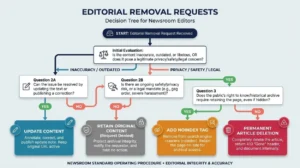
Legal removal requests operate through formal legal frameworks that challenge the lawfulness, accuracy, or necessity of published content, while editorial removal requests rely on publisher discretion and internal content governance policies. Legal routes function by demonstrating that the content breaches legal thresholds such as defamation, data protection principles, or privacy rights, depending on jurisdictional standards. Editorial routes operate independently of legal enforcement and depend on whether publishers agree that continued publication aligns with their editorial guidelines. Both approaches influence reputation signals differently because legal removal affects content existence, while editorial removal affects content availability at the source.
Legal removal processes typically involve structured evidence submission, legal justification, and formal correspondence with publishers or hosting entities. These processes affect search visibility by eliminating or restricting indexed content at its origin, which reduces its ability to contribute to entity perception within search ecosystems. Editorial removal, by contrast, relies on internal content review procedures that assess journalistic standards, factual accuracy, and editorial relevance. While legal routes provide stronger enforcement mechanisms, editorial routes offer faster resolution but lower guarantee of success. Reputation management evaluates both routes based on effectiveness, scalability, and impact on SERP composition.
Legal justification matters because search engines and publishers prioritise content stability unless a recognised legal basis requires removal or alteration. Strong legal reasoning strengthens the credibility of a removal request and increases the likelihood of compliance across content systems.
What role do publisher correction or amendment requests play?
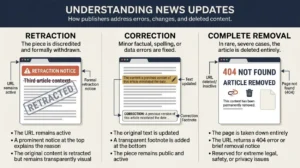
Publisher correction or amendment requests operate as editorial mechanisms that adjust existing newspaper content without necessarily removing it from publication archives or search indexes. These requests function by identifying inaccuracies, outdated information, or contextual issues that affect content interpretation. Publishers evaluate such requests based on journalistic integrity standards, factual verification, and editorial policy alignment. Unlike legal routes, correction requests focus on modification rather than elimination of content from search ecosystems.
Correction-based routes influence reputation signals by altering how information is interpreted rather than removing it entirely from SERPs. Search engines re-evaluate modified content during re-crawling, which can update entity perception and reduce misleading associations. However, amended articles may still retain visibility in search results because indexing systems preserve historical content versions. This creates a hybrid visibility model where corrected information coexists with original publication traces. Reputation management analyses this route as a partial mitigation strategy rather than a full removal solution.
Editorial corrections are less disruptive than removal but more limited in controlling long-term search visibility. They adjust perception without fully eliminating indexed reputation signals from search ecosystems.
What is de-indexing and how does it affect search visibility?
De-indexing is the process of removing a webpage from search engine indexes while the content may still exist on the original publisher’s website. This route operates through search engine compliance tools or formal requests that demonstrate legal, technical, or policy-based grounds for exclusion. When successful, de-indexing reduces search visibility by preventing content from appearing in SERPs, even if the original article remains accessible through direct URLs.

De-indexing affects reputation signals by interrupting the flow of indexed content into search evaluation systems. Search engines rely on indexed data to construct entity credibility, meaning de-indexed pages no longer contribute directly to SERP interpretation. However, de-indexing does not eliminate content from the internet; it only restricts discoverability through search engines. This distinction is critical in reputation management because visibility reduction does not equal content deletion.
De-indexing is used when content removal is not feasible but search visibility control is necessary to reduce reputational impact.
The most sustainable outcome is delivered by the route that permanently reduces the presence of damaging newspaper content within search ecosystems while maintaining compliance with legal and editorial constraints. Reputation management strategies differ based on whether they prioritise elimination, modification, or visibility control of indexed content, and each route produces different long-term effects on entity credibility and search ranking influence.
Removal-based routes deliver the strongest sustainability because they directly reduce the availability of content that generates negative reputation signals across SERPs. When a newspaper article is removed at source, search engines eventually de-index the content during re-crawling cycles, which eliminates its contribution to entity perception frameworks. However, sustainability depends on enforcement strength, legal validity, and publisher cooperation. Without these conditions, removal attempts may fail or result in partial mitigation only. This makes route selection a critical factor in long-term reputation stability.
De-indexing provides moderate sustainability because it restricts search visibility without altering the original publication. While this reduces exposure, the underlying content continues to exist and may reappear if indexing conditions change. Correction and amendment routes offer even lower sustainability in terms of visibility control, as they primarily adjust interpretation rather than eliminate content presence. Content suppression offers variable sustainability depending on ongoing optimisation efforts and competing content dynamics within SERPs. Each route therefore represents a different level of permanence within search ecosystems.
Permanence matters because search engines continuously re-evaluate indexed content, meaning temporary visibility reductions do not guarantee long-term reputation stability.
How do legal, editorial, and technical routes compare in effectiveness?
Legal, editorial, and technical routes differ significantly in effectiveness because each operates within a distinct layer of the content ecosystem, influencing either content existence, content interpretation, or search visibility. Legal routes operate through enforceable frameworks that challenge publication legitimacy, editorial routes depend on publisher discretion, and technical routes focus on indexing behaviour within search systems. Each method contributes differently to reputation signals and SERP composition.
Legal routes are typically the most effective when supported by strong justification because they compel action based on compliance requirements rather than preference. This increases the likelihood of full removal, which directly reduces negative entity credibility signals. Editorial routes are moderately effective because they rely on internal publisher governance, which may prioritise journalistic integrity over reputational concerns. Technical routes, including de-indexing and suppression, are effective for visibility control but do not address the source content directly.
The comparative evaluation of these routes highlights a clear hierarchy in terms of search impact. Legal removal provides maximum structural change, editorial modification provides partial correction, and technical suppression provides visibility adjustment. Each method interacts differently with search engine interpretation systems, affecting how reputation signals are constructed and maintained. Understanding these differences is essential for evaluating long-term SERP control strategies.
Legal removal offers the strongest SERP influence control because it eliminates indexed content rather than adjusting its ranking position or visibility status.
Dive Deeper With Our Expert Guides:
How to Build a Defamation Case to Support Removing a Damaging Article Online
What GDPR and Defamation Law Allow When Trying to Remove a News Article
How do search engines interpret competing reputation signals?
Search engines interpret competing reputation signals by analysing multiple indexed sources simultaneously to construct a coherent entity profile within SERP evaluation systems. These signals include newspaper articles, websites, public records, reviews, and contextual mentions across authoritative domains. When conflicting information exists, search systems evaluate authority, relevance, and consistency to determine which signals carry greater weight in search perception influence.
Newspaper articles often carry strong authority signals due to editorial credibility, which means they can significantly shape entity perception even when alternative information exists. However, search engines also consider recency, engagement, and semantic alignment when evaluating competing content. This creates a dynamic environment where reputation signals continuously shift based on newly indexed information and changes in content visibility.
Content removal, de-indexing, correction, and suppression all influence this balance differently. Removal eliminates signals entirely, de-indexing restricts signal contribution to SERPs, correction modifies interpretive context, and suppression reduces visibility without altering the underlying signal. Each mechanism therefore alters how search engines construct reputation frameworks for entities.
Conflicting signals reduce reputation stability because search engines must continuously reconcile inconsistent information when evaluating entity credibility.
Which route should be prioritised for UK newspaper article removal requests?
Route prioritisation depends on the legal basis, publication status, indexing behaviour, and reputational impact of the newspaper article within search ecosystems. No single route operates universally, as effectiveness depends on how strongly each mechanism interacts with publisher authority and search engine interpretation systems. Reputation management evaluates these factors to determine the most appropriate combination of legal, editorial, or technical actions.
Legal removal is prioritised when content breaches recognised legal thresholds, as this offers the highest probability of complete removal. Editorial correction is prioritised when factual inaccuracies or outdated information can be demonstrated without requiring legal enforcement. De-indexing is prioritised when visibility reduction is necessary but removal is not achievable. Content suppression is prioritised when structural removal is not possible and long-term visibility control is required across SERPs.
These prioritisation decisions directly influence search visibility outcomes because each route modifies reputation signals differently. Effective strategy selection ensures that entity credibility is stabilised across indexed environments while minimising long-term reputational risk. For individuals evaluating structured pathways in more detail, Remove a Newspaper Article Damaging Your UK Reputation With Expert Support provides a deeper breakdown of route-specific mechanisms and evaluation frameworks.
UK newspaper article removal operates through multiple routes, including legal removal, editorial correction, de-indexing, and content suppression, each of which influences search visibility and entity credibility in different ways. Search engines evaluate these routes based on authority, relevance, and indexing behaviour, meaning that reputation signals are continuously shaped by how content is managed across digital ecosystems. Legal routes offer the strongest permanence, editorial routes offer contextual adjustment, and technical routes provide visibility control without altering source content. Understanding these differences allows for more accurate evaluation of long-term reputation outcomes within search systems.
What routes are available for UK newspaper article removal?
UK newspaper article removal typically involves legal removal, editorial correction, de-indexing, and content suppression routes. Each route affects search visibility and reputation signals differently depending on how search engines evaluate the content.
How does legal removal of a newspaper article work in the UK?
Legal removal works by challenging the article under laws such as defamation, privacy, or data protection frameworks. If successful, it leads to full removal at source, which significantly reduces search visibility and entity credibility signals.
What is the difference between de-indexing and removal?
Removal deletes the article from the publisher’s website, while de-indexing only removes it from search engine results. De-indexing reduces search visibility but the content may still exist on the original site.
Can newspaper articles be corrected instead of removed?
Yes, editorial correction requests can update or amend inaccurate information without removing the article. This approach adjusts reputation signals but does not fully eliminate the content from search ecosystems.
How does content suppression affect newspaper article visibility?
Content suppression reduces the visibility of negative newspaper articles by promoting alternative positive or neutral content in search results. It does not remove the original article but changes SERP ranking influence and perception.