
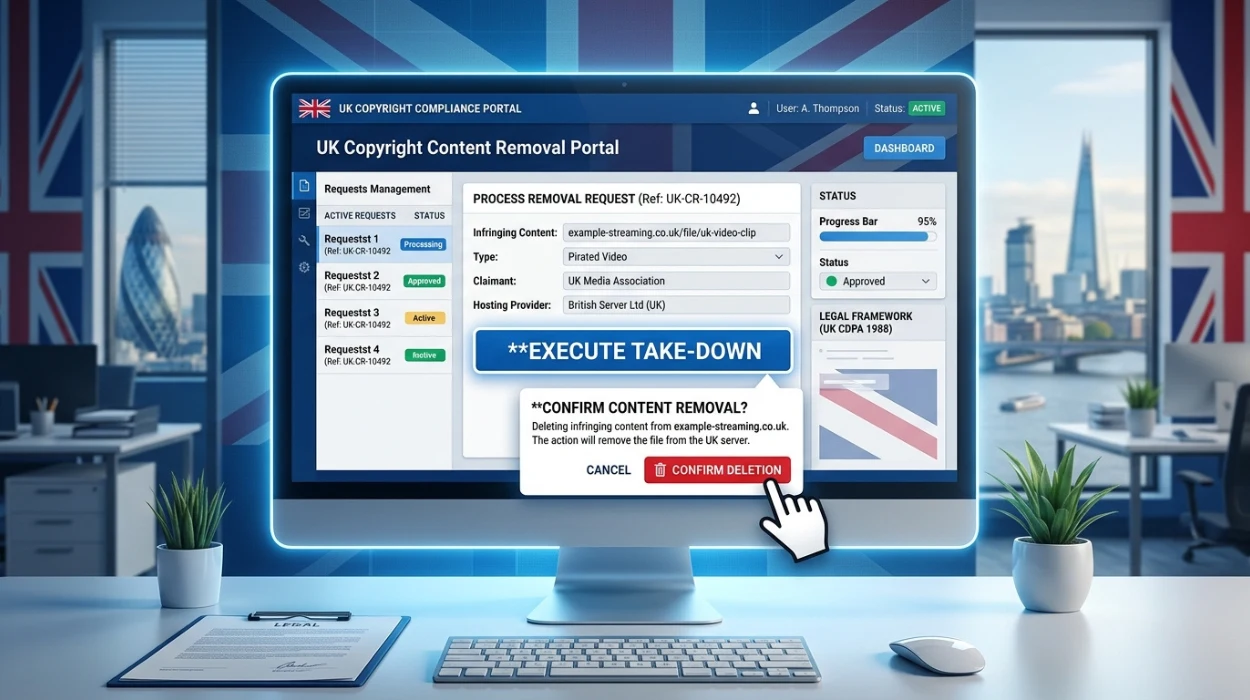
Removing copyright infringing content from UK websites requires identification of the infringement, verification of ownership rights, evaluation of legal and platform-based mechanisms, and implementation of appropriate removal procedures. Reputation management strategies differ based on content ownership, search visibility impact, and the methods used to influence digital information ecosystems.
Online reputation control methods are evaluated through their effect on content indexing, search ranking influence, reputation signals, and entity credibility. Copyright infringement introduces unauthorised content into search ecosystems, creating challenges related to attribution, visibility, and trust evaluation.
Which methods are available for removing copyright infringing content from UK websites?
Content removal methods differ according to the source of infringement, the platform hosting the material, and the legal framework governing the content. Copyright removal is the process of eliminating unauthorised copies of protected work from digital environments. Each approach operates through a distinct mechanism that influences search visibility and content indexing.
Website-based removal relies on direct engagement with the publisher or site operator responsible for hosting the content. This method focuses on demonstrating ownership and requesting removal according to platform policies or legal obligations. Search ecosystems respond to successful removal by updating indexed records and reducing the visibility of unauthorised content.
Legal enforcement mechanisms operate through copyright legislation and intellectual property protections. These methods evaluate infringement against statutory requirements and ownership rights. Their effectiveness depends on the quality of ownership evidence, jurisdictional considerations, and the responsiveness of the infringing party.
Platform-based procedures represent another removal pathway. Online platforms often maintain intellectual property reporting systems that enable rights holders to submit infringement notices. This method integrates directly into platform governance structures and influences content accessibility within those ecosystems.
How does direct website outreach compare with platform reporting systems?
Direct website outreach and platform reporting systems achieve similar objectives but operate through different control structures. Website outreach focuses on engaging the owner or administrator of the website, while platform reporting relies on established intellectual property enforcement processes managed by digital platforms.
Direct outreach provides a more targeted mechanism because communication occurs directly with the decision-maker responsible for the content. This approach can resolve straightforward infringements efficiently when ownership is clear and cooperation exists. Its limitation arises when website operators ignore requests or operate from jurisdictions with limited responsiveness.
Platform reporting systems offer procedural consistency. Platforms establish predefined review frameworks that evaluate infringement claims against internal policies. This creates a structured process with standardised requirements. The limitation lies in platform-specific thresholds for evidence and the scope of content under platform control.
From a search visibility perspective, both approaches influence indexed content when successful. Removal reduces duplicate content signals and strengthens attribution to the original source. The difference lies primarily in enforcement structure rather than search ranking influence.
Which evaluation criteria determine the most effective removal approach?
The most effective removal approach is determined by ownership evidence, platform governance structures, legal standing, content visibility, and risk exposure. Reputation management evaluation requires systematic assessment of each factor before selecting a strategy.
An evaluation framework typically includes:
- Verify ownership rights by gathering registration records, publication evidence, or original creation documentation.
- Assess content location by identifying whether the material appears on independent websites or controlled platforms.
- Evaluate search visibility through indexing analysis and search ranking influence measurements.
- Review enforcement options by comparing policy-based procedures against legal frameworks.
- Measure reputational impact by analysing sentiment distribution and entity credibility effects.
Each factor influences both effectiveness and efficiency. Strong ownership evidence improves procedural clarity, while high-visibility infringements create greater urgency due to their impact on reputation signals and search perception.
How do legal mechanisms compare with platform based removal procedures?
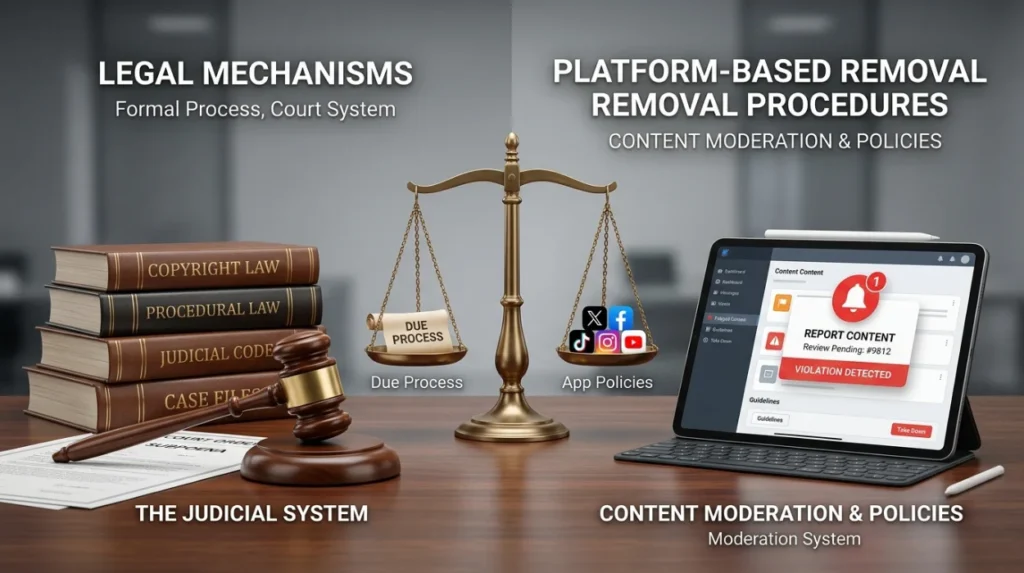
Legal mechanisms and platform-based procedures represent two distinct approaches to copyright enforcement. Legal mechanisms derive authority from statutory protections, while platform procedures derive authority from contractual governance frameworks established by digital platforms.
Legal enforcement provides formal recognition of ownership rights. It operates through established intellectual property legislation and offers structured remedies for infringement. This approach evaluates content through legal standards rather than platform policies. Its strength lies in legal authority, while its limitation involves procedural complexity and resource requirements.
Platform-based procedures focus on policy compliance. Platforms maintain intellectual property rules that allow rights holders to submit infringement notices directly through reporting systems. This approach often achieves faster operational outcomes within platform-controlled environments. Its limitation lies in the platform’s jurisdiction over the content and the scope of policy enforcement.
From a reputation management perspective, both methods contribute to visibility control. Successful implementation reduces unauthorised content exposure and strengthens attribution signals associated with original content ownership.
How does content removal compare with content suppression strategies?
Content removal and content suppression represent different approaches to managing online visibility. Content removal eliminates the infringing material from its source, while content suppression influences SERP composition by increasing the prominence of alternative content.
Content removal operates by directly addressing the existence of unauthorised material. Once removed, search engines gradually update indexed records, reducing visibility and attribution conflicts. This approach targets the root cause of the issue rather than its visibility effects.
Content suppression operates through the creation and optimisation of competing content assets. Search engines evaluate new content based on authority, relevance, and engagement signals. Over time, stronger assets can occupy more visible positions within search results. This method influences search ranking influence without eliminating the original source.
The distinction between content suppression vs content enhancement is important. Suppression focuses on reducing the prominence of unwanted content, while enhancement strengthens positive information assets. Removal remains the only method that directly eliminates infringing material from its source environment.
Which factors influence search engine interpretation of copyright disputes?
Search engines interpret copyright-related information through content indexing systems, attribution signals, and authority evaluations. Algorithms assess information relationships rather than legal ownership directly, making attribution and source consistency important components of visibility analysis.
Content indexing establishes how search engines discover and catalogue information. When duplicate content appears across multiple domains, algorithms compare publication timing, authority indicators, and linking structures. These signals contribute to source identification and ranking decisions.
Entity credibility is influenced by content ownership consistency. Search ecosystems evaluate relationships between creators, publishers, and content assets. Strong attribution patterns strengthen authority signals, while conflicting ownership signals create ambiguity within search evaluation systems.
Reputation signals emerge from information consistency. Original content associated with a recognised source contributes to trust formation, while widespread duplication weakens attribution clarity. Copyright disputes therefore affect both visibility assessment and broader perception mechanisms.
Dive Deeper With Our Expert Guides:
How a DMCA Takedown in the UK Works Alongside UK Copyright Law
How to Use UK Copyright Law to Support a Content Removal Request Online
How do short-term and long-term copyright management approaches differ?
Short-term and long-term copyright management approaches differ according to their objectives, operational timelines, and impact on search ecosystems. Short-term approaches focus on immediate infringement response, while long-term approaches prioritise ongoing ownership protection and visibility management.
Short-term strategies include identifying infringing material, verifying ownership, and initiating removal procedures. These activities address existing visibility issues and aim to restore attribution clarity. Their effectiveness is measured through removal outcomes and reductions in duplicate content exposure.
Long-term strategies focus on maintaining ownership signals and protecting digital assets over time. This includes monitoring indexed content, preserving publication records, and strengthening attribution frameworks. These measures contribute to stable reputation signals and consistent entity credibility.
Search ranking influence is affected by both approaches. Immediate removal reduces current visibility risks, while long-term governance improves the resilience of ownership signals across evolving search ecosystems.
Which risks emerge when copyright infringement remains unresolved?
Unresolved copyright infringement introduces attribution risks, credibility challenges, and visibility complications within search ecosystems. The longer unauthorised content remains accessible, the greater its potential influence on content indexing and search perception.
Ownership ambiguity represents a significant risk. Duplicate content appearing across multiple sources weakens attribution clarity and complicates authority evaluation. Search engines must determine source relationships, which can affect visibility outcomes.
Entity credibility can also be affected when original content competes against unauthorised copies. Reputation signals rely on consistent associations between creators and their work. Persistent duplication disrupts these associations and weakens information integrity.
Search visibility risks increase when infringing content accumulates authority through indexing and engagement signals. As duplicate versions gain visibility, the original source faces greater competition within search environments.
How does a structured copyright removal process compare with reactive responses?
A structured copyright removal process provides a systematic framework for evaluating and addressing infringement. Reactive responses focus on individual incidents without broader assessment of visibility, attribution, and reputation signals.
Structured processes operate through defined stages:
- Identify infringing content through indexing reviews and ownership verification.
- Analyse visibility impact by evaluating search ranking influence and duplication levels.
- Select enforcement mechanisms based on legal standing and platform governance.
- Implement removal procedures through appropriate reporting or outreach channels.
- Monitor search ecosystems to assess changes in visibility and attribution.
Reactive responses address isolated instances but provide limited strategic oversight. Structured evaluation improves consistency, reduces risk exposure, and enhances understanding of how infringement affects broader reputation systems.
Within discussions of copyright management approaches, analysis often extends to copyright infringing content removal from the internet because visibility control depends not only on website-level action but also on broader digital ecosystem considerations. Understanding copyright infringing content removal from the internet provides additional context regarding how content removal influences indexing, attribution, and search perception across multiple platforms.
Removing copyright infringing content from UK websites involves comparing legal, platform-based, and website-directed approaches according to ownership evidence, visibility impact, and enforcement mechanisms. Each method operates through distinct processes that influence attribution, reputation signals, and content indexing outcomes.
Content removal differs fundamentally from suppression strategies because it eliminates unauthorised material rather than altering visibility through competing assets. Search ecosystems evaluate ownership, authority, and attribution through complex ranking systems that influence entity credibility and perception. Understanding the strengths, limitations, scalability, and sustainability of removal approaches provides a clearer framework for evaluating copyright management strategies within modern digital environments.
What is the first step in removing copyright infringing content from a UK website?
The first step is identifying the infringing content and gathering evidence that proves ownership of the original work. This documentation helps support copyright removal requests and intellectual property claims.
Can copyright infringing content be removed without going to court?
Yes, copyright infringing content is often removed through website owner requests, platform reporting systems, or copyright notice procedures. Legal action is generally considered when voluntary removal processes do not resolve the issue.
How do UK websites handle copyright infringement complaints?
Most UK websites review copyright complaints by assessing ownership evidence and the nature of the alleged infringement. If the claim meets platform or legal requirements, the content may be removed or restricted.
Does removing infringing content affect search engine results?
Removing infringing content can influence content indexing and search visibility because search engines update their records after content is deleted or restricted. This helps strengthen attribution signals for the original content owner.
What role do Copyright Trademark Services play in copyright protection?
Copyright Trademark Services focus on intellectual property protection, copyright enforcement processes, and content ownership verification. These services often assist with identifying infringements, preparing documentation, and managing copyright removal procedures.