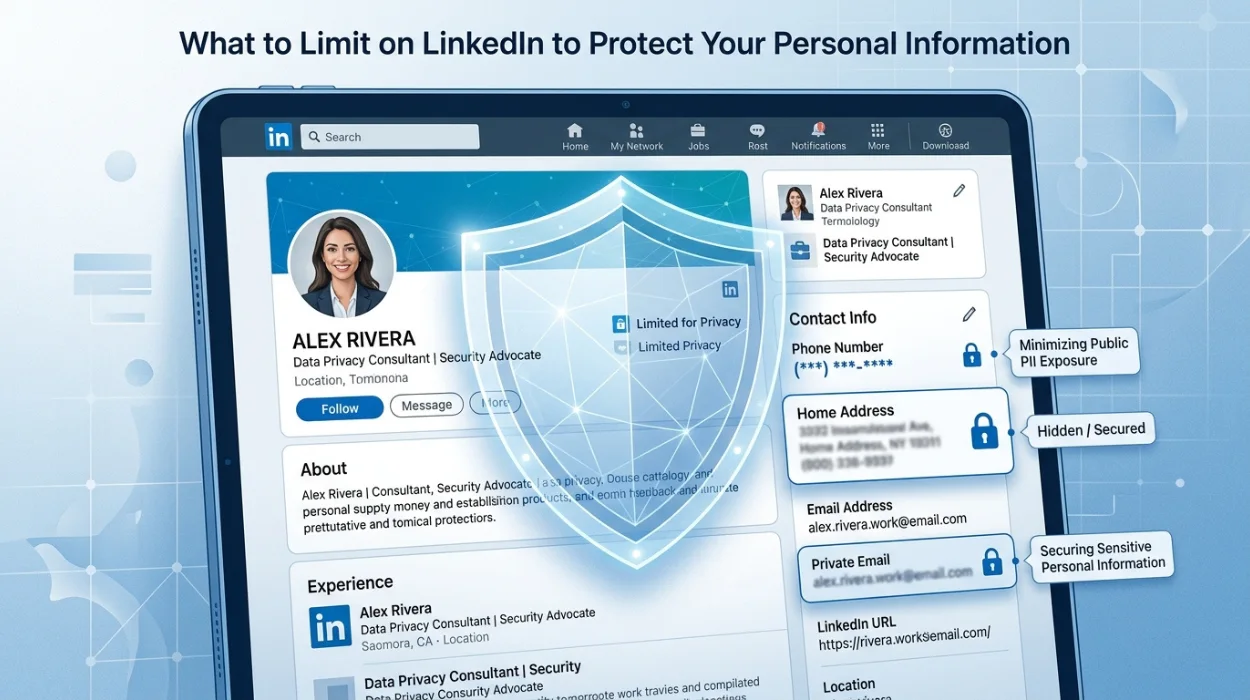
Limiting unnecessary personal information on LinkedIn reduces the amount of data available for public discovery, indexing, and association with your professional identity. The most effective approach balances professional visibility with privacy by restricting non-essential contact, location, personal, and identifying information.
Reputation management strategies differ based on whether the objective is to strengthen professional credibility, reduce unnecessary exposure, or control information already visible across search ecosystems. Online reputation control methods are evaluated through search visibility, reputation signals, entity credibility, and the way information is connected across indexed sources. A LinkedIn profile is therefore not simply a networking page; it forms part of an individual’s wider digital footprint.
Which LinkedIn information creates the greatest privacy exposure?
Limiting unnecessary contact and identifying information provides the strongest initial privacy control because these details extend beyond core professional identity. Phone numbers, personal email addresses, precise locations, personal websites, and unrelated biographical information increase the amount of information associated with an identifiable person. Each publicly accessible detail creates another reputation signal that can connect the profile to external sources.
Professional information has a different function because it establishes career identity and expertise. Job titles, professional qualifications, employment history, and relevant skills support entity credibility when presented accurately. The privacy issue therefore concerns the distinction between information that validates professional identity and information that unnecessarily expands personal exposure.
Search engines process publicly accessible information through crawling and content indexing. Once information becomes indexed, it can appear in search results when relevant queries match the content. Limiting non-essential information at source therefore reduces the amount of personal data entering the searchable digital footprint.
How should contact information be limited on LinkedIn?
Personal contact information is best limited to details that have a clear professional purpose. A personal mobile number, private email address, home address, or unrelated contact channel adds information that is not necessary for establishing professional credibility. Removing or restricting these details reduces the number of direct identifiers associated with the public profile.
Contact information operates as an identity connection within the wider digital ecosystem. An email address or phone number can appear on websites, directories, documents, social profiles, or other indexed sources. When the same identifier appears across multiple locations, it creates stronger associations between those sources and the individual.
The comparative advantage of limiting contact information is straightforward: it reduces exposure without materially weakening a professional profile’s core identity. A professional contact method can remain available where necessary, while personal identifiers remain restricted. This approach separates professional accessibility from unnecessary personal exposure.
Is location information necessary for a professional profile?
Location information provides professional context but does not require precise personal details. A broad region or professional market provides geographic relevance without exposing an exact residential location. The distinction is important because location can become more revealing when combined with an employer, job title, education history, or other identity signals.
Search engines evaluate location alongside other contextual information when interpreting an entity. A professional location can help establish relevance for geographic searches, while an overly precise location adds information without necessarily strengthening professional credibility. The privacy benefit therefore comes from maintaining useful geographic context while limiting unnecessary precision.
Location information also contributes to entity relationships. When an individual’s profile, employer page, directory listing, and other sources contain matching location information, search systems can associate those sources more confidently. Restricting unnecessary precision reduces the amount of information available for those associations without eliminating useful professional context.
Which profile fields should be prioritised for privacy?
Privacy prioritisation works best when profile fields are evaluated according to professional necessity, search visibility, and personal exposure. Fields directly supporting professional identity have greater reputational value than fields providing unrelated personal information. A structured evaluation therefore separates identity-building information from unnecessary identifying details.
A practical evaluation framework can:
- Review contact fields by identifying personal phone numbers, private email addresses, and non-essential contact channels that provide direct identifiers.
- Assess location details by replacing unnecessary precision with broader professional geographic information where appropriate.
- Evaluate personal descriptions by removing family details, private interests, or unrelated biographical information that does not support professional credibility.
- Check external links by identifying websites or profiles that reveal additional personal information beyond the intended professional identity.
- Audit public visibility by examining which profile fields are accessible to people outside the intended professional network.
This framework distinguishes privacy reduction from complete profile removal. The objective is to reduce unnecessary exposure while retaining information that supports professional identity and entity credibility.
How does LinkedIn information affect search visibility?

Public LinkedIn information can contribute to search visibility because accessible profile pages can be crawled, indexed, and evaluated by search engines. A profile containing a person’s name, occupation, employer, qualifications, and location creates a structured representation of that individual. Search engines can then associate the profile with relevant identity-related queries.
Search ranking influence depends on relevance, authority, content, and the wider information ecosystem. A professional profile can therefore appear prominently for searches involving a person’s name or professional role. The profile becomes one component of the SERP composition surrounding that entity.
Reducing unnecessary information does not necessarily mean reducing all search visibility. Instead, privacy-focused profile management distinguishes between useful professional information and unnecessary personal exposure. The result is a more controlled digital footprint in which professional identity remains clear without exposing unrelated personal details.
How does limiting personal information compare with removing a LinkedIn profile?
Limiting personal information and removing a profile address different reputation objectives. Profile privacy controls reduce the amount of information available while preserving professional visibility, whereas profile removal eliminates the profile as a source of professional information. The appropriate approach depends on whether the primary objective is privacy, professional discoverability, or complete source removal.
Content removal provides stronger source-level control because the profile no longer provides the same publicly accessible information. However, removing a professional profile also eliminates legitimate professional signals such as employment history, qualifications, expertise, and career associations. This creates a trade-off between exposure reduction and professional visibility.
Privacy restriction provides a more targeted approach. It removes or limits selected information while retaining the profile’s core professional function. From a reputation perspective, this supports content suppression vs content enhancement analysis because reducing unnecessary information changes exposure while retaining authoritative identity signals.
What is the difference between organic privacy control and reactive information removal?
Organic privacy control operates before unnecessary information becomes a significant part of the searchable digital footprint. It involves configuring profile visibility, limiting personal fields, controlling external links, and regularly reviewing public information. Reactive information removal begins after information has already become publicly accessible, indexed, copied, or associated with external sources.
Organic control has a preventive function. Limiting unnecessary information at the original source reduces the amount of data entering search ecosystems. It also reduces the number of secondary sources that can reproduce or reference the same information.
Reactive removal has a different mechanism. Once information appears on external websites or search results, source-level removal requires identifying the relevant content and addressing the appropriate publisher or platform. This creates additional operational requirements because the original profile no longer represents the only source of exposure.
The two approaches therefore differ in scalability and risk exposure. Preventive controls can be applied directly to the individual’s own profile, while reactive removal becomes more complex when information has spread across independent sources. Long-term privacy management therefore places greater emphasis on controlling information before unnecessary exposure expands.
How do professional profiles influence entity credibility?
Professional profiles influence entity credibility by providing structured information about an individual’s career identity, expertise, qualifications, and professional relationships. These details help search systems and users distinguish one individual from other entities with similar names. Consistent professional information therefore strengthens the clarity of the entity representation.
Excessive personal information does not necessarily strengthen that credibility. Family details, personal contact information, precise residential information, or unrelated interests provide additional identity signals without directly validating professional expertise. Their inclusion increases the digital footprint while contributing limited professional value.
Entity credibility is therefore strongest when professional information remains relevant and consistent. A profile that clearly establishes occupation, expertise, qualifications, and professional relationships provides useful context without requiring unnecessary personal disclosure. Privacy and credibility can consequently be evaluated as connected but distinct objectives.
Dive Deeper With Our Expert Guides:
How to Get Personal Details Removed From Old Forum Threads
How Reverse Image Search Exposes Personal Information Tied to Photos
Does limiting LinkedIn information reduce professional visibility?
Limiting non-essential information does not inherently reduce professional visibility when the core professional signals remain available. Search systems require relevant information to establish an entity’s professional identity, but they do not require every personal detail associated with that identity. A carefully structured profile can therefore maintain professional discoverability while reducing unnecessary exposure.
The key distinction is between professional signals and personal identifiers. A job title, industry, qualification, employer, and relevant skills contribute directly to professional entity recognition. A private phone number or exact residential location contributes less to professional credibility while increasing personal exposure.
This creates a more controlled search presence. The profile continues to communicate professional relevance while reducing the information available for unrelated searches or secondary identity associations. The result is not complete invisibility but a narrower and more intentional digital footprint.
How do external links increase privacy risk?
External links increase privacy exposure by connecting the professional profile with additional websites containing information about the same individual. A personal website, social media profile, portfolio, directory listing, or other online property can provide information beyond what appears directly on the professional profile. These relationships expand the entity’s digital footprint.
Search engines analyse links and contextual relationships as part of content and entity evaluation. When multiple sources contain matching names, photographs, locations, or employment information, the relationship between those sources becomes clearer. This can increase discoverability across the wider search ecosystem.
External links therefore require the same privacy assessment as profile fields. A link has professional value when it supports relevant expertise or credentials, but it also creates an additional route to information. Limiting unnecessary connections reduces the number of sources through which personal information becomes accessible.
Which is more sustainable: privacy controls or information removal?
Privacy controls provide stronger long-term sustainability when the information remains under the individual’s control. Restricting unnecessary profile fields prevents new exposure from the original source and reduces the amount of information available for indexing. This creates a preventive layer within digital footprint management.
Information removal becomes more complex after content has spread to independent sources. A copied biography, photograph, email address, or employment detail can appear on third-party websites even after the original profile has been changed. Each additional source creates a separate content management problem.
Reactive removal therefore remains relevant when personal information is already publicly distributed. However, sustainable reputation management combines prevention with monitoring so that newly exposed information is identified before it becomes deeply connected to the digital footprint. This approach reduces long-term risk while preserving appropriate professional visibility.
How should LinkedIn privacy strategies be evaluated?
LinkedIn privacy strategies are best evaluated through exposure, professional utility, search visibility, and sustainability. A strategy that removes all information provides strong exposure reduction but also eliminates professional identity signals. A strategy that leaves every field public preserves maximum visibility but increases personal information exposure.
A balanced evaluation measures:
- Compare professional value by determining whether each public field directly supports professional identity or credibility.
- Measure personal exposure by identifying information that reveals direct or indirect personal identifiers.
- Evaluate search visibility by checking which profile information appears in name-related and professional searches.
- Analyse external connections by identifying websites and profiles that expand the individual’s digital footprint.
- Review sustainability by checking whether privacy settings and public information remain appropriate as employment, location, and professional circumstances change.
This evaluation framework separates immediate privacy improvements from long-term reputation outcomes. It also prevents the mistaken assumption that maximum visibility always represents maximum professional value.
When is personal information removal more appropriate than profile privacy?
Personal information removal becomes more relevant when information has moved beyond the individual’s controlled profile and appears on external websites or indexed sources. Privacy settings control the original profile, but they do not automatically remove copies, references, directories, or previously indexed content elsewhere. The distinction represents the difference between source-level control and wider information removal.
The decision therefore depends on where the information exists. If unnecessary data remains only within the individual’s profile, adjusting visibility provides direct control. If the same information appears across third-party sources, the problem becomes a broader digital footprint issue requiring source identification and content-level evaluation.
Search visibility also influences the assessment. Information that exists online but has little discoverability represents a different risk profile from information prominently displayed for name-related searches. Evaluating source, visibility, authority, and context provides a more precise basis for selecting between privacy controls and removal strategies.
Protecting personal information on LinkedIn requires a distinction between professional visibility and unnecessary personal exposure. Professional identity signals such as qualifications, employment history, skills, and relevant expertise contribute to entity credibility, while excessive contact, location, and personal information expands the digital footprint without necessarily strengthening professional reputation.
Organic privacy controls provide preventive protection by limiting unnecessary information at the original source. Reactive removal addresses information that has already spread to external websites, directories, social platforms, or search indexes. Comparing these approaches through effectiveness, scalability, risk exposure, search visibility, and sustainability provides a clearer basis for digital footprint management.
The central consideration is not whether a professional profile should contain information, but whether each public detail has a defined professional purpose. A controlled profile preserves useful reputation signals while reducing unnecessary personal exposure, creating a more deliberate and sustainable online identity.
What personal information should you limit on LinkedIn?
Limit sensitive details such as your home address, personal phone number, private email address, date of birth and real-time location. Sharing less personal information can reduce the risk of unwanted contact, identity misuse and privacy exposure.
How can I protect my personal information on LinkedIn?
Review your LinkedIn privacy settings and restrict who can view your profile, contact details and activity. Avoid publishing sensitive personal information in your profile, posts, comments or uploaded documents.
Should I hide my phone number and email address on LinkedIn?
Yes, limiting public access to your phone number and personal email address can reduce unwanted messages and potential privacy risks. Use LinkedIn’s privacy controls to decide which information is visible to other users.
Can LinkedIn posts reveal too much personal information?
Yes, posts can disclose details about your location, workplace, daily routine, family or other private information. Review posts and older activity regularly and remove information that is unnecessary or overly revealing.
Can I remove personal information from LinkedIn?
You can edit or delete personal information from your LinkedIn profile, posts and other content you control. For information that remains visible through other sources, Clear Your Name can help assess available options for personal information removal.