
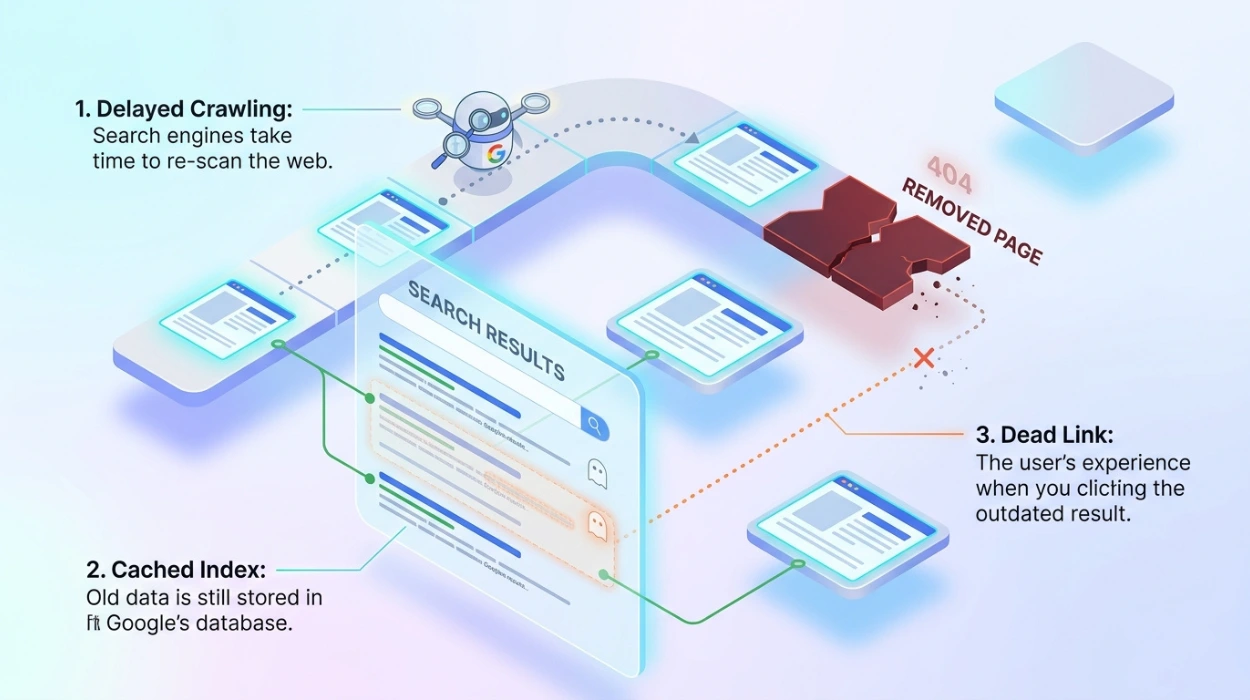
Dead and broken links continue appearing in Google after pages are removed because search engines retain indexed URLs until crawling, indexing, and evaluation systems confirm that the content has permanently changed or no longer exists. Reputation management is the process of analysing and understanding how digital information influences search visibility, entity perception, and online credibility across search ecosystems.
Online reputation refers to the collection of indexed content, references, hyperlinks, and trust signals that search engines evaluate when determining how an entity appears in search results. Every indexed page contributes to a digital footprint, regardless of whether the original content remains accessible. When a webpage is removed, its URL often continues existing within Google’s index until search crawlers revisit the location, process the server response, and update the search database. This delay explains why users frequently encounter dead or broken links in search results despite the source page no longer being available. Understanding this process provides greater insight into how search engines interpret content availability, authority signals, and long-term reputation indicators.
Why do dead and broken links continue appearing in Google after pages are removed?
Dead and broken links continue appearing because Google’s indexing systems operate independently from the availability of live webpages. A removed page represents a change on the website, whereas Google’s index represents stored information collected during previous crawls. Search engines evaluate the relationship between historical indexing data and newly discovered server responses before updating search results. This distinction explains why deleted content often remains visible even after becoming inaccessible. Search visibility depends on indexed records rather than immediate website changes.
Google maintains an index that stores information about webpages, including URLs, titles, metadata, structured information, and historical content relationships. Content indexing refers to the process of collecting, analysing, and storing webpage information for retrieval within search engine results pages. When a webpage disappears, Google requires additional crawling activity before confirming whether the removal reflects a temporary issue or a permanent change. Until this evaluation is complete, the indexed URL continues appearing in search results because the search engine has not yet replaced its stored understanding of the page.
The persistence of outdated URLs also reflects Google’s commitment to maintaining stable search quality. Search engines continuously compare historical indexing data with newly collected information to avoid removing valuable content based on temporary server interruptions. This evaluation process prioritises consistency, ensuring that search results accurately represent long-term website changes rather than isolated technical events.
How does Google’s indexing process influence removed pages?
Google’s indexing process influences removed pages by separating content discovery from content evaluation. Crawling identifies webpages, while indexing analyses their relevance, accessibility, authority, and relationship to existing information across the web. These independent stages explain why removed pages often remain visible despite no longer existing on the original website.
What is crawling and why does it matter?
Crawling refers to Google’s automated discovery process, during which search bots follow links and revisit previously indexed URLs to identify changes. Every crawl produces updated information about server responses, page content, redirects, canonical relationships, and accessibility. Search engines schedule crawling according to historical website activity, content freshness, internal linking, and authority signals rather than fixed time intervals. As a result, frequently updated websites often receive faster index refreshes than rarely modified domains.
A removed webpage does not disappear from Google’s understanding until the crawler revisits that specific URL and records its updated status. If the crawler has not yet returned, Google’s index continues presenting historical information because no new evidence exists to replace previous indexing records. This mechanism demonstrates how crawling directly influences the accuracy of search visibility.
What is indexing and how does it differ from crawling?
Indexing refers to the analytical stage during which Google determines whether collected information deserves inclusion within search results. Unlike crawling, indexing evaluates content quality, relevance, authority, duplication, structured data, and contextual relationships between webpages. The index functions as a searchable database rather than a live representation of every website.
When Google revisits a removed page, indexing systems assess the server response before updating stored information. Responses such as 404 errors, 410 status codes, redirects, or restored content each produce different indexing outcomes. Google analyses these signals alongside historical trust indicators before modifying search visibility. This evaluation ensures that the index reflects verified information instead of reacting immediately to isolated website changes.
Why does Google’s cache differ from live website content?

Google’s cache differs from live website content because cached information represents a previously stored snapshot rather than the current version of a webpage. Cached records exist to improve retrieval efficiency and preserve historical indexing references while Google’s systems continue evaluating newly discovered changes. This distinction often causes users to believe deleted pages still exist when, in reality, Google is displaying information collected during an earlier crawl.
A cached page reflects Google’s most recent stored version rather than the webpage’s present condition. If the original content has been removed after Google’s last crawl, the cache continues representing outdated information until another crawl updates the stored record. This process reinforces the difference between indexed information and live website availability.
Cached information also contributes indirectly to entity perception because search engines rely upon accumulated historical knowledge when interpreting website consistency and authority. Search evaluation considers both recent discoveries and established indexing history before adjusting rankings or removing URLs completely. Consequently, outdated cached records temporarily influence search visibility until Google’s systems complete the full reassessment cycle.
How do HTTP status codes affect search engine evaluation?
HTTP status codes affect search engine evaluation by communicating the accessibility and condition of webpages through standardised server responses. Search engines interpret these responses as technical signals that define how indexed URLs should be processed during future crawls and indexing updates. Each status code provides precise information that influences content indexing, search visibility, and long-term reputation signals.
A 404 response indicates that the requested resource cannot be found at its original location. Google interprets this response as evidence that the page is unavailable while continuing to monitor future crawls before deciding whether complete removal from the index is appropriate. This measured evaluation prevents accidental loss of search data caused by temporary technical interruptions.
A 410 response communicates that the content has been permanently removed. Unlike a standard 404 response, this signal provides stronger confirmation that the webpage no longer exists and allows Google’s indexing systems to process permanent removal more efficiently. Redirect responses introduce different evaluation pathways because they transfer search interpretation towards alternative URLs while preserving contextual relationships between linked resources.
Dive Deeper With Our Expert Guides:
How TripAdvisor’s Review System Works and What Makes a Review Eligible for Removal
How Unauthorised Images End Up Online and What Rights You Have in the UK
How do backlinks and internal links keep removed pages visible?
Backlinks and internal links keep removed pages visible because hyperlinks remain active signals within search ecosystems until search engines re-evaluate the relationships between connected URLs. Every hyperlink contributes contextual information that defines how webpages relate to one another, influencing both discovery and authority assessment. When a page is removed, external websites and existing internal navigation often continue pointing to the obsolete URL. These references encourage search crawlers to revisit the address even after the original content has disappeared. The continued presence of link references delays the complete removal of outdated URLs from search visibility because Google’s systems continue identifying the page as part of the broader web structure.
Internal links define website architecture by demonstrating the hierarchy and topical relationships between pages. If outdated navigation, archived content, XML sitemaps, or category pages continue referencing removed URLs, search engines interpret those references as evidence that the content remains relevant within the website’s structure. This ongoing relationship influences crawling frequency and index evaluation until all references are updated. As a result, search visibility reflects both the live website and the wider network of connected content rather than a single webpage in isolation.
External backlinks create additional layers of persistence. Search engines evaluate backlinks as authority and discovery signals that contribute to entity perception. A removed page receiving links from authoritative domains remains part of Google’s historical understanding because those references continue demonstrating relevance within the web ecosystem. The URL gradually loses prominence only after search engines confirm that the destination permanently returns removal signals and no longer contributes meaningful information.
How do reputation signals influence the visibility of removed content?
Reputation signals influence the visibility of removed content because search engines evaluate credibility through accumulated evidence rather than isolated events. Reputation signals refer to the collection of quality indicators that define trust, authority, consistency, and reliability across indexed content. These signals include content quality, linking relationships, structured data, historical indexing patterns, and topical relevance. Google’s evaluation systems combine these factors when determining how information appears within search engine results pages.
Entity perception develops through repeated analysis of interconnected content rather than individual pages alone. A removed webpage remains associated with its broader entity until search engines complete a comprehensive reassessment of surrounding signals. This process prevents abrupt changes that could reduce search quality or create inconsistencies within indexed knowledge. Reputation management therefore extends beyond individual URLs and encompasses the entire network of digital information connected to an entity.
Search visibility reflects cumulative evaluation rather than immediate technical changes. A deleted webpage removes one source of information, but surrounding reputation signals continue existing across indexed documents, backlinks, citations, and references. Google’s systems analyse this wider context before adjusting rankings, removing URLs, or updating search results, ensuring that entity perception remains accurate and stable over time.
What role does the digital footprint play in preserving historical search information?
A digital footprint refers to the collection of information that remains associated with an entity across websites, search engines, databases, archives, and linked resources. Search ecosystems interpret this footprint as an evolving record of digital activity rather than a collection of isolated webpages. Even after content disappears from its original location, traces frequently remain through indexed URLs, backlinks, cached information, citations, and archived references. This persistence explains why historical information continues influencing search visibility after webpages have been removed.
Every published page contributes information that becomes part of Google’s understanding of an entity. Search engines continuously compare historical records with newly discovered evidence to maintain consistency across search results. Removing a webpage changes one element of the digital footprint but does not immediately erase historical indexing data. Google’s systems require repeated verification before modifying stored associations between entities, topics, and webpages.
The digital footprint also strengthens contextual understanding within semantic search. Search engines evaluate relationships between content, authorship, website structure, and linked resources to determine topical authority and credibility. Historical information therefore remains valuable during algorithmic evaluation because it contributes evidence supporting broader entity interpretation. This analytical approach enables search systems to deliver stable and reliable results while gradually updating obsolete information.
How do search engine results pages reflect ongoing evaluation?
Search engine results pages reflect ongoing evaluation because every displayed result represents the latest confirmed understanding within Google’s indexing systems rather than a direct view of live websites. SERPs function as dynamic interfaces that present information according to content indexing, authority assessment, relevance analysis, and trust evaluation. The appearance of a removed URL indicates that Google’s systems continue processing evidence before replacing or removing the indexed record.
Content ranking dynamics depend upon continuous comparison between historical and newly collected information. Search algorithms evaluate technical signals, content quality, topical relevance, structured data, linking patterns, and user-oriented quality indicators before updating rankings. This layered assessment creates gradual changes rather than immediate replacements, ensuring that search visibility remains accurate and resistant to temporary disruptions.
SERP evaluation also reflects semantic relationships between entities. Google analyses how webpages connect to broader topics, organisations, products, services, and informational concepts. A removed page therefore influences search interpretation until surrounding semantic relationships are updated through additional crawling and indexing cycles. This mechanism reinforces the importance of understanding search ecosystems as interconnected knowledge networks rather than collections of independent webpages.
Why is understanding search ecosystems important for reputation management?
Understanding search ecosystems is important because reputation management depends upon interpreting how information is collected, analysed, indexed, and evaluated throughout the search process. Reputation management is not limited to content creation or webpage removal; it involves understanding how search engines organise knowledge and assign credibility to entities over time. Every indexed document contributes to search visibility through technical signals, contextual relationships, and semantic associations.
Search engines evaluate information using interconnected systems that combine crawling, indexing, ranking, entity analysis, and trust assessment. Each component influences how digital information appears within search results and how online credibility develops. Dead and broken links therefore represent technical outcomes of broader indexing processes rather than isolated website errors. Recognising these relationships provides a more accurate understanding of why removed content continues appearing within Google after deletion.
A structured understanding of search ecosystems also clarifies the relationship between technical website changes and search perception. Content removal affects live webpages immediately, while search visibility changes according to Google’s independent evaluation timeline. This distinction explains why digital reputation evolves progressively through verified indexing updates instead of instantaneous technical actions.
Dead and broken links continue appearing in Google because search engines separate webpage availability from indexing, crawling, and semantic evaluation. Google’s systems analyse historical records, technical responses, authority signals, and contextual relationships before modifying search visibility. This structured process protects search quality by ensuring that indexed information reflects verified changes rather than temporary website conditions.
Reputation management refers to understanding how digital information is interpreted across search ecosystems, where every indexed page contributes to entity perception, trust signals, and online credibility. Content removal changes the source website immediately, but search engine evaluation follows an independent analytical process based on content indexing, SERP evaluation, and accumulated reputation signals. Recognising these mechanisms provides a clearer understanding of why outdated URLs remain visible until Google’s systems complete their ongoing reassessment of the digital footprint.
Why do dead and broken links remain in Google after a page is removed?
Dead and broken links remain in Google because the search engine updates its index only after recrawling and re-evaluating the URL. Until Google’s indexing systems confirm the page has been permanently removed, the outdated result can continue appearing in search results.
How long does Google take to remove broken links from search results?
The timeframe depends on Google’s crawl frequency, indexing schedule, and the server response returned by the removed page. Pages returning permanent removal signals, such as a 410 status code, are generally processed more efficiently than temporary errors.
Does deleting a webpage immediately remove it from Google Search?
No. Deleting a webpage removes it from the website, but Google continues displaying the indexed URL until its crawlers revisit the page and update the search index. Search visibility changes only after Google’s evaluation process is complete.
Can dead links affect online reputation and search visibility?
Yes. Dead links can influence search visibility by creating outdated search results and weakening the accuracy of an entity’s digital footprint. They also affect user perception when searchers encounter inaccessible pages within Google’s search results.
What is the difference between a dead link and a broken link in Google Search?
A dead link usually refers to a URL that no longer leads to existing content, while a broken link is any hyperlink that fails because of missing pages, incorrect URLs, or server errors. Google evaluates both through crawling and content indexing before updating its search results.



