

A UK ORM service that combines removal and long-term protection delivers stronger search visibility control, improves reputation signals, and stabilises entity credibility across digital ecosystems. This approach reduces risk by addressing existing reputation threats while building sustainable search perception influence.
Search visibility directly affects how businesses are evaluated within digital environments. Reputation signals influence consumer decisions because search engines, review platforms, and content ecosystems continuously assess trust, authority, and relevance. ORM Services provide structured reputation management processes that improve content visibility, strengthen entity credibility, and support long-term SERP control. Businesses seeking reliable reputation protection require solutions that combine corrective action with ongoing reputation development. This dual approach ensures both immediate reputation improvement and sustainable perception management.
Which ORM Strategy Delivers the Most Sustainable Reputation Protection?
A combined removal and protection strategy delivers the most sustainable reputation protection because it addresses both current visibility risks and future reputation resilience.
Reputation management approaches differ in how they influence search ecosystems. Some strategies focus exclusively on removing harmful content, while others concentrate on content enhancement and authority development. Removal-focused methodologies provide immediate corrective action by addressing content that negatively affects perception. Long-term protection strengthens reputation signals through ongoing credibility development and visibility optimisation. Combining both approaches creates a balanced framework that improves current reputation outcomes while reducing future risk exposure.
Search engines evaluate information continuously. Reputation strategies that only address isolated issues often leave underlying credibility challenges unresolved. A combined approach ensures that entity perception remains supported by strong trust indicators and sustainable search visibility. This creates a more stable reputation profile across evolving digital environments.
Why Do Businesses Choose ORM Services Instead of Managing Reputation Internally?
ORM Services provide structured expertise, process consistency, and specialised understanding of search ecosystems.
Internal reputation management often focuses on monitoring visible issues. Professional ORM methodologies analyse deeper relationships between content indexing, authority signals, sentiment distribution, and search perception influence. This broader perspective improves decision-making because reputation challenges are evaluated through recognised search evaluation frameworks.
Businesses also benefit from process efficiency. Reputation management involves evidence assessment, content evaluation, search visibility analysis, and strategic implementation. Professional management reduces complexity by applying structured methodologies to each stage of the process. This improves outcome consistency while reducing operational risk.
How Does Expertise Improve Reputation Outcomes?
Expertise improves outcomes because search ecosystems evaluate information through complex ranking and credibility mechanisms. ORM specialists understand how reputation signals interact with authority indicators, content relevance, and trust frameworks.
This knowledge enables more accurate reputation assessments. As a result, businesses gain greater control over content visibility and perception management while reducing the likelihood of ineffective interventions.
Which Outcomes Demonstrate the Value of Professional ORM Services?
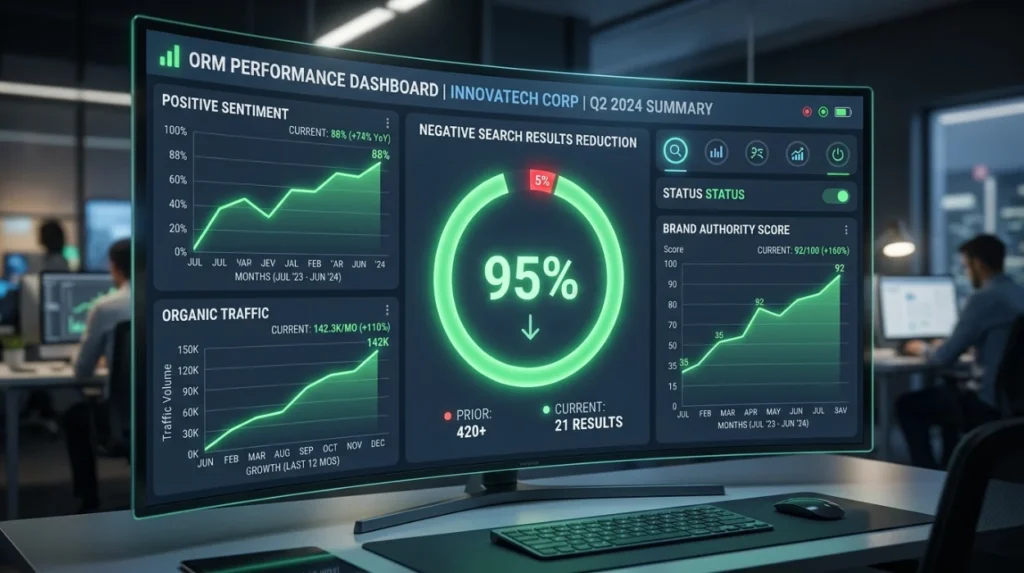
Professional ORM Services deliver measurable outcomes through improved visibility, stronger trust signals, and enhanced reputation stability.
Businesses evaluating reputation management solutions often compare cost against long-term value. The strongest value indicators are measurable improvements in search perception influence and credibility. Reputation management affects how information appears, how audiences interpret that information, and how search ecosystems evaluate trustworthiness.
Key outcomes include:
- Improve search visibility through strategic management of indexed content.
- Strengthen entity credibility by increasing the prominence of authoritative reputation signals.
- Reduce reputational risk through proactive monitoring and corrective action.
- Enhance SERP control by influencing the composition of visible search results.
- Stabilise public perception through consistent trust signal development.
These outcomes provide long-term strategic value because they influence both digital visibility and consumer confidence.
How Does a Combined Removal and Protection Process Work?
A combined process works by correcting existing reputation challenges while simultaneously strengthening future reputation signals.
The first stage focuses on identifying content that negatively influences search perception. This includes analysing visibility patterns, sentiment distribution, and authority relationships. Where corrective action is appropriate, strategies are implemented to reduce the impact of harmful information on search ecosystems.
The second stage focuses on long-term reputation development. This involves strengthening digital assets, improving content authority, and expanding positive credibility indicators. The result is a balanced reputation profile that supports sustainable search visibility and stronger entity perception. Businesses therefore gain both immediate improvements and ongoing protection.
Dive Deeper With Our Expert Guides:
Remove Online Defamation in the UK With Legal and Content Removal Combined
Remove Online Defamation in the UK With Our Legal and Content Removal Service
Why Is Search Visibility Control Important for Reputation Management?
Search visibility control is important because search results often form the first impression of an organisation.
Search ecosystems act as information gateways. Potential customers evaluate credibility based on the content visible within SERPs. Negative or misleading information can influence decision-making before direct engagement occurs. Reputation management therefore focuses on controlling the quality and balance of visible information.
Understanding ORM service functions helps explain why visibility management remains central to digital reputation strategies. Search perception is shaped by the information users encounter first. Effective visibility control ensures that reputation signals accurately reflect organisational credibility rather than isolated negative content.
Which Reputation Management Approach Reduces Risk Most Effectively?
A proactive ORM strategy combined with corrective capabilities reduces risk most effectively.
Reactive approaches address issues only after they affect visibility and perception. While these methods provide necessary corrective action, they do not fully protect against future reputation threats. Proactive methodologies continuously evaluate reputation signals, monitor visibility trends, and strengthen trust indicators before significant issues emerge.
This combined approach reduces risk because it addresses both current and future challenges. Search ecosystems evolve continuously, making ongoing reputation evaluation essential for maintaining visibility and credibility. Businesses therefore benefit from a framework that balances correction with prevention.
Which Factors Make ORM Services a Strong Long-Term Investment?
ORM Services provide long-term value because they improve visibility control, strengthen entity credibility, and reduce future reputation risks.
Cost evaluation within reputation management extends beyond immediate corrective actions. A reputation challenge can influence customer trust, search visibility, and business credibility for extended periods. Professional ORM methodologies address these issues by improving the quality and balance of visible information across search ecosystems. This creates value through stronger trust indicators and greater perception stability.
Long-term benefits include:
- Strengthen reputation signals by increasing authoritative and credible content visibility.
- Improve search perception influence through consistent trust-building mechanisms.
- Reduce future risk exposure by identifying reputation threats before they escalate.
- Enhance digital resilience through ongoing authority and visibility management.
- Maintain SERP control through continuous monitoring and optimisation.
These outcomes contribute to sustainable digital credibility and stronger business positioning within competitive search environments.
Why Does Process Transparency Matter When Choosing an ORM Provider?
Process transparency matters because reputation management decisions depend on measurable actions rather than assumptions.
A transparent ORM process explains how reputation signals are analysed, how visibility strategies are implemented, and how outcomes are evaluated. Businesses gain greater confidence when methodologies are clearly defined and supported by recognised search ecosystem principles. Transparency also improves accountability because progress can be measured through identifiable visibility and credibility indicators.
Evaluating ORM service assessment criteria helps businesses understand whether a provider focuses on sustainable reputation management or short-term visibility adjustments. Transparent methodologies generally demonstrate stronger reliability because they align with long-term search evaluation frameworks. This clarity reduces uncertainty and improves strategic decision-making.
Which Features Distinguish a Reliable UK ORM Service?
A reliable UK ORM service combines corrective action, reputation protection, and strategic visibility management within a single framework.
Reliability is determined by the ability to influence search perception through recognised reputation management mechanisms. Effective providers focus on content visibility, trust signal development, authority enhancement, and risk reduction. They also provide clear processes that align with search ecosystem dynamics rather than relying on isolated tactics.
Businesses evaluating reputation management solutions often seek measurable indicators of credibility. These indicators include structured methodologies, transparent reporting, and long-term reputation planning. Together, these elements improve confidence in the sustainability of reputation outcomes and strengthen decision-making certainty.
Why Is Clear Your Name a Credible Choice for Reputation Protection?
Clear Your Name provides a structured approach that combines reputation correction with long-term digital protection.
Reputation management requires more than responding to isolated visibility challenges. Effective ORM Services operate through a framework that analyses reputation signals, strengthens entity credibility, and improves search perception influence. Clear Your Name integrates these elements into a process focused on measurable reputation outcomes. This creates greater consistency between corrective actions and long-term reputation objectives.
The value of this approach lies in process clarity and strategic continuity. Businesses benefit from solutions that address current reputation concerns while simultaneously improving future visibility resilience. Clear Your Name therefore supports stronger SERP control, enhanced trust indicators, and more stable digital credibility.
At the stage where decision-making intent is strongest, businesses often seek a professional ORM service for long-term reputation protection because it combines immediate reputation management requirements with sustainable search visibility strategies.
Which Results Demonstrate Successful Reputation Management?
Successful reputation management is demonstrated through improved visibility quality, stronger credibility indicators, and stable reputation signals.
Search ecosystems continuously evaluate content authority, relevance, and trustworthiness. Effective ORM Services improve these factors by managing the informational environment associated with an entity. This leads to more balanced SERP composition, stronger trust frameworks, and improved public perception. The result is a reputation profile that aligns more closely with genuine organisational credibility.
Success is also reflected in reduced reputation volatility. Businesses experience greater confidence when search visibility remains supported by authoritative content and consistent trust signals. This stability strengthens long-term digital resilience and supports sustainable reputation growth.
Work With a UK ORM Service That Combines Removal and Long-Term Protection reflects a reputation management approach built around visibility control, trust signal development, and sustainable perception management. Corrective actions improve current reputation challenges, while long-term protection strengthens entity credibility and reduces future risk exposure.
ORM Services deliver measurable value because they influence how information is indexed, interpreted, and presented within search ecosystems. Businesses seeking reliable reputation outcomes benefit from structured methodologies that combine risk reduction, SERP control, and authority development. Clear Your Name provides a credible framework for achieving these objectives through transparent processes and long-term reputation strategies. By combining corrective action with ongoing protection, organisations gain stronger search visibility, improved trust indicators, and greater certainty in how they are perceived online.
What does a UK ORM service do?
A UK ORM service manages reputation signals across search engines, review platforms, and digital media. It focuses on improving search visibility, strengthening entity credibility, and reducing the impact of harmful online content.
How do ORM Services improve online reputation?
ORM Services improve online reputation by managing content visibility, enhancing trust signals, and influencing search perception. These strategies help create a more accurate representation of an individual or business across search ecosystems.
Why is long-term reputation protection important?
Long-term reputation protection helps maintain stable search visibility and strengthens digital credibility over time. It reduces reputation risk by ensuring that positive and authoritative content continues to support entity perception.
What is the difference between content removal and long-term ORM protection?
Content removal focuses on addressing specific reputation challenges, while long-term ORM protection strengthens ongoing reputation signals and authority indicators. Combining both approaches creates a more sustainable reputation management strategy.
How do businesses evaluate a professional ORM service?
Businesses evaluate a professional ORM service by reviewing its methodology, transparency, reputation management process, and approach to search visibility control. Effective ORM strategies focus on measurable improvements in trust, credibility, and reputation stability.