
Reporting harmful Facebook content in the UK is a platform-enforcement process; professional removal is a broader reputation management intervention focused on content suppression vs content enhancement and legal or technical escalation. Reputation management strategies differ based on who controls the content, who reviews the request, and which search ranking influence signals remain visible after action is taken.
What does reporting harmful Facebook content achieve?
Reporting harmful Facebook content is a user-led moderation request that asks the platform to assess policy breaches against its own rules. The mechanism operates inside Facebook’s trust and safety system, where content is reviewed against community standards, abuse categories, and safety thresholds.
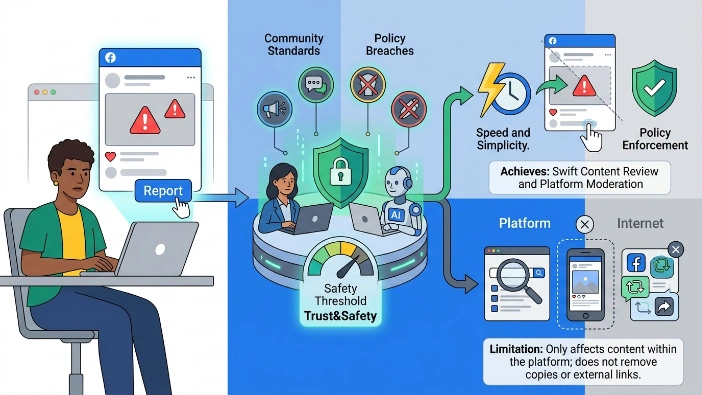
The main strength is speed and simplicity, because the process is native to the platform and requires no external legal or technical coordination. The main limitation is scope, because a report affects the post inside Facebook but does not necessarily alter search visibility, screenshots, reposts, or indexed copies elsewhere.
How does professional removal differ from reporting?
Professional removal is a structured reputation management process that combines evidence review, platform escalation, legal analysis, and, in some cases, search deindexing or suppression tactics. It operates by identifying the content owner, publication context, jurisdiction, and policy or law that supports removal, then matching that against the channel most likely to produce action. Compared with simple reporting, it adds procedural depth and often targets persistent exposure across search engines, social platforms, and archived references. Its strength lies in entity credibility control and cross-platform impact; its limitation lies in higher complexity, slower execution, and dependence on stronger documentation.
Which approach removes content faster?
Reporting harmful content is faster when the violation is obvious and the platform’s automated or moderation team recognises it immediately. The mechanism is direct: a complaint enters the queue, the system checks policy alignment, and the content remains or disappears based on that internal decision. Professional removal is slower at the start because it requires evidence assembly, claim validation, and route selection across policy, privacy, defamation, or safety frameworks. The trade-off is durability, because a successful professional removal action usually addresses the source more comprehensively than a single moderation report.
Which method influences search results more?
Professional removal influences search visibility more because it can target the source page, cached traces, copied mentions, and the wider content network surrounding the harmful material. Reporting harmful Facebook content changes the platform entry itself, but search engines often continue to surface related pages, snippets, or third-party references if the content has already been indexed. Search engines interpret reputation signals through consistency, repetition, freshness, and source authority, so a removed post on one platform does not erase the broader search context. In practice, professional removal reduces visible risk across the SERP, while reporting alone often leaves perception residuals intact.
How do trust signals differ between the two?
Reporting generates a local trust signal inside Facebook because it tells the platform that the content has triggered a policy concern. Professional removal generates a wider trust signal because it addresses the material at the source, reduces repeated exposure, and can support a cleaner entity profile across search and social environments. The difference matters for sentiment distribution, since one removed post can still leave a negative pattern if similar items remain visible elsewhere. Reporting treats the symptom at platform level; professional removal targets the reputation signal pattern that shapes external perception.
When is each approach more effective?
Reporting is more effective when the content clearly breaches Facebook policy, such as harassment, impersonation, threats, or privacy violations. Professional removal is more effective when the issue extends beyond one platform, involves legal nuance, or requires suppression of duplicated and indexed material. A useful evaluation framework compares four factors.
- Assess the source, because platform-native violations favour reporting, while original publisher control favours removal escalation.
- Measure spread, because isolated posts respond better to moderation, while replicated content requires broader intervention.
- Review persistence, because temporary takedowns leave residual search exposure, while formal removal reduces recurrence.
- Check jurisdiction, because UK-facing harm often depends on privacy, defamation, or misuse of personal information.
What are the limitations of reporting alone?
Reporting alone is limited by platform discretion, policy interpretation, and the possibility that the content remains available while under review. It also lacks control over external copies, quote posts, screenshots, and search engine indexing. That means the harm can continue in search perception even after the original Facebook post disappears. From a reputation management perspective, reporting is reactive, not structural, so it rarely resolves multi-channel exposure on its own.
What are the risks and sustainability trade-offs?
Reporting has low operational risk because it uses standard platform mechanisms and requires minimal escalation. Its sustainability is weak when the same topic, account, or narrative reappears across multiple channels, because each new instance needs a separate action. Professional removal has higher operational cost and more process friction, but it offers stronger long-term control over entity credibility and repeated visibility. For durable reputation management, the best outcome depends on whether the objective is one-post moderation or broader content suppression vs content enhancement across the search ecosystem.
Dive Deeper With Our Expert Guides and Related Blog Posts:
How Facebook Account Removal for Harassment Works in the UK Under Platform Policy
How to Remove a Harmful Facebook Post in the UK Through Proper Reporting Channels
How should the options be evaluated strategically?
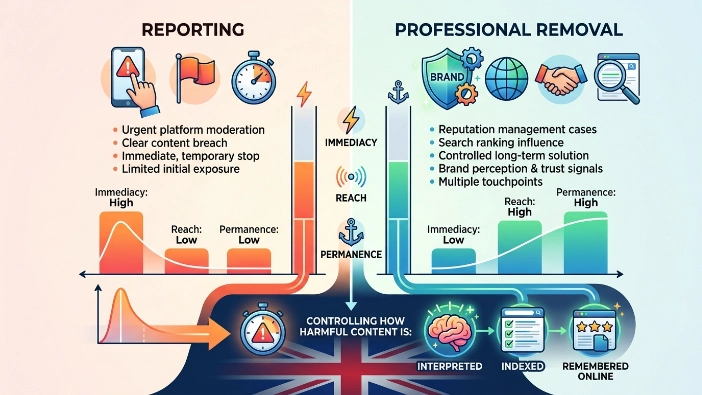
The most effective strategy compares immediacy, reach, and permanence rather than treating the two methods as substitutes. Reporting fits urgent platform moderation cases where the content breach is clear and the exposure is limited. Professional removal fits reputation cases where the issue affects search ranking influence, brand perception, or personal trust signals across multiple touchpoints. In UK reputation management, the difference is not only about deleting a post; it is about controlling how the harmful content is interpreted, indexed, and remembered online.
Reporting harmful Facebook content in the UK is a narrow platform response, while professional removal is a broader reputation control method that addresses source, search, and persistence. The strategic choice depends on scope, speed, legal context, and the level of search visibility that remains after the first action is taken.
What are Facebook content removal services?
Facebook content removal services help request takedowns of harmful, false, abusive, or privacy-violating posts on Facebook. They usually involve policy review, evidence collection, and removal requests based on Facebook rules or legal grounds.
How do I remove harmful content from Facebook?
You can report the content directly through Facebook if it breaks platform rules. For more complex cases, Facebook content removal services assess whether the post also qualifies for legal escalation, privacy claims, or defamation review.
Does reporting a Facebook post guarantee removal?
No, reporting does not guarantee removal because Facebook decides based on its own policies and evidence review. A post is more likely to be removed when it clearly violates community standards or privacy rules.
Can deleted Facebook content still appear in Google search results?
Yes, removed Facebook content can still remain visible in search results for a while due to indexing or cached copies. Search visibility often needs separate review if the goal is reputation protection.