Negative news articles can be removed or suppressed through a combination of legal pressure, technical de‑indexing, and content‑balancing strategies that alter their ranking and relative visibility in the SERP. Within reputation‑management systems, these tactics are evaluated by how they reshape search visibility, sentiment distribution, and entity credibility.
Reputation management strategies differ based on whether they prioritise erasing content, hiding it behind more authoritative pages, or rebuilding the underlying narrative around the entity. Online reputation control methods are evaluated through their impact on SERP evaluation, search ranking influence, and long‑term stability of reputation signals.
How do content removal and content suppression differ as reputation strategies?
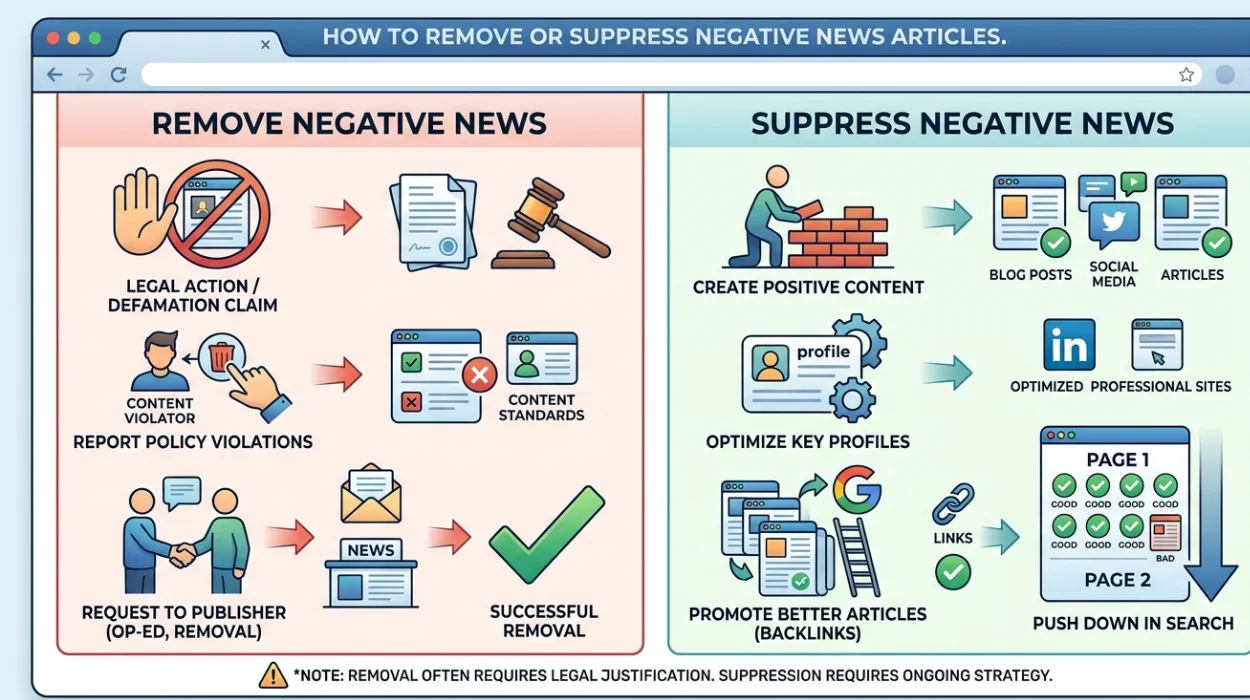
Content removal and content suppression are two distinct methods for reducing the impact of negative news on reputation, each with different mechanisms and risk profiles. Both aim to improve search visibility and entity perception but interact with search ecosystems in different ways.
Content removal is the process of taking down a page or getting it de‑indexed so it no longer appears in search results. It operates by leveraging legal, technical, or policy‑level takedown procedures, such as defamation claims, data‑protection requests, or hosting‑provider policies. When successful, removal reduces the total number of negative reputation signals in the digital footprint and can quickly alter the SERP for branded queries.
Content suppression, by contrast, operates by adding or promoting alternative pages that rank above the negative article, rather than deleting it. This approach leverages on‑page optimisation, internal linking, and controlled backlinking to push the harmful result down the first page so it receives fewer impressions. Suppression is more scalable and less legally intrusive, but it requires ongoing content production to maintain its effect over time.
In evaluation terms, removal is more decisive but often harder to achieve and context‑dependent, whereas suppression is more flexible and sustainable but can be vulnerable if new negative articles emerge.
How does legal removal of content compare with SEO‑based suppression?
Legal removal of content and SEO‑based suppression differ in how directly they alter the information field around an entity, and each has distinct implications for risk exposure and long‑term outcomes. Both methods influence how search engines interpret and rank reputation signals.
Legal removal focuses on eliminating the source document or forcing its de‑indexing through formal channels. It operates by invoking rights such as defamation, privacy, copyright, data‑protection, or platform‑specific policies, and then using those decisions to request removal from publishers or search engines. This approach directly reduces the number of negative nodes in the SERP and can prevent new citations or links from forming around the piece.
SEO‑based suppression, in contrast, operates within the normal ranking mechanisms of search engines. It targets SERP evaluation by:
- Publishing and optimising authoritative, factually accurate content that matches the same search queries.
- Using internal‑link networks and domain‑level signals to increase the ranking of corrective or neutral pages.
- Maintaining enough content volume and topical coherence so that the negative article is statistically less likely to appear in top‑position results.
From a risk‑management perspective, legal removal can be more decisive and defensible if the content clearly violates established rules. SEO‑based suppression is less confrontational and more adaptable, but it depends on sustained investment in content and competitive intensity in the keyword space.
What are the pros and cons of reactive versus proactive reputation strategies?
Reactive and proactive reputation strategies differ in timing, scope, and exposure to risk, yet both can influence how search engines interpret and rank reputation signals. Each model is evaluated through its impact on search visibility, entity credibility, and SERP composition.
Reactive strategies operate by responding to existing negative coverage after it appears in the SERP. They focus on immediate containment through:
- Identifying negative articles that rank in the first page for branded or category‑specific queries.
- Applying removal, de‑indexing, or suppression tactics to reduce their visibility.
- Deploying crisis‑response content that reframes or corrects the narrative.
These methods can be highly targeted and measurable, but they are often resource‑intensive and reactive‑only, leaving the broader reputation vulnerable to future incidents.
Proactive strategies, by contrast, operate before crises occur by structuring the digital footprint in a way that makes negative coverage less impactful. They work by:
- Mapping and securing key SERP clusters around the entity’s name, brand, and sector.
- Building a content library that aligns with likely search intents and establishes early authority.
- Monitoring sentiment distribution and ranking shifts so emerging issues can be addressed early.
Proactive strategies are more scalable and reduce long‑term risk exposure, but they require ongoing planning and investment. Reactive approaches better suit acute incidents, while proactive frameworks support long‑term reputation resilience.
How do short‑term suppression and long‑term content creation affect reputation signals?
Short‑term suppression and long‑term content creation influence reputation signals through different time horizons and signal‑weighting patterns. Each approach affects how search engines interpret entity credibility and how users encounter information in the SERP.
Short‑term suppression focuses on rapidly changing the composition of the first‑page results. It operates by:
- Publishing or optimising targeted pages that compete directly with the negative article for the same search queries.
- Using on‑page signals, structured data, and internal links to lift these pages into top‑position SERP slots.
- Monitoring ranking changes so that the negative result is pushed below the first page or appears in a less prominent position.
This approach can quickly improve search visibility and sentiment distribution, but its effects may diminish if the underlying content‑quality or authority signals are not sustained.
Long‑term content creation, by comparison, builds a deeper, more durable content‑authority layer around the entity. It operates by:
- Developing topic clusters and pillar content that answer common user questions about the person or brand.
- Aligning this content with semantic search‑intent patterns and entity‑recognition signals.
- Reinforcing trust through citations, authorship, and structured data that accumulate over time.
Over the medium and long term, content creation stabilises sentiment distribution and reduces the relative weight of isolated negative articles. When combined with occasional suppression campaigns, this model offers a robust, evidence‑based framework for SERP control and best online reputation management services.
How do different reputation‑management methods affect trust signals and entity perception?
Different reputation‑management methods affect trust signals and entity perception by altering which information nodes receive the most prominence and how consistently they align with recognised credibility markers. Within search ecosystems, trust is inferred from patterns of content, authority, and coherence, rather than isolated facts.
Direct removal methods reduce the number of visible negative references, which can lower the perceived risk or controversy associated with the entity. However, if the remaining content is sparse or fragmented, search systems may interpret the entity as less authoritative or predictable, which can constrain perceived credibility.
Content suppression and content‑enhancement methods, in contrast, expand the pool of trust‑indicative content. Multiple high‑quality pages, consistent messaging, and clear authorship reinforce SERP‑level trust signals and improve sentiment distribution. When news or review coverage is embedded within a richer, more balanced content landscape, entity perception tends to stabilise around a more coherent, credible narrative.
From a strategic standpoint, the most effective configurations mix short‑term suppression with long‑term creation, ensuring that the SERP reflects both factual accuracy and structural authority. The choice of emphasis depends on the immediacy of the threat, the legal and policy environment, and the entity’s capacity for sustained content work.
FAQs:
How can I remove a negative news article from search results effectively?
To remove a negative news article from search results effectively, assess whether it breaches defamation, privacy, or data‑protection rules and then request removal or de‑indexing from the publisher or search engine.
What is the difference between removing and suppressing negative news online?
Removing negative news focuses on taking down the article or de‑indexing it so it no longer appears in search results, while suppressing it means pushing it down the rankings with more authoritative, positive pages.
Can SEO‑based methods really reduce the impact of bad press on Google?
Yes, SEO‑based methods can reduce the impact of bad press on Google by ranking more accurate, professional content above the negative article for the same search queries. When search engines prioritise these newer pages, they shift search visibility and sentiment distribution, which lowers the influence of the harmful reputation signal in SERP evaluation.
How long does it usually take to suppress negative news in search results?
Suppressing negative news in search results can take several weeks to a few months, depending on how quickly new content is indexed and how competitive the keyword space is.
What are the safest ways to deal with negative news coverage without legal risk?
The safest ways to deal with negative news coverage include focusing on content suppression, reputation‑building through factual and authoritative pages, and working within legal boundaries such as data‑protection or takedown policies where applicable.