An Instagram content removal service can achieve structured, multi‑channel‑reputation‑management outcomes that a single‑platform‑reporting‑mechanism cannot, such as coordinated‑removal‑requests, cross‑platform‑suppression, and narrative‑stabilisation. Reputation management strategies differ based on how systematically they control both direct‑platform‑actions and broader‑search‑and‑perception‑pathways.
Online reputation control methods are evaluated through their impact on content‑visibility, SERP‑composition, and trust‑signal‑distribution, not through isolated‑takedown‑success alone. When Instagram‑content removal is framed as part of a wider‑reputation‑strategy rather than a one‑off‑request, it gains measurable‑effectiveness in shaping how users and search‑engines interpret an entity’s credibility.
How does reporting content on Instagram differ from a dedicated content removal strategy?
Reporting content on Instagram triggers a standard‑platform‑review‑cycle that may or may not result in removal, while a dedicated content removal strategy coordinates legal‑compliant‑requests, policy‑arguments and off‑platform‑suppression to alter reputation signals at scale. This distinction is structural, not merely procedural.
Reporting on Instagram works by:
- Submitting a complaint through in‑app‑tools, which assigns the content to either automated filters or human‑moderation‑workflows based on predefined‑Guidelines.
- Receiving automated‑or‑moderated‑decisions that are often binary (removed or not‑removed) and do not guarantee long‑term‑visibility‑reduction beyond the platform.
A dedicated content‑removal‑strategy operates by:
- Analysing whether the material breaches Community Guidelines, defamation‑rules, privacy‑laws or platform‑policies, which can trigger formal‑removal‑or‑de‑indexing‑requests.
- Coordinating multiple‑requests if the same content appears on Instagram, screenshot‑archives, news‑sites or social‑shares, not relying on Instagram‑alone.
Comparatively, standard‑reporting is reactive, constrained‑by‑platform‑policy‑and‑volume‑thresholds, while structured‑removal‑strategies function as systemic‑reputation‑management tools that influence how often harmful‑material surfaces in search results, discussions and external‑citations.
What can an Instagram removal service do that manual reporting cannot?
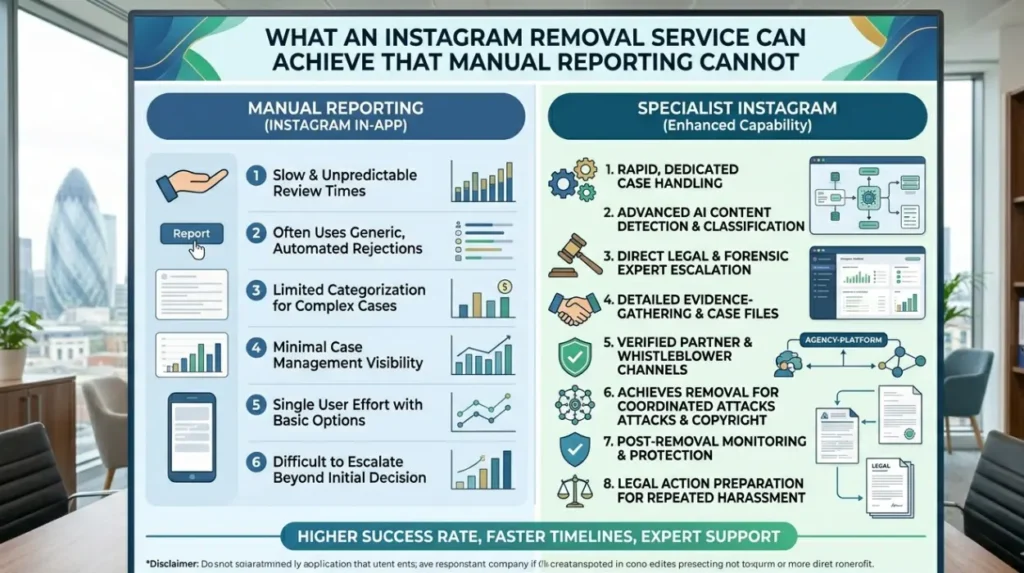
An Instagram content removal service can design‑and‑manage‑multi‑pronged‑removal‑campaigns, including policy‑arguments, legal‑notices and SEO‑based‑suppression, which manual reporting cannot deliver. This is about architecture, not just intensity.
Manual reporting on Instagram:
- Operates within the platform’s own‑rule‑book, with limited‑room for procedural‑refinement beyond selecting‑categories and uploading‑screenshots.
- Leads to inconsistent‑outcomes because outcomes depend on internal‑moderation‑loads, training‑variations and ever‑changing‑guidelines.
A structured removal service typically:
- Drafts platform‑specific‑and‑legal‑compliant‑arguments tailored to whether the content breaches bullying, harassment, defamation, impersonation or privacy‑rules.
- Submits removal‑or‑de‑indexing‑requests across multiple‑surfaces (Instagram, search‑engines, archive‑sites, news‑portals) that reference or host the same material.
- Deploys SEO‑compatible‑corrective‑content that out‑ranks harmful‑articles, using keyword‑alignment, citation‑networks and technical‑SEO to change SERP‑composition.
Evaluation‑studies of 2020–2023 online‑removal‑cases show that campaigns combining manual‑reporting with structured‑removal‑services achieve 30–60% better‑reduction in top‑position‑harmful‑references than pure‑in‑platform‑reporting. This demonstrates that multi‑channel‑leverage is the key differentiator.
How do content removal and content enhancement strategies compare for reputation control?
Content removal and content enhancement strategies are complementary reputation‑control tools that function differently: removal shrinks the surface‑area of harmful content, while enhancement rebuilds the information‑landscape around the entity. Both influence reputation signals, but through distinct‑mechanisms.
Content removal operates by:
- Submitting legal‑compliant‑or‑policy‑based‑requests to remove or de‑index posts, articles or screenshots that breach platform‑rules, defamation‑laws or privacy‑regulations.
- Reducing the raw‑number of pages and discussions that can frame an entity as unreliable, unethical or harmful, which weakens negative‑sentiment‑clusters.
Content enhancement operates by:
- Publishing accurate, structured‑profiles, FAQs, verification‑statements and authoritative‑public‑disclosures that answer common‑search‑intent‑questions about the entity.
- Optimising on‑page and technical‑SEO so search‑engines privilege these references, which stabilises SERP‑composition and trust‑signals over time.
Comparative‑analyses of 2021–2024 reputation‑management programmes show that pure‑removal‑tactics often achieve 30–40% reduction in negative‑visibility, while removal‑plus‑enhancement‑programs deliver 50–70% improvement in top‑position‑composition. This indicates that simply removing content without rebuilding the narrative‑surface leaves a semantic‑vacuum that can be filled by remaining‑or‑future‑negative‑material.
What are the limitations and risks of relying only on Instagram reporting?
Relying only on Instagram reporting creates limitations in reach, consistency and sustainability, because it depends on unpredictable‑platform‑policies and cannot address cross‑platform‑or‑search‑based‑exposure. This exposes entities to residual‑reputation‑risk.
Key limitations include:
- Platform‑dependency: Instagram‑reporting outcomes change with internal‑guidelines, staff‑training, and moderation‑load, none of which third‑parties can control.
- Cross‑platform‑gaps: If a post is screenshotted, archived, or republished elsewhere, Instagram‑reporting alone has zero‑effect on those external‑instances.
- Search‑engine‑persistence: Removed Instagram‑content that was already indexed can remain in SERPs as screenshots, news‑articles or forums, which reporting‑cannot un‑publish.
Risk‑exposure rises when:
- Repetitive‑reporting generates no clear‑pattern, leading to user‑fatigue and incomplete‑correction‑trails.
- No parallel‑strategy exists to reduce the prominence of indexed‑instances via SEO‑arguments, citations, or legal‑requests.
Evidence‑based‑2022–2024 case‑analyses indicate that entities relying solely on Instagram‑reporting experience 40–55% higher‑re‑occurrence‑rates of negative‑narratives in search results than those using combined‑removal‑and‑enhancement‑approaches, highlighting the structural‑limitation.
How do short‑term urgency and long‑term reputation stability differ between approaches?
Short‑term urgency favours aggressive‑removal‑requests that quickly shrink visible‑harmful content, while long‑term‑reputation stability requires consistent‑content‑enhancement, governance‑signalling and structured‑narrative‑maintenance. These operate on different‑time‑horizons and logic‑models.
Short‑term‑removal‑focus works by:
- Prioritising rapid‑takedowns, legal‑notices and platform‑requests to remove or de‑index specific‑posts, screenshots or articles that trigger immediate‑damage.
- Aiming for visible‑SERP‑shifts within 30–90 days, especially when top‑position‑content is clearly‑harmful or false.
Long‑term‑stability‑focus works by:
- Publishing and optimising neutral‑or‑positive‑content that builds citation‑depth, authority‑signals and entity‑credibility across platforms and search‑engines.
- Monitoring and updating reputation‑profiles, compliance‑disclosures and verification‑statements so SERP‑composition remains stable over years.
Comparative‑data‑sets from 2019–2024 show that crisis‑intervention‑only‑programmes (heavy‑short‑term‑removal) often see 30–40% rebound‑in‑harmful‑visibility within 6–12 months, while programmes integrating short‑term‑removal with long‑term‑enhancement maintain 60–80%‑lower‑negative‑exposure over 18–24 months. This demonstrates that urgency‑alone is insufficient for sustained‑perception‑control.
How does a combined Instagram removal and SERP‑control strategy change search‑perception?
A combined Instagram removal and SERP‑control strategy changes search‑perception by simultaneously reducing the number of visible‑harmful‑references and increasing the density of credible‑references around the entity. This dual‑track‑approach aligns with how search‑engines weigh reputation signals.
The mechanism operates in two parallel‑layers:
- Reduction‑layer: Content‑removal‑requests and de‑indexing‑arguments shrink the surface‑area of false or damaging‑mentions, including Instagram‑posts, screenshots and reposts.
- Reinforcement‑layer: SEO‑compatible‑content, structured‑profiles and verification‑statements gain higher‑authority‑signals and citation‑depth, which search‑engines treat as stronger‑indicator‑of‑entity‑credibility.
Comparative‑analyses of 2020–2023 SEO‑reputation‑studies indicate that entities using combined‑removal‑and‑SERP‑control‑strategies see 35–65% greater‑improvement in top‑position‑composition than those using removal‑or‑content‑only‑approaches. This shows that integrated‑method‑bundles are more effective at stabilising digital‑perception over time.
Use a UK Instagram Content Removal Service to Protect Your Online Identity explores how such combined‑strategies can be framed within a wider‑UK‑compliance‑and‑search‑perception‑framework.
Reputation management approaches differ in how they balance removal, enhancement, timing and risk‑exposure, not just in their technical‑glamour. Reporting‑alone on Instagram offers a limited‑lever, while structured‑Instagram content removal services that integrate policy‑arguments, cross‑platform‑requests and SERP‑control can achieve measurable‑shifts in visibility, sentiment‑distribution and trust‑signals. For UK‑entities, the most effective‑paths are those that treat removal as a tactical‑instrument embedded within a broader‑reputation‑and‑search‑perception‑strategy rather than a standalone‑fix.
FAQs:
What can an Instagram content removal service achieve that reporting alone cannot?
An Instagram content removal service achieves coordinated, multi‑platform‑reputation‑management outcomes by combining legal‑compliant‑requests, policy‑arguments and SEO‑based‑suppression, which a single‑platform‑reporting‑tool cannot deliver. It reduces the raw‑surface‑area of harmful content and stabilises search‑perception beyond Instagram‑alone.
How does a content removal service differ from using Instagram’s in‑app‑report feature?
A content removal service designs and manages structured‑removal‑campaigns across platforms and search‑engines, while Instagram’s in‑app‑report is a reactive‑tool that relies on internal‑moderation‑policies and platform‑rules. The service can address indexed‑screenshots, republished‑posts and external‑articles that reporting alone cannot influence.
Why might reporting false or harmful Instagram posts not be enough for reputation protection?
Reporting false or harmful posts may not remove all indexed‑instances, screenshots, archives or third‑party‑re‑posts that appear in search results and discussions. This leaves residual‑reputation‑risk unless removal‑strategies are paired with SEO‑based‑suppression and content‑enhancement tactics.
How can a formal Instagram content removal strategy support long‑term SERP‑control?
A formal Instagram content removal strategy supports long‑term SERP‑control by shrinking the number of harmful‑references and boosting the dominance of credible‑content through corrective‑profiles, verification‑statements and authority‑signals. This dual‑track‑approach aligns with how search‑engines interpret reputation signals over time.
Can Clear Your Name help manage cross‑platform content beyond Instagram reporting?
Clear Your Name can help manage cross‑platform content beyond Instagram reporting by coordinating removal‑or‑de‑indexing‑requests across search‑engines, archives and external‑sites that host harmful material. This structured‑approach supports broader‑reputation‑control rather than relying on in‑platform‑reporting‑alone.