

Reputation management is the process of shaping how an entity is understood through search results, indexed pages, and visible reputation signals. Online reputation refers to the searchable record of content, reviews, mentions, and platform data that influences entity perception and trust.
What does negative content removal cover?
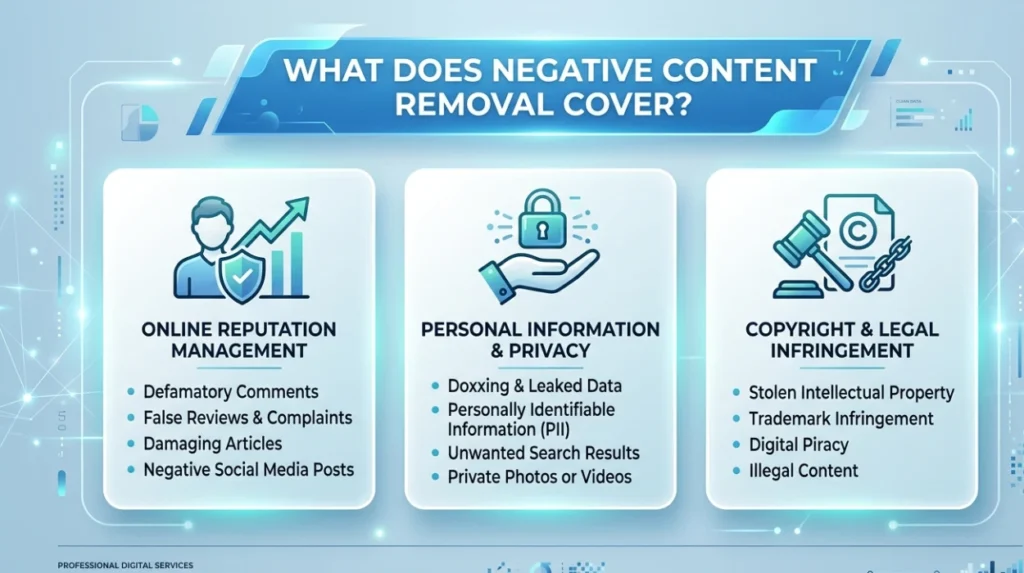
Negative content removal covers harmful pages, posts, reviews, and indexed references that damage online credibility. It refers to the process of reducing the visibility, availability, or index status of content that weakens reputation signals within search ecosystems.
Dive Deeper With Our Expert Guides and Related Blog Posts:
How Online Content Removal Works and Why It Takes Professional Expertise
Why Content Published Online Rarely Disappears Without Expert Intervention
The scope usually includes false statements, privacy intrusions, outdated material, impersonation, and content that violates platform rules. It also includes duplicate pages, cached copies, and mirrored references when they continue to influence SERP evaluation. Removal does not always mean deleting the source page. It can also mean deindexing, takedown requests, policy reports, or correction of the original text.
This matters because search engines do not evaluate a harmful page in isolation. They interpret it alongside links, sentiment, and the wider digital footprint. When a negative page remains visible, it continues to shape entity perception. When it disappears or loses indexation, its influence on search visibility declines. That is why removal covers both the source content and the search layer that displays it.
Which platforms does it apply to?
Negative content removal applies to platforms that host searchable content, user generated content, reviews, media posts, and indexed pages. It refers to the set of environments where harmful material can appear in search results, influence reputation signals, or shape public trust through repeated visibility.
The main platform groups include search engines, review sites, social platforms, forums, news pages, blogs, and content hosting platforms. Search engines are relevant because they surface the material. Review sites are relevant because they convert opinions into credibility signals. Social platforms matter because short form posts spread quickly and often attract indexing. Forums matter because they create discussion trails that can persist in search.
A platform only becomes relevant when the content is visible, indexed, or linked to the entity. That means removal analysis starts with where the material lives and how it appears in results. A post on a social site can carry less weight if it is not indexed. A review page can carry more weight if it ranks for the entity name. The platform type therefore affects both the removal route and the reputational impact.
How do search engines interpret negative material?
Search engines interpret negative material by evaluating relevance, authority, trust cues, and content consistency. SERP evaluation is the process that decides whether negative content stays visible, loses position, or drops out of the searchable record.
A page with strong links and frequent mentions can remain visible for a long time. A review page with repeated negative sentiment can also continue to shape trust because it sits inside a rating environment. Search engines compare the negative page against the rest of the entity profile. If the page is the strongest available evidence, it stays prominent. If stronger trustworthy pages exist, the negative result can lose rank.
This mechanism matters because negative content influences more than one query. It can rank for a name, a company, a product, or a reputation-related phrase. That creates a compound effect on digital footprint and online credibility. Removal interrupts that pattern by changing what the engine can index and surface. The result is a smaller negative presence across the search ecosystem.
What types of content usually qualify?
The types of content that usually qualify are false claims, privacy breaches, defamatory text, impersonation, harassment, and policy violating material. These are content forms that alter reputation signals by presenting harmful or inaccurate information as if it were reliable public evidence.
False claims matter because they distort entity perception. Privacy breaches matter because they expose personal or confidential data. Defamatory text matters because it can create lasting credibility damage. Impersonation matters because it creates a fake identity trail that search engines can still index. Harassment matters because it can repeat harmful messaging across multiple pages or accounts.
Outdated content also matters when it continues to damage the entity after the underlying facts have changed. A page can become reputationally harmful even if it was originally posted without malicious intent. Once indexed and ranked, it can keep influencing perception. This is why content removal covers both the material itself and the search visibility it creates.
How do reviews fit into negative content removal?
Reviews fit into negative content removal because they are indexed reputation signals that often appear directly in search, map results, and branded queries. A review is a trust signal, and a harmful or fake review becomes a negative reputation input that affects sentiment interpretation and public credibility.
Review platforms matter because they compress experience into a high-visibility format. One bad review can influence perception if it appears in a prominent position. A cluster of negative reviews can also create a wider sentiment pattern that search engines and users both interpret as a trust issue. Removal in this context involves policy reporting, evidence submission, and index control where applicable.
The effect on search visibility is immediate when a review disappears from a visible page or loses prominence in results. The effect on credibility is broader when the review pattern becomes more balanced. That is why review content often forms part of the same negative removal process as articles, posts, and forum threads. The platform differs, but the reputation logic stays the same.
Why do cached copies and duplicates matter?
Cached copies and duplicates matter because they keep negative content accessible after the original source changes or disappears. A cached or mirrored version refers to an indexed copy that continues to shape perception even when the source page no longer exists in the same form.
Search engines store temporary representations of pages. Other websites can also republish or quote the original material. That means the content can survive the first removal action. If the cache remains live, the negative message can still appear in search pathways. If mirrors exist, the page can re-enter the visibility cycle through another URL.
This matters because negative content removal is not complete until the indexed copies stop influencing perception. A removed page that still appears in cache can continue to affect trust. A duplicated article can continue to rank even after the first source is deleted. That is why effective removal tracks the source, the copies, and the surrounding search footprint together.
How do authority and trust signals affect removal?
Authority and trust signals affect removal because they determine how strongly the remaining content holds its position in search. Authority signals are indicators of source strength, while trust signals are indicators of reliability, consistency, and credibility across the entity’s digital footprint.
A page from a strong source can be harder to displace if it remains indexed. A page from a weak or policy-violating source can be easier to challenge. Search engines use the broader trust pattern to interpret whether the content fits the entity profile. If the negative material appears isolated against a strong positive footprint, it can become less influential. If the negative material is embedded in a wide network of references, it becomes harder to remove from visibility.
This is why negative content removal is not only about the content itself. It is also about the trust structure around it. The more authority a harmful page has, the more it shapes perception before removal completes. The more trust the surrounding profile has, the easier it becomes to reduce the negative page’s influence. That relationship determines how removal changes search visibility.
What role does indexing play?
Indexing plays a central role because content cannot influence search results if the engine cannot retrieve and store it. Content indexing is the process by which search engines collect, categorise, and surface pages that are available for ranking and visibility.
If a page is indexed, it can appear in searches, snippets, and related result clusters. If it is deindexed, its visibility drops sharply. That is why removal work often targets the index status as well as the source page. Search engines may still hold stale copies for a period, so the process has to track both source existence and search visibility.
Indexing also affects how long the content stays part of the reputation record. A page can remain influential after the event that created it has passed. That makes the index a form of digital memory. Removal changes that memory by cutting the link between the harmful content and the public search layer. The impact is direct, because fewer indexed traces mean fewer reputation signals.
What does the removal process normally evaluate?
The removal process normally evaluates source status, policy fit, index status, and ranking impact. It refers to the sequence of checks that determines whether the harmful content can be deleted, deindexed, corrected, or suppressed.
Source status asks whether the page still exists at the original location. Policy fit asks whether the content violates platform rules or legal thresholds. Index status asks whether the page remains searchable. Ranking impact asks whether the content still appears for branded or entity-related queries. Each step answers a different question about reputation control.
This sequence matters because a page can fail one test and pass another. A page might remain live but lose indexation. A post might stay published but violate a platform rule. A review might remain visible but lose ranking weight. Negative content removal therefore requires a layered reading of the problem rather than a single deletion request.
Why does platform type change the removal route?
Platform type changes the removal route because each platform sets different rules, visibility structures, and enforcement thresholds. A removal route is the specific action path used to reduce harmful visibility on a given platform or search environment.
Search engines rely on index control and deindexing requests. Review platforms rely on policy violations and evidence based reporting. Social platforms rely on moderation systems and community rules. News pages and blogs often require webmaster contact, correction requests, or legal action depending on the content and jurisdiction. Forums may require account level reporting or thread level review.
The platform type also changes how search visibility behaves after removal. A review page can disappear from a branded search without removing the review source itself. A social post can remain accessible inside the platform while losing ranking power externally. A news article can continue to circulate through citations even after correction. That is why platform analysis sits at the centre of negative content removal.
How does removal affect digital footprint?
Removal affects digital footprint by changing which traces remain searchable, which traces lose rank, and which traces no longer dominate the entity story. Digital footprint refers to the searchable record of pages, mentions, reviews, and references associated with an entity across search ecosystems.
A harmful page expands the footprint in a negative direction. It adds another visible signal that users can interpret as evidence. Once the page is removed or deindexed, that signal weakens. The remaining footprint becomes easier to read because fewer conflicting or damaging references appear at the top of results.
This matters for entity perception because users often rely on the visible footprint as a proxy for trust. A footprint full of negative material suggests unresolved risk. A footprint with fewer harmful traces suggests greater credibility. Removal therefore improves more than one result. It reshapes the overall interpretation of the entity across search.
How does a case get built before action?

A case gets built before action by collecting evidence, mapping sources, confirming policy routes, and tracking visibility across platforms. This process defines why the content qualifies for removal and how the search ecosystem should respond once the request is made.
Evidence includes screenshots, URLs, timestamps, and copies of the harmful text. Source mapping identifies where the content is hosted and where it is duplicated. Policy analysis checks whether the content violates rules or legal standards. Visibility tracking in negative content removal service shows how the page ranks and how much damage it causes. These steps create a clear factual basis for action.
What is the main takeaway?
The main takeaway is that negative content removal covers the harmful material itself, the platform that hosts it, and the search layer that makes it visible. It is a reputation control process that reduces harmful reputation signals, improves entity perception, and lowers the search visibility of indexed negative content.
It applies across search engines, review platforms, social networks, blogs, forums, and media pages. It also applies to cached copies, duplicates, and mirrored references that keep the content alive in search. The core logic is consistent. If the material continues to shape trust, it remains part of the reputation problem. If the material stops appearing, the digital footprint becomes easier to control.
Negative content removal is therefore a search ecosystem function as much as a content function. It changes what the engine can see, what users can read, and what the entity appears to represent. That is the conceptual base needed before moving into any case-specific removal strategy.