
Online reputation control methods are evaluated through visibility impact, trust restoration, and the speed at which harmful pages lose search influence. Reputation management strategies differ based on whether the issue requires removal, suppression, correction, or wider content enhancement.
What does an online content removal service actually handle?
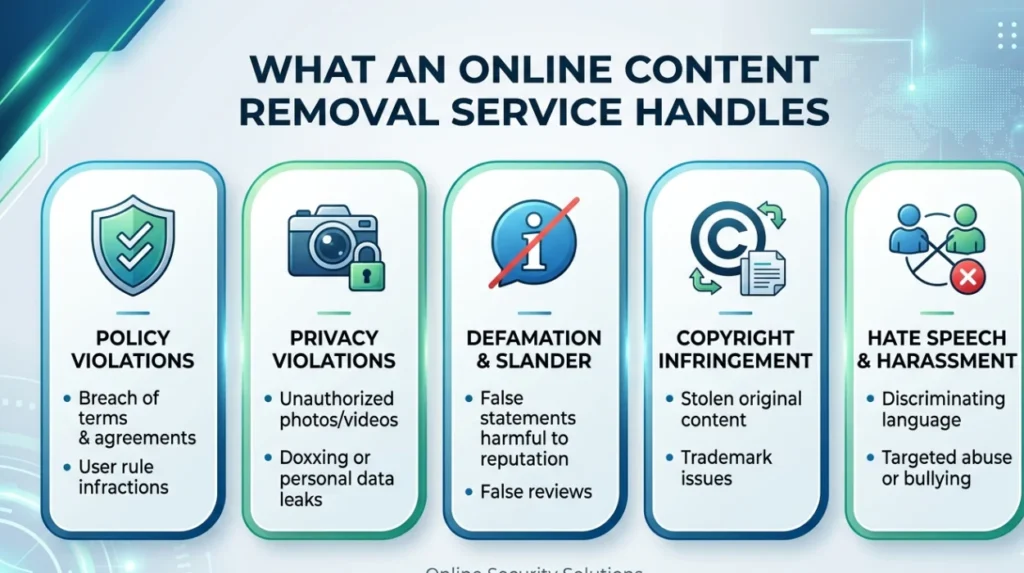
An online content removal service handles harmful pages by targeting deletion, deindexing, correction, or suppression depending on the content source and platform rules. The service evaluates whether the page can be removed at source, excluded from search results, or counterbalanced through stronger reputation signals that improve entity credibility.
The process begins with classification. A page can be defamatory, outdated, private, misleading, duplicated, or policy violating. Each classification changes the removal route. Search engines interpret these categories differently because indexed content carries different ranking influence depending on freshness, authority, and external linkage.
Dive Deeper With Our Expert Guides and Related Blog Posts:
What the Most Effective Routes Are for Getting a Google Image Removed in the UK
How to Compare Content Removal Services Before You Pay Anything
A removal service does not work on one method alone. It compares content suppression versus content enhancement and selects the method with the strongest fit. Suppression reduces the visibility of the harmful page. Enhancement builds stronger pages that occupy the search space more effectively. The decision depends on the extent of damage and the control available over the original source.
The impact on search visibility is direct. If the page disappears from the index, its ranking influence falls immediately. If the page remains live but loses authority, the effect takes longer. If the page is corrected instead of deleted, the search ecosystem receives a revised reputation signal rather than a full removal signal. Each route changes perception in a different way.
How does a removal review compare with a suppression review?
A removal review compares source deletion options with ranking suppression options. Removal changes the existence or index status of the content, while suppression changes the visibility position of the content without changing the underlying source page.
Removal works by addressing the page itself. That can involve a platform request, a webmaster request, a legal notice, or a search engine deindexing route. Suppression works by increasing the strength of neutral or positive pages so the harmful content falls lower in the SERP. The first method is structural. The second method is competitive.
The main strength of removal is permanence. If a page disappears from the source or is deindexed properly, the immediate harmful signal weakens. The limitation is access. Some publishers refuse removal, and some platforms only act when policy thresholds are met. Suppression has wider applicability because it does not depend on the cooperation of the original host. Its limitation is sustainability, because the harmful page can return if search ranking conditions change.
Search engines interpret both approaches differently. Removal reduces the available dataset. Suppression leaves the content live but changes the hierarchy of the visible results. That means removal produces a cleaner footprint, while suppression produces a managed footprint. The difference matters because trust signals improve faster when the visible source of harm no longer ranks prominently.
What happens during the first assessment?
The first assessment defines the scope, evidence quality, and likelihood of action. Assessment measures the content type, the source authority, and the search ranking influence of the page before the removal route is selected.
The assessment starts with URL mapping. The page is identified, indexed status is checked, and the search results are reviewed for prominence. The service then analyses the content itself. The question is not only whether the page is harmful. The question is whether the page is actionable under platform rules, content policy, or legal thresholds.
Evidence quality shapes the outcome. A page with false statements, privacy violations, or impersonation issues has a different route from a page that is simply negative. The assessment also measures sentiment distribution around the entity. If the negative content occupies the top positions, the reputation signal is stronger and the response becomes more urgent. If the content sits lower in the SERP, the strategy can shift towards measured suppression and support content.
This stage also reveals cost exposure. A case that needs platform negotiation alone usually costs less than a case that requires multiple escalation layers. It also reveals timing exposure. Fast acting removals create quicker visibility change, while complex cases require longer execution windows. That is why a review stage matters before any commitment.
How do search engines treat removed or corrected content?
Search engines treat removed or corrected content as altered evidence within the entity record. If a page is removed, deindexed, or corrected, the engine adjusts what it can crawl, store, and rank, which changes the entity’s reputation signals over time.
A removed page may still persist briefly through cached copies or external references. A deindexed page loses public visibility in search results even if the source remains active. A corrected page still exists, but the negative signal is reduced or replaced. These differences matter because search ranking influence does not end the moment a request is sent. It changes when the engine updates its model of the content.
Correction is useful when the content contains inaccurate statements that can be updated at the source. It is weaker than deletion when the page itself is the harm. Deindexing works well when visibility, not source existence, is the core issue. Removal is strongest when the harmful material can be fully eliminated. The choice depends on how the engine is likely to interpret the resulting signal.
Search visibility changes through these mechanisms because the SERP is a ranked representation of available evidence. When the evidence changes, the result set changes. This is why professional content removal uses more than a single action. It aligns source status, index status, and perception management in one process.
What is the difference between reactive and organic approaches?
Reactive approaches respond after harmful content appears. Organic approaches build a stronger reputation environment before or after the issue. Reactive removal focuses on immediate harm reduction, while organic reputation work focuses on long term entity credibility and search result composition.
Reactive work is narrower. It handles a page, a report, a request, or a takedown action. It is appropriate when the harmful content is already visible and the damage is measurable. The advantage is speed. The limitation is dependency on external cooperation and platform rules.
Organic work is broader. It creates authoritative pages, accurate profiles, and trusted references that reshape the search environment over time. This changes sentiment distribution and improves the balance of visible signals. The advantage is sustainability. The limitation is slower impact because ranking systems need time to process the new pattern.
The two methods do not compete in a simple way. They operate at different layers of the problem. Reactive removal reduces immediate damage. Organic support strengthens the recovered profile. The best outcome often comes from using both, but the decision depends on whether the issue is urgent, ongoing, or structurally embedded in the search profile.
Which approach delivers the strongest long term value?
The strongest long term value comes from combining removal with content enhancement when the problem is not fully contained by deletion alone. A blended strategy delivers better sustainability because it reduces harmful visibility while reinforcing the entity with stronger reputation signals that survive ranking fluctuation.
Removal alone can create a gap if no credible pages replace the harmful result. Search engines then re-evaluate the entity using whatever evidence remains. That can allow older negative pages or alternative pages to regain position. Content enhancement fills the gap with better ranking assets. It changes the composition of the SERP, not just one result.
This matters for trust restoration. Users do not evaluate a single page in isolation. They interpret the visible result set as a whole. A clean removal outcome creates immediate relief, but a strong replacement environment stabilises perception over time. That is why long term value depends on both negative content reduction and positive content reinforcement.
For decision validation, the analytical framework in what to expect when using an online content removal service in the UK supports this comparison by showing how outcome quality changes across different removal models. It helps separate temporary visibility gains from durable search control.
What risks affect the outcome?
The main risks are incomplete removal, reinstated visibility, weak evidence, and slow platform response. Risk exposure rises when the content remains accessible, when the source republished the material, or when the search engine keeps cached and linked versions in circulation.
Incomplete removal creates a false sense of progress. A page may disappear from one search result and still remain visible through another query variation. Reinstated visibility occurs when the page is republished or mirrored on a different domain. Weak evidence reduces the chance of platform action because the request lacks a policy basis. Slow response increases exposure because the harmful page continues to shape perception during the waiting period.
These risks explain why professional handling matters. The process has to account for source control, search index behaviour, and alternate copies. A removal action without follow through often leaves the entity in a partially repaired state. That state is unstable because the negative signal still influences trust and ranking.
Risk also affects cost. A low cost service that delivers weak control often generates greater long term expense through repeated interventions. A more structured process usually costs more up front but reduces future exposure. That is the central trade off in content removal work.
How should a buyer compare providers?
A buyer should compare method clarity, evidence handling, visibility tracking, and outcome verification. The best provider explains which removal routes apply, how results are measured, and how the service reduces search visibility without relying on vague assurances.

Method clarity matters because not every provider handles the same content types. Some work only with direct takedowns. Others manage deindexing, suppression support, or correction requests. Evidence handling matters because removal requests fail without documented proof. Visibility tracking matters because the result only counts if the harmful page loses search influence. Outcome verification matters because the buyer needs proof that the page no longer shapes the entity profile.
A practical comparison framework can be used in order.
- Confirm the content type, for example defamation, privacy breach, outdated material, or impersonation.
- Check the action route, for example removal, deindexing, correction, or suppression.
- Review evidence requirements, for example screenshots, URLs, timestamps, or source records.
- Measure expected visibility change, for example page loss, ranking drop, or snippet removal.
- Validate follow up, for example cache checks, reinstatement monitoring, and SERP review.
This framework reduces uncertainty and connects the removal action to the actual reputation outcome.
What does a UK client usually gain from a structured process?
A UK client usually gains clearer process control, stronger search visibility management, and lower risk of prolonged reputational damage. A structured process improves entity credibility by addressing the source of the harm and aligning the result with UK content norms, platform rules, and search engine behaviour.
The gain is practical. Search result quality improves when harmful content is removed or reduced. Trust signals improve when the visible footprint becomes cleaner and more consistent. Perception improves when the SERP no longer prioritises harmful pages. The result is not only fewer negative touchpoints. The result is a more reliable public record in search.
This is where the distinction between speed and durability matters. Fast actions reduce immediate stress. Durable actions reduce long term exposure. A structured removal approach does both when the case supports it. When the case does not support full removal, suppression and content enhancement become the fallback path.
Free UK consultation fits this decision stage because it marks the transition from analysis to action without changing the underlying logic of the comparison. It supports validation after the buyer understands how the removal ecosystem works.
A content removal service in the UK works through assessment, evidence, and the right action route. Removal, deindexing, correction, and suppression each affect search visibility differently. The strongest decision is based on risk, sustainability, and the ability to influence reputation signals at source.