
Facebook account removal for harassment in the UK operates through Meta’s Community Standards, which prohibit targeted bullying, repeated threats, and coordinated campaigns that cause alarm or distress. Reports are evaluated by a combination of automated detection and human review; accounts that accumulate repeated violations can be disabled or removed from the platform.
Reputation management strategies differ based on whether they focus on content suppression, content enhancement, or legal‑coordinated removal. Online reputation control methods are evaluated through how they shift search visibility, alter sentiment distribution, and reshape the digital footprint over time. This article analyses how harassment‑based account removal on Facebook interacts with these broader reputation‑management choices in a UK context.
What role does Facebook policy play in harassment‑related removals?
Meta’s Community Standards define harassment and bullying as behaviours that repeatedly target a person with threats, intimidation, or degrading content likely to cause alarm or distress. Mass‑harassment policies additionally cover coordinated campaigns, even where individual posts may not breach other rules, if they pose a risk of offline harm.
Under this framework, Facebook operates by:
- Mapping reported content against its bullying and harassment policy tiers.
- Applying automated classifiers to flag repeated targeting, threats, or hate‑coded language.
- Routing borderline or high‑risk cases to human reviewers for contextual assessment.
For UK users, this policy layer functions as a primary reputation‑control mechanism: disabling or removing a harassing account can remove a significant source of negative signals and reduce the volume of toxic content indexed in search engines. Yet limitations arise where policy thresholds are not met (for example, vague but non‑explicit threats) or where the behaviour is distributed across many accounts rather than centralised on one profile.
How does Facebook’s internal reporting and removal process work?
Facebook’s internal reporting‑and‑removal workflow is designed to move from user‑driven reports to systemic enforcement actions without requiring direct legal filings in most cases. Users can report specific posts, profiles, groups, or message threads, attaching screenshots and contextual notes that help reviewers understand the course of harassment.
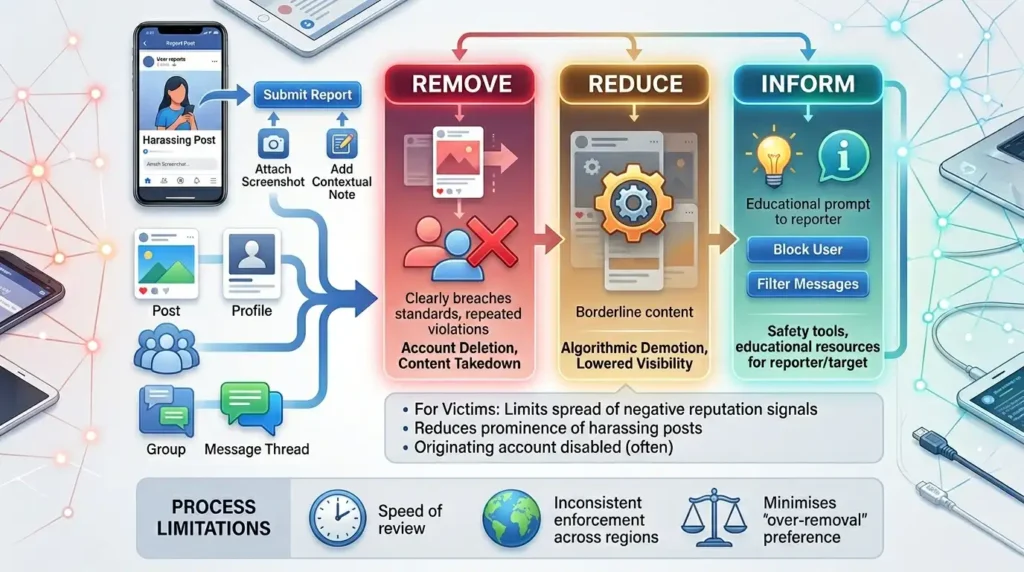
Meta’s “Remove, Reduce, Inform” triad explains the mechanism:
- Remove applies when content clearly breaches bullying or harassment standards or when accounts repeatedly violate policies.
- Reduce lowers visibility of borderline content without full takedown, often via algorithmic demotion rather than deletion.
- Inform surfaces educational prompts to the reporter or to the target, sometimes including safety tools such as blocking or filtering.
For UK‑based victims, this process can limit the spread of negative reputation signals by reducing the prominence of harassing posts and, in many cases, disabling the originating account. However, its effectiveness is constrained by the speed of review, inconsistent enforcement across regions, and the platform’s preference to minimise “over‑removal” in line with free‑expression commitments.
How does harassment‑related removal compare with content‑removal services?
Reputation management that targets Facebook harassment can be approached either directly via Meta’s tools or through external Facebook Content Removal Services, which operate as intermediaries specialising in evidence‑based reporting and escalation. Direct platform reporting is available to all users, whereas external services typically supply structured evidence‑packs, legal framing, and follow‑up workflows that mirror professional legal or compliance procedures.
Organising the comparison by mechanism and outcome:
From a reputation‑management perspective, direct reporting is the baseline mechanism; external services sit at the evaluation layer, analysing what can be removed and how to frame it for maximum content suppression. Neither approach guarantees removal, but the service‑mediated route can systematically increase the chances of successful takedowns by aligning with Meta’s internal standards and evidence‑ practices.
What are the differences between reactive takedowns and proactive reputation control?
Reactive takedowns focus on identifying and removing harmful content after it appears, whereas proactive reputation control invests in building positive or neutral signals that dilute or outweigh negative material. In the harassment context, a reactive approach is to remove a specific Facebook account or post; a proactive approach is to publish verifiable, context‑rich content that shifts sentiment distribution in search results.
Reactive takedowns operate by:
- Locating precise URLs and user profiles.
- Triggering removal or demotion workflows via reporting channels.
- Periodically monitoring for reappearance or re‑creation of harming accounts.
In contrast, proactive reputation control mechanisms include:
- Publishing authoritative content (e.g., professional profiles, news pieces, thought‑leadership material).
- Optimising this content for search intent and semantic relevance to the target entity.
- Structuring internal links and citations to reinforce entity credibility and search ranking influence.
For UK users, the practical trade‑off is between short‑term relief (removing a harassing account or post) and long‑term resilience (reducing the relative weight of any single negative item in search). Reactive takedowns are effective for immediate harm reduction but may not prevent future harassment; proactive control can gradually alter the SERP composition, yet it has a slower impact on visibility of live, policy‑breaching content.
How do these approaches affect search visibility and trust signals?
Search engines interpret reputation signals through a mix of content freshness, authoritativeness, and user‑interaction patterns across multiple domains, including social platforms. When a Facebook account that hosts harassment is removed or demoted, the volume of negative signals associated with that entity can decrease, which may reduce the prominence of that account in search results and alter the overall sentiment distribution.
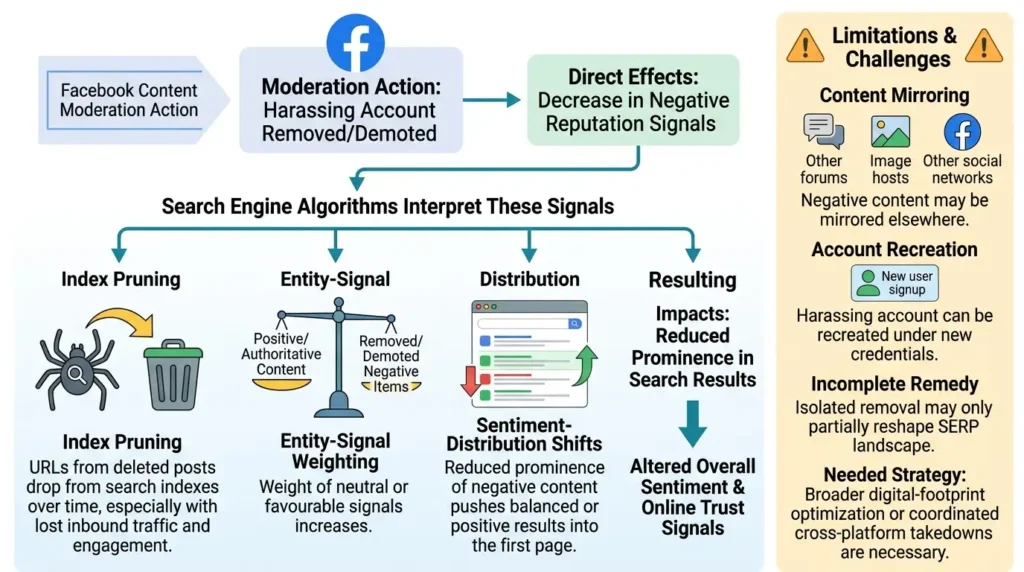
Mechanisms at work include:
- Index pruning: If posts are deleted, the URLs may drop from search indexes over time, especially if they lose inbound traffic and engagement.
- Entity‑signal weighting: Authoritative, positive content can increase the weight of neutral or favourable signals relative to removed or demoted negative items.
- Sentiment‑distribution shifts: Even if some negative results remain, their reduced prominence can push more balanced or positive results into the first page.
However, limitations arise when negative content is mirrored elsewhere (on forums, image hosts, or other social networks), or when the harassing account is recreated under new credentials. In such situations, isolated removal on Facebook may only partially reshape the SERP landscape; broader digital‑footprint optimisation or coordinated cross‑platform takedowns become necessary to sustain reputation‑signal control.
What are the risk and sustainability implications of each approach?
Content‑removal‑centric approaches to Facebook harassment are generally fast‑acting but carry higher execution risk and lower long‑term sustainability. Success depends on Meta’s internal standards, reviewer subjectivity, and enforcement capacity, all of which can vary over time and may change in response to policy reforms or regulatory pressure.
By contrast, reputation‑enhancement strategies exhibit lower short‑term risk because they are additive rather than confrontational. They do not rely on third‑party enforcement decisions and instead focus on building search ranking influence through consistent, verifiable content. Nevertheless, they require ongoing investment in content creation, SEO optimisation, and monitoring, which can be resource‑intensive.
Dive Deeper With Our Expert Guides and Related Blog Posts:
How to Remove a Harmful Facebook Post in the UK Through Proper Reporting Channels
How to Remove a Defamatory Facebook Post in the UK Using Platform and Legal Routes
Scalability also differs:
- Removal‑focused tactics can be applied repeatedly to discrete harassment episodes but may not scale efficiently if campaigns are distributed across many accounts or platforms.
- Reputation‑enhancement tactics scale more naturally as each new piece of content strengthens the overall entity profile, although they are less effective in situations where immediate harm‑reduction is required.
From a UK‑centric perspective, the regulatory environment (including the Online Safety Act and related guidance) adds an extra layer of enforcement pressure on platforms, which may increase the long‑term effectiveness of both formal complaints and coordinated removal campaigns. At the same time, regulatory complexity can also introduce compliance risk for any actor that escalates content‑removal requests aggressively or without clear evidence.
How should you choose between removal, suppression, and reputation‑building?
Choosing between Facebook account removal, content suppression, and broader reputation‑building hinges on the balance between harm immediacy, control scope, and long‑term sustainability. If harassment is active, concentrated, and clearly breaches Meta’s bullying and harassment standards, a removal‑focused strategy is often the most direct way to reduce the volume of negative signals and lower the offender’s reach.
If the harassment is diffuse, recurrent, or already embedded in multiple platforms, a hybrid strategy that combines removal‑focused actions with systematic reputation‑building is more effective. This hybrid approach:
- Uses targeted reporting and escalation to remove or demote the most harmful Facebook accounts.
- Deploys content creation and SEO‑driven reputation‑building to strengthen positive entity signals.
- Monitors search visibility and sentiment distribution over time to adjust the mix of suppression and enhancement.
For UK users navigating harassment‑related reputation issues, the key distinction is not whether to remove or enhance, but how to sequence and proportion these methods. Short‑term takedowns can stabilise the situation; long‑term reputation‑management can make the entity less vulnerable to future campaigns by altering the underlying digital‑footprint structure and search ranking influence.
For deeper insight Explore:
Remove a Harassing Facebook Account in the UK With Our Expert Takedown Service
How do Facebook content removal services work in the UK?
Facebook content removal services help identify and report harassment, defamatory posts, or fake accounts to Meta under its Community Standards and online safety rules. These services compile evidence and escalate reports so the platform can review and, where appropriate, remove or disable violating content or profiles.
Can a Facebook content removal service get a harassing account deleted?
A Facebook content removal service can increase the chances of a harassing account being disabled by submitting structured reports that meet Meta’s bullying and harassment policy thresholds. Success depends on whether the content clearly breaches the rules, and services typically combine platform reporting with broader reputation‑management tactics.
What evidence is needed for Facebook content removal?
Effective Facebook content removal relies on screenshots, URLs, timestamps, and a clear chronology showing repeated harassment, threats, or impersonation. Services often organise this evidence into a formal report so Meta can review it quickly under its removal and enforcement procedures.
Are Facebook content removal services legal in the UK?
Facebook content removal services operate within UK law and Meta’s Community Standards, focusing on reporting content that breaches harassment, impersonation, or defamation rules. They do not access accounts illegally and instead use formal reporting channels and, where needed, legal‑style evidence to support takedown requests.