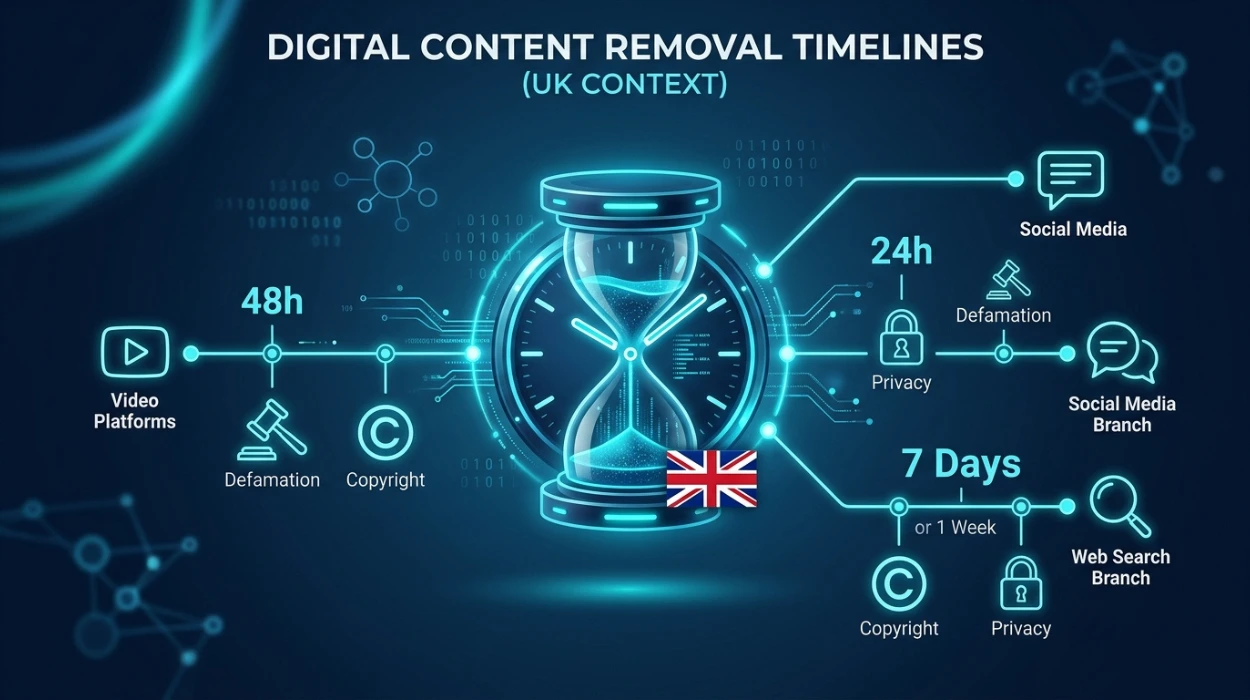
Content removal timelines in the UK range from a few hours to several weeks depending on platform governance systems, content type, and legal escalation routes.
Reputation management is the systematic control and analysis of how information appears, spreads, and ranks across search ecosystems. Online reputation refers to the structured entity perception formed through indexed content, user-generated signals, and algorithmic evaluation within search engines and digital platforms.
What determines how long content removal takes in the UK?
Content removal timelines in the UK are determined by platform moderation architecture, legal compliance requirements, and content classification systems. Each system evaluates removal requests through structured policy enforcement layers that control indexing, visibility, and de-ranking speed.
Reputation management is structured around how search engines and platforms interpret trust signals, content legitimacy, and policy violations. Content removal refers to the process of eliminating or suppressing digital material from indexed systems, platform feeds, or search engine results. These systems rely on automated classifiers combined with human review layers to evaluate whether content breaches legal or policy thresholds.
Platform governance speed directly depends on how content is classified within moderation pipelines. High-risk categories such as defamation, privacy violations, or explicit harmful material trigger accelerated review workflows. Lower-risk content enters standard queues that follow extended verification cycles before de-indexing or suppression occurs.
Search visibility is directly influenced by indexing frequency and algorithmic prioritisation. Content that has already been widely indexed across external sources requires additional recalibration across multiple SERP layers, increasing total removal duration. In contrast, newly published content remains within narrower indexing boundaries, allowing faster suppression outcomes.
How does platform moderation architecture influence content removal speed in the UK?

Platform moderation architecture defines content removal speed in the UK by controlling how quickly reports are escalated, reviewed, and actioned within internal enforcement systems. These architectures operate through layered moderation pipelines that prioritise content based on risk classification and policy severity.
Moderation architecture refers to the internal system design that governs how platforms process flagged content through automated detection, queue assignment, and human review validation. This system determines whether content is removed instantly, temporarily restricted, or escalated for compliance assessment.
Automated moderation layers analyse metadata, keywords, image patterns, and behavioural signals to classify content severity. When high confidence violations are detected, content enters rapid enforcement channels that reduce exposure within hours. Lower-confidence cases transition into manual review queues that extend processing duration due to verification requirements.
Human moderation layers evaluate contextual relevance, legal implications, and jurisdictional compliance under UK regulatory expectations. This evaluation step ensures alignment with data protection standards and platform liability frameworks, which directly increases processing time for ambiguous content cases.
Search visibility reduction is also influenced by how quickly platforms update internal indexing states. When moderation architecture synchronises efficiently with external search engines, content suppression occurs faster across SERPs, reducing digital footprint persistence.
How long does social media content removal take in the UK?
Social media content removal in the UK typically completes within 24 hours to 30 days depending on content severity, reporting structure, and policy classification outcomes. Removal speed is controlled by automated detection systems combined with escalation-based human review protocols.
Social media content removal refers to the enforcement process where user-generated posts, images, or videos are deleted, restricted, or de-indexed within platform ecosystems following policy evaluation. This process directly affects entity perception by altering visible reputation signals associated with an individual or organisation.
High severity content such as privacy breaches or explicit harmful material triggers accelerated enforcement systems. These systems reduce exposure rapidly by removing visibility from public feeds and limiting search discoverability within platform ecosystems. Standard content violations follow structured review queues that extend processing time due to verification stages.
Content indexing plays a critical role in removal duration. Once content is distributed across multiple nodes within a platform’s network, de-indexing requires synchronised updates across servers and caching systems. This increases the total time required for full visibility elimination.
Reputation signals associated with social content also persist temporarily in external search engines due to cached SERP snapshots. Even after removal, residual indexing can remain visible until search engines recrawl and update their datasets.
How long does search engine removal take in the UK?
Search engine content removal in the UK typically takes between several days and multiple weeks depending on indexing depth, backlink propagation, and algorithmic recrawl frequency. Removal is governed by search engine compliance frameworks and legal de-indexing protocols.
Search engine removal refers to the process of eliminating URLs, snippets, or cached pages from search engine results pages through de-indexing requests, legal notices, or algorithmic suppression. This process directly influences search visibility by altering how entity-related content appears in SERPs.
When content is deeply indexed, removal requires multiple crawl cycles before full suppression occurs. Search engines operate on scheduled bot systems that revisit URLs at variable intervals, meaning outdated content may persist until recrawling occurs.
Authority signals such as backlinks and domain strength extend visibility duration even after removal requests are submitted. Strongly linked content maintains residual ranking signals that delay complete disappearance from SERP evaluations.
Legal removal routes, including privacy or defamation claims, accelerate de-indexing by bypassing standard crawl dependency cycles. These routes directly modify search index entries, reducing exposure timelines significantly compared to organic recrawl processes.
How do content types affect removal timelines in the UK?
Content type determines removal timelines in the UK by influencing classification severity, review complexity, and indexing persistence across digital systems. Different content categories trigger distinct moderation pathways that affect overall processing speed.
Content type refers to the classification of digital material such as text, images, videos, or structured media that is evaluated under platform policies and search engine guidelines. Each type generates different reputation signals and requires different validation mechanisms for removal.
Visual content such as images and videos typically requires additional analysis layers due to metadata extraction, object recognition, and contextual verification. This increases processing time compared to text-based content, which is evaluated primarily through linguistic and semantic analysis systems.
Defamatory or identity-related content often undergoes legal escalation workflows that extend review duration due to compliance verification requirements. These workflows evaluate jurisdictional standards and ensure alignment with UK regulatory frameworks before enforcement action is finalised.
User generated content distributed across multiple platforms also increases persistence duration. When identical content appears across different ecosystems, removal requires parallel coordination across separate moderation systems, extending total de-indexing timelines.
How do algorithmic trust signals influence content removal speed?
Algorithmic trust signals influence content removal speed in the UK by determining how quickly platforms and search engines prioritise de-indexing actions. These signals evaluate credibility, engagement history, and content propagation strength across digital networks.
Algorithmic trust signals refer to machine evaluated indicators that assess content reliability, source authority, and behavioural interaction patterns within search and platform ecosystems. These signals directly affect how rapidly content is demoted or removed from visibility structures.
High-trust domains with established authority scores often retain indexed content longer due to stronger ranking stability. Conversely, low trust sources are deprioritised within indexing systems, allowing faster visibility reduction once removal processes begin.
Engagement velocity also affects persistence duration. Content with high interaction rates generates stronger algorithmic reinforcement, which extends indexing cycles before full suppression occurs. This reinforcement influences SERP evaluation outcomes and delays de-indexing completion.
Reputation systems integrate these signals to maintain search quality integrity. As a result, removal speed becomes directly linked to how algorithmic systems interpret content relevance and trustworthiness within evolving search datasets.
Content removal timelines in the UK are shaped by platform architecture, search engine indexing systems, content classification types, and algorithmic trust evaluation processes. Each layer of the digital ecosystem contributes to how quickly information is de-indexed, suppressed, or fully removed from visibility structures.
Reputation management frameworks explain how digital content influences entity perception through structured ranking signals, SERP evaluation systems, and indexing persistence. Understanding these mechanisms clarifies why removal durations vary across platforms and content categories while remaining dependent on systemic enforcement cycles.
How long does content removal take in the UK depending on the platform?
Content removal timelines in the UK vary by platform moderation systems and policy enforcement speed. Social media platforms may remove content within 24 hours to 30 days depending on severity and verification steps. Search engines often take several days to weeks due to indexing and recrawling cycles.
Why does content removal time differ between social media and search engines in the UK?
Social media platforms process removal through internal moderation systems, while search engines rely on indexing and crawl-based updates. This means social platforms can delete or restrict content faster, but search engines require time to update SERPs and cached results. As a result, search visibility may persist even after original removal.
What factors affect how fast content is removed online in the UK?
Content removal speed depends on classification type, platform moderation architecture, and legal or policy escalation requirements. High-risk content such as privacy violations or defamation is prioritised for faster review. Lower-risk content typically follows standard queues, extending the overall timeline.
Can removed content still appear in Google search results in the UK?
Yes, removed content can still appear in Google results due to cached pages and delayed indexing updates. Search engines require time to recrawl and refresh their databases after content is deleted. This is why search visibility may continue temporarily even after removal from the original platform.
Do legal removal requests speed up content removal in the UK?
Legal removal requests can significantly speed up the process by bypassing standard moderation queues. These requests often trigger direct compliance review and faster de-indexing actions in search engines and platforms. However, processing time still depends on verification and jurisdictional assessment.