

Removing a video from YouTube in the UK depends on identifying the correct removal pathway, including copyright claims, privacy complaints, or policy violation reports. Each method operates through a different review framework and produces different outcomes for content visibility, search perception, and reputation signals.
Reputation management strategies differ based on the source of reputational harm, the authority of the removal mechanism, and the persistence of indexed content. Online reputation control methods are evaluated through their influence on search visibility, entity credibility, content indexing, and long term SERP composition.
Which removal grounds are most effective for removing a YouTube video in the UK?
Copyright, privacy, and policy-based removals operate through different enforcement mechanisms and produce different levels of authority within content moderation systems.
Copyright enforcement is a legal rights-based process. It evaluates ownership of protected intellectual property and determines whether content has been used without authorisation. Privacy complaints focus on identifiable personal information and assess whether publication breaches recognised privacy standards. Policy reports analyse whether content violates platform governance rules.
The effectiveness of each approach depends on evidential strength rather than reporting volume. Copyright claims rely on ownership verification. Privacy complaints rely on identity and disclosure assessments. Policy reports rely on behavioural and content classification analysis. Each framework follows a distinct review process.
From a reputation management perspective, copyright claims generally create the strongest enforcement pathway because ownership rights are easier to verify through documented evidence. Privacy complaints create strong authority where personal information is involved. Policy-based reports depend heavily on interpretation and category matching, creating greater variability in outcomes.
Search visibility is affected differently by each mechanism. Content removed through any successful pathway loses accessibility, reducing future reputation signal generation. However, the authority supporting the removal decision influences the speed and certainty of enforcement.
How does a copyright claim compare with a privacy complaint?
A copyright claim evaluates ownership rights, while a privacy complaint evaluates personal information exposure.
Copyright infringement refers to unauthorised use of protected creative material. The review process focuses on intellectual property ownership and evidence of original authorship. Privacy concerns refer to the disclosure of identifiable personal information within digital environments. The review process evaluates identity exposure and the legitimacy of publication.
The operational difference lies in the review criteria. Copyright enforcement requires ownership documentation, content comparison, and rights verification. Privacy enforcement requires identification analysis, contextual review, and risk assessment relating to personal data.
From a search ecosystem perspective, both methods influence content indexing and reputation signals. However, copyright operates through legal ownership frameworks, while privacy operates through personal rights frameworks. This distinction affects how evidence is gathered and assessed.
Entity credibility can be influenced by both forms of content removal. However, privacy-related actions focus on protecting identity exposure, whereas copyright-related actions focus on protecting creative ownership. The reputational implications therefore differ according to the type of information involved.
How do policy violations compare with legal removal grounds?
Policy violations operate through platform governance systems, whereas legal grounds operate through recognised rights based frameworks.
A policy violation is a breach of platform rules. A legal ground is a breach of recognised legal protections such as copyright or privacy rights. Although both can result in content removal, their enforcement authority originates from different systems.
Policy enforcement operates by comparing content against internal standards. Review teams analyse categories such as harassment, impersonation, misinformation, harmful conduct, or prohibited content. Legal enforcement operates by assessing rights ownership or personal data concerns according to established legal principles.
The comparative limitation of policy-based removals is interpretative complexity. Content may create reputational damage while remaining compliant with platform rules. Legal grounds provide clearer evaluation criteria because they focus on identifiable rights rather than behavioural classifications.
Search ranking influence changes when content is removed through either mechanism. However, legal removals often produce stronger certainty because evidential thresholds are more objective. Policy removals remain dependent on classification outcomes and contextual interpretation.
Which approach provides the fastest path to content removal?
Speed depends on evidential clarity, review complexity, and the removal framework used.
A removal pathway operates efficiently when the evidence directly satisfies the review requirements. Copyright submissions with clear ownership documentation often move through structured review systems. Privacy complaints progress efficiently when identifiable information is clearly demonstrated. Policy complaints require broader contextual evaluation and frequently involve additional interpretation.
The speed of a decision does not determine the long-term reputational outcome. Search ecosystems continue processing indexed information until content accessibility changes. As a result, review timelines influence exposure duration rather than overall removal authority.
From a reputation analysis perspective, speed represents a tactical consideration rather than a strategic measurement. The more important factor is the certainty of the removal basis. A slower but stronger enforcement mechanism often produces greater long-term control over reputation signals.
The evaluation of removal speed therefore requires balancing efficiency against evidential strength and sustainability.
How do copyright, privacy, and policy grounds affect search visibility differently?
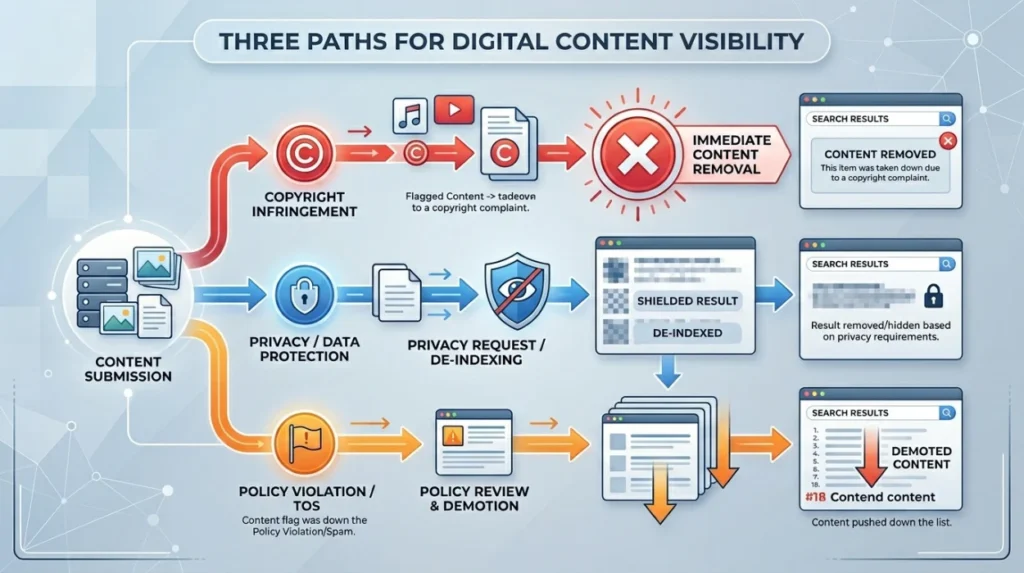
Each removal pathway affects search visibility through a different governance mechanism.
Copyright-based removals affect visibility through rights enforcement. Privacy-based removals affect visibility through identity protection frameworks. Policy-based removals affect visibility through platform compliance decisions. Although the outcome may appear similar, the underlying reason for removal differs significantly.
Search engines evaluate content accessibility when determining indexing status. Content that is removed becomes less available for crawling, ranking, and reference generation. This reduces the future accumulation of reputation signals associated with the content.
The distinction becomes important when evaluating entity credibility. Legal removals often reflect rights protection concerns, while policy removals reflect governance compliance issues. Search ecosystems process these contexts differently when assessing content relationships and authority signals.
The influence on SERP composition therefore extends beyond simple removal. The reason for content disappearance contributes to how information ecosystems evolve over time.
How does content removal compare with content suppression strategies?
Content removal eliminates accessibility, while content suppression alters visibility distribution.
Content removal is a direct intervention that seeks to eliminate the source of reputational exposure. Content suppression is a visibility management approach that seeks to reduce prominence by increasing the presence of alternative content. These methods address reputation challenges through different mechanisms.
Content suppression operates by influencing search ranking influence. Additional relevant content creates alternative reputation signals that compete for visibility. Content removal operates by reducing or eliminating the original source of exposure.
The comparative advantage of removal is certainty when successful. The comparative advantage of suppression is scalability across large information ecosystems. However, suppression does not eliminate the original content, while removal does not guarantee the elimination of references, discussions, or secondary citations.
Within reputation management, content suppression vs content enhancement represents a strategic distinction. Suppression focuses on visibility reduction, whereas enhancement focuses on increasing positive reputation signals and strengthening entity credibility.
Which reputation management approach is more sustainable over time?
Long-term sustainability depends on the permanence of the underlying mechanism.
A sustainable reputation strategy is one that continues influencing search perception after initial implementation. Copyright enforcement remains sustainable because it relies on ownership rights. Privacy protections remain sustainable because they relate to personal information control. Policy-based outcomes remain dependent on ongoing compliance evaluations.
Content enhancement strategies operate differently. They build additional reputation signals that strengthen entity credibility across search ecosystems. While removal addresses individual content assets, enhancement influences broader perception patterns.
The comparison between reactive and organic methods illustrates this distinction. Reactive methods address existing exposure. Organic methods influence future perception formation. Both contribute to reputation management, but their timelines and outcomes differ significantly.
Search engines continuously evaluate information ecosystems. Sustainability therefore depends on whether a strategy influences isolated content or broader sentiment distribution across multiple sources.
Dive Deeper With Our Expert Guides:
How to Remove a YouTube Video in the UK Using Privacy Copyright and Policy Routes
What a YouTube Video Removal Service Covers That Platform Reporting Alone Does Not
How do search engines evaluate reputation signals connected to video content?
Search engines evaluate reputation signals through relevance analysis, authority assessment, and entity relationship mapping.
A reputation signal is any piece of information that contributes to search-based understanding of an entity. Video content contains metadata, transcripts, engagement metrics, references, and contextual associations. These elements contribute to entity credibility assessments.
The evaluation process analyses how content relates to recognised topics, people, organisations, and events. Search systems compare consistency, authority, and relevance across multiple sources. This process creates broader understanding beyond the individual video itself.
Removal strategies influence this ecosystem by changing content availability. Suppression strategies influence the ecosystem by redistributing visibility. Enhancement strategies influence the ecosystem by introducing additional authoritative content.
Within consideration-stage reputation management analysis, understanding search engine interpretation is essential because reputation is ultimately shaped by how information is indexed, ranked, and associated within search environments.
What factors should be evaluated before choosing a video removal strategy?
The selection process depends on evidence quality, enforcement authority, scalability, and long-term impact.
A structured evaluation framework includes:
- Assess evidence quality – Verify ownership documentation, privacy concerns, or policy breaches before selecting a removal pathway.
- Compare enforcement authority – Measure whether copyright, privacy, or policy grounds provide the strongest review framework.
- Evaluate search visibility impact – Analyse how removal changes content indexing and future reputation signal generation.
- Measure sustainability – Determine whether the chosen approach addresses immediate exposure or long-term entity credibility.
- Analyse ecosystem effects – Review how removal influences SERP composition, sentiment distribution, and digital footprint development.
This framework demonstrates that effective reputation management requires strategic evaluation rather than reliance on a single mechanism. Different pathways address different forms of exposure and influence search ecosystems in different ways.
Removing a YouTube video in the UK involves evaluating copyright, privacy, and policy-based pathways rather than relying solely on reporting mechanisms. Each approach operates through a distinct review framework with different evidential requirements, enforcement authority, and effects on search visibility.
From a reputation management perspective, content removal is one component of a broader search ecosystem strategy. Copyright enforcement, privacy protection, policy compliance, content suppression, and content enhancement each influence reputation signals differently. Understanding these distinctions allows for more accurate evaluation of effectiveness, sustainability, risk exposure, and long-term impact on entity credibility.
Within broader reputation management analysis, discussions around Remove a Harmful Video From YouTube UK With Our Professional Takedown Service frequently emerge when evaluating direct removal approaches alongside longer-term visibility management strategies.
How can I remove a video from YouTube in the UK?
A video can be removed from YouTube UK through copyright claims, privacy complaints, or policy violation reports if the content meets the relevant review criteria. The correct removal pathway depends on the nature of the content and the evidence available.
What is the difference between a copyright claim and a YouTube policy report?
A copyright claim focuses on unauthorised use of protected content and requires proof of ownership. A YouTube policy report evaluates whether a video breaches platform rules such as harassment, impersonation, or prohibited content guidelines.
Can I request YouTube video removal for privacy reasons?
Yes. Privacy-based removal requests are available when a video contains identifiable personal information, images, or sensitive details that create privacy concerns. The review process assesses identity exposure and publication context before making a decision.
Does removing a YouTube video improve online reputation?
Removing a video can reduce the visibility of content that contributes negative reputation signals. However, online reputation is also influenced by search results, content indexing, entity credibility, and broader digital footprint factors.
How long does a YouTube video removal request take in the UK?
The review timeframe varies depending on whether the request is based on copyright, privacy, or policy grounds. Requests supported by clear evidence generally move through the assessment process more efficiently than cases requiring extensive contextual evaluation.