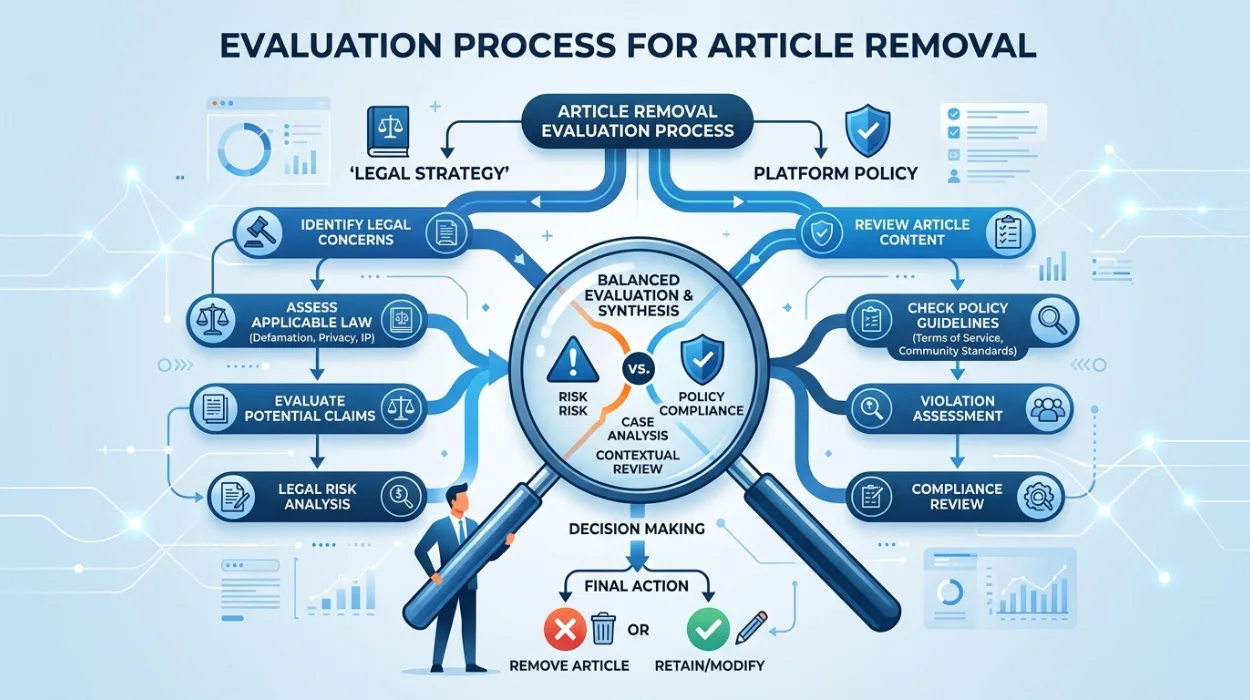
Reputation management strategies differ based on how search engines interpret authority, legality, and content persistence across indexed systems.
Online reputation control methods are evaluated through structured comparisons of legal enforceability, platform governance, and search ranking influence within SERP ecosystems.
How do legal routes compare with platform-based removal in reputation control systems?
Legal routes are formal enforcement mechanisms that remove or suppress content based on statutory obligations, while platform-based removal operates through internal policy compliance within hosting or indexing systems. Both approaches function as distinct authority layers that influence search visibility outcomes.
Legal routes operate by applying jurisdictional standards such as defamation law, privacy protection, and data protection regulations. These mechanisms require external validation through legal review or adjudication before content can be altered or de-indexed. Platform routes, in contrast, depend on internal moderation frameworks that evaluate whether published material violates content policies.
The mechanism of legal intervention produces stronger authority signals within search ecosystems because search engines treat court-backed or regulator-backed actions as high-trust directives. Platform-based removal relies on policy interpretation, which varies across systems and introduces inconsistency in enforcement outcomes.
In comparative terms, legal routes demonstrate higher authority but slower execution, while platform routes deliver faster but less universally enforceable outcomes. This creates a structural trade-off between authority strength and operational speed within reputation management systems.
How do publisher based decisions differ from search engine de-indexing actions?
Publisher-based decisions control content at the source level, while search engine de-indexing controls visibility without necessarily removing the original content. These two mechanisms operate at different layers of the content ecosystem.
Publisher decisions involve editing, updating, or removing content directly from the originating website. This action eliminates the content from its source, which reduces future crawling and indexing signals. Search engine de-indexing operates independently by removing the content from SERP inclusion while the original page may still exist online.
The mechanism of publisher control affects content persistence at the origin, which directly influences long-term indexing stability. De-indexing affects only visibility within search results, leaving the underlying content accessible through direct URLs. This creates a separation between content existence and search visibility.
From a comparative perspective, publisher-based removal provides stronger structural elimination of content, while de-indexing offers targeted visibility suppression. Search engines interpret de-indexing as a ranking exclusion signal, not a content deletion event, which affects entity perception differently.
How do article removal services evaluate platform policies against legal thresholds?
Article removal services evaluate platform policies against legal thresholds by mapping content characteristics to both internal moderation rules and external regulatory frameworks. This dual evaluation determines whether removal requests can be escalated beyond publisher refusal.
Platform policies define acceptable content standards such as harassment rules, misinformation restrictions, and privacy violations. Legal thresholds define enforceable violations such as defamation, copyright infringement, or unlawful data publication. Each framework operates independently but influences removal eligibility within reputation systems.
The mechanism of evaluation compares policy violations against legal enforceability to identify the strongest applicable route. When platform rules are sufficient, removal occurs through internal moderation. When legal thresholds are stronger, escalation into formal legal processes becomes necessary.
Comparatively, platform policies offer broader accessibility but lower enforcement consistency across different systems. Legal thresholds provide higher enforcement authority but require stronger evidence and procedural validation. This distinction shapes the strategic pathway selection in article removal workflows.
How do search engines interpret removal signals across different authority levels?

Search engines interpret removal signals as structured indicators of content validity, authority, and index eligibility within ranking systems. These signals differ depending on whether they originate from legal, platform, or publisher actions.
Legal removal signals are interpreted as high-authority directives that enforce de-indexing or suppression with strong compliance weighting. Platform signals represent policy-based adjustments that influence indexing status without necessarily implying legal invalidation of content.
Publisher-driven removal signals affect crawling patterns and indexing frequency but do not always guarantee immediate de-indexing if the content has already been widely distributed or cached. This creates variability in how quickly search visibility changes occur.
In comparative terms, search engines assign highest trust to legal directives, moderate trust to platform enforcement, and lowest structural authority to publisher-level changes once indexing has stabilised. These differences directly shape SERP composition and ranking recalibration.
How does content persistence influence evaluation strategy selection?
Content persistence influences evaluation strategy selection by determining whether removal, suppression, or optimisation-based approaches are required within reputation systems. Persistent content continues to generate reputation signals even after initial removal attempts fail.
Persistent articles remain part of indexed datasets, contributing to entity-level associations and sentiment distribution across search results. This forces evaluation frameworks to consider whether suppression or de-indexing is more viable than full removal.
The mechanism of strategy selection evaluates content durability, distribution breadth, and backlink integration. High persistence content requires stronger intervention routes, often shifting from publisher negotiation to platform or legal escalation. Low persistence content may be resolved through standard removal requests.
Comparatively, persistent content increases the complexity of remediation strategies because it expands the number of systems influencing visibility. Non-persistent content allows faster resolution through direct publisher or platform intervention.
Dive Deeper With Our Expert Guides:
How negative press impacts your business and how to respond to protect your brand
How to remove a news article from the internet and when it is legally possible
How do short term and long term strategies differ in SERP control mechanisms?
Short-term strategies focus on immediate suppression or removal of visible content, while long-term strategies focus on stabilising entity perception and reducing negative signal dominance across indexed ecosystems.
Short-term mechanisms include de-indexing requests, platform takedown actions, and rapid suppression of specific URLs within SERPs. These approaches prioritise visibility reduction without necessarily altering underlying content ecosystems. Long-term mechanisms involve content restructuring, authority building, and sustained signal distribution adjustments.
The mechanism of short-term control operates by targeting immediate ranking influence and search visibility disruption. Long-term control operates by reshaping entity associations and improving overall credibility signals across multiple indexed sources.
In comparative evaluation, short-term strategies deliver immediate visibility changes but limited durability, while long-term strategies deliver stable reputation recalibration but require extended timeframes. Search engines interpret long-term signals as more stable indicators of entity credibility.
How do evaluation frameworks determine the most effective removal route?
Evaluation frameworks determine the most effective removal route by analysing legal strength, platform compliance, indexing stability, and SERP influence across multiple content layers. This structured assessment ensures that each route aligns with the highest available authority level.
The mechanism begins by categorising content based on violation type, distribution level, and persistence within search indexes. Each category is mapped to a corresponding removal pathway, ranging from publisher negotiation to legal enforcement or platform escalation.
Search ranking influence is assessed to determine whether content significantly impacts entity perception or remains low-impact within SERPs. High-impact content requires stronger intervention routes due to its influence on trust signals and visibility distribution.
Comparatively, evaluation frameworks prioritise enforceability over convenience, ensuring that the selected route maximises removal success probability while minimising repeated escalation cycles. This structured decision model governs all subsequent reputation control actions.
Article removal evaluation systems operate through structured comparisons between legal authority, platform governance, publisher control, and search engine interpretation mechanisms. Legal routes provide the strongest enforcement signals, while platform and publisher actions offer varying levels of control over visibility and indexing.
Search engines respond differently to each removal signal type, shaping SERP composition and entity perception based on authority strength and persistence of indexed content. Evaluation frameworks ensure that strategy selection aligns with content durability, violation type, and reputational impact.
How do article removal services evaluate legal and platform routes before taking action?
Article removal services assess whether content violates legal standards such as defamation, privacy, or data protection laws, alongside platform-specific policies. This evaluation determines if legal escalation or platform-based takedown is the most effective route for content removal or de-indexing.
What is the difference between legal removal and platform-based content removal?
Legal removal is based on enforceable laws and requires formal validation, often resulting in stronger authority signals for search engines. Platform-based removal relies on internal rules of hosting or publishing systems and can lead to faster but less universally binding outcomes.
Why do some articles remain visible in search results after removal requests?
Articles remain visible when they are still indexed by search engines and no valid legal or platform directive has enforced de-indexing. Search engines continue to display such content based on ranking signals, relevance, and existing indexing status.
How do search engines respond to legal takedown requests?
Search engines treat valid legal takedown requests as high-authority signals that can lead to de-indexing or restricted visibility in SERPs. These actions directly affect content indexing status and reduce its influence on entity-level search results.
What factors determine the success of an article removal strategy?
Success depends on legal enforceability, platform policy alignment, and how deeply the content is indexed across search systems. Stronger legal grounds and clear policy violations increase the likelihood of removal or reduced search visibility.