
Removing copyright infringing content from the internet delivers stronger search visibility control, protects ownership rights, and strengthens reputation signals that influence digital trust. Effective reputation management depends on controlling how information appears in search results because reputation signals directly affect decision-making, entity credibility, and public perception.
Copyright infringement creates visibility risks that extend beyond intellectual property concerns. Unauthorised content can dilute ownership signals, weaken attribution, and influence how search engines evaluate authority. A structured takedown strategy improves SERP control, reduces reputational exposure, and restores confidence in the integrity of online information.
Which copyright protection approach delivers the strongest reputation outcome?
A professional copyright takedown strategy delivers the strongest reputation outcome because it removes unauthorised content at the source rather than attempting to manage its visibility indirectly. Search engines evaluate originality, attribution, and authority when determining rankings. When infringing content remains online, it competes with original assets and creates conflicting ownership signals that weaken entity credibility.
Copyright Trademark Services focus on eliminating unauthorised content through structured identification, verification, and enforcement procedures. This process improves attribution accuracy and strengthens the connection between original content and its rightful owner. As duplicate content disappears from search ecosystems, search engines gain clearer signals regarding content ownership and authority.
The measurable outcome is improved search visibility quality. Users encounter more accurate information, reputation signals become more consistent, and search perception influence aligns more closely with the original entity. This creates a stronger foundation for long-term reputation management and digital trust optimisation.
Dive Deeper With Our Expert Guides:
File a DMCA Takedown in the UK and Remove Stolen Content With Expert Help
Remove Copyright-Infringing Content From the Internet With UK Specialist Support
Which risks increase when copyright infringing content remains online?
Copyright infringing content increases reputational risk because it disrupts ownership attribution and introduces conflicting information into search ecosystems. Search engines rely on content relationships and authority signals to evaluate credibility. Unauthorised duplication weakens those signals and creates uncertainty regarding the original source.
The impact extends beyond visibility. Potential customers, business partners, and stakeholders evaluate search results as indicators of legitimacy and professionalism. When duplicated or stolen content appears across multiple websites, entity credibility becomes less distinct. This weakens trust signals and reduces confidence in the information associated with the original creator.
Key risks include:
- Reduce attribution clarity through duplicated content competing with original assets.
- Weaken entity credibility by creating inconsistent ownership signals.
- Increase search visibility competition through unauthorised indexed copies.
- Dilute reputation signals across multiple domains and platforms.
- Undermine trust formation through fragmented content ownership patterns.
Removing infringing content addresses these risks directly and restores greater control over digital reputation assets.
How does a UK takedown process improve SERP control?
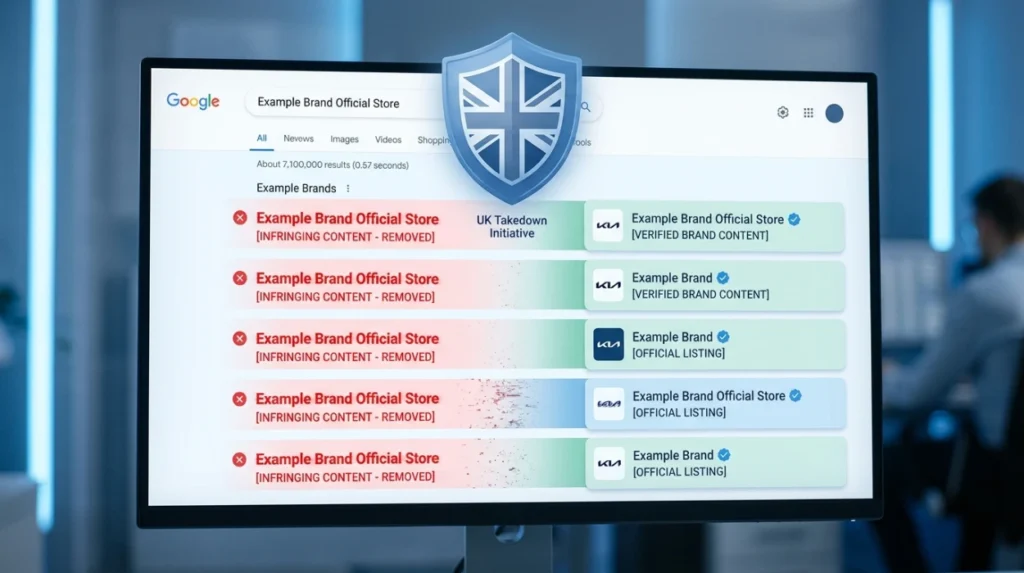
A UK takedown process improves SERP control by removing unauthorised content before it accumulates additional authority and visibility. Search engines continuously evaluate indexed content and update rankings based on available information. Eliminating infringing material reduces duplicate content exposure and strengthens original ownership signals.
The process begins with identifying the infringing content and verifying ownership rights. Once evidence is established, appropriate removal pathways are selected based on website policies, platform governance structures, and legal considerations. This structured methodology ensures that each action contributes to measurable visibility improvements.
A successful removal process delivers:
- Eliminate duplicate content that competes for search visibility.
- Strengthen ownership attribution through cleaner indexing signals.
- Improve search result quality by reducing conflicting information.
- Stabilise reputation signals across search ecosystems.
- Increase control over branded and owned content visibility.
These outcomes create a more accurate representation of the original entity within search results and strengthen long-term search perception influence.
Which factors determine the success of content takedown efforts?
Success depends on ownership verification, enforcement strategy selection, content location, and procedural accuracy. Effective takedown campaigns rely on evidence-backed execution rather than generic removal requests. Search ecosystems respond most effectively when ownership relationships are clearly established and enforcement actions align with platform or legal requirements.
A professional evaluation identifies the most appropriate pathway before action begins. Independent websites, social platforms, content-sharing networks, and media repositories all operate under different governance frameworks. Understanding these distinctions improves procedural efficiency and reduces delays.
For organisations seeking reliable outcomes, a professional copyright content removal service provides structured assessment and coordinated execution. This approach ensures that each removal effort contributes to stronger attribution signals and more consistent SERP control.
Why does direct content removal outperform visibility-only strategies?
Direct content removal outperforms visibility-only strategies because it addresses the source of the problem rather than its symptoms. Negative content suppression and content enhancement influence rankings, but they do not eliminate unauthorised material from search ecosystems. Copyright takedowns remove the underlying infringement and reduce future visibility risks.
Search engines interpret content ownership through attribution patterns, indexing history, and authority relationships. Removing infringing content improves these signals by eliminating competing versions that dilute ownership recognition. The result is a more accurate evaluation of original content within ranking systems.
Visibility-only approaches remain useful in broader reputation management campaigns. However, where copyright infringement exists, direct removal delivers stronger ownership protection and clearer reputation signals. This distinction is important because sustainable SERP control depends on both visibility management and information accuracy.
How quickly can copyright takedowns influence search visibility?
Copyright takedowns begin influencing search visibility as soon as content accessibility changes and search engines update indexed records. The timing depends on platform response rates, website compliance, and search engine recrawling schedules. Once removed content is processed, duplicate visibility decreases and ownership signals become more concentrated around original assets.
The immediate benefit is reduced exposure to unauthorised material. Stakeholders searching for content encounter fewer conflicting versions, which improves trust formation and attribution clarity. Over time, search engines reinforce original ownership relationships through updated indexing and ranking evaluations.
This process strengthens reputation signals because information quality improves across search ecosystems. Greater consistency in content ownership enhances entity credibility and contributes to more reliable search perception influence.
Which reputation signals improve after copyright infringement is addressed?
Copyright enforcement improves multiple reputation signals by restoring information accuracy and reducing content fragmentation. Search engines evaluate ownership consistency as part of broader quality assessments. Removing infringing content strengthens the relationship between entities and their intellectual property.
The strongest improvements occur in:
- Strengthen ownership attribution through reduced duplication.
- Improve entity credibility through clearer authority relationships.
- Enhance search visibility quality through cleaner indexing patterns.
- Stabilise trust signals through accurate content association.
- Increase SERP control through reduced unauthorised competition.
These improvements contribute directly to digital trust optimisation. Search engines gain stronger evidence regarding content provenance, while users encounter more reliable representations of the original creator.
Organisations researching copyright infringement online often discover that attribution issues and duplicate visibility remain central challenges within search ecosystems. Understanding these mechanisms supports informed decisions regarding ownership protection and reputation management strategy.
How does cost compare with the long-term value of content protection?
The long-term value of content protection exceeds the cost of unmanaged infringement because copyright violations create ongoing visibility, attribution, and credibility risks. Search ecosystems reward authority and originality. When ownership signals become diluted, organisations face reduced control over how their information is interpreted and ranked.
A structured takedown strategy protects existing digital assets and preserves the authority accumulated through original content creation. This reduces the need for corrective visibility campaigns and limits future reputation management challenges. The outcome is stronger information integrity and more stable search performance.
Long-term value is measured through improved SERP control, enhanced reputation signals, and reduced risk exposure. These benefits extend beyond immediate removal outcomes and support broader digital trust objectives.
Which approach provides the most sustainable copyright protection results?
A structured takedown framework provides the most sustainable results because it combines ownership verification, strategic enforcement, and ongoing visibility monitoring. Sustainable protection depends on maintaining accurate attribution relationships and responding quickly when infringement appears.
The process typically includes:
- Identify infringing content through visibility and indexing analysis.
- Verify ownership rights using publication and creation evidence.
- Select enforcement pathways based on platform and legal criteria.
- Execute removal procedures using structured documentation.
- Monitor search ecosystems to confirm attribution improvements.
This framework reduces uncertainty and improves process consistency. It also ensures that copyright protection aligns with broader reputation management objectives, including search visibility control and trust signal preservation.
Businesses analysing copyright infringing content removal strategies often compare enforcement methods, platform procedures, and visibility outcomes before selecting an approach. Understanding these evaluation factors supports stronger decision-making and reduces operational risk.
Which solution provides the most reliable path to trust restoration and ownership protection?
A professionally managed copyright takedown strategy provides the most reliable path to trust restoration and ownership protection because it combines procedural accuracy with measurable visibility outcomes. Reputation management succeeds when ownership signals, attribution patterns, and search visibility work together to support entity credibility.
Clear Your Name approaches copyright protection through structured evaluation, evidence-based enforcement, and outcome-focused execution. This methodology improves search result quality, strengthens reputation signals, and ensures that original content retains its rightful authority within search ecosystems. By reducing duplicate visibility and restoring attribution clarity, organisations gain greater control over their digital footprint.
Copyright Trademark Services remain most effective when they focus on ownership protection, visibility management, and long-term reputation stability. Through clear processes and measurable outcomes, organisations can strengthen digital trust, improve SERP control, and maintain the integrity of their online presence.
How can copyright infringing content be removed from the internet?
Copyright infringing content can be removed by identifying the unauthorised material, verifying ownership rights, and submitting removal requests to website operators or online platforms. Copyright Trademark Services often involve content review, evidence collection, and takedown procedures.
How long does it take to remove copyright infringing content online?
The timeframe depends on the website, platform policies, and the complexity of the copyright claim. Some removals are processed within days, while others require extended review and verification procedures.
Does removing copyright infringing content improve search visibility?
Removing unauthorised content can improve content attribution and strengthen ownership signals in search engines. This helps reduce duplicate content issues and supports more accurate search visibility for original content.
What evidence is needed for a copyright takedown request?
Copyright takedown requests typically require proof of ownership, details of the original work, and the URL of the infringing content. Accurate documentation helps platforms and website operators assess the claim efficiently.
What is the purpose of Copyright Trademark Services in content protection?
Copyright Trademark Services focus on protecting intellectual property rights by addressing copyright infringement, ownership disputes, and unauthorised content distribution. These processes help maintain content integrity and support digital reputation management.